Key Takeaways
- NextEra Energy yields 3.0% and raised its dividend 10.1% a year from fiscal 2020 to fiscal 2025. Procter & Gamble yields 2.6% and raised its dividend 5.6% a year from fiscal 2021 to fiscal 2026.
- NextEra plans to slow its dividend growth to 6% a year from year-end 2026 through 2028, while it works to close a merger with Dominion Energy that Virginia regulators’ staff recommended against as structured.
- Both dividends are covered. NextEra paid out 61% of normalized EPS in fiscal 2025, and P&G paid out 67% of free cash flow over the twelve months to Sept. 30, 2026.
- P&G carries net debt of 0.9x EBITDA against NextEra’s 8.1x, and Virginia’s decision on the Dominion deal is expected in January.
Procter & Gamble (PG) declared its quarterly dividend of $1.0885 a share on Oct. 13, along with a reminder of its record: “P&G has been paying a dividend for 136 consecutive years since its incorporation in 1890 and has increased its dividend for 70 consecutive years.”
Eight days later, NextEra Energy (NEE) reaffirmed a different kind of promise. It plans raises of roughly 10% a year through 2026, then 6% a year from year-end 2026 through 2028. So if you could buy just one and leave it alone for 20 years, which dividend do you want?
| Metric | NextEra Energy (NEE) | Procter & Gamble (PG) |
|---|---|---|
| Forward dividend yield | 3.0% | 2.6% |
| Dividend growth, 5 years | 10.1% a year (fiscal 2020-2025) | 5.6% a year (fiscal 2021-2026) |
| Coverage measure | Payout ratio of normalized EPS | Cash dividend payout ratio |
| Coverage, last reported | 61% (fiscal 2025) | 67% (TTM to Sept. 30, 2026) |
| Coverage, forward | 62% (fiscal 2026 consensus) | 68% (fiscal 2027 consensus) |
| Net debt/EBITDA | 8.1x | 0.9x |
| Interest coverage | 14.8x | 24.2x |
Source: TIKR. Yields at today’s prices; net debt/EBITDA and interest coverage over the last twelve months.
6 safe dividend stocks paying retirees 6%+ yields
There are over 100 stocks paying 6%+ annual dividends today.
But after an extensive investment review leveraging TIKR’s proprietary data, we now believe only six of them are truly safe for retirees.
They’re all yours as part of our new investment report. Learn more about how to get access right here.
NextEra is building fast, and borrowing to do it
NextEra’s third-quarter adjusted earnings rose to $1.24 a share from $1.13 a year earlier. Management expects 2026 adjusted EPS of $3.92 to $4.02 and growth of 8%+ a year through 2032.
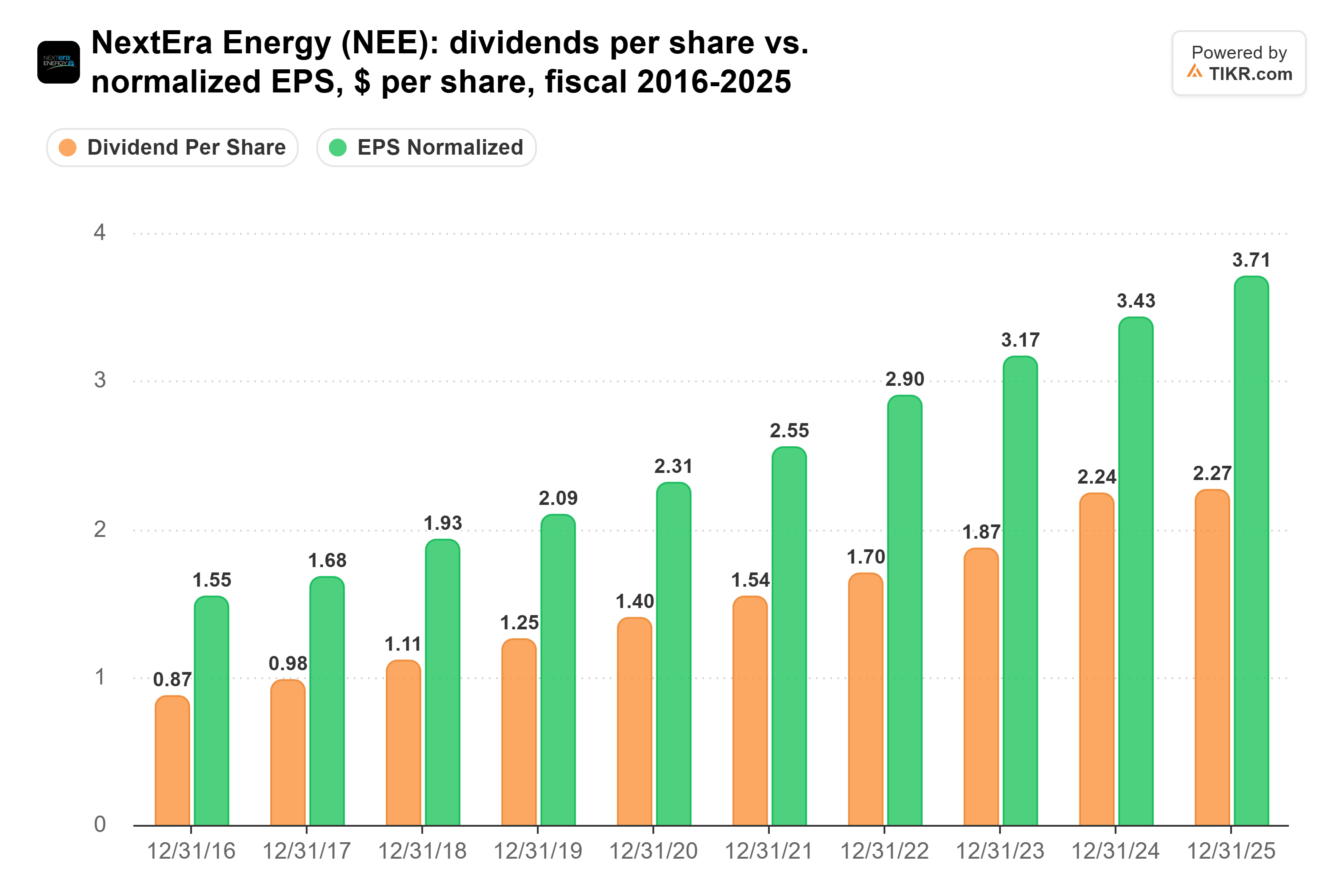
As a regulated utility, NextEra is judged on earnings: it paid out a steady 61% of normalized EPS in fiscal 2025, and consensus puts fiscal 2026 at 62%. That ratio has stayed between 56% and 65% every year since fiscal 2016:
The cost shows up on the balance sheet. NextEra carries net debt of 8.1x EBITDA, and its CFO said on the third-quarter call that it still expects $12 billion to $17 billion of total equity needs through 2032. Then there’s Dominion. On Nov. 6, Virginia’s State Corporation Commission staff recommended against the merger as structured, unless binding ratepayer conditions are added, even after the companies agreed to 101 of 117 proposed conditions on Nov. 3. None of that changes today’s coverage, but NextEra’s 9%+ earnings growth target for the combined company depends on the deal closing.
P&G grows slower on a much lighter balance sheet
NextEra’s challenge is funding growth, while P&G’s is protecting margins. In its fiscal 2027 first quarter, to Sept. 30, P&G grew net sales 4% to $23.3 billion and core EPS 1% to $2.00. Even so, it kept full-year core EPS guidance at flat to 3% growth. It now expects a commodity cost headwind of about $1.4 billion after tax, an 11% drag on core EPS growth.
The dividend is comfortably covered. It took 67% of free cash flow over the twelve months to Sept. 30, 2026, and consensus has 68% for fiscal 2027. Free cash flow grew from $9.37 billion in fiscal 2017 to $15.2 billion in fiscal 2026 (years to June), clearing the dividend every year:

Its tightest year was fiscal 2025, at 70%. Slow growth is the main risk, with organic sales guided up just 1% to 3% this year.
So which dividend wins?
If I’m holding one dividend stock for the next 20 years, it’s Procter & Gamble.
That’s despite the income math. At each stock’s 5-year rate, $10,000 in NextEra pays $300 this year and about $1,882 in year 20, an 18.8% yield on your cash. The same $10,000 in P&G pays $260 now and about $736 in year 20, a 7.4% yield. NextEra’s move to 6% raises will narrow that gap, but 6% still beats P&G’s 5.6%.
Over two decades, though, I care most about whether the check keeps rising through whatever comes. P&G has raised its dividend for 70 straight years and has a balance sheet with less than 1x net debt. NextEra’s growth leans on new stock, a merger still waiting on regulators, and 8.1x leverage.
NextEra’s dividend isn’t in trouble, either: analysts already have the slowdown in their numbers. Consensus has normalized EPS rising from $4.03 in 2026 to $4.75 in 2028, while the dividend rises from $2.49 to $2.77:

So its coverage should improve from here. Still, when I picture 2046, I trust P&G’s cash flow and its record more.
Virginia’s decision on the Dominion deal, expected in January, could change that. If NextEra closes the deal on workable terms and keeps its equity needs near the low end of its range, I’d find the bigger check a lot harder to pass up.
Forget Procter & Gamble: 6 safe 6%+ dividend yields you can buy right now
Dividends can hold the key to enormous wealth. But only if you buy the right ones.
Picking the right high-yield dividend stock can be the difference between a dream retirement…and scraping by every month, waiting for the next Social Security check to clear.
We’ve identified six stocks yielding 6%+ that we believe every retiree should know about right now. (And Procter & Gamble isn’t one of them.)
Disclaimer:
Please note that the articles on TIKR are not intended to serve as investment or financial advice from TIKR or our content team, nor are they recommendations to buy or sell any stocks. We create our content based on TIKR Terminal’s investment data and analysts’ estimates. Our analysis might not include recent company news or important updates. TIKR has no position in any of the stocks mentioned. Thank you for reading, and happy investing!