Key Takeaways
- NVIDIA CEO Jensen Huang said on the BG2 podcast that about a third of the business, classical computing with no AI labs involved, is growing 30% to 40% a year.
- Huang puts all frontier labs together at 25% to 30% of NVIDIA’s compute, highlighting demand beyond those labs without establishing their share of revenue.
- The main risk is concentration: Steve Eisman points to a 10-Q line showing 70% of NVIDIA’s accounts receivable come from five customers.
- NVIDIA trades at 17.7x forward earnings, near its three-year low and well below its 30.3x average.
How much of NVIDIA (NVDA) really rides on OpenAI and Anthropic?
Investors have been asking since the market started debating whether OpenAI’s revenue is $70 billion or $50 billion. On the Oct. 15 episode of the BG2 podcast, CEO Jensen Huang answered by carving his business into thirds, starting with one that has nothing to do with AI labs:
“I’m going to call it a third of our business. And that business is growing, call it 30%, 40% per year. In the absence of any AI labs, NVIDIA is not zero, we’re quite a large company.”
Which is putting it mildly.
Huang’s three thirds
Here’s how Huang splits NVIDIA’s compute…
- Classical computing: data processing, simulation, graphics, plus older machine learning like fraud detection at Visa (V) and Mastercard (MA). About a third, growing 30% to 40% a year, according to Huang—a business he says does not depend on AI labs.
- AI labs: 25%, “maybe 30%,” spread across five or six labs, including Muse at Meta Platforms (META), Gemini at Alphabet (GOOGL), xAI’s Grok and, as of this year, Anthropic (the slice bears worry about).
- Startups and new clouds: “a vast number of new startups” in physical AI, biology and materials science, all renting NVIDIA’s chips. About a third (Huang’s next-generation AWS).
So all the labs together make up about a quarter of the business. “We’re putting way too much pressure on two labs,” Huang said.
The rest of the business is booming too
NVIDIA’s latest quarter points the same way. In the three months to July 26, 2026, revenue hit $96.2 billion, up 106% from a year earlier…
- Hyperscale: $48.7 billion, up 102%
- AI clouds, industrial and enterprise: $40.3 billion, up 138%, which NVIDIA credits to AI natives, enterprises and sovereign customers
- Edge computing (which takes in the old gaming, professional visualization and automotive lines): $7.2 billion, up 27%
The fastest-growing line is the one outside the giant cloud buyers. (It includes AI natives, which can mean labs, and hyperscalers renting from AI clouds, so it’s a rough read.)
The legacy lines carry weight, too: in the year ended January 2026, gaming brought in $16.0 billion, professional visualization $3.2 billion and automotive $2.3 billion.
And the whole pie keeps growing. Revenue went from $131 billion in the year ended January 2025 to $216 billion a year later. Analysts expect $412 billion in the year ending January 2027, then $692 billion the year after, in line with the roughly 70% growth NVIDIA guided to in August:
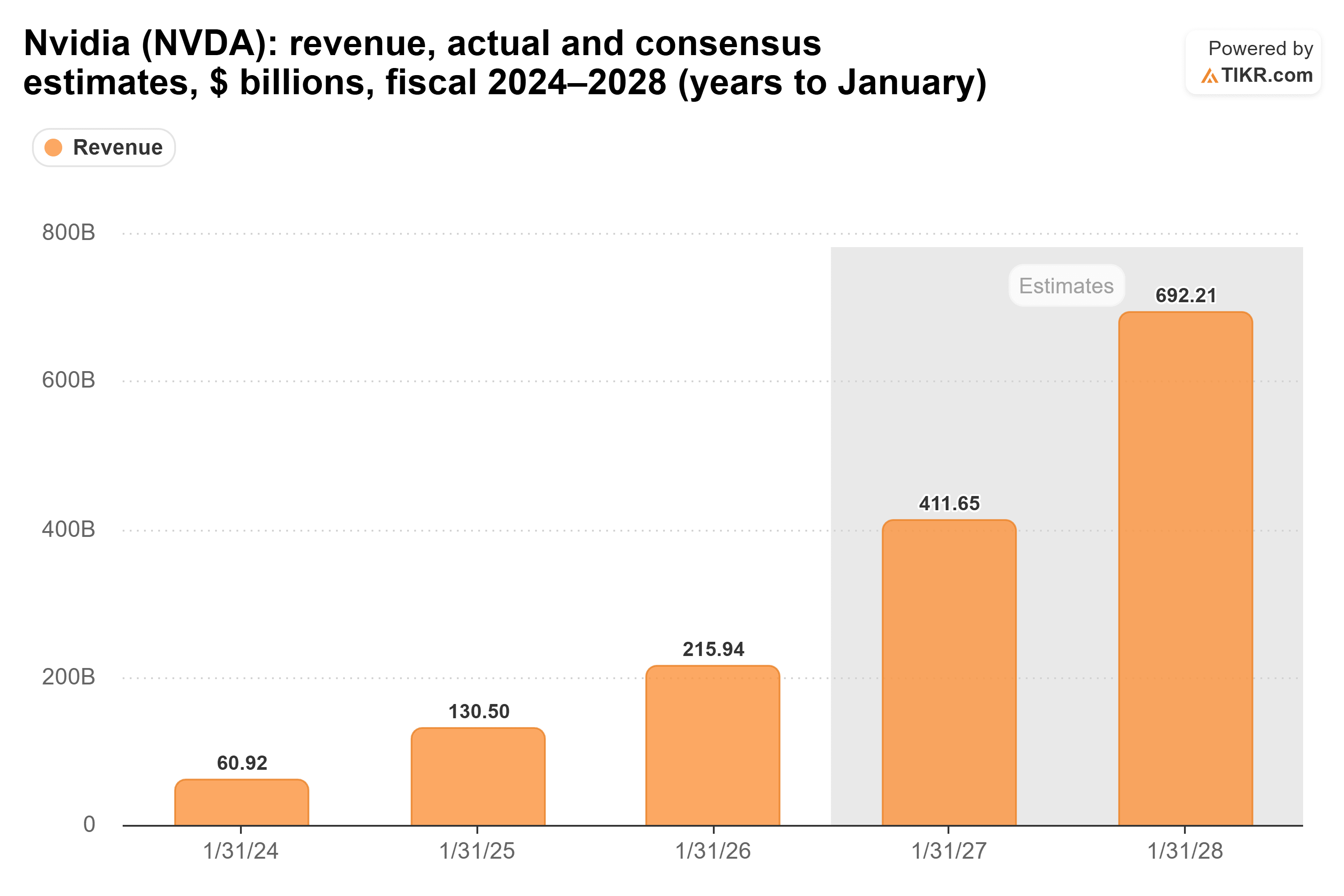
As an illustration, cutting this year’s $412 billion revenue consensus by 30% leaves about $288 billion, roughly 34% above last year’s $216 billion. But Huang’s estimate describes compute, not a disclosed revenue share, and this calculation assumes the rest of demand stays unchanged. It is not a forecast of NVIDIA’s revenue without the labs.
Five customers is a real risk
The strongest case against Huang comes from Steve Eisman, the investor made famous by The Big Short. On The Compound and Friends, he pointed to a line in NVIDIA’s 10-Q:
“70% of NVIDIA’s accounts receivable, which is a proxy for revenue, is from five customers”
Those are probably the hyperscalers, he added, and “if you go to the hyperscalers 70% of their AI revenue is from Anthropic and OpenAI.”
That highlights a separate risk: NVIDIA can serve diverse end users while relying on a concentrated group of direct customers. The filing does not identify those five customers or show how Huang’s demand categories map onto them. Their 70% share of receivables also does not establish a 70% share of revenue.
AI clouds, industrial and enterprise accounts for about 45% of data center revenue, but that does not establish reduced exposure to those five customers or the frontier labs. NVIDIA says this category includes demand from AI natives and hyperscalers using AI clouds. As Azeem Azhar, founder of Exponential View, put it on The Ezra Klein Show, Anthropic “might collapse, but NVIDIA will be fine.”
Priced like the labs are everything
Investors aren’t buying Huang’s math yet. NVIDIA trades at 17.7x forward earnings. That’s barely above its three-year low of 17.5x from Sept. 14, far below its 30.3x average, and nowhere near the 46.7x it hit in June 2024…
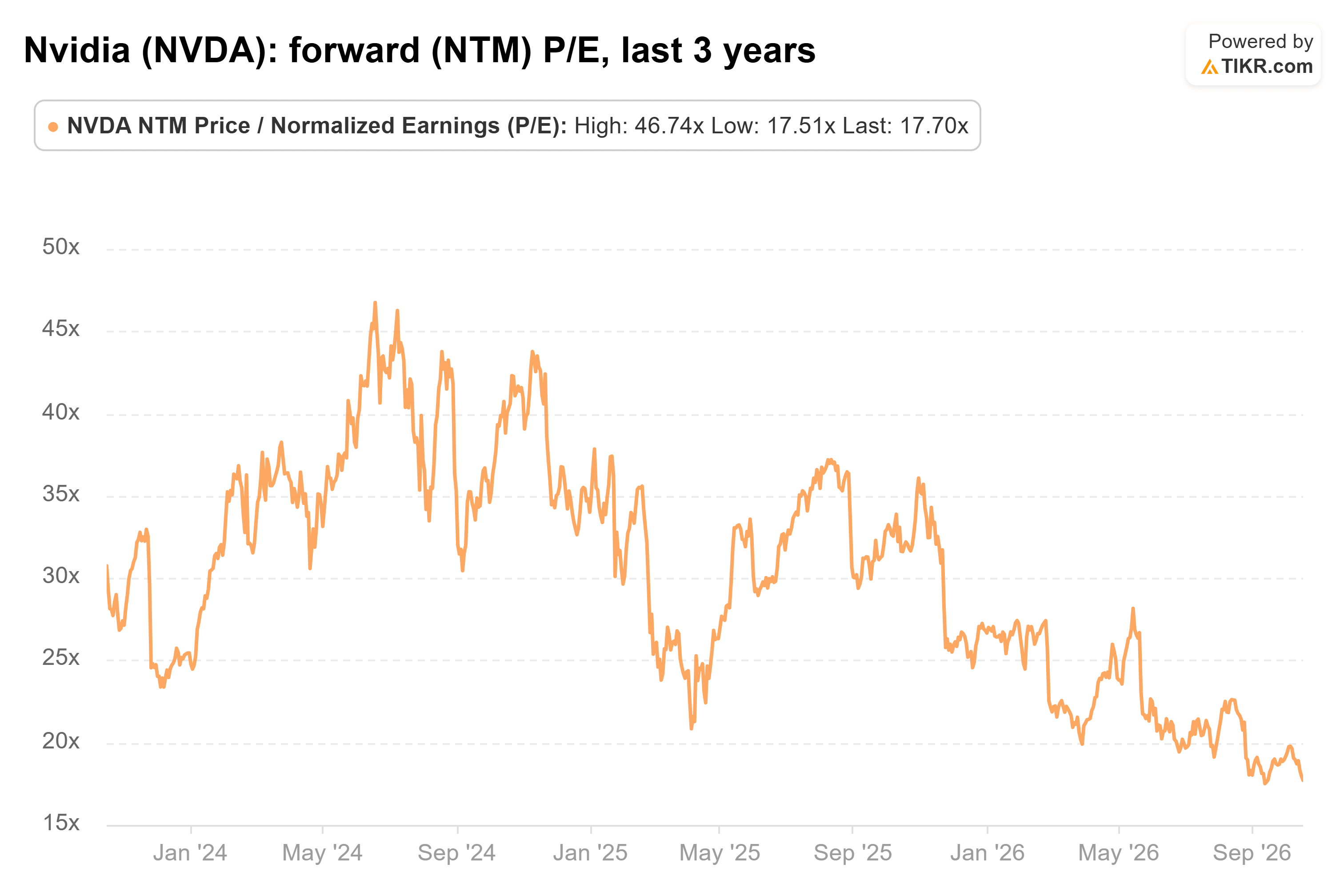
I think Huang has the better of this argument. NVIDIA is growing across all three reported revenue categories, and Huang’s comments highlight demand beyond the frontier labs. They do not establish how much revenue would survive if those labs disappeared. Yet the stock is priced as though two labs are the whole story.
Of course, Eisman’s five customers are the thing to watch. NVIDIA guided to $108.0 billion of revenue for the quarter ending in October, and that report will show whether its biggest buyers are still spending.
So what is NVIDIA stock actually worth?
TIKR lets you forecast the future price of any stock in less than a minute. Just enter a few assumptions into TIKR’s valuation model and see what NVIDIA could be worth. Start from Wall Street consensus estimates, or adjust the inputs to reflect your own view of the business. It’s free to use.
Disclaimer:
Please note that the articles on TIKR are not intended to serve as investment or financial advice from TIKR or our content team, nor are they recommendations to buy or sell any stocks. We create our content based on TIKR Terminal’s investment data and analysts’ estimates. Our analysis might not include recent company news or important updates. TIKR has no position in any of the stocks mentioned. Thank you for reading, and happy investing!