
Key Takeaways for UPS Stock as of August 2026
- Beat-and-Raise Selloff: UPS topped Q2 estimates on July 28 with $22.8B revenue and $1.76 adjusted EPS, then raised FY2026 guidance to $91.2B and $7.22 EPS, and shares still fell 5.9% that day.
- Analyst Split: 14 buys, 12 holds, 2 underperforms, 1 sell make up current UPS coverage.
- Target Gap: The Street’s mean price target on UPS sits at $116, about 11% above the stock’s current $104 price, even after August’s pullback.
- Model Upside: TIKR’s mid-case model values UPS stock at $169 by December 2030, implying 62% total return and an 11.6% annualized gain from here.
Compare UPS’s raised guidance against the market’s skeptical reaction on TIKR for free →
Why UPS Stock Fell After Beating Earnings and Raising Guidance
United Parcel Services (UPS) beat Wall Street’s second-quarter numbers on July 28, then watched its stock drop 6% to $106 the same day.

Revenue came in at $22.8 billion against a $21.84 billion estimate, a 4.55% beat, and adjusted earnings per share hit $1.76 against $1.66 expected, a 5.75% beat. Management didn’t stop there. UPS raised its full-year 2026 revenue outlook to $91.2 billion from $89.7 billion and lifted adjusted EPS guidance to $7.22.
The drop came down to timing skepticism, not the quarter itself. Stephens analyst Bascome Majors pressed CFO Brian Dykes on the Q2 earnings call about why UPS’s implied second-half operating profit ramp looked steeper than in recent years. Dykes didn’t hedge. “The first half performance gives us a lot of confidence in the momentum that we’re seeing,” he said. “That’s going to help us deliver the second half of the year.” Morgan Stanley wasn’t as convinced, holding an underweight rating and a $76 price target on concerns about Amazon volume, regional competition and labor costs weighing on the outlook.
What the skeptics are discounting is the structural work already banked. UPS finished its Amazon glide-down in the quarter, cutting roughly $4.5 billion in related expense and pushing automated-facility volume to 68.5% of the U.S. network, up from 64% a year ago. U.S. domestic operating profit grew 21% year over year to an 8% margin, more than double what it produced in the first quarter. CEO Carol Tomé called the network reconfiguration “the foundation,” not the destination. The market sold a beat-and-raise quarter anyway, and that gap between what UPS delivered and how the stock traded is the real story here.
See how UPS’s raised 2026 outlook stacks up against its own operating history on TIKR for free
UPS Stock’s Ratings Split and Why Targets Climbed as Shares Fell
Coverage on UPS stock currently splits 14 buys, 12 holds, 2 underperforms and 1 sell, drawn from the 26 analysts publishing a price target. The mean target sits at $116, 11% above the stock’s current $104 price, even after the post-earnings selloff.

That gap widened after the print, not before it. The mean target stood at $114 heading into the June quarter and climbed to $116 by August 7, even as the stock’s own close slipped from $108 to $105 over the same window.
The median target moved further still, from $115 to $117.50. Buy ratings ticked higher too, from 13 to 14, while the pool of analysts publishing a target thinned from 31 a year ago to 26 today. Fewer analysts are covering UPS stock, but the ones still doing it got more bullish right when the stock got cheaper.
TIKR Values UPS Stock at $169, Pricing In the Domestic Margin Recovery
TIKR’s mid-case model values UPS stock at $169 by December 2030, implying 62% total return from the current $104 price, or 12% annualized over the next 4.4 years.
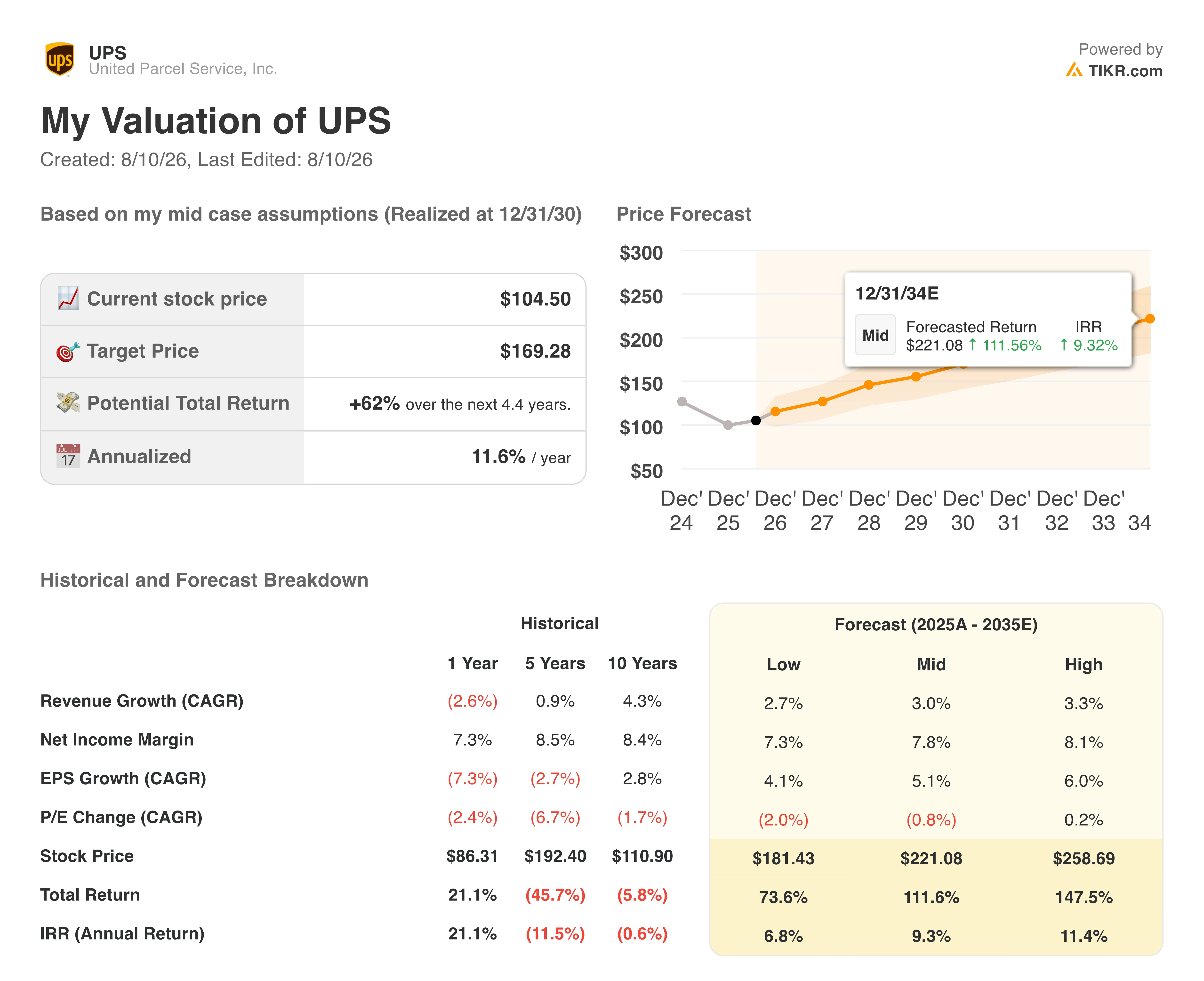
That annualized rate sits well above what investors typically underwrite for a mature parcel carrier, and it says most of the upside case rests on margin expansion rather than fresh volume growth. The case leans on the same domestic math management laid out on the July 28 call: a network already running an 8% operating margin, with automation and cost cuts still working through the base.

That cash story only half confirms it. UPS’s free cash flow margin turned positive at 0.73% in the second quarter, up from negative 3.65% a year ago, but it’s still thinner than every other quarter over the past two years except that one, and down from 5.63% in the first quarter of 2026. The operating margin recovery is showing up on the income statement before it’s fully reached the cash flow line.
If the 50 to 100 basis point spread between revenue-per-piece growth and cost-per-piece growth holds through the back half as Dykes projected, the Street’s own $116 target starts to look conservative next to TIKR’s longer-run number.
Explore the assumptions behind TIKR’s $169 mid-case target for UPS stock on TIKR for free →
Should You Invest in United Parcel Service, Inc.?
The only way to really know is to look at the numbers yourself. TIKR gives you free access to the same institutional-quality financial data that professional analysts use to answer exactly that question.
Pull up United Parcel Service, Inc. stock and you’ll see years of historical financials, what Wall Street analysts expect for revenue and earnings in the quarters ahead, how valuation multiples have moved over time, and whether price targets are trending up or down.
You can build a free watchlist to track United Parcel Service, Inc. alongside every other stock on your radar. No credit card required. Just the data you need to decide for yourself.
Access Professional Tools to Analyze UPS stock on TIKR for Free →
Looking for New Opportunities?
- See what stocks billionaire investors are buying so you can follow the smart money.
- Analyze stocks in as little as 5 minutes with TIKR’s all-in-one, easy-to-use platform.
- The more rocks you overturn… the more opportunities you’ll uncover. Search 100K+ global stocks, global top investor holdings, and more with TIKR.
Disclaimer:
Please note that the articles on TIKR are not intended to serve as investment or financial advice from TIKR or our content team, nor are they recommendations to buy or sell any stocks. We create our content based on TIKR Terminal’s investment data and analysts’ estimates. Our analysis might not include recent company news or important updates. TIKR has no position in any stocks mentioned. Thank you for reading, and happy investing!