Key Takeaways
- One investor on X called Palo Alto Networks the most overvalued stock in the market, at a market value above $300 billion on about $14 billion of revenue.
- Palo Alto is priced for years of AI-security growth, and Bloomberg’s report that CrowdStrike is in talks to buy Zscaler points to a tougher rival.
- Counting acquisitions for the full year, Palo Alto guides to about 18% revenue growth, below the 20% Fortinet guides for 2026.
- At 79x forward earnings against a 57x five-year average, a return to average would cost the stock about 28%, and a return to February’s 38x about half.
Palo Alto Networks (PANW) beat and raised with its fiscal first-quarter report. But one investor thinks the stock has run well ahead of the business.
They asked on X how Palo Alto is “not the most overvalued stock in the market,” pointing to a “$300b market cap for a company with $14b of revenue and $5b of EBITDA.” They added: “Even looking at 2031 projections, the expectation is for $9b of EBITDA.”
Palo Alto may also be about to face a tougher rival. On Friday, Bloomberg reported that CrowdStrike (CRWD) is in talks to buy Zscaler (ZS), though a deal isn’t certain. Jefferies says the combination would make CrowdStrike a “more formidable” competitor to Palo Alto across several product categories.
TIKR tracks 54 analysts on Palo Alto Networks. How many say “Buy”?
See the full breakdown of Buy, Hold, and Sell ratings on Palo Alto Networks, along with Wall Street’s revenue and earnings estimates, all in one place. More than 500,000 investors use TIKR to research stocks like this one. See Palo Alto Networks’ Analyst Ratings
Analysts are already above the guide
The poster has the revenue about right. Palo Alto raised its fiscal 2027 revenue guidance (its year ends in July) to $14.52 billion-$14.57 billion, from $14.10 billion-$14.20 billion. Analysts’ estimates are a bit above even that, and they see revenue topping $19 billion by fiscal 2029:
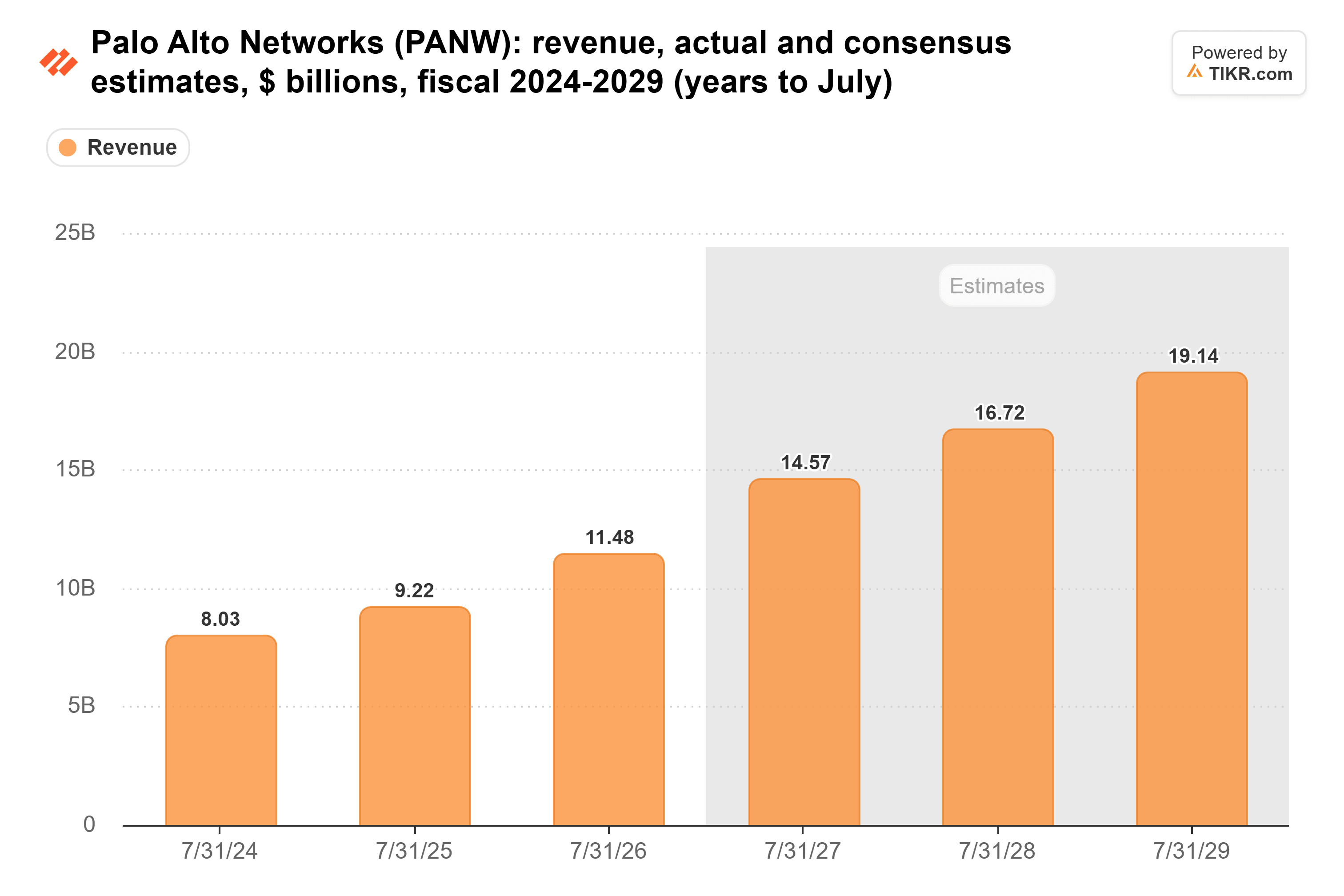
Those estimates were set before the CrowdStrike-Zscaler report, and a stronger rival would put the later years at risk first.
Plus, a good chunk of that growth was bought. Palo Alto spent $24.4 billion on acquisitions in fiscal 2026, led by CyberArk, and paid $18.5 billion of it in stock. Counting the acquired companies for the whole year, fiscal 2026 revenue grew 17%, and the new guidance works out to about 18% growth on that base. Fortinet (FTNT), a rival for the same budgets, guides to 20% revenue growth for 2026.
The AI security story is real
First-quarter revenue rose 39% to $3.44 billion, above Palo Alto’s guidance of $3.30 billion-$3.31 billion. Prisma AIRS, its AI security platform, reached nearly $170 million of annual recurring revenue within five quarters of launch. Asked on the first-quarter call how early the market for AI security is, CEO Nikesh Arora said, “People haven’t figured out how to secure Claude Code or Codex or Cursor yet.”
If that demand keeps compounding, the 2031 projections could prove too low.
But a combined CrowdStrike-Zscaler could sell much of what Palo Alto pitches as one platform, right in the path of its SASE business, whose ARR grew 30% last quarter.
A trip back to average costs 28%
Palo Alto trades at 79x forward earnings, well above its five-year average of 57x:
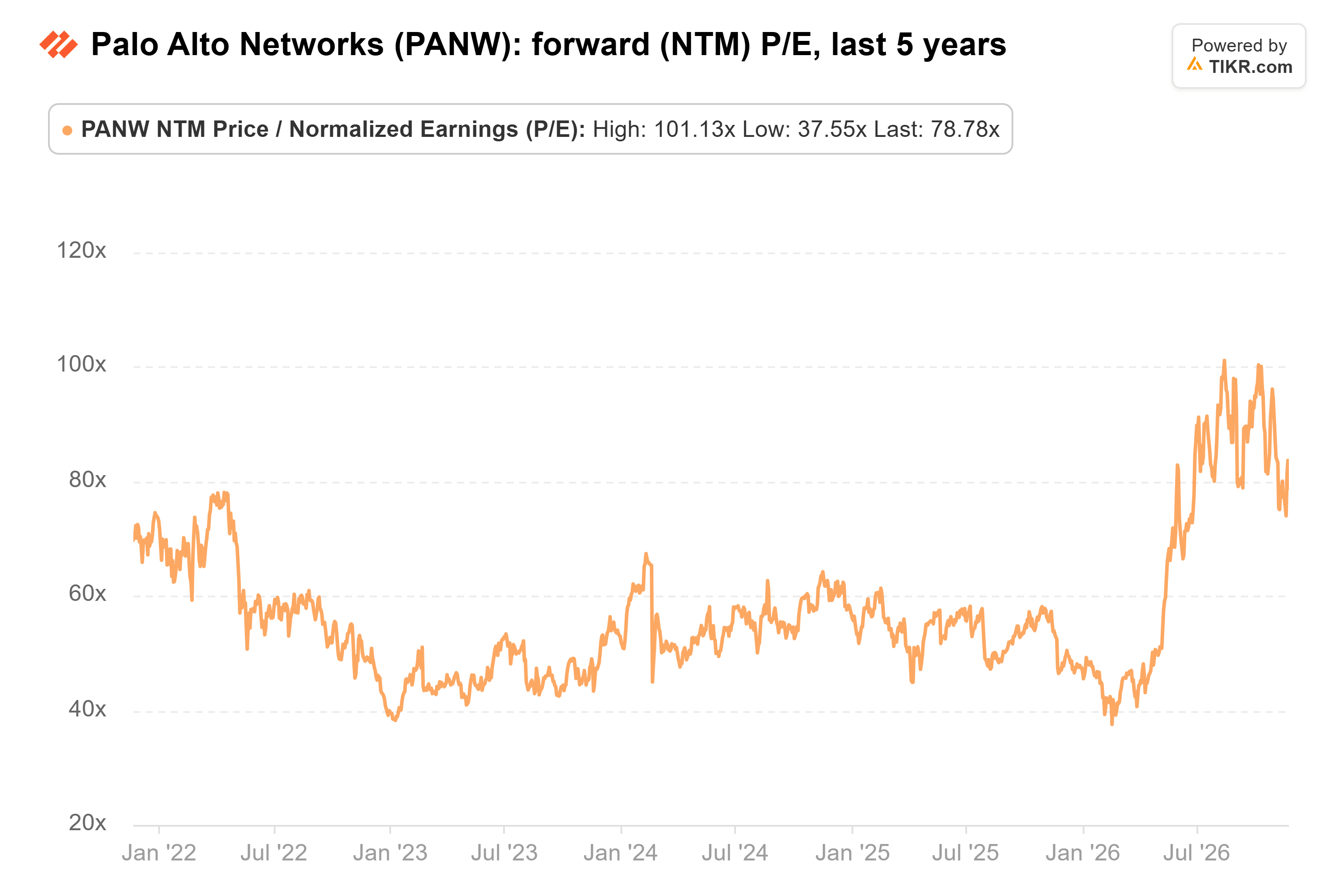
The multiple peaked at 101x in August, but it was just 38x on Feb. 18.
If earnings hold and the multiple drifts back to its 57x average, the stock loses about 28%. Back to February’s 38x, it roughly halves.
Earnings growth won’t close that gap quickly. Palo Alto raised its fiscal 2027 adjusted EPS guidance to $4.26-$4.30, from $4.16-$4.19, just 11%-12% above fiscal 2026’s $3.84. Per-share growth trails revenue because shares outstanding rose 22% to 818 million in about 15 months, mostly from the stock-funded deals. At that pace, it would take about three years of earnings growth to make up a 28% drop in the multiple.
Profits after stock pay are thinner, too. On a GAAP basis, Palo Alto’s operating margin fell in fiscal 2026:

Stock-based compensation came to $1.8 billion last fiscal year, equal to 44% of free cash flow.
Priced for everything to go right
Palo Alto may not be the single most overvalued stock in the market. But at 79x, investors are paying today for years of AI-security growth that hasn’t arrived yet. I’d wait for a better price.
A CrowdStrike-Zscaler deal that falls apart could change that, as could a fiscal second-quarter report, likely in February, that beats the $3.53 billion-$3.55 billion revenue guidance and finally includes an organic growth figure, which the first quarter didn’t.
So what is Palo Alto Networks stock actually worth?
TIKR lets you forecast the future price of any stock in less than a minute. Just enter a few assumptions into TIKR’s valuation model and see what Palo Alto Networks could be worth. Start from Wall Street consensus estimates, or adjust the inputs to reflect your own view of the business. It’s free to use.
Value Palo Alto Networks for free
Disclaimer:
Please note that the articles on TIKR are not intended to serve as investment or financial advice from TIKR or our content team, nor are they recommendations to buy or sell any stocks. We create our content based on TIKR Terminal’s investment data and analysts’ estimates. Our analysis might not include recent company news or important updates. TIKR has no position in any of the stocks mentioned. Thank you for reading, and happy investing!