Key Takeaways
- SpaceX (SPCX) CEO Elon Musk says Starship’s propellant cost will drop below $500,000 per flight while payload capacity exceeds 200 tons, following the historic upper-stage tower catch on November 14.
- Musk’s target implies fuel spending below $2,500 per ton of payload, more than 75% below an earlier estimate. That is the propellant bill, not the full cost of launching a rocket.
- SpaceX generated $14.6 billion in third-quarter revenue, while a $44 billion GPU financing transaction announced on November 20 highlights the capital required for its AI expansion.
- At $127.79 per share, SpaceX carries a market valuation near $1.74 trillion. Starship’s progress strengthens its long-term prospects, but the stock still looks expensive.
Musk’s $500,000 fuel target changes the math
SpaceX caught Starship’s upper stage with its launch tower on November 14, marking the first successful recovery of the spacecraft after returning from orbit.
The ship spent approximately 22.5 hours in space before returning to Starbase, bringing SpaceX closer to making its giant rocket fully reusable.
Two days later, Musk was already talking about how cheaply it could fly.
Responding to an X post estimating that Starship costs approximately $1 million to fuel for a 100-ton orbital payload, Musk wrote:
“Propellant cost per flight will drop below $500k and payload will exceed 200 tons.”
That’s a dramatic difference.
At $1 million for 100 tons, propellant costs approximately $10,000 per ton of payload. Musk’s target would bring that figure below $2,500 per ton, a reduction of more than 75%.
Those figures are projections, not demonstrated operating costs.
Musk also outlined plans for Starship V4, describing a spacecraft approximately 70 meters long, with more than 60% additional propellant capacity and nine engines.
The larger ship could explain the higher payload target. Musk hasn’t explained how the total propellant bill would fall despite the increase in fuel capacity.
And fuel is only one part of a launch’s cost.
The real opportunity comes from recovering both stages and flying them repeatedly without expensive refurbishment. That would allow SpaceX to spread vehicle manufacturing costs across more missions.
TIKR tracks 40 analysts on SpaceX. How many say “Buy”?
See the full breakdown of Buy, Hold, and Sell ratings on SpaceX, along with Wall Street’s revenue and earnings estimates, all in one place. More than 500,000 investors use TIKR to research stocks like this one.
SpaceX is its own biggest launch customer
SpaceX has an advantage most satellite operators lack: it launches its own satellites.
During the third quarter of 2026, 23 of the company’s 35 launches carried internal payloads. That’s approximately 66% of its launch activity.
Cheaper flights could therefore reduce Starlink’s deployment costs while allowing SpaceX to keep earning revenue from commercial launch customers.
Analysts expect the business to grow rapidly.

TIKR consensus estimates project revenue of approximately $49 billion in 2026, $181 billion in 2027, and $337 billion in 2028.
Most of that growth, though, is expected to come from a business that doesn’t directly depend on Starship.
SpaceX’s Super Intelligence segment generated $7.56 billion in third-quarter revenue, up from $813 million a year earlier. That increase accounted for approximately 75% of the company’s total year-over-year revenue growth.
Cheaper Starship flights won’t directly drive those AI revenue forecasts. Their value lies in making satellite operations, and potentially future orbital computing infrastructure, less expensive to expand.
The company is already spending heavily.
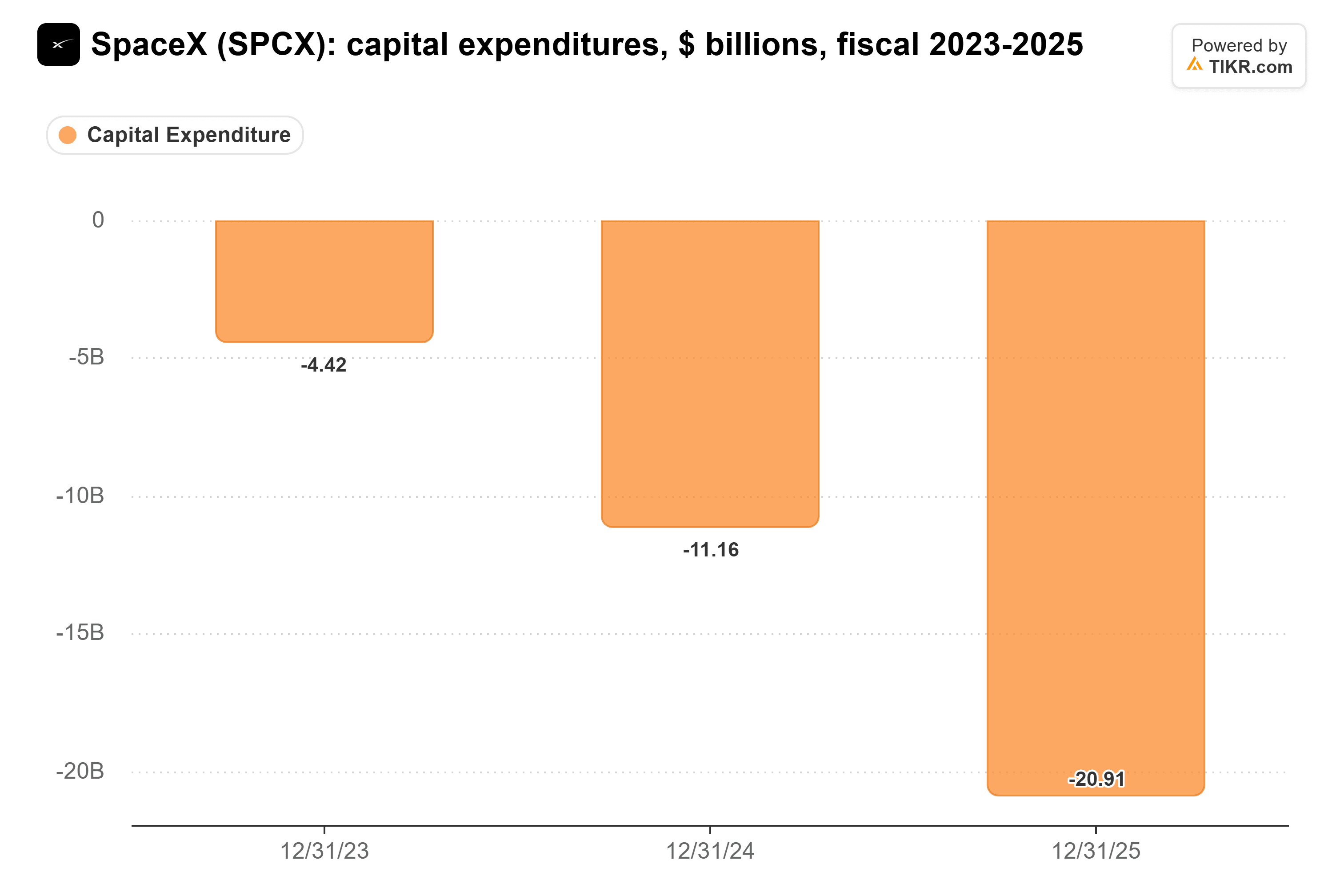
Annual capital expenditures climbed from approximately $4.42 billion in 2023 to $11.2 billion in 2024 and $20.9 billion in 2025.
Trailing 12-month spending has since reached approximately $55.1 billion.
Most recent investment supports ground-based AI infrastructure. Super Intelligence accounted for approximately $40 billion of SpaceX’s $48.1 billion in capital expenditures during the first nine months of 2026.
That spending challenge became even clearer on November 20, when a roughly $44 billion financing package was priced to fund GPUs and related equipment for SpaceX’s AI expansion.
The transaction underscores how much capital the company needs to keep adding computing capacity. Lower rocket launch costs won’t solve that problem.
For Starlink, though, where deploying and replacing satellites is a recurring requirement, cheaper launches could make a meaningful difference.
Fuel is cheap. Reusing the rocket is the hard part
SpaceX’s operating margins show why controlling costs matters.
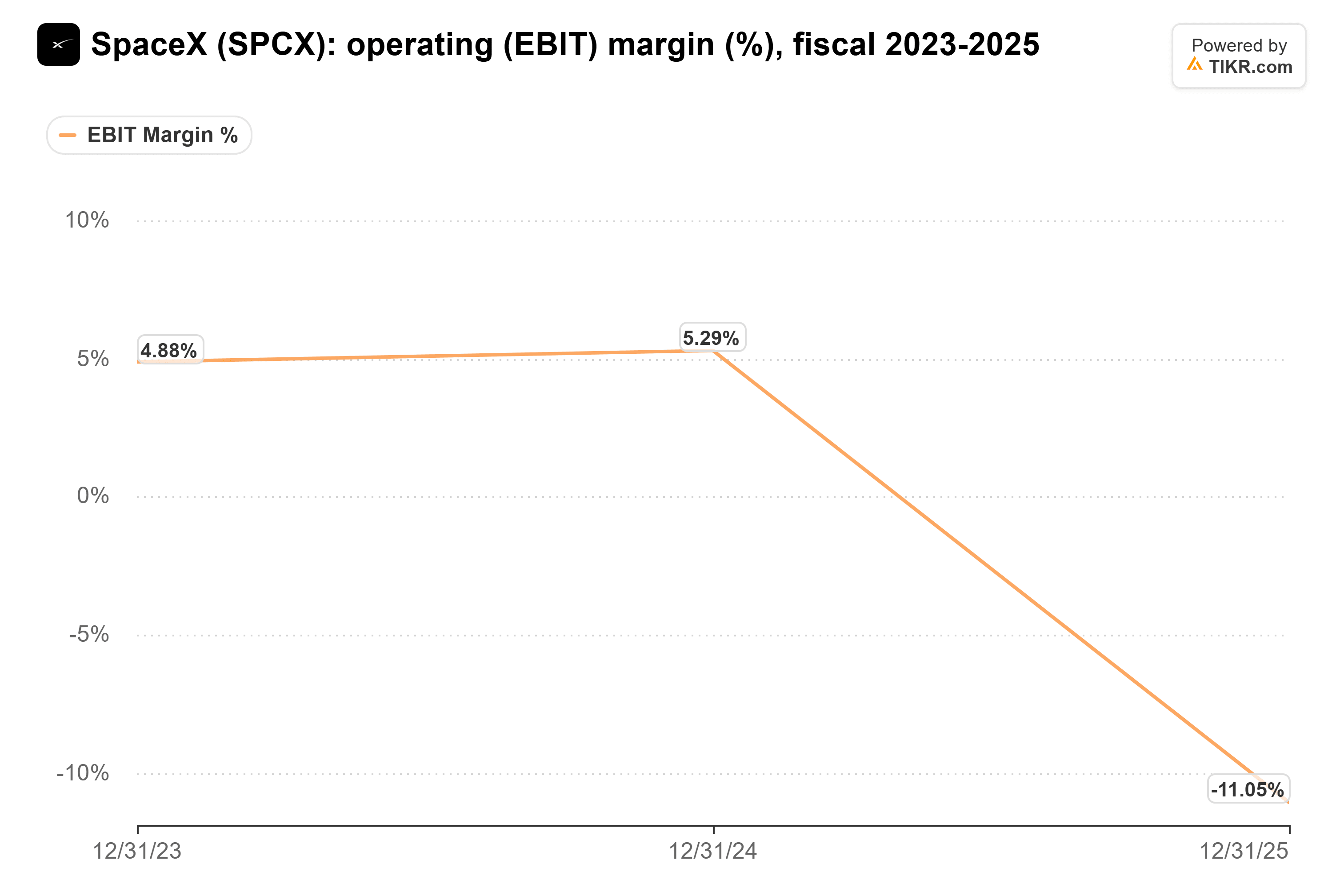
The company’s operating margin stood at approximately 4.9% in 2023 and 5.3% in 2024 before falling to negative 11.1% in 2025.
Its Super Intelligence business recorded a $6.4 billion operating loss in 2025, while Connectivity generated approximately $4.4 billion in operating income.
Profitability has improved since then.
In the third quarter of 2026, SpaceX generated approximately $2.8 billion in operating income on $14.6 billion in revenue, representing an operating margin of 19.1%.
Its Connectivity segment delivered an even stronger 45.1% operating margin.
Lower satellite deployment costs could strengthen those economics. SpaceX also earns launch revenue from some competing satellite operators while operating its own launch infrastructure.
The November 14 mission showed how much work remains.
SpaceX canceled the planned booster catch following a fuel-system problem, and the booster was lost in the Gulf of Mexico.
The successful upper-stage recovery was a major achievement, but SpaceX has not yet demonstrated repeated recovery and reflight of both Starship stages.
On November 18, Musk also said SpaceX plans to preserve Ship 42, the historic upper stage caught on November 14, for public display rather than fly it again.
That means another spacecraft will need to demonstrate the first successful upper-stage reflight.
Musk has targeted weekly Starship flights during the first half of 2027. Reaching that pace economically will require reliable reuse, shorter turnaround times, and lower refurbishment costs.
The $500,000 propellant target is impressive. Proving Starship can fly repeatedly at a low total cost matters far more to investors.
SpaceX’s $1.74 trillion valuation leaves little room for error
SpaceX’s technological progress is impressive, but investors still have to consider what they’re paying for it.
The stock closed at $127.79 on November 20, giving SpaceX an equity valuation of approximately $1.74 trillion.
Based on consensus revenue estimates, that represents roughly 35.5 times projected 2026 sales and 9.6 times projected 2027 sales.
Those multiples reflect extraordinary growth expectations across Starlink, launch services, and Super Intelligence.
The bigger challenge is turning that growth into sustainable cash flow.
SpaceX generated approximately $15.8 billion in trailing operating cash flow against $55.1 billion in capital expenditures, leaving free cash flow negative by roughly $39.3 billion.
Much of that spending supports AI infrastructure rather than Starship. SpaceX generates cash from operations, but its investment requirements remain enormous.
The recently priced $44 billion GPU financing package also highlights the financial commitments required to expand the company’s computing capacity.
Its profitable Connectivity business and ambitious growth forecasts support its long-term investment case. The valuation already assumes exceptional execution across several capital-intensive businesses.
At approximately $128 per share, I would avoid buying SpaceX stock for now. Its technology and growth opportunities are compelling, but paying roughly 35.5 times expected 2026 revenue leaves too little room for disappointment.
The principal risk is that delays in Starship reuse or disappointing returns on AI infrastructure spending prevent SpaceX from converting its projected growth into sustainable free cash flow.
I’d reconsider that verdict if SpaceX demonstrates repeatable Starship reuse, improves free cash flow, and delivers the profitability needed to support its premium valuation.
The next milestone I’m watching isn’t another fuel-cost prediction. It’s the first recovered Starship upper stage that flies again with lower refurbishment expenses and faster turnaround times.
That’s when Musk’s ambitious fuel target could begin translating into a more compelling financial advantage.
So what is SpaceX stock actually worth?
TIKR lets you forecast the future price of any stock in less than a minute. Just enter a few assumptions into TIKR’s valuation model and see what SpaceX could be worth. Start from Wall Street consensus estimates, or adjust the inputs to reflect your own view of the business. It’s free to use.
Disclaimer:
Please note that the articles on TIKR are not intended to serve as investment or financial advice from TIKR or our content team, nor are they recommendations to buy or sell any stocks. We create our content based on TIKR Terminal’s investment data and analysts’ estimates. Our analysis might not include recent company news or important updates. TIKR has no position in any of the stocks mentioned. Thank you for reading, and happy investing!