Key Takeaways
- Kinder Morgan yields 3.8% to Merck’s 2.3%, and $10,000 in Kinder Morgan would pay about $1,170 more over 20 years at each company’s five-year dividend growth rate.
- Merck’s dividend grew 5.8% a year from fiscal 2020 to fiscal 2025, against 2.2% at Kinder Morgan, so Merck’s yearly income would pass Kinder Morgan’s around 2041.
- Merck paid out 66% of its free cash flow over the last twelve months, while Kinder Morgan’s distributable cash flow covered its fiscal 2025 dividend 2.1x, with far more debt behind it.
- Merck’s main risk is Keytruda losing exclusivity, and Kinder Morgan’s is funding a record $14.4 billion project backlog.
Kinder Morgan (KMI) reported a record $14.4 billion project backlog on Oct. 21, and Merck (MRK) raised its full-year profit outlook eight days later.
Both look like dividends you could hold for decades. Kinder Morgan’s 3.8% yield is the bigger check today, whereas Merck’s dividend has grown more than twice as fast over the past five years.
So if I could hold only one for the next 20 years, which would it be?
| Metric | Merck (MRK) | Kinder Morgan (KMI) |
|---|---|---|
| Dividend yield | 2.3% | 3.8% |
| Annual dividend | $3.40 | $1.19 |
| Dividend growth, fiscal 2020-2025 | 5.8% a year | 2.2% a year |
| Dividend coverage | 66% cash dividend payout ratio (TTM) | 2.1x distributable cash flow coverage (fiscal 2025) |
| Net debt / EBITDA (LTM) | 1.5x | 4.1x |
| Interest coverage (LTM) | 5.2x | 3.0x |
Source: TIKR and StockAnalysis; yields at today’s prices.
6 safe dividend stocks paying retirees 6%+ yields
There are over 100 stocks paying 6%+ annual dividends today.
But after an extensive investment review leveraging TIKR’s proprietary data, we now believe only six of them are truly safe for retirees.
They’re all yours as part of our new investment report. Learn more about how to get access right here.
Merck has room to keep raising
Merck’s third-quarter sales rose 5% to $18.1 billion. Keytruda brought in $8.6 billion of that, up 6%. Winrevair sales jumped 93% to $694 million, while Januvia and Bridion keep shrinking against generics.
The dividend is well-covered, using 66% of free cash flow over the twelve months to Sept. 30, 2026. Free cash flow swings from year to year, but it has covered the dividend in every year since fiscal 2021:
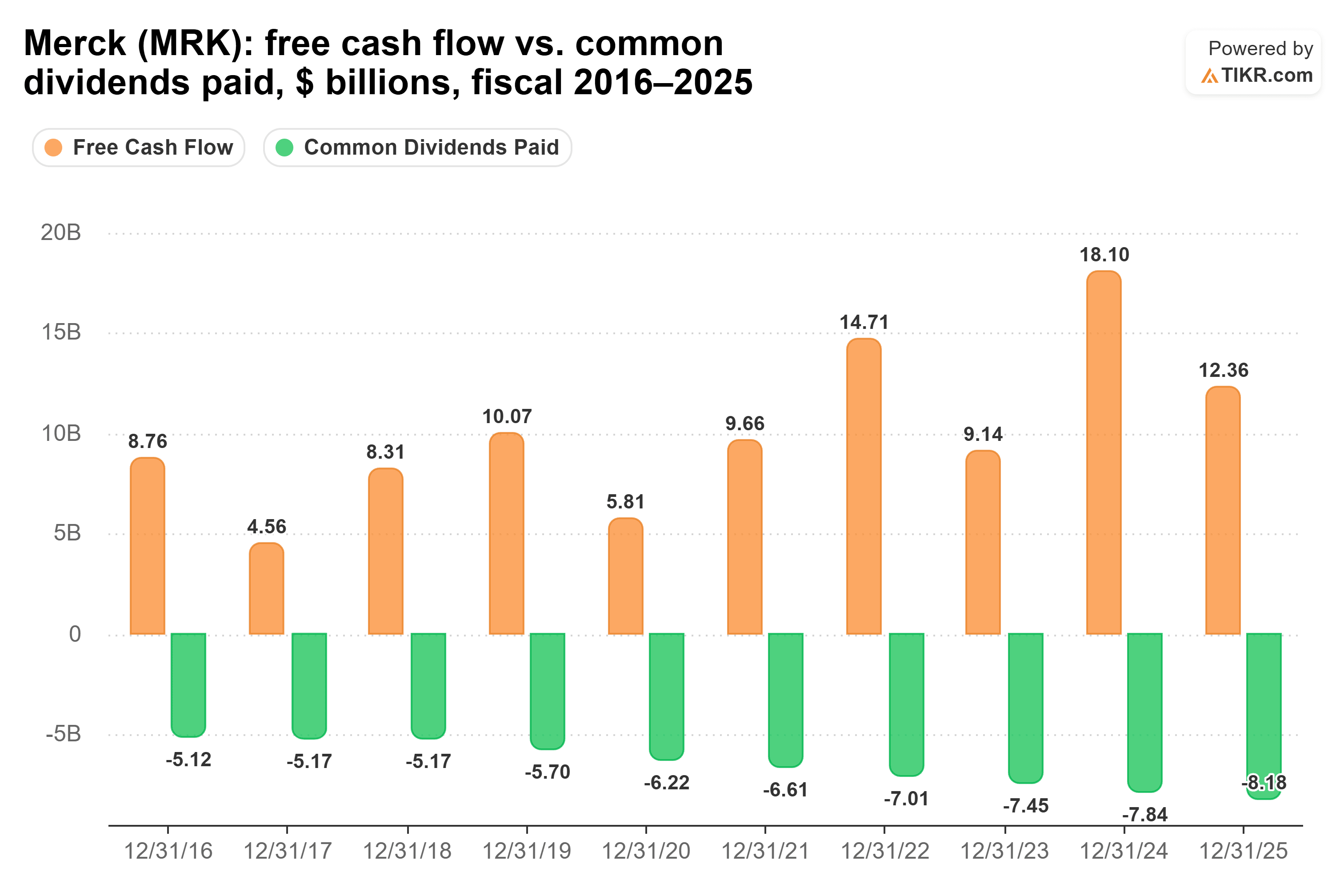
It did fall short of the dividend in fiscal 2017 and fiscal 2020, and the payout ratio hit 81% in fiscal 2023.
CFO Caroline Litchfield said on the third-quarter call, “We remain committed to the dividend with the goal of increasing it over time.” A payout of two-thirds of free cash flow leaves room for that.
The risk is Keytruda, nearly half of third-quarter sales, as it heads toward losing exclusivity. (An Oct. 22 leak of trial data on Merck’s experimental cancer vaccine with Moderna knocked the stock down as much as 2% and drew a law firm’s securities-fraud investigation on Oct. 30. None of that touches the cash behind the dividend.)
Kinder Morgan’s bigger check carries more debt
Kinder Morgan answers Merck’s faster growth with a bigger check. As a pipeline, it’s judged on distributable cash flow, which covered its fiscal 2025 dividend a comfortable 2.1x. That coverage has held up for a decade, at 1.9x even in its leanest year, fiscal 2023:
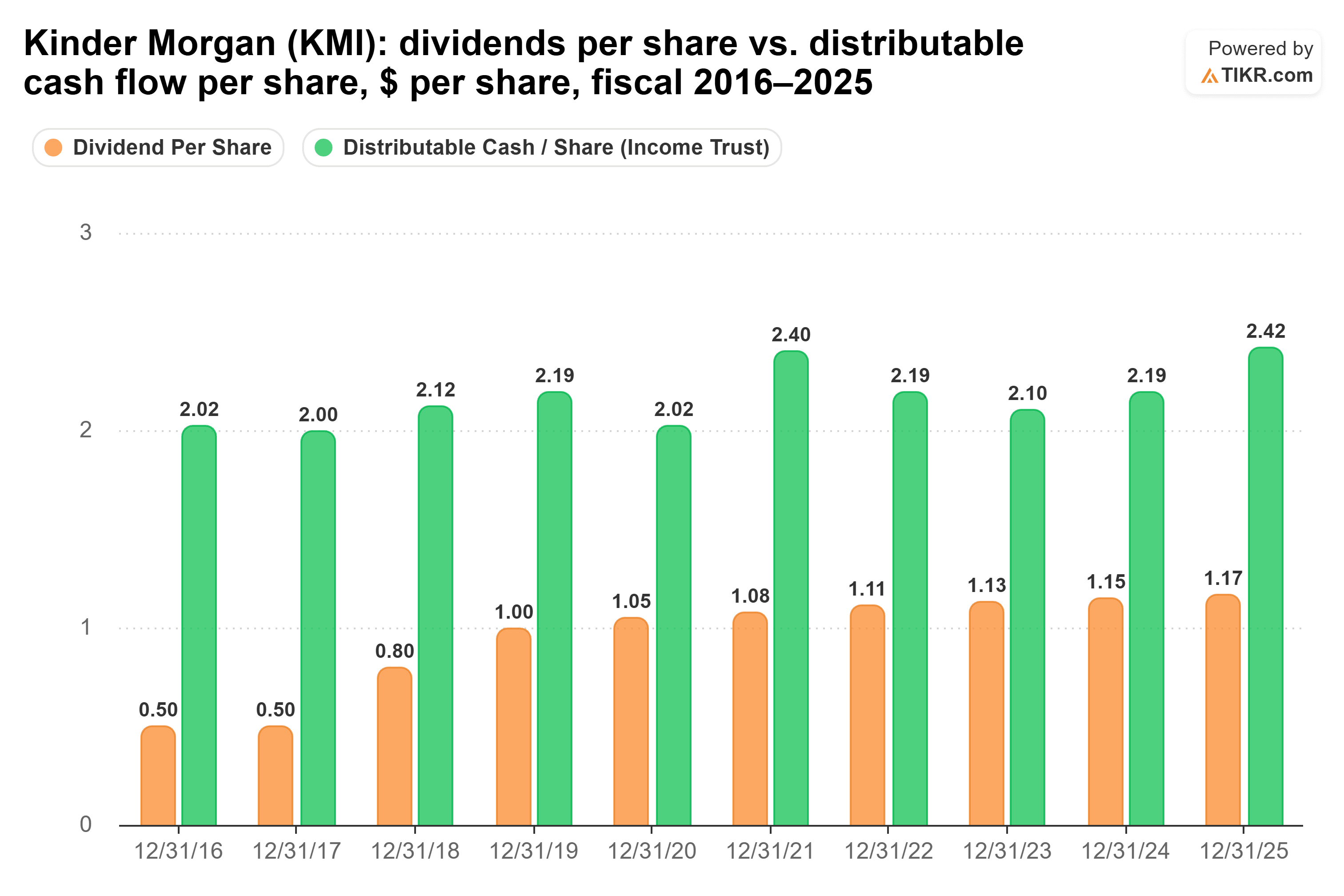
The chart starts just after a cut, though. Kinder Morgan paid $1.60 a share in fiscal 2015 and $0.50 in fiscal 2016, and today’s $1.19 is still below that fiscal 2015 level.
The business is growing. Adjusted EBITDA rose 9% to $2.18 billion in the third quarter of 2026, and the backlog grew by $5.4 billion in the quarter, with $13.2 billion of it now in natural gas projects, as LNG exports and power demand grow. On Oct. 21, the board declared a $0.2975 quarterly dividend, $1.19 a year after a 2% raise. Executive Chairman Richard Kinder said on the call, “We are in a business that is in need of substantial additional infrastructure.” He bought 500,000 shares, about $15 million worth, on Nov. 6.
That infrastructure isn’t cheap. Management expects capital spending of around $4 billion a year for the next few years. Free cash flow after capital spending and dividends came to just $230 million in the first nine months of 2026.
So which dividend wins?
Merck gets my dividend dollars for the next 20 years.
Over that long a stretch, I care most about a dividend’s ability to keep growing through the bad years. Merck has less debt (1.5x EBITDA against 4.1x), better interest coverage (5.2x against 3.0x) and the faster-growing check. At its 5.8% pace, $10,000 in Merck would pay about $665 in year 20. So, call it a 6.7% yield on your cash today, before any gain in the stock.
Kinder Morgan would still pay more in all: about $9,408 over the 20 years against about $8,238 for Merck at their five-year rates. Merck’s yearly check only passes it around 2041. I’m happy to give up that $1,170 for the stronger balance sheet.
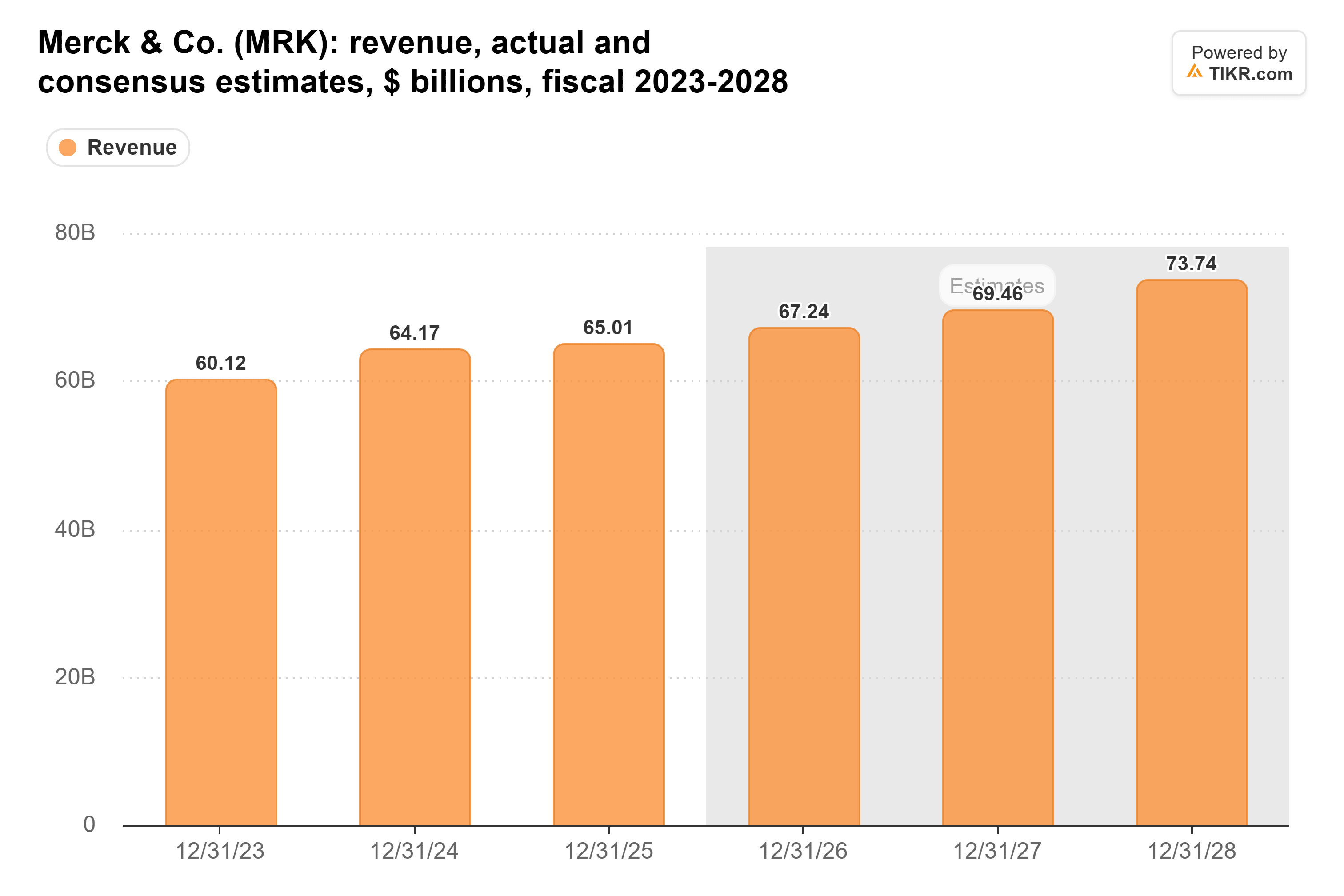
Keytruda is the question mark. Litchfield calls its loss of exclusivity “really more of a hill on the overall revenues of our company.” Analysts expect revenue to rise from $65.0 billion in fiscal 2025 to $73.7 billion in fiscal 2028:
This isn’t to say Kinder Morgan’s dividend isn’t safe. Its distributable cash flow covers the check more than twice over, it has a record backlog behind it, and its own executive chairman is buying. It’s just that, over 20 years, I’d rather own the dividend with less debt behind it and more growth ahead.
Of course, if Keytruda’s hill turns out steeper than Merck expects, that 66% payout ratio could tighten in a hurry.
Forget Merck: 6 safe 6%+ dividend yields you can buy right now
Dividends can hold the key to enormous wealth. But only if you buy the right ones.
Picking the right high-yield dividend stock can be the difference between a dream retirement…and scraping by every month, waiting for the next Social Security check to clear.
We’ve identified six stocks yielding 6%+ that we believe every retiree should know about right now. (And Merck isn’t one of them.)
Disclaimer:
Please note that the articles on TIKR are not intended to serve as investment or financial advice from TIKR or our content team, nor are they recommendations to buy or sell any stocks. We create our content based on TIKR Terminal’s investment data and analysts’ estimates. Our analysis might not include recent company news or important updates. TIKR has no position in any of the stocks mentioned. Thank you for reading, and happy investing!