Key Takeaways
- Intel CEO Lip-Bu Tan says AI systems have gone from about eight GPUs for every CPU to roughly one for one, and in some cases to more CPUs than GPUs.
- AI agents depend on general-purpose processors, so more demand for server CPUs helps Intel, AMD and Arm alike.
- Intel can’t make enough server chips to meet demand, and analysts have cut its 2027 earnings estimate since its October report.
- AMD looks like the cleanest way to play the trend: its data center revenue rose 97% in the third quarter, and its server sales more than doubled.
Intel (INTC) CEO Lip-Bu Tan has put a number on how fast AI is swinging back toward his company’s main product.
In an interview with Brian Sozzi that Yahoo Finance aired during its Invest conference, Tan was asked whether a CPU renaissance is starting. He said AI used to run on about eight GPUs for every CPU but is at “kind of parity now,” and “in some cases actually more CPU than GPU.”
That’s a big shift for every company selling server CPUs. It lifts Intel’s two biggest rivals in those chips, Advanced Micro Devices (AMD) and Arm Holdings (ARM), right along with it. (Keep in mind that Tan is counting chips. A top GPU sells for far more than a CPU, so the dollars are nowhere near even.)
TIKR tracks 50 analysts on Intel. How many say “Buy”?
See the full breakdown of Buy, Hold, and Sell ratings on Intel, along with Wall Street’s revenue and earnings estimates, all in one place. More than 500,000 investors use TIKR to research stocks like this one. See Intel’s Analyst Ratings
Agents keep CPUs busy
Gerard Williams III is co-founder and CEO of the CPU startup NUVACORE and was Apple’s chief chip architect. He explained the shift to Bloomberg’s Mark Gurman in a recent podcast interview. He said high-performance CPUs “are necessary in order to enable these large language models to do their work. They orchestrate memory, they orchestrate the security aspects, and do some of the fundamental work.”
AI agents push that work further. On the MTS podcast, the host brought up a chart that split a dollar of agent work roughly 90% to CPUs and 10% to model inference. Ivan Burazin, co-founder and CEO of the agent-infrastructure startup Daytona, said he’d “been saying that forever,” and added: “if people think that inference is a huge market wait until they see the rest of it.”
Intel’s own forecast points the same way. As recently as April, Tan put the ratio at one CPU for every four GPUs. On the company’s third-quarter call, CFO Dave Zinsner said Intel expects industry server CPU units to grow more than 30% in both 2026 and 2027.
Intel can’t make enough of them
Intel should be the biggest winner here. Its data center and AI group brought in $7.3 billion of its $16.5 billion third-quarter revenue, up 78% from a year earlier.
The problem is supply. Zinsner expects the industry to stay short of chips through 2027 and into 2028. On top of that, a substrate shortage and a two-week shutdown at Intel’s Israel fab after an October explosion are both limiting Xeon shipments. Intel expects the shutdown alone to cost about $600 million in revenue across the fourth quarter and the first quarter of 2027. Tan has called unlocking Xeon supply Intel’s “immediate priority.”
The rest of the business is heading the wrong way, too. Intel’s fourth-quarter revenue guidance of $15 billion to $16 billion came in about $1.6 billion below the analyst consensus at the midpoint. Management expects industry PC unit shipments to fall about 12% this year and roughly another 10% in 2027. Intel Foundry posted a $1.85 billion operating loss in the third quarter.
Analysts still expect Intel’s revenue to climb from $52.9 billion in 2025 to $83.8 billion in 2028:
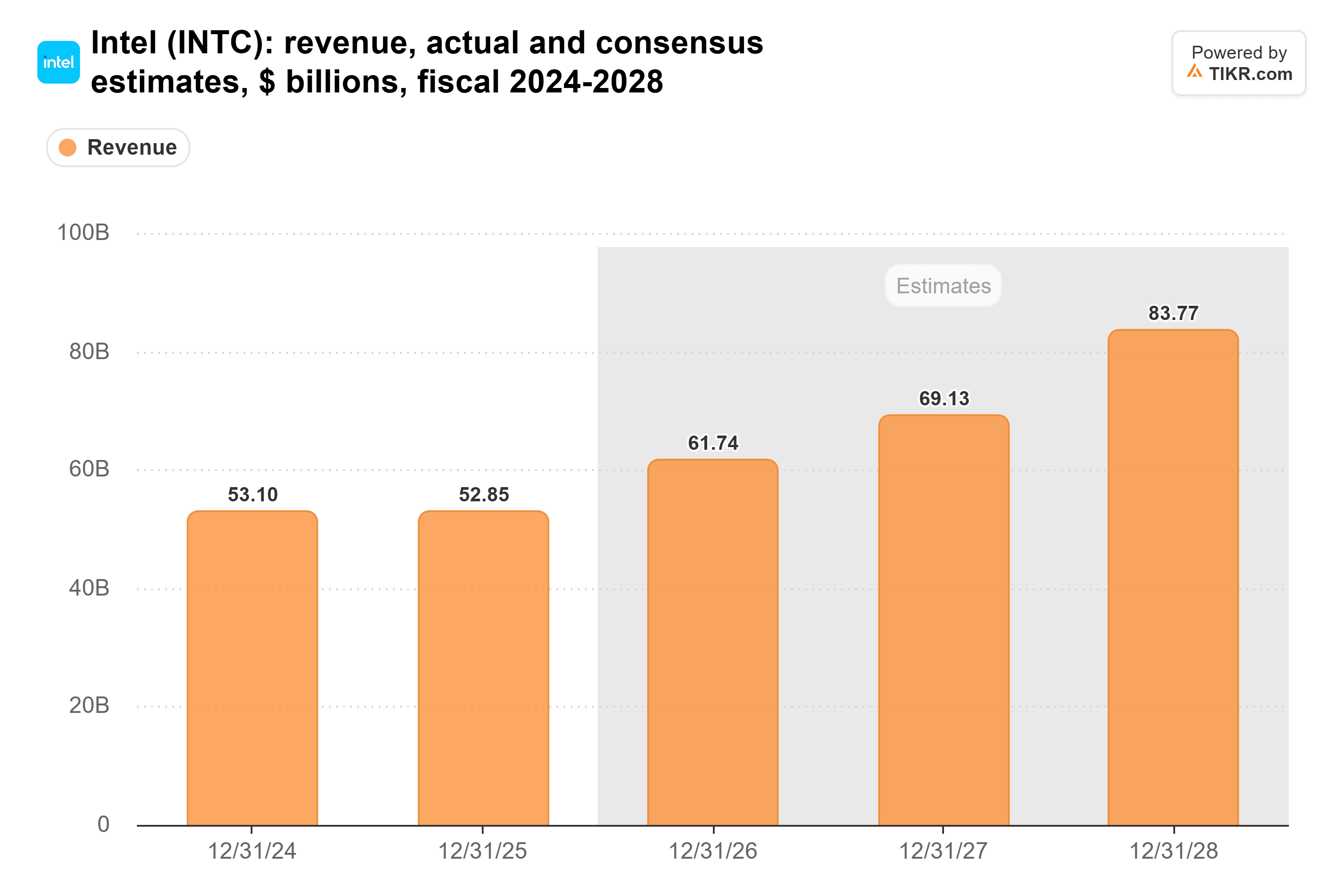
Earnings estimates are moving the other way, though. Analysts cut their 2027 normalized EPS estimate to $1.79, from $2.11 before the October report. So far, selling more server chips isn’t making Intel more profitable in analysts’ eyes.
AMD is already cashing in
AMD sells into the same demand without paying for a factory network that lost nearly $2 billion in the third quarter. Its data center revenue rose 97% in that quarter to a record $8.5 billion. The growth came from its EPYC server CPUs and its new Instinct MI450 GPUs, and CEO Lisa Su said server sales to both cloud and enterprise customers more than doubled.
JPMorgan estimates Intel’s share of server x86 CPU revenue has fallen from 77% to 53% since November 2022. Server builders are leaning in as well: Dell has launched new PowerEdge servers built on AMD’s sixth-generation EPYC chips.
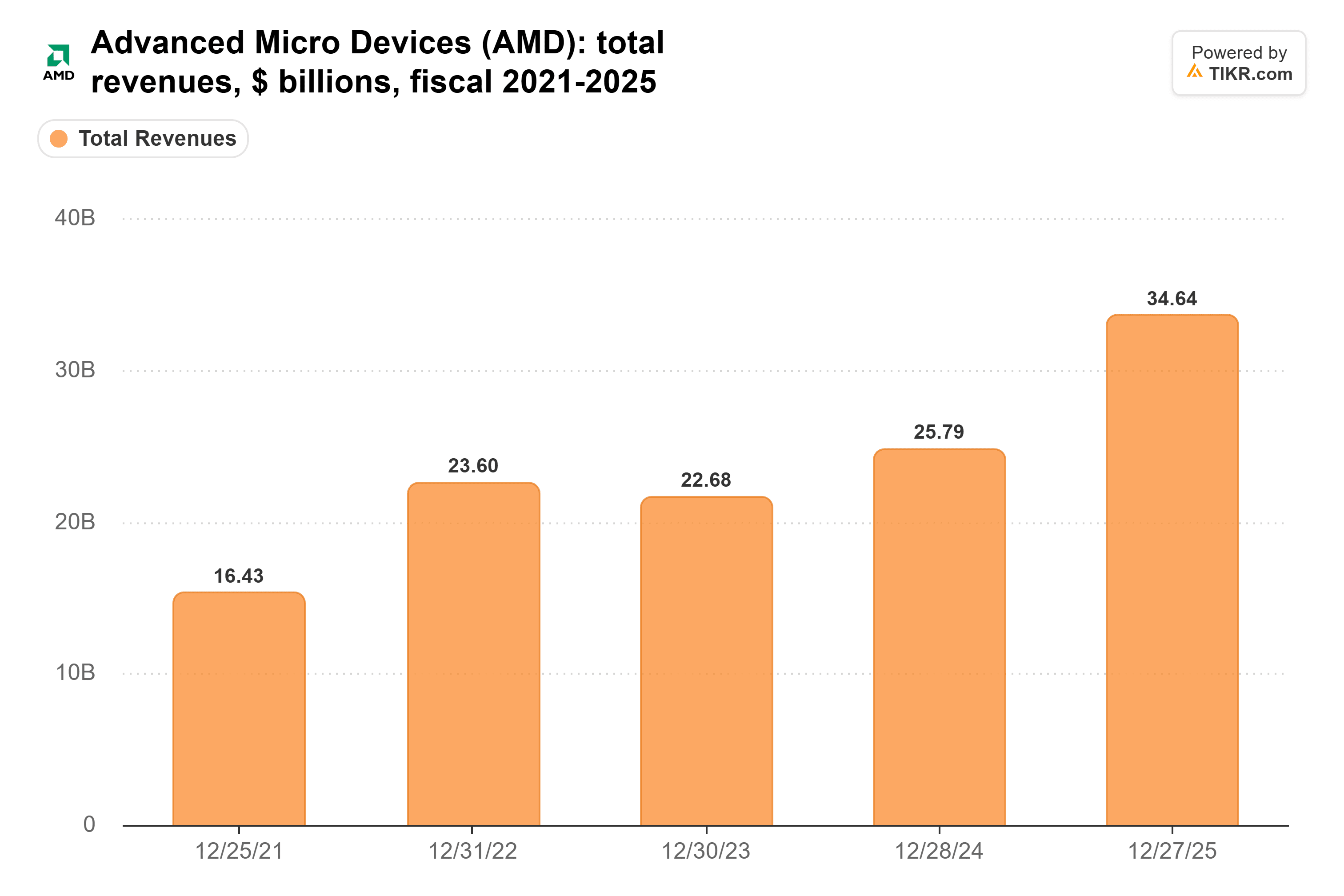
AMD’s revenue has more than doubled since 2021, from $16.4 billion to $34.6 billion in 2025:
Arm comes in through the cloud
Arm gets a share of this through the cloud companies, which design their own Arm-based processors for the same agent and inference work. Every server CPU a cloud giant builds for itself instead of buying from Intel or AMD is a win for Arm, and its data center royalties doubled in the quarter that ended in September.
Arm now sells its own server chip, too. It expects up to $2 billion in revenue from the Arm AGI CPU across fiscal 2027 and 2028, with deliveries starting in its fiscal fourth quarter (January to March 2027).
Analysts expect Arm’s revenue to more than double, from $4.92 billion in the year ended March 2026 to $11.1 billion in the year ending March 2029:
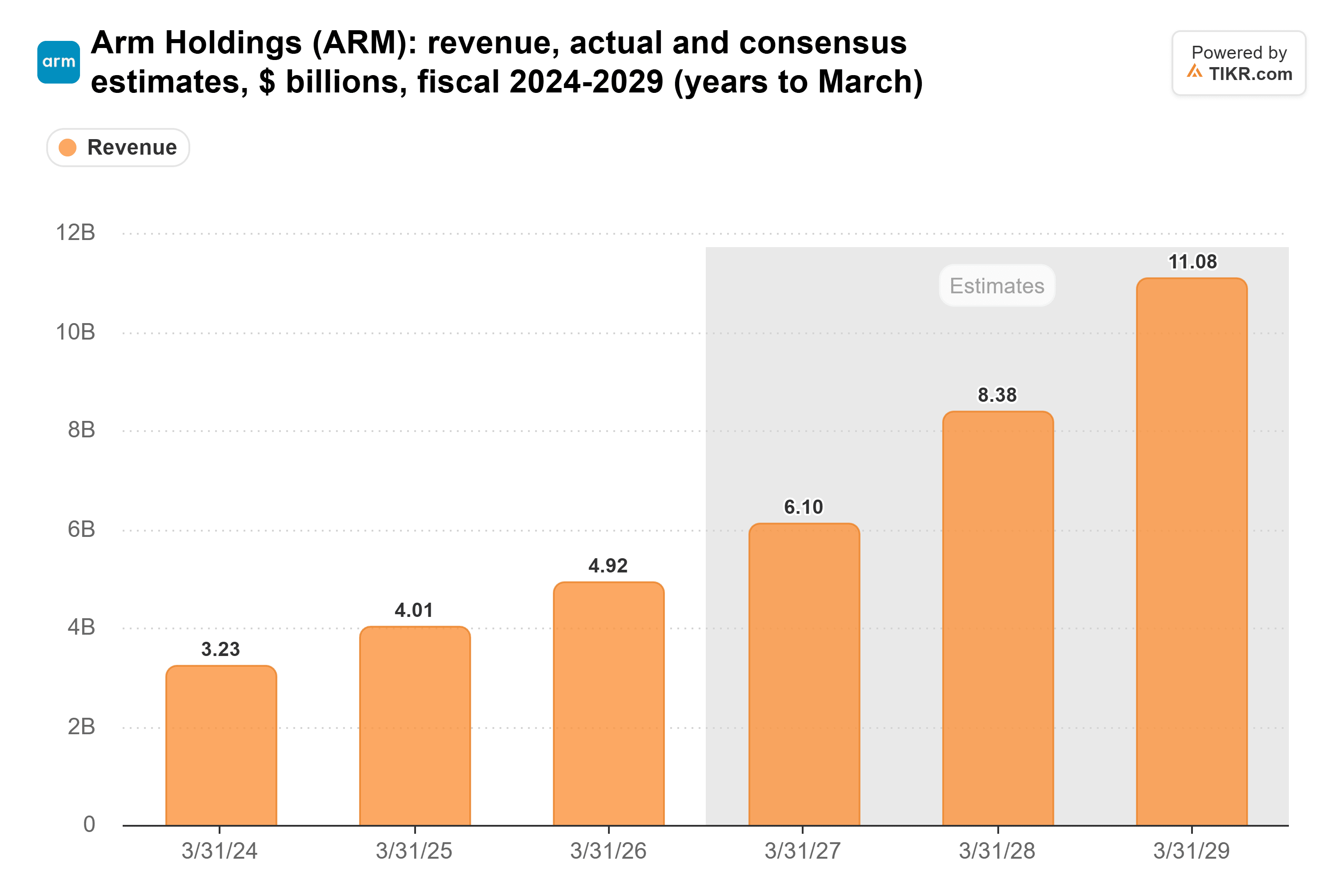
Those estimates already assume a lot of growth. Arm needs the CPU’s comeback to keep going just to meet them.
AMD is the one to own on this trend
Tan is probably right about the direction, and all three companies should sell more CPUs into AI. But Intel has to fix its supply and shrink its foundry losses before the trend shows up in its earnings, and Arm’s estimates already expect a lot.
AMD looks like the cleanest way to own it. Its server sales are growing faster than Intel’s data center business, and it has no fabs of its own to pay for.
Of course, parity is still management’s estimate, not a figure Intel reports. If Intel’s Xeon shipments catch up with demand and its foundry losses keep shrinking, it would deserve a second look.
So what is Intel stock actually worth?
TIKR lets you forecast the future price of any stock in less than a minute. Just enter a few assumptions into TIKR’s valuation model and see what Intel could be worth. Start from Wall Street consensus estimates, or adjust the inputs to reflect your own view of the business. It’s free to use.
Disclaimer:
Please note that the articles on TIKR are not intended to serve as investment or financial advice from TIKR or our content team, nor are they recommendations to buy or sell any stocks. We create our content based on TIKR Terminal’s investment data and analysts’ estimates. Our analysis might not include recent company news or important updates. TIKR has no position in any of the stocks mentioned. Thank you for reading, and happy investing!