Key Takeaways
- Steve Eisman says AI capex could peak in 2027, and the hyperscalers could return to positive cash flow as soon as the second half of that year, if data center construction slows.
- Charlie Bilello says Meta spends 43% of its revenue on capex, compared with 39% for Microsoft, 34% for Alphabet and 27% for Amazon, so a slowdown would free up the largest share of revenue at Meta.
- Analysts expect Meta’s free cash flow to bottom at negative $48.0 billion in 2027, while Microsoft’s has stayed above $59 billion a year since fiscal 2022.
- Applied Materials expects cloud capex to rise more than 50% in 2027, so Meta’s turn likely comes later than Eisman hopes. Meta’s 2027 capex plan, due in late January, is the next test.
The midterms’ backlash against data centers has Wall Street asking whether Big Tech’s AI spending is about to slow. And if it does, the hyperscaler with the most to gain may be Meta Platforms (META).
Steve Eisman, the investor Michael Lewis made famous in “The Big Short,” laid out the upside on the Nov. 13 episode of The Real Eisman Playbook. If data center construction slows by “something like 10 to 30 percent,” he said:
“AI CapEx would peak in 2027 and hyperscalers would, therefore, return to positive cash flow by perhaps as soon as the second half of 2027.”
Some have far more to get back than others. In a post on X, Creative Planning’s Charlie Bilello said capex is at a record share of revenue at all four of the biggest spenders: 43% at Meta, 39% at Microsoft (MSFT), 34% at Alphabet (GOOG) and 27% at Amazon (AMZN).
That puts Meta first in line.
TIKR tracks 61 analysts on Meta Platforms. How many say “Buy”?
See the full breakdown of Buy, Hold, and Sell ratings on Meta Platforms, along with Wall Street’s revenue and earnings estimates, all in one place. More than 500,000 investors use TIKR to research stocks like this one. See Meta Platforms’ Analyst Ratings
Meta has the deepest hole to climb out of
Meta’s spending has already wiped out its free cash flow. It generated between $43.0 billion and $52.1 billion of it a year from 2023 to 2025, and analysts expect it to turn negative in 2026 and bottom out in 2027:
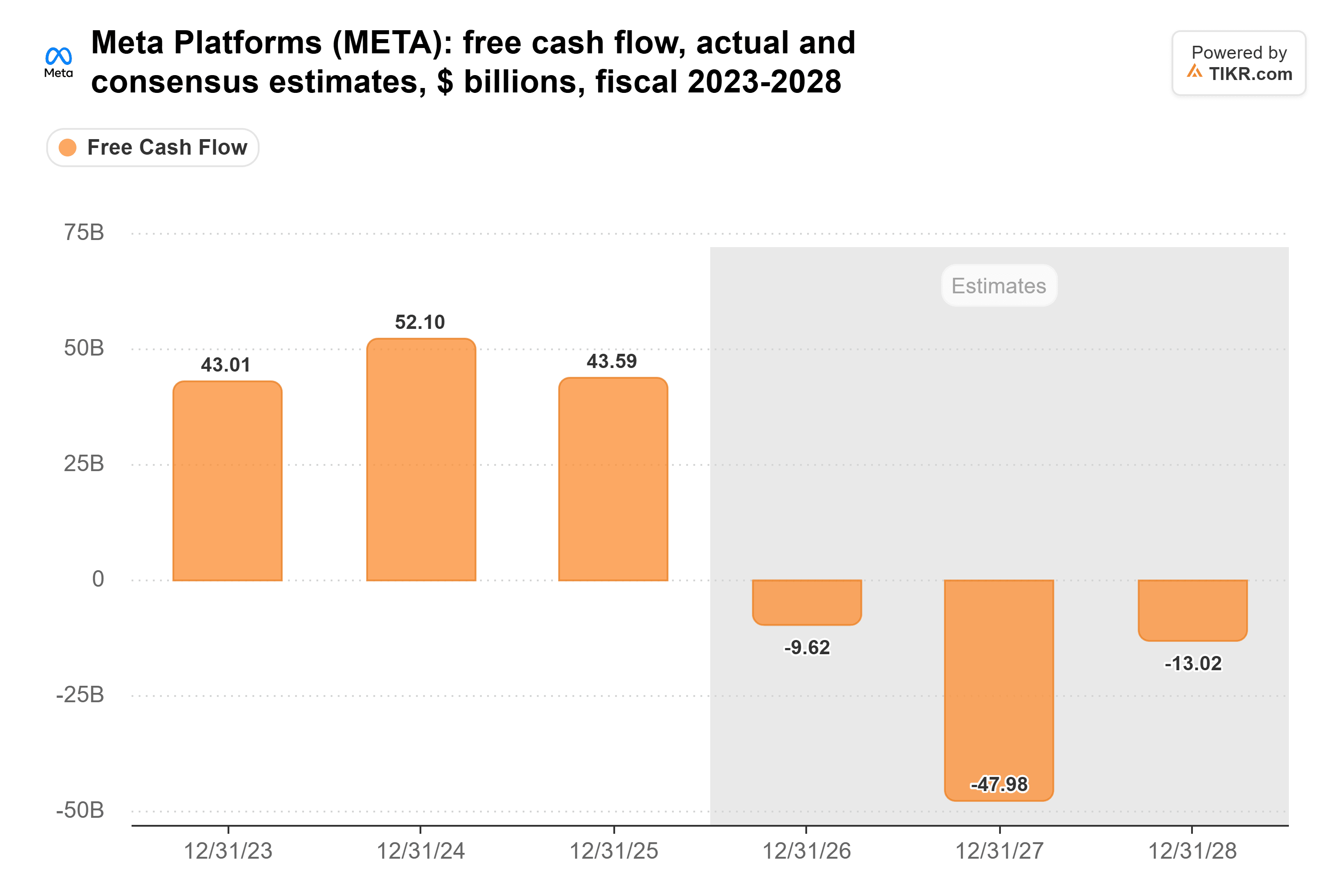
That 2027 low is negative $48.0 billion. Getting back to 2025’s $43.6 billion would take a swing of more than $90 billion.
The culprit is capex. Meta spent $18.7 billion on it in 2021 and $69.7 billion in 2025, and most of that jump came in 2025 alone:
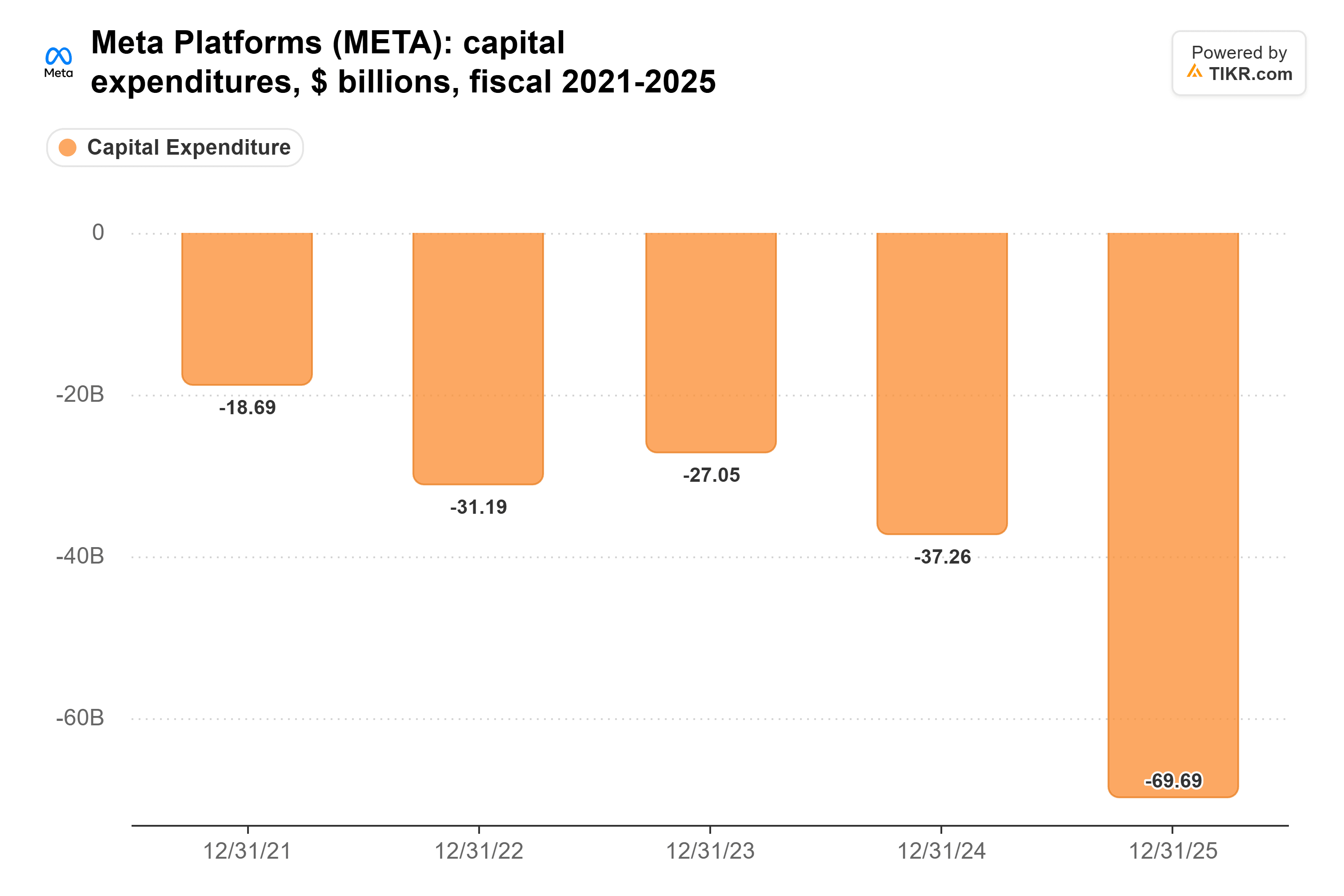
Meta guides 2026 capex to $135 billion to $145 billion. Consensus has it at about $210 billion in 2027 and about $227 billion in 2028, so analysts don’t have Meta’s spending peaking in 2027. Even so, they expect its free cash flow to improve by $35 billion in 2028 as revenue grows into the build. If spending really does top out in 2027, Meta’s cash could turn faster than the Street expects.
Eisman’s other complaint fits Meta best too. He said “investors have grown sick of all the debt and equity raised by the hyperscalers,” and Meta has lined up more than $60 billion of new funding since late October. Its shortest new dollar note pays 5.85%, compared with 4.2% on its shortest note from a year earlier.
Microsoft never stopped making cash
Microsoft spends nearly as much of its revenue on capex as Meta, but its free cash flow has held up far better. It went from $74.1 billion in the year ended June 2024 to $67.0 billion in the year ended June 2026:
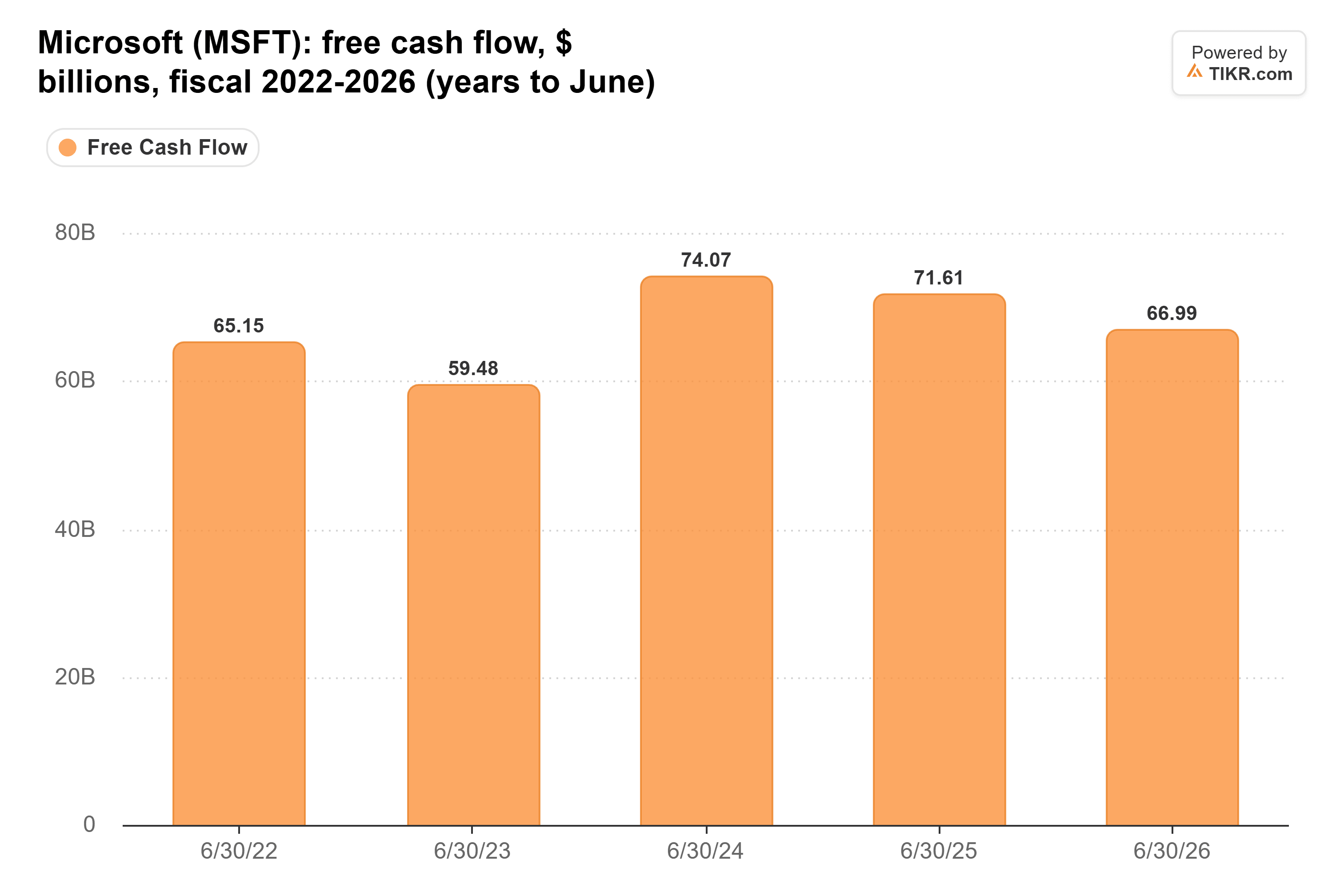
So, a 2027 peak would hand Microsoft more cash, but it never lost its “positive cash flow” in the first place. Alphabet and Amazon spend an even smaller share of revenue on capex, 34% and 27% by Bilello’s count, so a peak frees up less of each dollar they bring in. A slower build helps all four, and Meta has the most of its revenue tied up in it.
The equipment makers see a much bigger 2027
The companies selling the tools see 2027 very differently. On Applied Materials’ fourth-quarter call, CFO Brice Hill said that “Cloud CapEx is expected to increase more than 50% in 2027 to well over $1 trillion.” Its customers want more tools than it can ship, too. And Eisman himself called a slowdown “a big if.”
The two views can still fit together. Stephen Parker of J.P. Morgan Private Bank told CNBC’s Closing Bell that “all the stuff for 2027 is already approved, so that’s probably going to go forward,” and that markets will start thinking about 2028. If the slowing comes after 2027’s projects are built, 2027 ends up as the peak, just a very expensive one.
Eisman’s timing looks early, at least for Meta. With 2027’s projects already approved and spending still climbing, Meta’s free cash flow looks more likely to turn in 2028 than in the back half of 2027. But whenever the build slows, Meta has the largest share of its revenue to win back, and its shareholders may stand to gain the most.
The first real test comes in late January, when Meta sets out its 2027 budget and capex plan on its fourth-quarter call. If that plan lands well above the Street’s estimate, Meta’s cash would likely take longer to turn.
So what is Meta stock actually worth?
TIKR lets you forecast the future price of any stock in less than a minute. Just enter a few assumptions into TIKR’s valuation model and see what Meta could be worth. Start from Wall Street consensus estimates, or adjust the inputs to reflect your own view of the business. It’s free to use.
Disclaimer:
Please note that the articles on TIKR are not intended to serve as investment or financial advice from TIKR or our content team, nor are they recommendations to buy or sell any stocks. We create our content based on TIKR Terminal’s investment data and analysts’ estimates. Our analysis might not include recent company news or important updates. TIKR has no position in any of the stocks mentioned. Thank you for reading, and happy investing!