
Key Takeaways
- Since late October, Meta has lined up more than $60 billion in stock, preferred and bonds, including $25 billion of Class A shares priced at $625.
- Third-quarter capex of $34.9 billion was more than operating cash flow, so free cash flow turned negative at $2.1 billion even with 26% revenue growth.
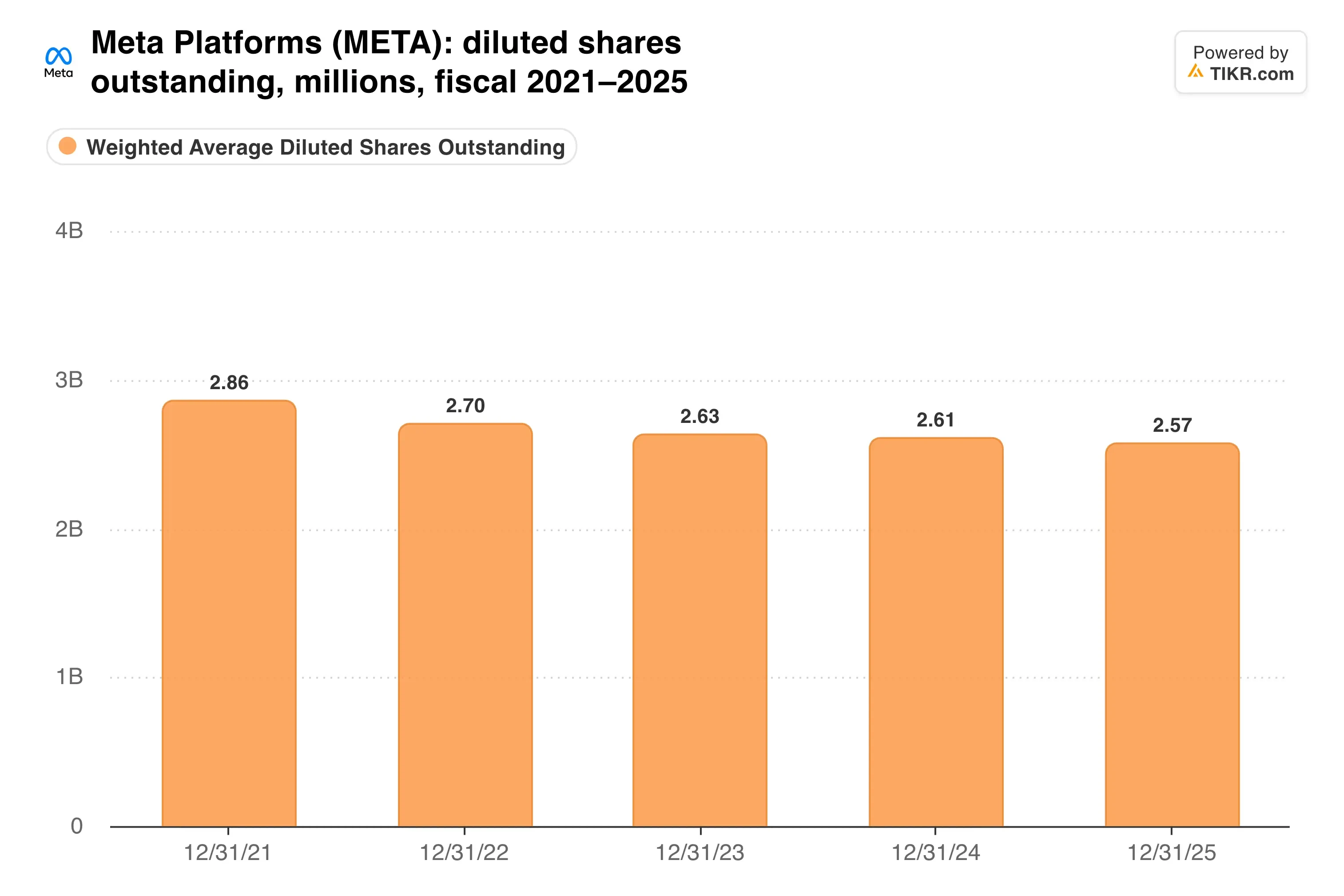
- The new debt pays higher coupons than last year’s, and the 46 million forward shares add about 1.8% dilution before a planned Class C program.
- The fourth-quarter report, expected in late January, should lay out 2027 capex and show whether ad growth can carry the larger funding bill.
For years, Meta Platforms (META) used spare cash to shrink its share count. Now it is selling stock and bonds to pay for AI.
Since late October, Meta has priced $25 billion of Class A stock at $625 and $12.5 billion of mandatory convertible preferred. It also sold $15 billion of US notes and a debut €9 billion euro deal. So the total tops $60 billion.
Alphabet (GOOGL) faces the same squeeze with far more cushion. Its free cash flow was negative for a second straight quarter, yet it still held $265.1 billion in cash and marketable securities.
Investors seem calm for now. Meta shares jumped about 5% on Monday after JPMorgan added the stock to its Analyst Focus List.
Meta taps every market at once
The financing came together in about two weeks:
- $25 billion of Class A common at $625 through forward sale agreements, plus a fully exercised option for 6 million more shares
- $12.5 billion of mandatory convertible preferred paying 6.5%
- $15 billion of US notes due 2031 to 2056, then €9 billion of euro bonds that drew a record €53 billion of orders
Meta gets no cash from the common stock until it settles the forwards by November 19, 2027. At that point, it expects about $28.7 billion before expenses.
So why raise now? Cash flow tells the story…
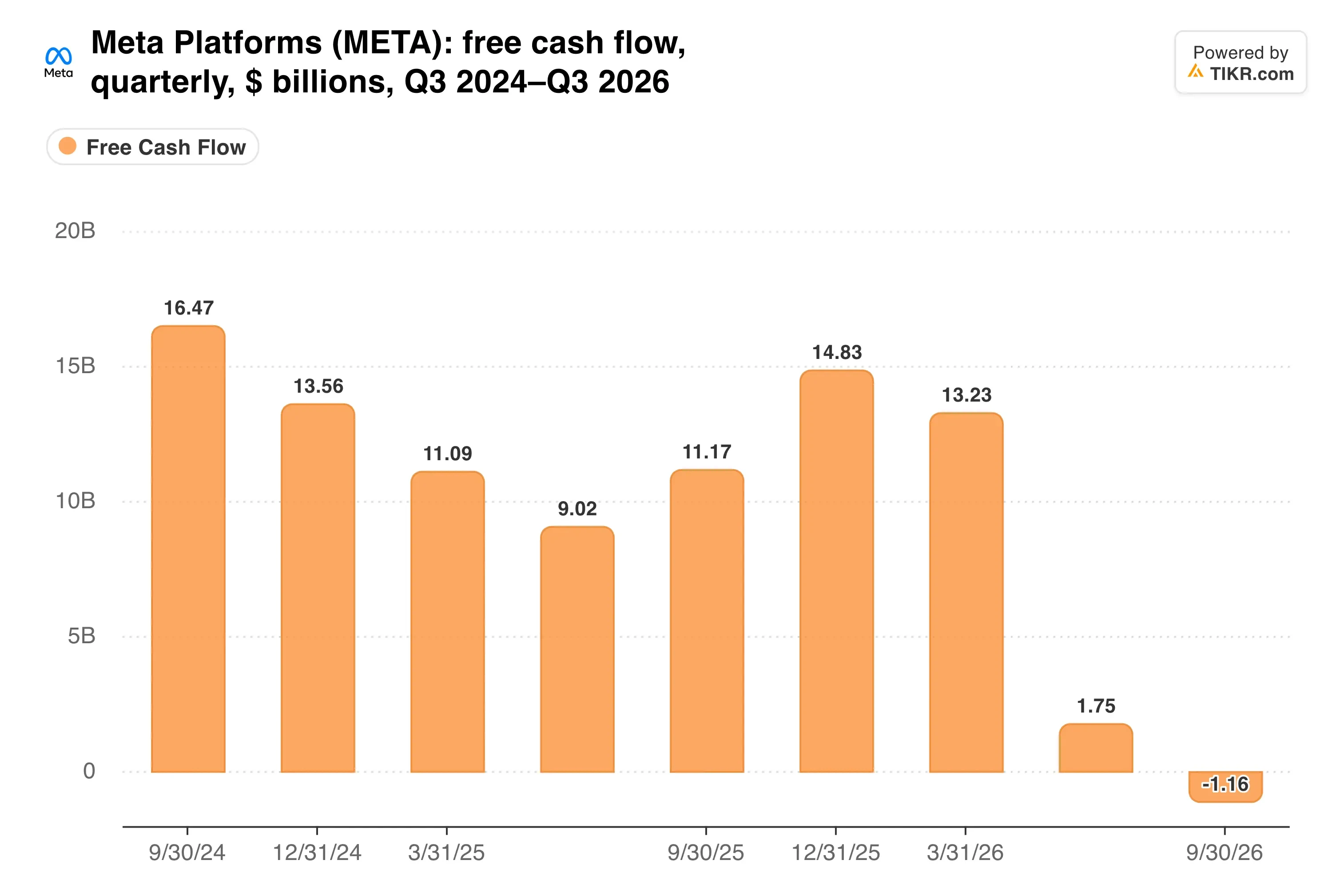
Third-quarter capex of $34.9 billion topped operating cash flow of $32.8 billion. As a result, free cash flow turned negative at $2.1 billion.
The ad engine still pays
Lenders are betting on a very strong core. Third-quarter revenue rose 26% to $64.6 billion, ahead of the $63.34 billion Wall Street expected. Ad impressions grew 10%, and the average price per ad rose 14%.
“Our investments are paying off, the core business is strong, and we’re seeing velocity across the board,” CEO Mark Zuckerberg said with the results.
Guidance backs him up. Meta expects fourth-quarter revenue of $73 billion to $76 billion, and it narrowed 2026 capex guidance to $135 billion to $145 billion by lifting the low end.
How does that spending stack up against Alphabet’s?

Alphabet still outspends Meta, with 2026 capex guidance of $195 billion to $205 billion. However, its cash pile is more than three times Meta’s $82.5 billion, so Meta had less room to self-fund.
TIKR tracks 63 analysts on Meta Platforms. How many say “Buy”?
See the full breakdown of Buy, Hold, and Sell ratings on Meta Platforms, along with Wall Street’s revenue and earnings estimates, all in one place. More than 500,000 investors use TIKR to research stocks like this one. See Meta Platforms’ Analyst Ratings
Dilution raises the bar
New money carries a price. The shortest new dollar note pays 5.85%, while Meta’s shortest note from last November paid 4.2%. At the long end, the coupon reaches 7.5%.
Equity costs more. The 46 million forward shares equal about 1.8% of roughly 2.56 billion common shares, before the preferred converts. Meta also plans to sell up to $60 billion of Class C shares at market prices, which could add far more.
Buybacks spent years pulling the share count lower, but this raise pushes it the other way.
Legal costs add pressure too. Meta booked a $9.89 billion charge tied to a teen mental health settlement with state attorneys general, and that cut third-quarter operating margin to 20% from 40%.
My take: Selling stock near $625 is a sensible way to fund the buildout. Revenue is growing 26%, so the spending has a real engine behind it. Still, costlier debt and steady dilution raise the bar for 2027 returns, and I’d wait for the January plan before adding shares.
The next checkpoint is the fourth-quarter report, expected in late January. It should lay out 2027 capex, while the nonvoting Class C stock takes effect that same month.
So what is Meta stock actually worth?
TIKR lets you forecast the future price of any stock in less than a minute. Just enter a few assumptions into TIKR’s valuation model and see what Meta could be worth. Start from Wall Street consensus estimates, or adjust the inputs to reflect your own view of the business. It’s free to use.
Disclaimer:
Please note that the articles on TIKR are not intended to serve as investment or financial advice from TIKR or our content team, nor are they recommendations to buy or sell any stocks. We create our content based on TIKR Terminal’s investment data and analysts’ estimates. Our analysis might not include recent company news or important updates. TIKR has no position in any stocks mentioned. Thank you for reading, and happy investing!