Key Takeaways
- Intel shares plunged more than 20% in late trading after its fourth-quarter revenue guide of $15 billion to $16 billion missed the $17.07 billion consensus.
- Data Center and AI revenue jumped 78% to $7.3 billion, while the PC group fell 5% as memory shortages hit demand.
- Nvidia CEO Jensen Huang resigned on November 12, adding doubt to the partnership behind Nvidia’s $5 billion investment in Intel.
- Intel’s fourth-quarter report, expected in late January, will show whether Fab 28 has recovered and gross margin lands near 38%.
Intel (INTC) stock plunged more than 20% in late trading after its October 29 report, even though third-quarter revenue rose 21% to $16.5 billion. The outlook did the damage.
Then on November 12, Nvidia (NVDA) CEO Jensen Huang resigned, and Nvidia shares closed down about 4%. That matters to Intel because Nvidia invested $5 billion in the company and is building chips with it. Advanced Micro Devices (AMD), Intel’s main x86 rival, rose about 6% during the session.
So Intel faces two questions. Can it make enough server chips, and will Nvidia’s next leader stay committed?
Guidance came up $1.6 billion short
Intel beat its own targets last quarter, with non-GAAP EPS of $0.52, up from $0.23.
The fourth-quarter guide erased that goodwill:
- Revenue of $15 billion to $16 billion, against a $17.07 billion LSEG consensus
- Non-GAAP EPS of $0.25, against estimates of $0.43
- Gross margin of 38% on a non-GAAP basis, down from 44.1% in the third quarter
Part of the gap came from an accident. An October explosion at Fab 28 in Kiryat Gat, Israel, killed two workers and shut the plant for about two weeks. Intel expects roughly $300 million of lost fourth-quarter revenue and about 200 basis points of margin, with a similar revenue hit in the first quarter.
PCs are the bigger drag, though. Memory shortages have lifted laptop prices, and Intel expects industry PC units to fall about 12% this year and roughly 10% in 2027.
“We see the PC slowdown continuing at least through the first half of next year,” CFO David Zinsner said in the earnings release.
Here’s how differently Intel’s two product groups are moving…
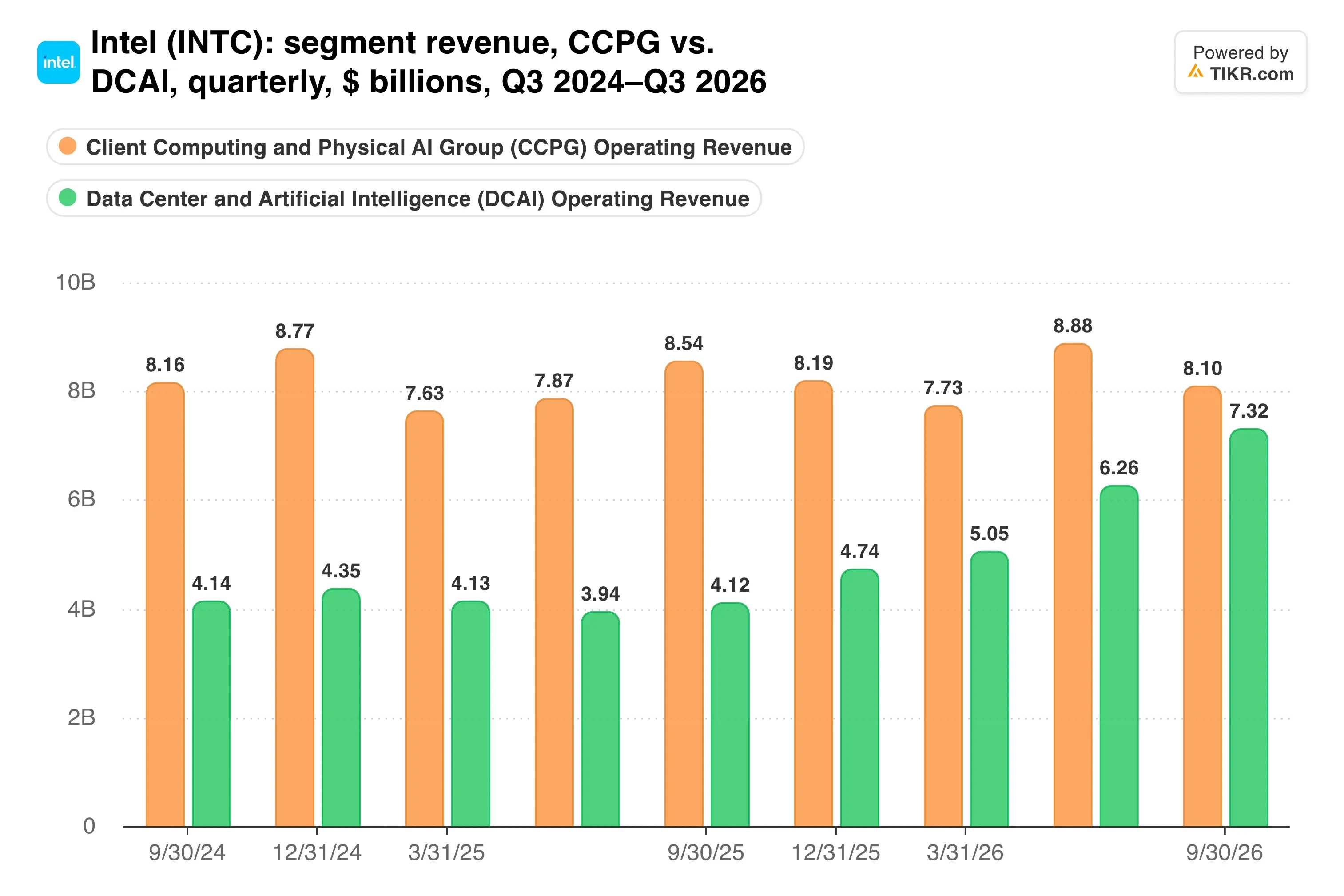
Data Center and AI revenue jumped 78% to $7.3 billion, while the PC group slipped 5% to $8.1 billion and missed estimates.
Servers now carry the turnaround
The data center segment earned $3.0 billion of operating income last quarter, up from $964 million a year earlier, for a margin near 41.5%.
“Our immediate priority is to unlock additional supply to meet extraordinary demand for our Xeon family,” CEO Lip-Bu Tan said in the release. Substrate and memory shortages, plus the Israel shutdown, are capping output.
Nvidia adds a fresh wrinkle. Huang championed the 2025 deal pairing Intel CPUs with Nvidia graphics chips, and CFO Colette Kress is now interim CEO while Nvidia searches for a permanent successor.
So how have the three chipmakers traded through all of this?
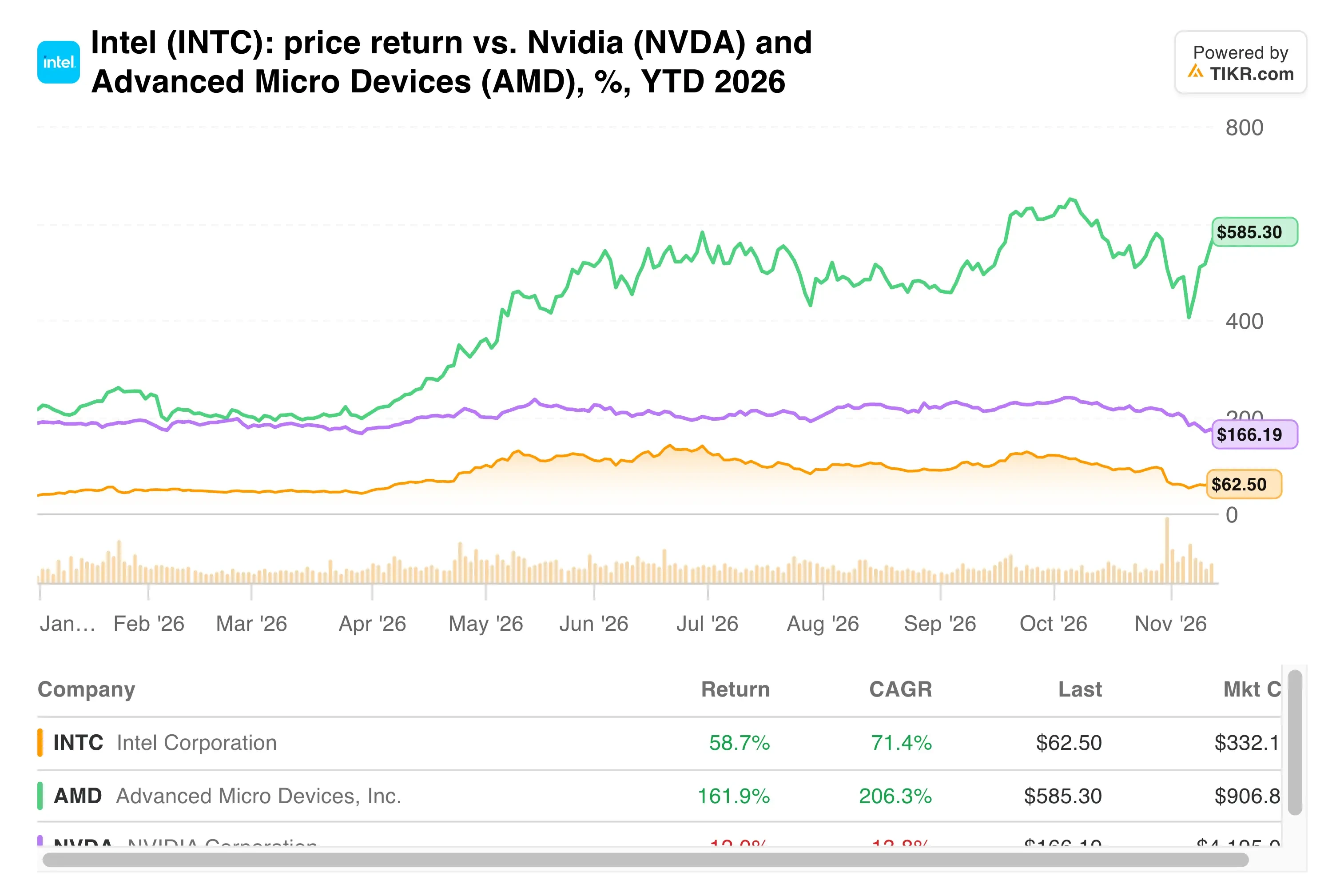
On the day Huang resigned, AMD rose about 6% while Nvidia slid, a sign investors see openings for rivals.
TIKR tracks 50 analysts on Intel. How many say “Buy”?
See the full breakdown of Buy, Hold, and Sell ratings on Intel, along with Wall Street’s revenue and earnings estimates, all in one place. More than 500,000 investors use TIKR to research stocks like this one. See Intel’s Analyst Ratings
The margin reset comes first
Profitability is the harder part. Intel’s guide implies gross margin falling about six points in one quarter, and Fab 28 explains only two of them.
Foundry still weighs on profits. Intel Foundry lost $1.85 billion last quarter, narrower than the $2.32 billion loss a year earlier, while its revenue rose 58% to $6.7 billion.
Put the fourth-quarter guide next to recent quarters, and the reversal is hard to miss.
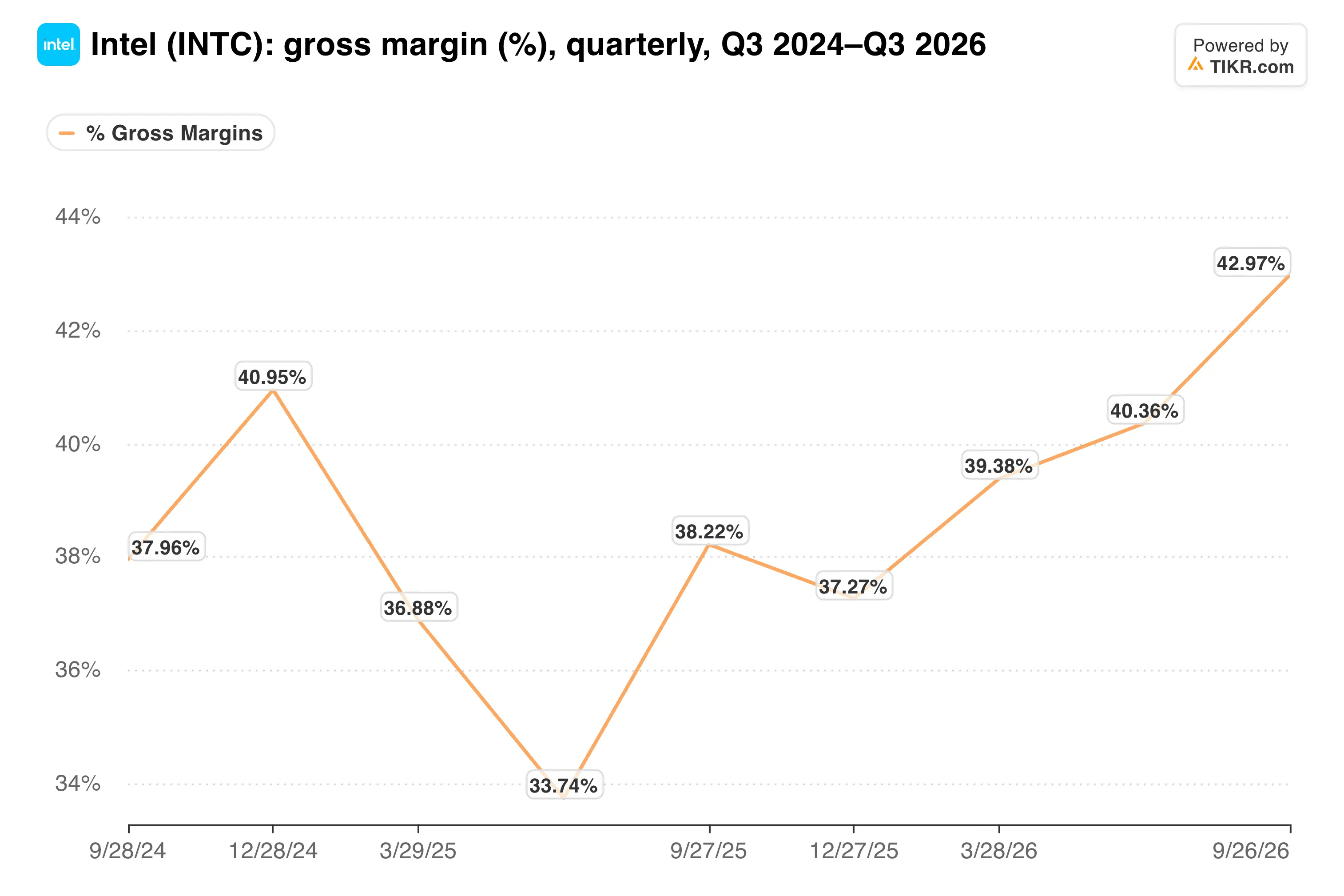
Non-GAAP gross margin hit 44.1% last quarter, up from 40.0% a year earlier, which makes the 38% guide a sharp step back.
My take: The server business is real, and 78% growth at a 41% margin proves it. However, Intel is supply-limited in its best segment and demand-limited in its biggest one, which usually means a few rough quarters. I’d want proof that Xeon output is recovering before buying this dip. The Nvidia question matters less, since Intel keeps the $5 billion either way.
Intel’s fourth-quarter report, expected in late January, will show whether Fab 28 is back at full output and whether gross margin lands near the 38% guide.
So what is Intel stock actually worth?
TIKR lets you forecast the future price of any stock in less than a minute. Just enter a few assumptions into TIKR’s valuation model and see what Intel could be worth. Start from Wall Street consensus estimates, or adjust the inputs to reflect your own view of the business. It’s free to use.
Disclaimer:
Please note that the articles on TIKR are not intended to serve as investment or financial advice from TIKR or our content team, nor are they recommendations to buy or sell any stocks. We create our content based on TIKR Terminal’s investment data and analysts’ estimates. Our analysis might not include recent company news or important updates. TIKR has no position in any stocks mentioned. Thank you for reading, and happy investing!