Key Takeaways
- Hims & Hers reports third-quarter results after the close on Nov. 9. It has guided to $880 million to $900 million of revenue, which would be growth of 47% to 50%.
- The report has to show that growth turning into cash. Cash from operations went negative in the second quarter as receivables from branded weight-loss drugs piled up.
- Eli Lilly and Novo Nordisk both reported strong obesity demand this season, though Lilly’s U.S. prices fell, mostly on Zepbound.
- Capital spending is already down, so the positive free cash flow management expects in the second half has to come from collecting that cash.
Hims & Hers Health (HIMS) rose 1% on Oct. 29, a day the S&P 500 fell 0.3%. It reports third-quarter results after the close on Monday, Nov. 9.
Revenue probably won’t be the hard part. Hims has guided to $880 million to $900 million, growth of 47% to 50%. Novo Nordisk (NVO) raised its full-year outlook on Nov. 4 on higher expectations for its GLP-1 sales. Eli Lilly (LLY) raised its own on Oct. 29.
The question is whether that growth is still turning into cash.
Analysts keep raising the top line
Analysts expect revenue to keep climbing well past 2025’s $2.35 billion.
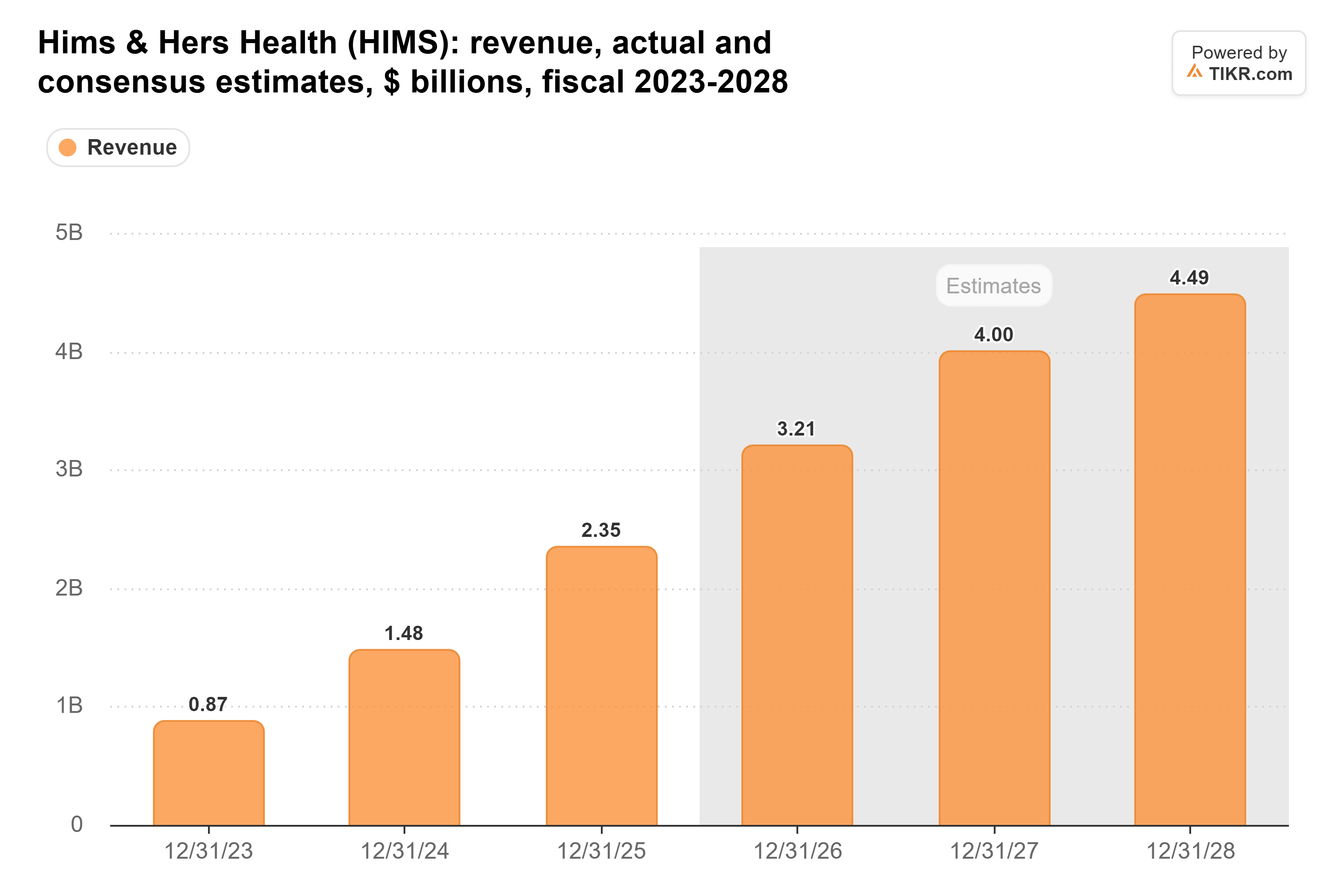
Over the past year, analysts raised their 2026 revenue estimate 15%, to $3.21 billion. They cut their 2026 normalized EPS estimate 80%, to $0.28. Branded drugs brought volume back, but each dollar of them carries far less profit. Gross margin fell to 63.8% in the second quarter from 76.4% a year earlier.
TIKR tracks 16 analysts on Hims & Hers. How many say “Buy”?
See the full breakdown of Buy, Hold, and Sell ratings on Hims & Hers, along with Wall Street’s revenue and earnings estimates, all in one place. More than 500,000 investors use TIKR to research stocks like this one. See Hims & Hers’ Analyst Ratings
The cash went into receivables
Cash from operations turned negative in the second quarter, even as capital spending fell.
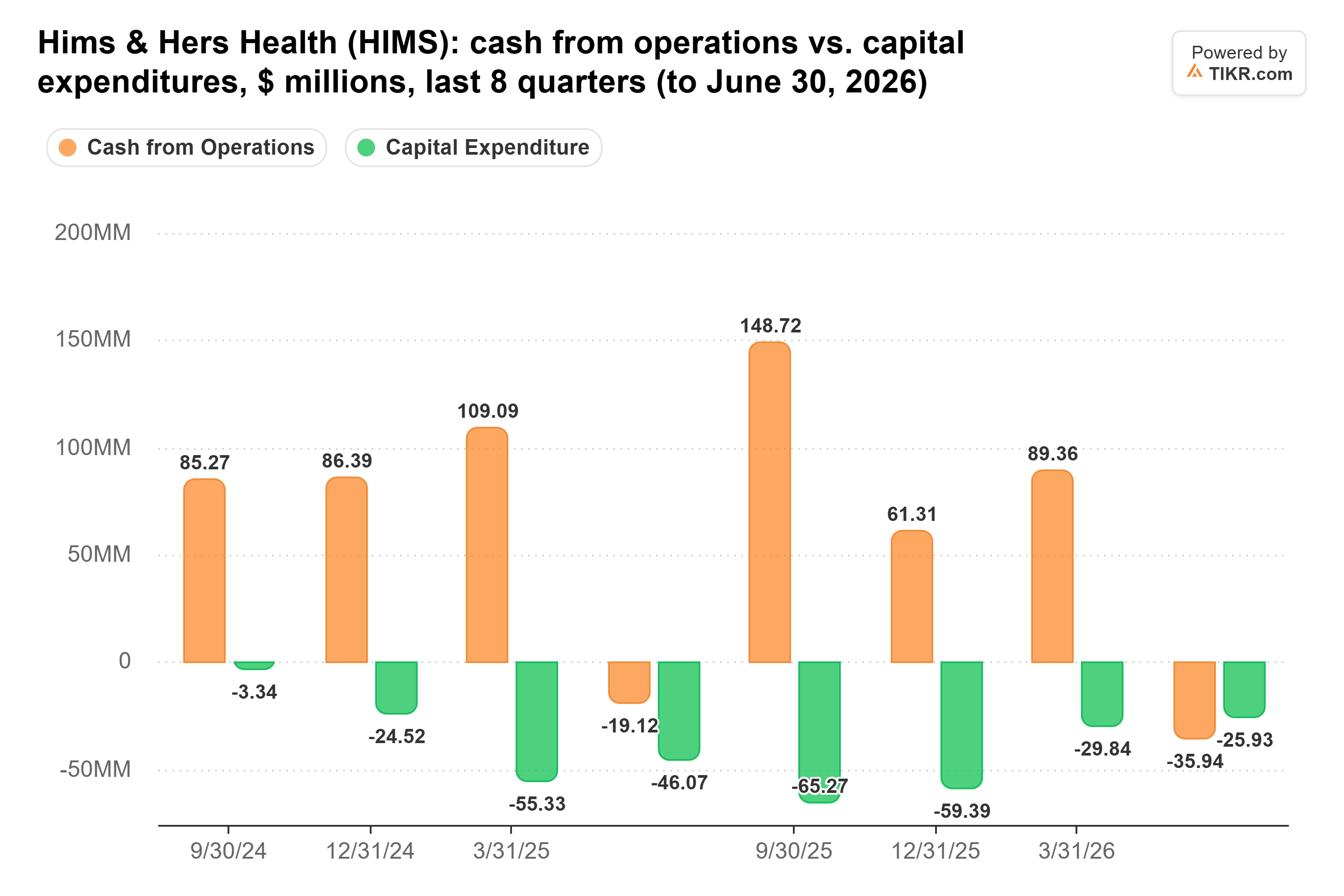
This year the money went into working capital. Receivables jumped to $375.3 million at June 30 from $32.1 million at the end of 2025. Discounts and rebates owed by drugmakers made up $347.4 million of that. In June, Hims set up a $400 million receivables facility with JPMorgan to turn them into cash sooner.
Management expects free cash flow to turn positive in the second half as working capital normalizes. It needs to. First-half free cash flow came in just below zero. So analysts’ $72 million full-year estimate has to come entirely from the second half. And last year’s third quarter brought in $149 million of cash from operations.
Hims’ acquisition bills fall outside that free cash flow figure. It owes $537.4 million of deferred payments within 12 months, mostly for Eucalyptus, the Australian platform it bought in June, and it may settle much of that in stock.
Plus: Hims plans to launch NAD+, sermorelin and glutathione by year-end, a line it makes itself. That gives the plants it built new work as HHS opened a door to compounding six more peptides while it writes a formal rule.
Lilly and Novo see plenty of demand
Novo’s report bears most directly on Hims, since Wegovy is now the center of Hims’ U.S. weight-loss business. Its obesity sales rose 22% at constant exchange rates in the third quarter. The Wegovy pill brought in DKK 5.4 billion, while Wegovy injectable sales slipped 2%.
Did that pill demand reach Hims? It had 2,891,000 subscribers at June 30.
Lilly’s report shows the price side. Its U.S. revenue rose 34% to $15.1 billion, on 41% more volume and 7% lower realized prices. Zepbound drove most of that price decline.
Hims’ management said in February that U.S. injectable GLP-1 prices had fallen more than 80% in 18 months. Cheaper drugs can bring in more subscribers, but they can also lower what each one pays.
On Nov. 6, Lilly agreed to let Hims sell Zepbound and Foundayo directly on its platform. Prices start at $299 a month for Zepbound and $149 for Foundayo. Hims took in $92 a month per average subscriber in the second quarter. At Lilly, volume is still outrunning price. Is it at HIMS?
Cash first, then guidance
Hims trades at about 20x forward earnings, well below its three-year average of about 35x on TIKR’s figures. The market already doubts the profit side.
Here’s where I land: the bar is cash. Cash from operations needs to be back above zero, with receivables growing slower than revenue. If adjusted EBITDA also lands inside the $75 million to $95 million guide, that’s enough to hold this multiple. Another negative cash quarter would make the discount look earned.
Guidance will still move the stock more than any cash line. Hims has cut its full-year adjusted EBITDA guide twice this year while raising revenue. The latest cut, in August, took it to $275 million to $325 million. A third cut would outweigh a good cash quarter.
So what is Hims & Hers stock actually worth?
TIKR lets you forecast the future price of any stock in less than a minute. Just enter a few assumptions into TIKR’s valuation model and see what Hims & Hers could be worth. Start from Wall Street consensus estimates, or adjust the inputs to reflect your own view of the business. It’s free to use.
Disclaimer:
Please note that the articles on TIKR are not intended to serve as investment or financial advice from TIKR or our content team, nor are they recommendations to buy or sell any stocks. We create our content based on TIKR Terminal’s investment data and analysts’ estimates. Our analysis might not include recent company news or important updates. TIKR has no position in any of the stocks mentioned. Thank you for reading, and happy investing!