
Key Takeaways
- Moderna (MRNA) stock gained approximately 8% over five trading sessions through November 5, closing at $241 as investors reassessed its personalized cancer vaccine.
- Merck (MRK) and Moderna reported that intismeran combined with Keytruda reduced the risk of melanoma recurrence or death by 42%, with a 58% reduction after six months in a prespecified sensitivity analysis.
- Moderna reported $1.31 billion in third-quarter revenue on November 6 and raised its 2026 revenue-growth outlook to 15%-25%, although its premium valuation remains a concern.
What Happened?
Moderna (MRNA) stock gained approximately 8% across five trading sessions ending November 5, rising from $223 to $241 as investors reconsidered the potential of its personalized cancer vaccine developed with Merck (MRK).
The rebound followed an October selloff triggered by Phase 3 melanoma results that initially disappointed investors despite demonstrating a meaningful clinical benefit. No new trial results were released during the rebound.
Moderna subsequently reported third-quarter earnings on November 6, with revenue increasing 29% year over year to $1.31 billion, supported by stronger international COVID-19 vaccine demand.
The company generated $162 million in net income, reversing a $200 million loss a year earlier, and raised its full-year revenue-growth outlook to 15%-25% from its previous expectation of up to 10%.
Although these results arrived after the five-session rally, they provided additional evidence of improving commercial performance.
Meanwhile, Moderna’s personalized cancer vaccine, intismeran, remains a potentially transformative long-term opportunity.
According to the companies’ Phase 3 INTerpath-001 results, intismeran combined with Keytruda reduced the risk of melanoma recurrence or death by 42% compared with Keytruda alone.
That result was below the 49% reduction observed after five years in the earlier Phase 2 trial, contributing to investors’ initial disappointment.
However, the Phase 3 findings revealed an important distinction.
During the first six months, both treatment groups showed similar outcomes, with a hazard ratio of 0.99. After six months, a prespecified sensitivity analysis showed a 58% reduction in recurrence or death risk.
As discussed in TIKR’s earlier Moderna analysis, Chief Development Officer David Berman argued that the benefit could strengthen with longer follow-up, pointing to improvement observed during Phase 2.
CEO Stéphane Bancel also believes the technology could eventually treat additional cancer types.
“We believe that it’s going to work in more cancers than melanoma because of a mechanism of action,” Bancel told Bloomberg Talks on October 26.
The companies are evaluating the personalized vaccine approach in kidney, bladder, and lung cancers, potentially expanding the opportunity beyond melanoma.
Merck also has considerable financial incentives to support the program. Its third-quarter results showed that Keytruda and Keytruda Qlex generated $8.6 billion in combined sales.
The partners share intismeran’s development costs and profits equally and are preparing regulatory submissions, with a potential 2027 launch dependent on approval.
Is Moderna Stock Undervalued or Overvalued?
Moderna’s improving financial performance and expanding cancer vaccine pipeline strengthen its long-term outlook, but its elevated valuation suggests investors already expect substantial commercial success.
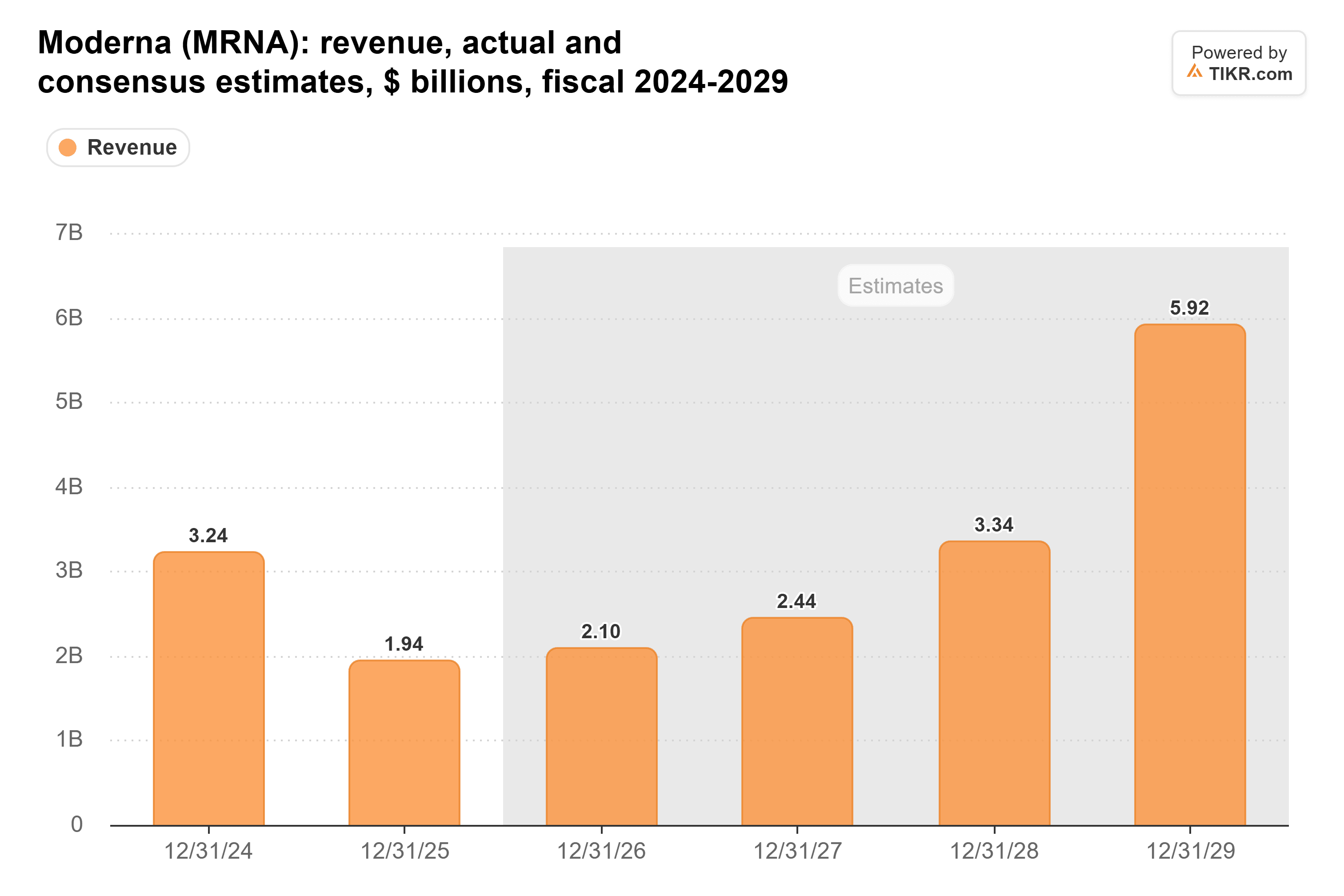
TIKR’s November 2 consensus estimates projected revenue reaching $3.34 billion in 2028, still roughly half the $6.85 billion generated in 2023, highlighting the importance of new commercial products.
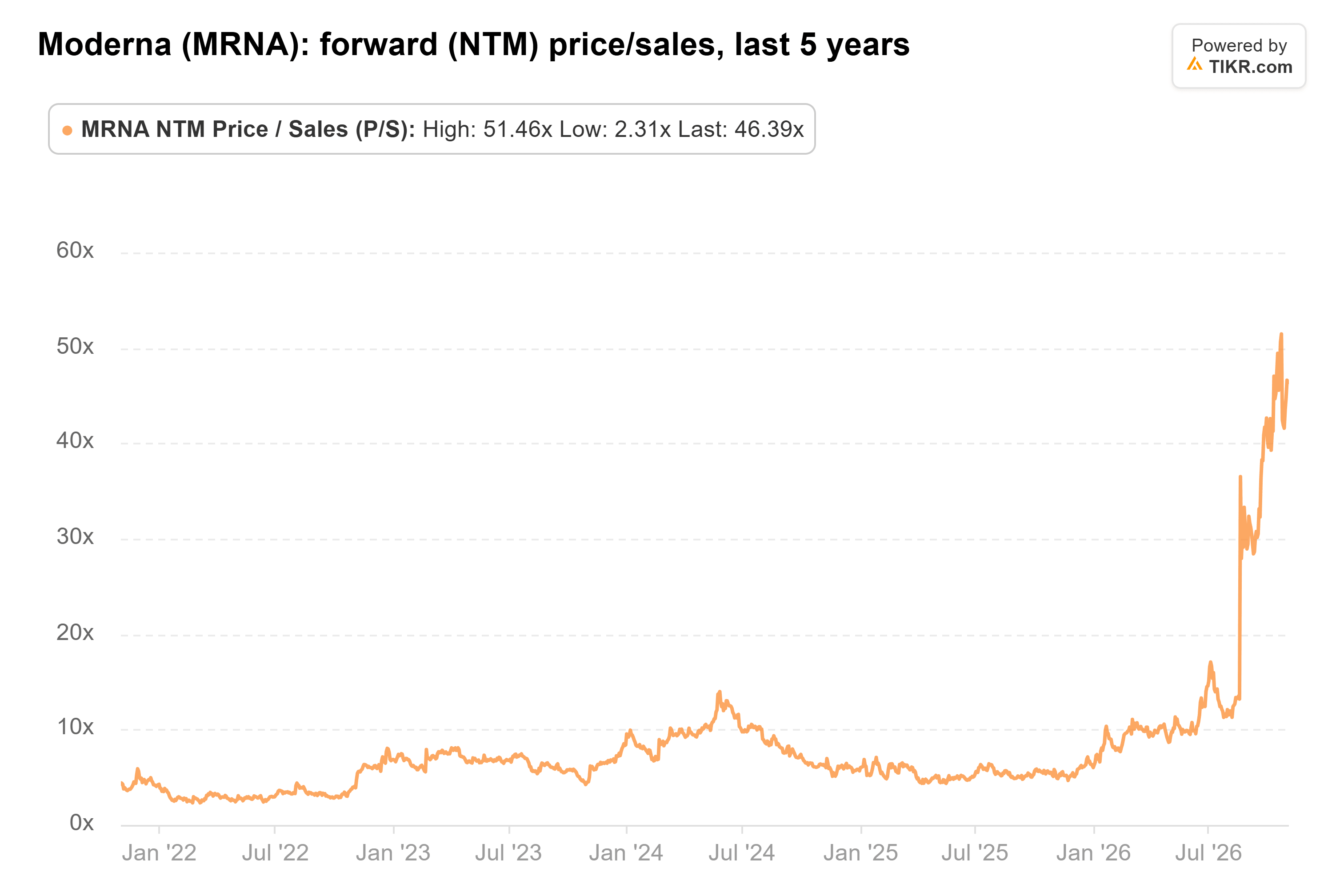
As of November 2, Moderna traded at approximately 46x forward sales, substantially above its five-year average of 7.9x, indicating that investors were assigning significant value to the experimental oncology pipeline.
Over the next 12 months, stronger vaccine revenue, potential regulatory progress for intismeran, and additional cancer trial developments could support Moderna’s growth prospects.
However, uncertainty surrounding overall-survival data, commercial execution, regulatory approval, and the company’s premium valuation creates downside risk if future results disappoint.
Moderna appears overvalued relative to its historical sales multiple, although successful cancer vaccine commercialization across multiple tumor types could eventually justify a higher valuation.
The key question is whether Moderna can translate promising clinical results into sustainable revenue growth and deliver the commercial success already reflected in its share price.
So what is Moderna stock actually worth?
TIKR lets you forecast the future price of any stock in less than a minute. Just enter a few assumptions into TIKR’s valuation model and see what Moderna could be worth. Start from Wall Street consensus estimates, or adjust the inputs to reflect your own view of the business. It’s free to use.
Disclaimer:
Please note that the articles on TIKR are not intended to serve as investment or financial advice from TIKR or our content team, nor are they recommendations to buy or sell any stocks. We create our content based on TIKR Terminal’s investment data and analysts’ estimates. Our analysis might not include recent company news or important updates. TIKR has no position in any of the stocks mentioned. Thank you for reading, and happy investing!