Key Takeaways
- Sen. Elizabeth Warren attacked UnitedHealth’s Amedisys deal on Nov. 1, two days before Democrats won Congress.
- Her Break Up Big Medicine Act would require UnitedHealth to separate its care providers, home health included, from its insurer and PBM within a year.
- Analysts expect normalized EPS to recover from $16.35 in 2025 to $23.29 in 2027, largely on Optum’s care business.
- A breakup looks unlikely under Trump’s veto, but the pressure caps the multiple, so returns depend on earnings.
Democrats won both chambers of Congress on Nov. 3, and healthcare sits near the top of their agenda. That’s awkward timing for UnitedHealth Group (UNH).
Two days earlier, Sen. Elizabeth Warren (D-Mass.) went after its $3.3 billion Amedisys purchase on X:
“UnitedHealth already sells your insurance, employs your doctor, and manages your prescriptions. Now Trump’s DOJ let them buy home health and hospice giant Amedisys for $3.3 BILLION – giving them MORE power to raise costs and deny care. We need to break up Big Medicine.”
Her party just won Congress.
Amedisys Isn’t Going Anywhere
The deal is done. The Justice Department sued to block it in November 2024, then settled in August 2025 once the companies agreed to sell 164 home health and hospice locations worth about $528 million a year in revenue. UnitedHealth closed the purchase on Aug. 14, 2025.
Warren’s route is legislation, which means getting past a Senate filibuster and a possible Trump veto. J.P. Morgan analysts expect that veto to bring gridlock, not sweeping reform, Reuters reported.
Warren Has a Bill for That
Her bigger weapon is the Break Up Big Medicine Act, introduced Feb. 10 with Sen. Josh Hawley (R-Mo.). It would bar one company from owning both an insurer or pharmacy benefit manager and a provider, with one year to divest one side. Its definition of a provider names home-health providers, which puts Amedisys in scope.
That would split Optum’s care business from UnitedHealthcare, and the two are intertwined: UnitedHealth’s segments booked $168.0 billion of revenue from each other in 2025, equal to 62.1% of Optum’s $270.6 billion.
Hawley’s name matters. A breakup needs Republican votes, and the bill hasn’t moved since February.
TIKR Tracks 26 Analysts on UnitedHealth. How Many Say “Buy”?
See the full breakdown of Buy, Hold, and Sell ratings on UnitedHealth, along with Wall Street’s revenue and earnings estimates, all in one place. More than 500,000 investors use TIKR to research stocks like this one. See UnitedHealth’s Analyst Ratings
Optum Has the Most Ground to Make Up
Analysts expect normalized EPS to climb from $16.35 in 2025 to $23.29 in 2027, still short of 2024’s $27.66.
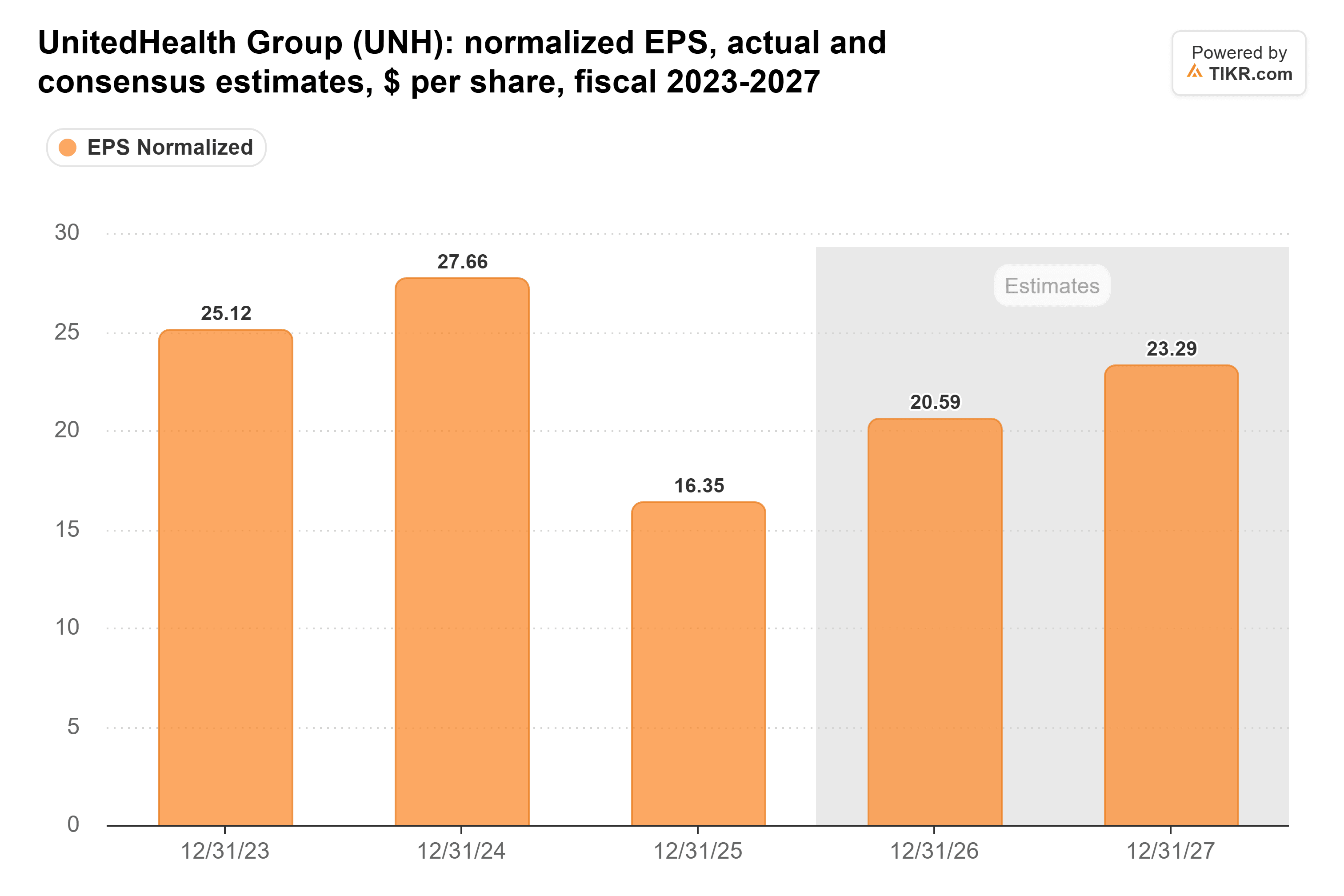
Most of that rests on margins. UnitedHealth’s EBIT margin held between 8.3% and 8.8% from 2021 through 2023, slipped to 8.1% in 2024, then dropped to 4.8% in 2025.

Optum Health earned $7.8 billion from operations in 2024 and lost $278 million in 2025. Its adjusted margin was 2.6% in the third quarter, against a 6% to 8% target for 2028. That’s the business Warren’s bill would wall off from the insurer.
Don’t Count on a Re-Rating
The election rally was a Medicaid trade. Centene closed up 12.6% on Nov. 4 and hospital operators gained 9% to 16%, while UnitedHealth rose just 1.2%. The bet was that Democrats could delay Medicaid cuts, which does nothing for UnitedHealth’s antitrust problem.
On Oct. 23, Raymond James cut its target to $450 from $475, blaming a multiple squeezed by midterm worries and possible Medicare Advantage rule changes.
After an 11% run in a month, UnitedHealth traded at 18x forward earnings on Nov. 2, just under its five-year average of 19x, well under April 2022’s 25x and well above May 2025’s 11x low.
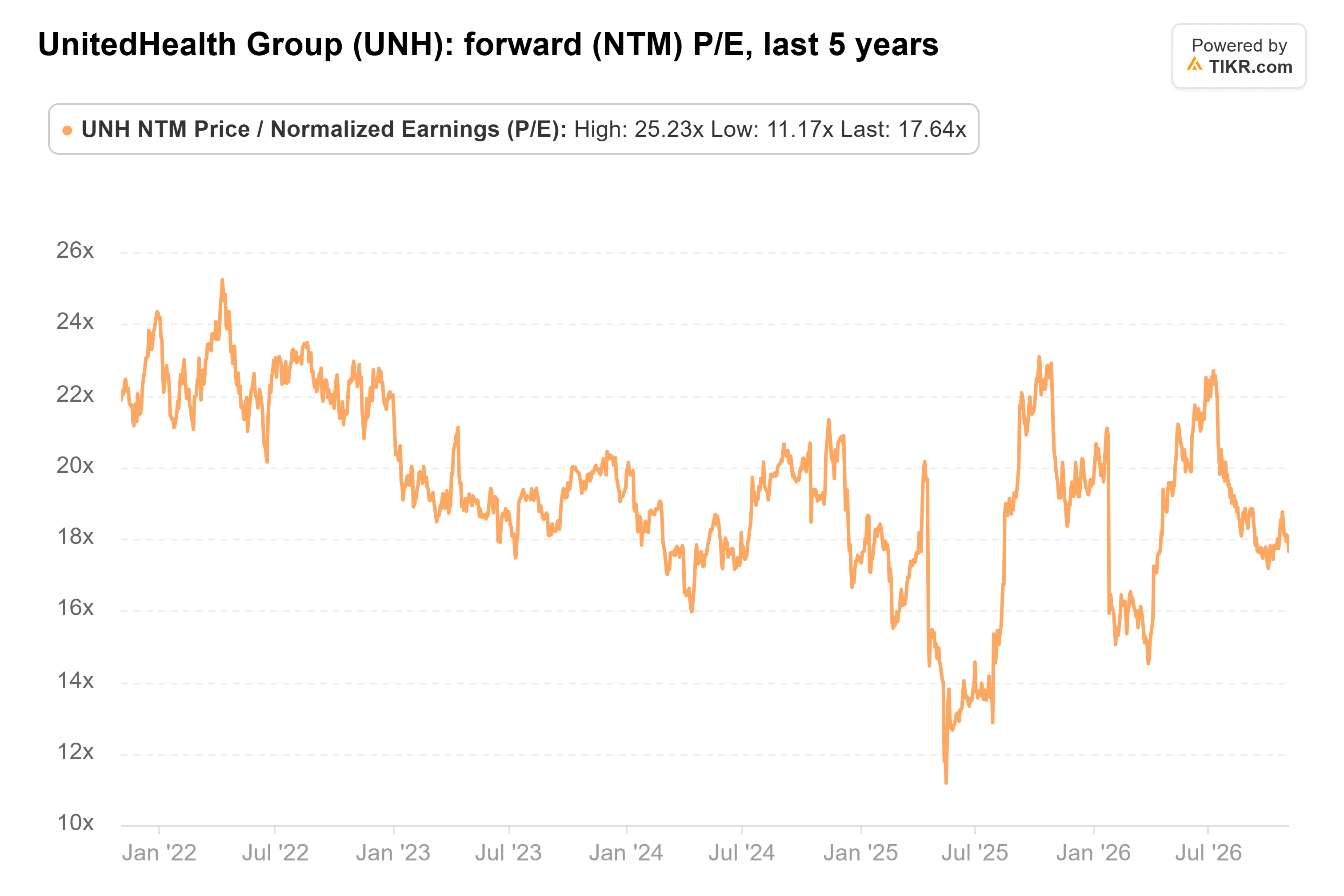
UnitedHealth Needs Earnings Growth
I don’t see a breakup becoming law while Trump holds the veto. But hearings and posts like Warren’s will keep UnitedHealth’s structure in the headlines once the new Congress sits in January, and that makes a return to 25x hard to picture.
Gains have to come from earnings. Deliver the $23.29 analysts expect for 2027, and the stock can climb at today’s multiple. The first test is the 2027 outlook management promised before year-end. A guide below consensus would hurt more than anything Warren posts.
So What Is UnitedHealth Stock Actually Worth?
TIKR lets you forecast the future price of any stock in less than a minute. Just enter a few assumptions into TIKR’s valuation model and see what UnitedHealth could be worth. Start from Wall Street consensus estimates, or adjust the inputs to reflect your own view of the business. It’s free to use.
Disclaimer:
Please note that the articles on TIKR are not intended to serve as investment or financial advice from TIKR or our content team, nor are they recommendations to buy or sell any stocks. We create our content based on TIKR Terminal’s investment data and analysts’ estimates. Our analysis might not include recent company news or important updates. TIKR has no position in any of the stocks mentioned. Thank you for reading, and happy investing!