Key Takeaways
- Hank Paulson says too much money is chasing AI, and 52% of fund managers in Bank of America’s November survey expect an AI hyperscaler to announce a capex cut within six months.
- Microsoft’s free cash flow has fallen two years running, while Amazon’s 12-month and Alphabet’s quarterly figures have turned negative.
- A capex cut would save the cutting hyperscaler cash and could hurt Arista Networks if it reaches networking orders.
Hank Paulson ran the Treasury through the 2008 crisis, so when he calls a boom dangerous, I listen.
On Nov. 17, he told Semafor’s Silicon Valley & The World: “I’ve never seen so much money chasing one opportunity with not a lot of earnings and ROI backing it up.”
Microsoft (MSFT), Amazon (AMZN), Alphabet (GOOG) and Meta Platforms (META) are among the biggest spenders. Meta’s capex outran its operating cash in the third quarter, its first negative free cash flow quarter since 2012.
In Bank of America’s November fund manager survey, 52% expect an AI hyperscaler to announce a capex cut within six months. That could hit suppliers like Arista Networks (ANET), which has named Microsoft and Meta as its two largest customers (42% of 2025 revenue).
Follow the Cash at Microsoft, Amazon and Alphabet
With revenue climbing, free cash flow is the better test of whether AI pays off.
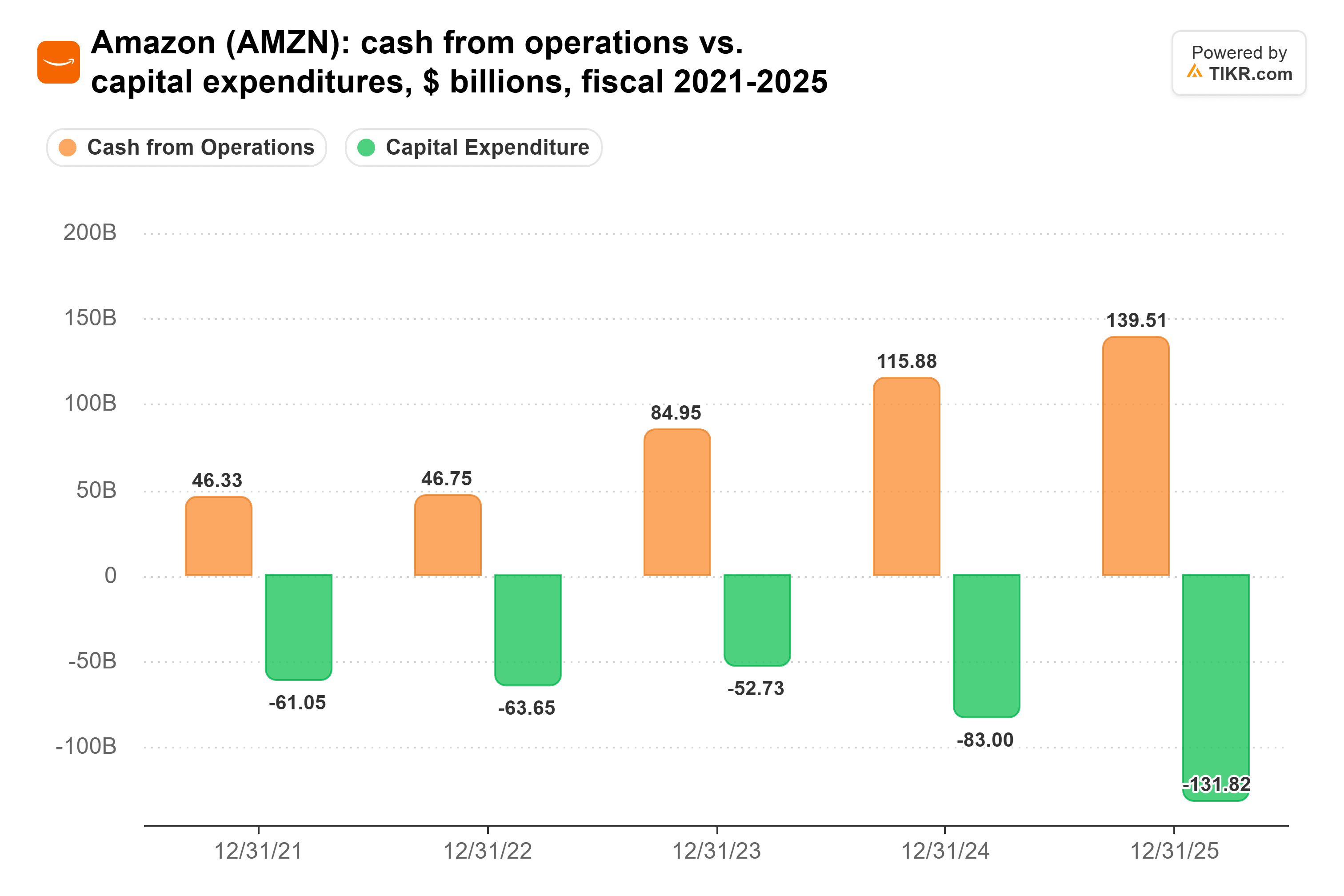
Amazon spent $131.8 billion on capex in 2025, or 94% of its $139.5 billion of operating cash flow. Its own free cash flow measure shows a $42.4 billion outflow in the 12 months to Sept. 30.
Microsoft’s free cash flow has fallen two years running, even as revenue grew 18% in fiscal 2026, to $331.8 billion.
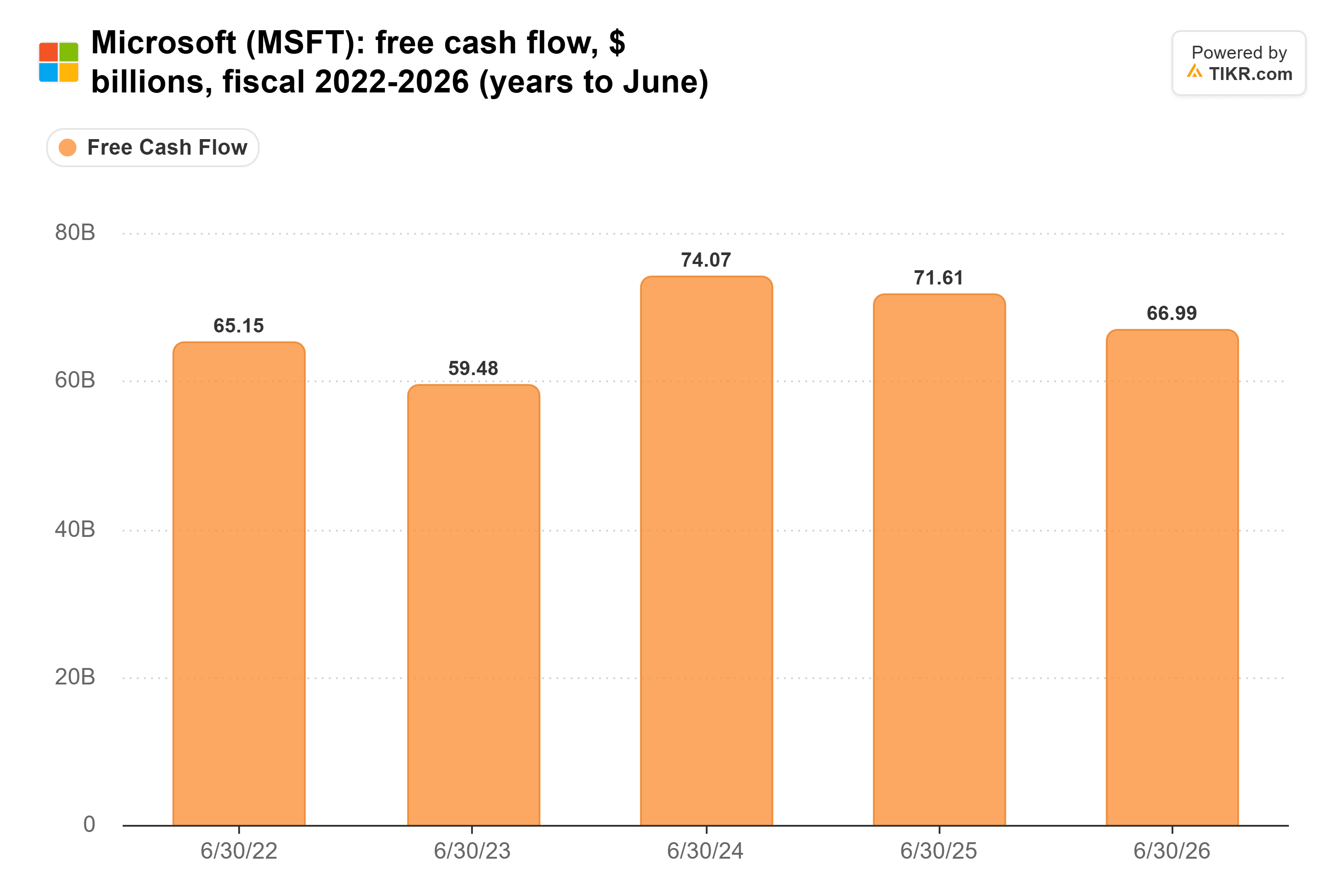
Operating cash flow rose $46.8 billion that year and cash capex rose $51.4 billion, so the whole gain went into the build-out. Analysts expect fiscal 2027’s free cash flow to fall by about half, to $32.7 billion.
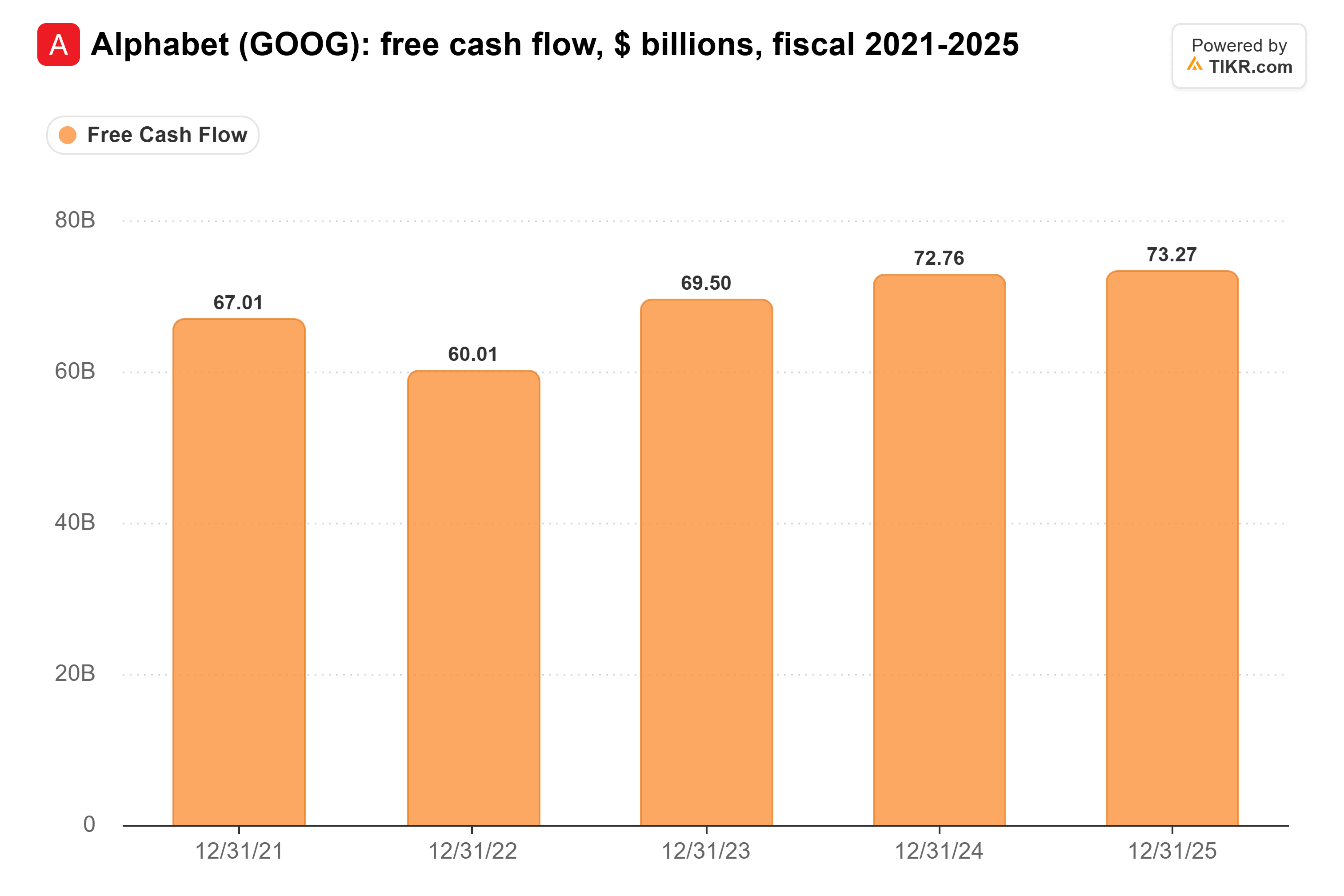
Alphabet’s free cash flow held up in 2025, rising $0.5 billion to $73.3 billion as capex jumped to $91.4 billion from $52.5 billion. Then it turned negative: outflows widened from $5.9 billion in the June quarter to $9.1 billion in September.
Demand Isn’t the Issue
Microsoft’s commercial remaining performance obligation reached $678 billion at June 30, up 84%, and CFO Amy Hood said it grew 25% excluding OpenAI.
But a backlog turns into cash over years, and the bills come due now.
TIKR Tracks 58 Analysts on Microsoft. How Many Say “Buy”?
See the full breakdown of Buy, Hold, and Sell ratings on Microsoft, along with Wall Street’s revenue and earnings estimates, all in one place. More than 500,000 investors use TIKR to research stocks like this one. See Microsoft’s Analyst Ratings
A Capex Cut Could Be the Bull Case for Amazon Stock
After outspending its operating cash in 2021 and 2022, Amazon cut capex to $52.7 billion in 2023 and kept $32.2 billion after capex as operating cash flow rose 82%.
If a hyperscaler announces the cut fund managers expect, I’d read it as good news for its shareholders. That goes double for Meta, where ads remain the main way to earn back its AI spending.
Suppliers could take the hit. Arista grew third-quarter revenue 58.5% to $3.66 billion and guided to $3.9 billion to $4.0 billion for the fourth. With 42% of 2025 sales from those two, a cut to either’s networking orders could weigh on revenue.
The Cash Test for Microsoft, Amazon and Alphabet
Until free cash flow grows again, these three are asking shareholders to take the AI payoff on faith. I wouldn’t pay up for any of them until the cash or the capex moves.
Microsoft’s backlog could turn into cash faster than analysts expect. Its December-quarter report is the first test: free cash flow well above the $5.9 billion from a year earlier would start to answer Paulson.
So What Is Microsoft Stock Actually Worth?
TIKR lets you forecast the future price of any stock in less than a minute. Just enter a few assumptions into TIKR’s valuation model and see what Microsoft could be worth. Start from Wall Street consensus estimates, or adjust the inputs to reflect your own view of the business. It’s free to use.
Disclaimer:
Please note that the articles on TIKR are not intended to serve as investment or financial advice from TIKR or our content team, nor are they recommendations to buy or sell any stocks. We create our content based on TIKR Terminal’s investment data and analysts’ estimates. Our analysis might not include recent company news or important updates. TIKR has no position in any of the stocks mentioned. Thank you for reading, and happy investing!