
Key Takeaways
- Elon Musk said on Nov. 19 that Starlink “started with a speech in Seattle,” replying to a post that put it at 13.6 million users.
- Starlink earned $2.37 billion of SpaceX’s $2.79 billion of third-quarter operating income, though average revenue per user fell to $69 from $83 a year earlier.
- Starlink’s push into airline cabins and phones raises the stakes for Viasat and AST SpaceMobile.
- SpaceX’s value rests mostly on compute, so Starlink is a cushion if its compute renters pull back.
SpaceX (SPCX) is mostly a compute story these days. But on Nov. 19, Elon Musk took a moment to remember where its satellite business began.
An X account posted that Musk opened SpaceX’s satellite office in Seattle in 2015, and that Starlink now has 13.6 million users and is on over 3,800 planes.
Musk’s reply? “Starlink started with a speech in Seattle.”
Not bad for one speech. Lufthansa Group plans to have Starlink on its entire fleet of around 850 aircraft by 2029, which puts Viasat (VSAT), an airline Wi-Fi incumbent that Lufthansa has also worked with, on notice. And Starlink Mobile just launched in Mongolia with Mobicom, a move into the phone service AST SpaceMobile (ASTS) is built to sell.
Starlink earns the profit
The 13.6 million figure matches the consumer subscriber count in SpaceX’s third-quarter release, up 89% from 7.2 million a year earlier. Management said on the third-quarter call that about 12,000 planes are under contract.
Starlink also earns most of SpaceX’s profit: its Connectivity segment earned $2.37 billion of the company’s $2.79 billion of GAAP operating income in the third quarter. Over the first nine months of 2026, it earned $5.21 billion at a 40.7% margin.
There’s one catch: each new customer pays less. Consumer revenue rose 57% in the third quarter, well behind the jump in subscribers, as average revenue per user fell to $69 from $83 a year earlier. The figure did tick up from $66 in the second quarter, but management has said expanding into new countries may push it down over time.
TIKR tracks 40 analysts on SpaceX. How many say “Buy”?
See the full breakdown of Buy, Hold, and Sell ratings on SpaceX, along with Wall Street’s revenue and earnings estimates, all in one place. More than 500,000 investors use TIKR to research stocks like this one. See SpaceX’s Analyst Ratings
Airlines and phones are the next fight
Starlink’s 12,000-plane backlog matters most to Viasat. In its Nov. 5 report, Viasat’s quarterly sales rose 3.4% to $1.18 billion and fell short of analysts’ estimates. Its next report, expected in early February, needs to show that its commercial aviation backlog is still growing as airlines move to Starlink.
Phones are a newer fight. Starlink says that in Mongolia, “phones in areas without cell signal will automatically connect to our satellites.”
AST SpaceMobile is building broadband service for ordinary phones. In its third-quarter release on Nov. 9, it said it expects initial, intermittent nationwide service in the US and other key markets by the end of 2026. Its next report, expected in early March, should show whether its carrier deals are turning into paid service before Starlink wins those carriers over.
Starlink is SpaceX’s safety net
The stock isn’t priced on any of that, though. On the Nov. 19 episode of 20VC, Scale Venture Partners general partner Rory O’Driscoll said that “most of the business and most of the market cap and most of the TAM, according to their own S1, is all about compute.” He wouldn’t buy SpaceX at this price, and said owning it is really a bet on what Anthropic will be paying SpaceX for compute a year from now.
Analyst estimates show how much of that bet is still ahead:
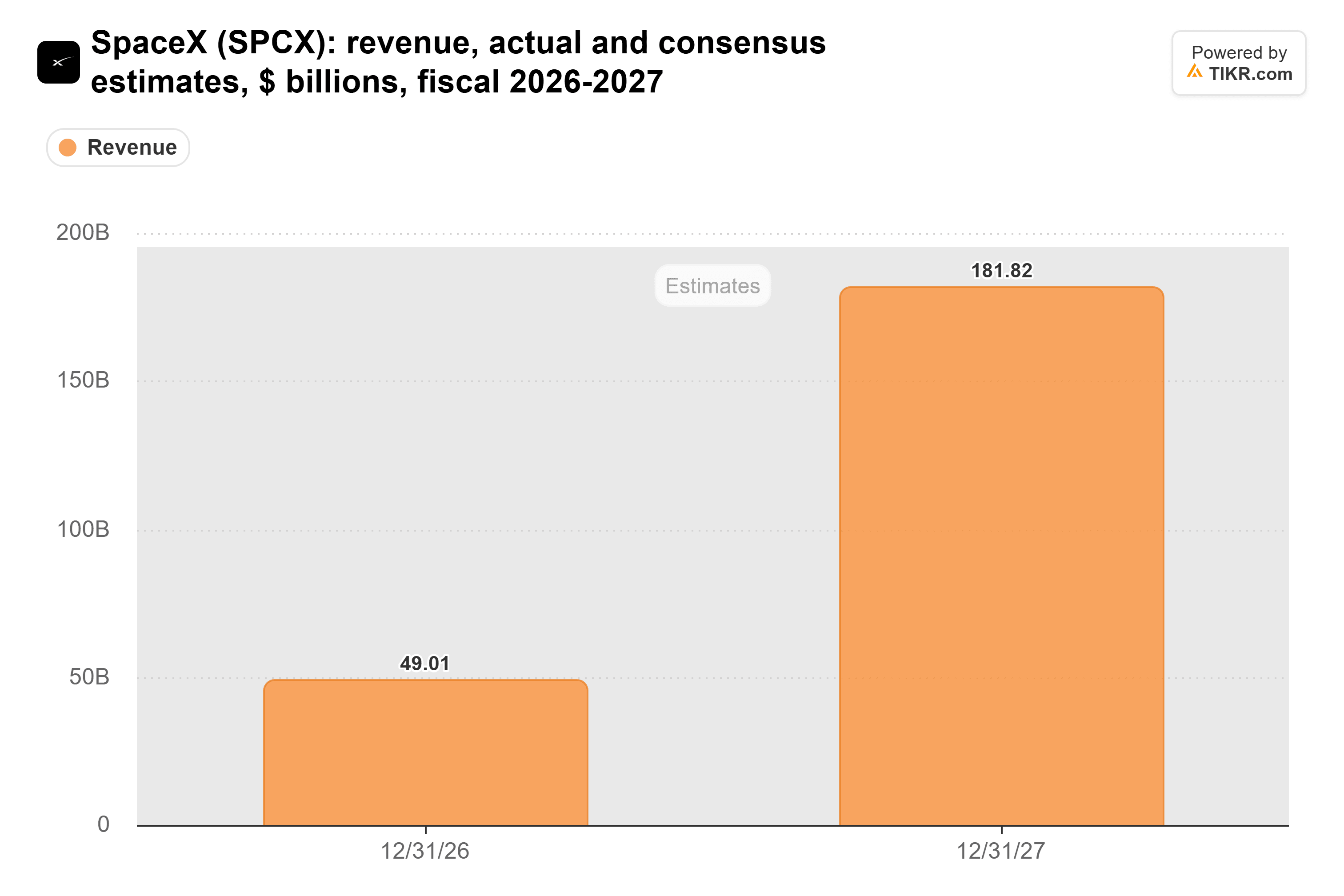
Wall Street expects revenue to climb from $49.0 billion this year to $182 billion in 2027. Compute, already 51.9% of third-quarter revenue, is the main engine: management has said cloud services will be the largest contributor to its target of a $100 billion annual revenue run rate by December. A single compute customer supplied 34.5% of SpaceX’s third-quarter revenue, and Bloomberg has identified it as Anthropic. Company filings show either side can end those compute deals on 90 days’ notice once their initial terms run out in early 2027.
And Starlink can’t pay for the compute build on its own. Cash from operations covered capex in 2023, then fell far behind as capex climbed:
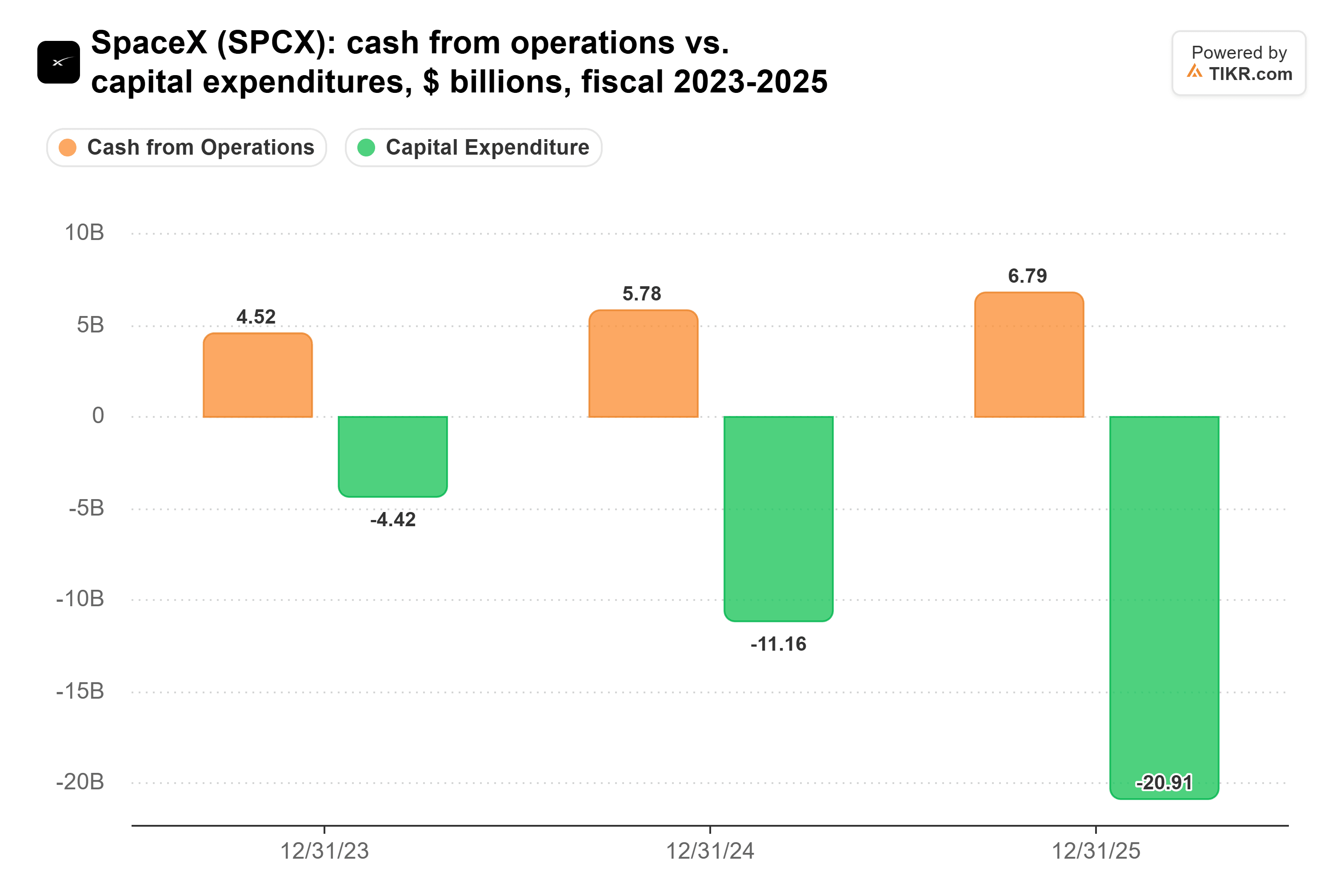
In the first nine months of 2026, capex hit $48.1 billion against $13.1 billion of operating cash flow, and management expects another $35 billion to $40 billion in the fourth quarter. Starlink’s $5.21 billion of operating income over those nine months would cover about 11% of that spending.
That’s why the 13.6 million users still matter: Starlink doesn’t depend on any one AI lab, so if compute renters pull back, it’s the business left holding up SpaceX’s cash flow and its credit.
The next check is SpaceX’s fourth-quarter report in early 2027: whether consumer revenue growth narrows its gap with subscriber growth, and whether Connectivity’s margin stays near 40.7%. If they don’t, SpaceX shareholders are counting even more on Anthropic renewing.
So what is SpaceX stock actually worth?
TIKR lets you forecast the future price of any stock in less than a minute. Just enter a few assumptions into TIKR’s valuation model and see what SpaceX could be worth. Start from Wall Street consensus estimates, or adjust the inputs to reflect your own view of the business. It’s free to use.
Disclaimer:
Please note that the articles on TIKR are not intended to serve as investment or financial advice from TIKR or our content team, nor are they recommendations to buy or sell any stocks. We create our content based on TIKR Terminal’s investment data and analysts’ estimates. Our analysis might not include recent company news or important updates. TIKR has no position in any of the stocks mentioned. Thank you for reading, and happy investing!