Key Takeaways
- GE Vernova stock is 35% below its high, even though the company raised its year-end gas turbine goal to at least 130 gigawatts from at least 125.
- Analysts kept raising earnings estimates through the selloff, so the market is pricing in a peak in turbine demand that the contracts don’t show yet.
- The main risk is cash: customer deposits drive much of this year’s free cash flow, which analysts expect to roughly halve in 2027.
- Vertiv and Howmet Aerospace both reported fast-growing demand, and GE Vernova’s late-January report will show whether contracts reach 130 gigawatts.
GE Vernova (GEV) stock is 35% below its high and down 16% in the past month alone, but the gas turbine contracts behind its earnings kept climbing the whole way down.
The backlash against data centers has hit the whole AI power trade, dragging Vertiv (VRT) down with GE Vernova. Suppliers like Howmet Aerospace (HWM), whose gas turbine revenue grew 45% last quarter, face the same question: has turbine demand peaked, or only the stocks?
The contract count kept climbing
GE Vernova’s third-quarter release on Oct. 28 gave the clearest answer so far:
- Gas Power equipment backlog and slot reservations reached 122 gigawatts, up from 116 at the end of June.
- 13 gigawatts of slot reservations turned into firm orders.
- The year-end goal went up to at least 130 gigawatts, from at least 125.
- Total orders came to $29.3 billion, up 96% organically, and backlog rose $20 billion in three months to $197 billion.
For scale, 130 gigawatts is more than five years of output at the 24 gigawatts a year management plans to build in 2028.
TIKR tracks 37 analysts on GE Vernova. How many say “Buy”?
See the full breakdown of Buy, Hold, and Sell ratings on GE Vernova, along with Wall Street’s revenue and earnings estimates, all in one place. More than 500,000 investors use TIKR to research stocks like this one. See GE Vernova’s Analyst Ratings
Estimates went up while the stock went down
Wall Street kept raising its numbers through the slide. TIKR’s consensus has normalized EPS of $15.73 for 2026, $26.06 for 2027 and $37.32 for 2028:
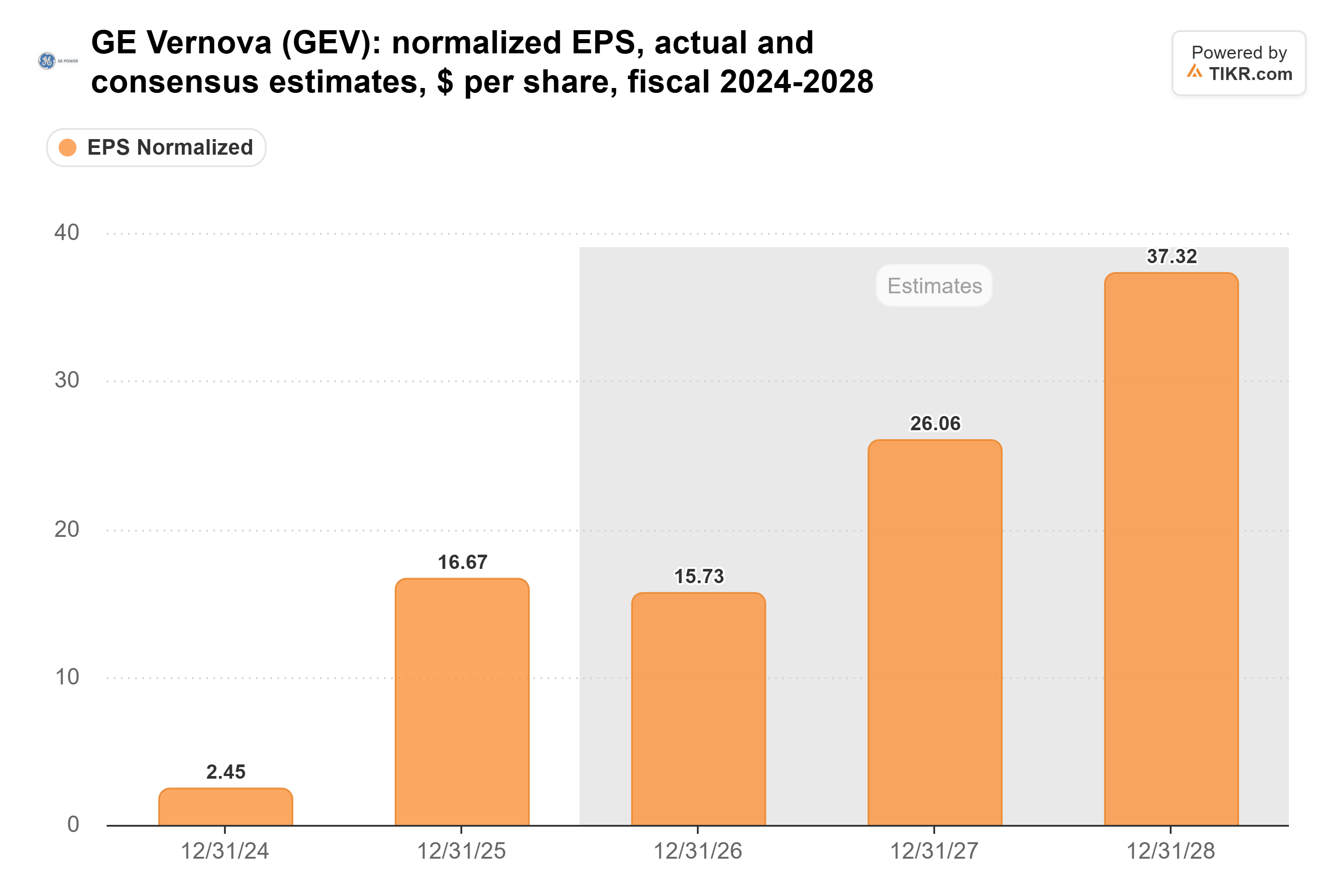
(2025’s $16.67 got a lift from a $2.9 billion tax benefit in the fourth quarter, so 2026 isn’t really the step back it looks like.)
A year ago, analysts expected $18.38 for 2027, and that estimate has risen 4.7% over the past 90 days, right through the selloff. With the price falling and the estimates rising, GE Vernova closed last at about 34x forward earnings, the bottom of its range over the past year:
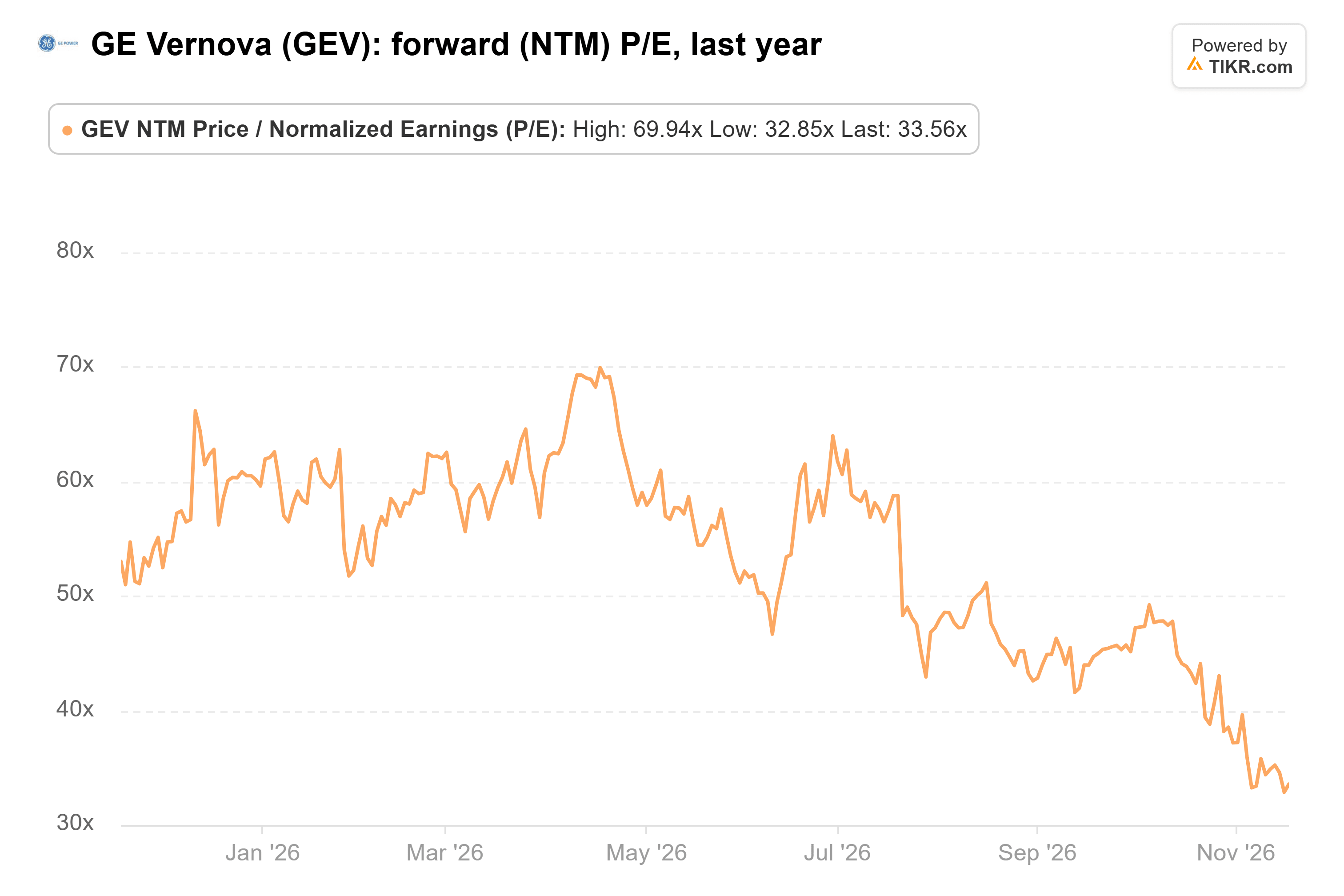
That’s well under its 54x average for the year, and about half its peak near 70x in April.
Customers are paying up front
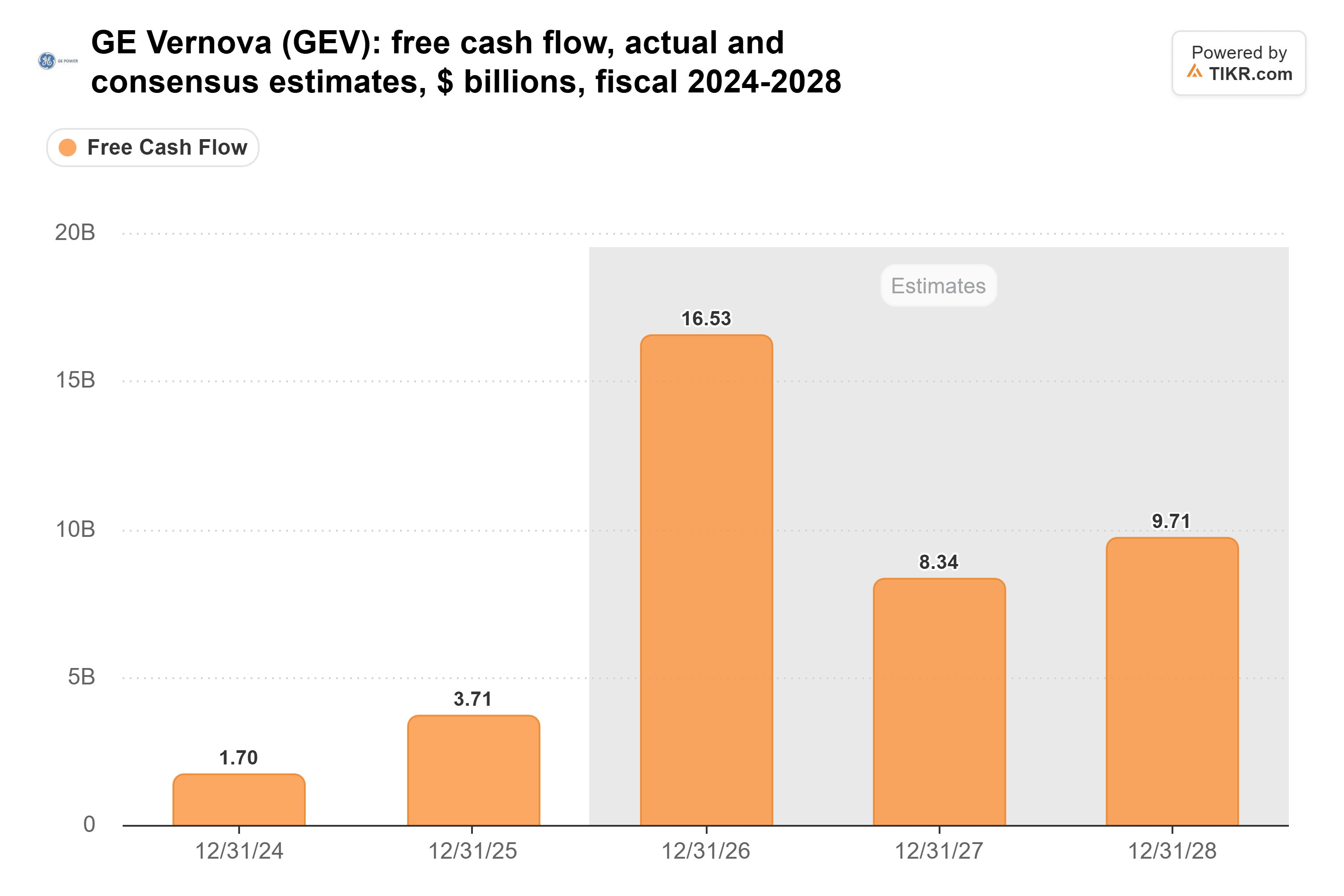
The bears do have a point about cash. Contract liabilities and deferred income added $19.5 billion to operating cash in the first nine months of 2026, against $2.4 billion a year earlier, as buyers paid up front to lock in turbine slots.
Every turbine shipped uses up some of that prepaid cash, so analysts expect free cash flow to fall from $16.5 billion in 2026 to $8.3 billion in 2027, before it recovers to $9.7 billion in 2028:
Data-center buyers can also change course. SoftBank took a $3.7 billion charge on power equipment for its Ohio campus and other US sites, and CFO Yoshimitsu Goto said the Ohio project is undergoing “a thorough reassessment.” GE Vernova told CNBC its deposits on orders and slot reservations are non-refundable, and as of mid-year, data centers accounted for only about 20% of its contracted gas gigawatts.
Vertiv and Howmet see the same demand
Vertiv’s business is also running ahead of its stock. Its organic orders more than doubled in the third quarter, and it raised its 2026 sales guidance by $650 million, to $14.65 billion at the midpoint. Its next report, expected in February, will be the first to show whether data-center buyers have pulled back since SoftBank’s charge.
Howmet looks further out. CEO John Plant said “Demand in the gas turbines market continues to strengthen with customers looking to increase volumes beyond previous expectations, which supports the outlook beyond 2028.” Howmet trades at 34x forward earnings, the same as GE Vernova, even though analysts expect its EPS to grow 21% in 2027, against GE Vernova’s 66%.
Priced for a peak that hasn’t arrived
The way I see it, the stock has priced in a peak in turbine demand that GE Vernova’s contracts haven’t shown yet. At about 34x forward earnings with estimates still rising, I’d take that trade as long as deposits keep coming in. Analysts already expect the cash to normalize as turbines ship, so it’s in the price.
The fourth-quarter report, expected in late January, is the next test. Contracts at or above 130 gigawatts and backlog above $200 billion would show demand still growing. A stall near 122 gigawatts, or a gas customer pulling back after SoftBank, would support the bears.
So what is GE Vernova stock actually worth?
TIKR lets you forecast the future price of any stock in less than a minute. Just enter a few assumptions into TIKR’s valuation model and see what GE Vernova could be worth. Start from Wall Street consensus estimates, or adjust the inputs to reflect your own view of the business. It’s free to use.
Disclaimer:
Please note that the articles on TIKR are not intended to serve as investment or financial advice from TIKR or our content team, nor are they recommendations to buy or sell any stocks. We create our content based on TIKR Terminal’s investment data and analysts’ estimates. Our analysis might not include recent company news or important updates. TIKR has no position in any of the stocks mentioned. Thank you for reading, and happy investing!