Key Takeaways
- Nvidia beat third-quarter estimates and raised next fiscal year’s revenue growth outlook to about 75%, after retail investors piled into its selloff.
- Nvidia’s earnings estimates rose as the stock fell, leaving it at 11x forward earnings against a 30x three-year average.
- A test of 2,943 similar drops in big US stocks since 2017 found no edge from buying them.
- Robinhood, Interactive Brokers and Charles Schwab collect on the trading either way.
Retail investors didn’t just buy the Nvidia (NVDA) dip. They bought it in record size.
Jensen Huang’s resignation as CEO “sparked the biggest ever opening 30 minutes of retail net buying we’ve recorded in Nvidia,” according to Vanda Research, as Ben Carlson read out on this week’s episode of the Animal Spirits podcast. Over three trading days, Nvidia took 61% of all US retail net buying, the kind of flow that runs through brokers like Robinhood (HOOD), Interactive Brokers (IBKR) and Charles Schwab (SCHW).
Then Nvidia beat estimates and raised its outlook in its first report without Huang. But one investor who tested 2,943 big dips found buying them isn’t a good habit.
2,943 drops, and no edge
One investor on the r/StockMarket subreddit pulled every case from October 2017 to August 2026 where one of the 500 most traded US stocks fell 15% or more in 10 trading days while the broad market was calm. Bought at the next open and sold 20 trading days later, those 2,943 drops averaged a 0.29% loss, against a 0.90% gain on a random day in the same stock. The poster calls that “no edge.” Buying the drop came out ahead in only 4 of the 10 years.
TIKR tracks 63 analysts on Nvidia. How many say “Buy”?
See the full breakdown of Buy, Hold, and Sell ratings on Nvidia, along with Wall Street’s revenue and earnings estimates, all in one place. More than 500,000 investors use TIKR to research stocks like this one. See Nvidia’s Analyst Ratings
Nvidia’s estimates went the other way
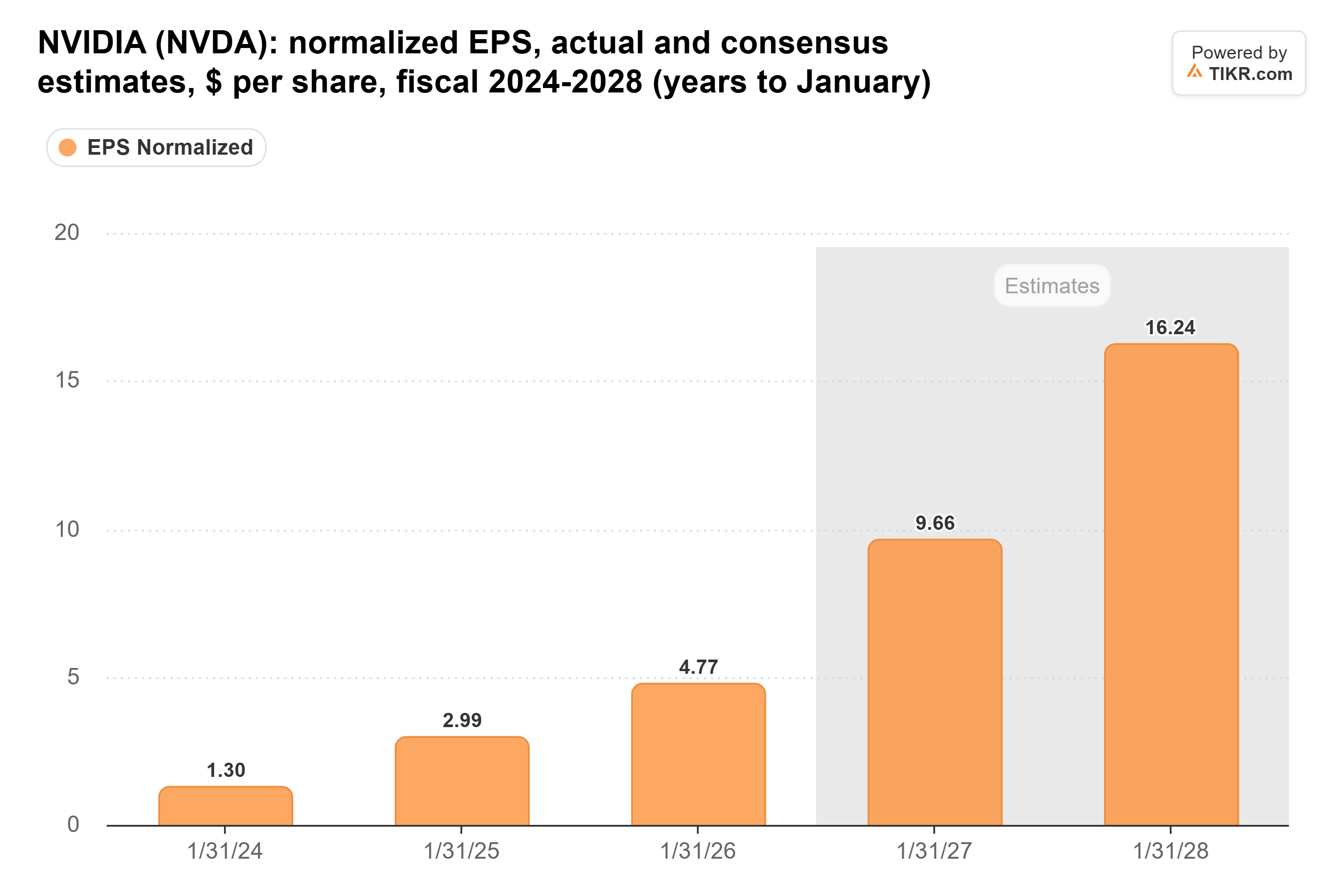
The poster tested price alone, though, and Nvidia’s estimates rose while the stock fell. Over the past month, analysts nudged up their normalized EPS estimates for each of the next three fiscal years, to $9.66 for the year ending January 2027, $16.24 for the year after and $21.44 for the one after that:
With the price down and the estimates up, the multiple collapsed. Nvidia traded at 11x forward earnings going into the report, against a 30x average over the past three years and a peak of 47x in June 2024:
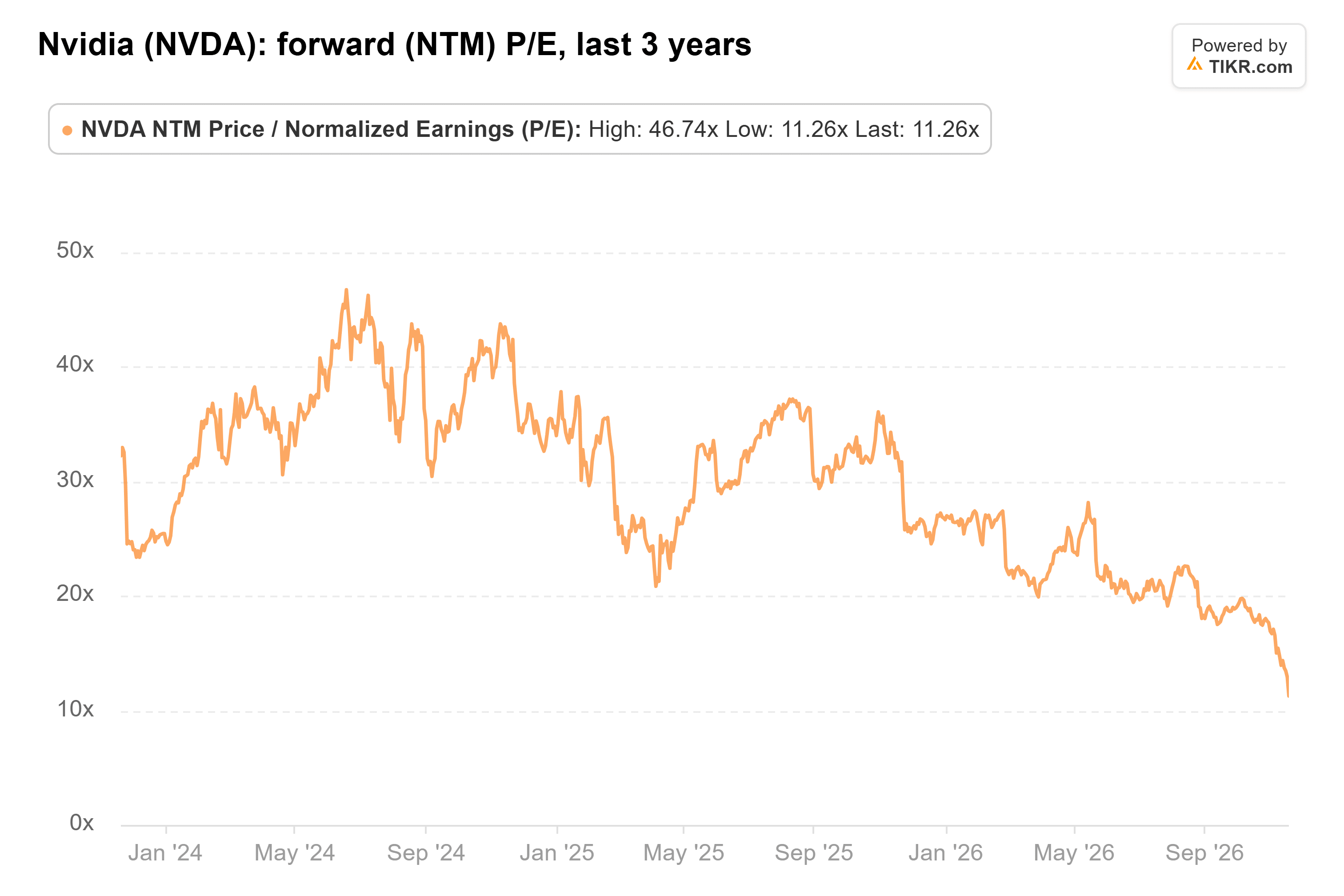
That’s below every quarter-end reading TIKR has going back to 2014.
Then the earnings backed the buyers
Nvidia beat in the third quarter, with adjusted EPS of $2.68 on $115.8 billion of revenue, against the $2.47 and $109.15 billion Wall Street expected. Interim CEO Colette Kress guided the fourth quarter to $127.4 billion-$132.6 billion of revenue and raised next fiscal year’s growth outlook to about 75%, from the 70% Huang gave three months earlier.
Analysts already expected Nvidia’s revenue to keep climbing fast:
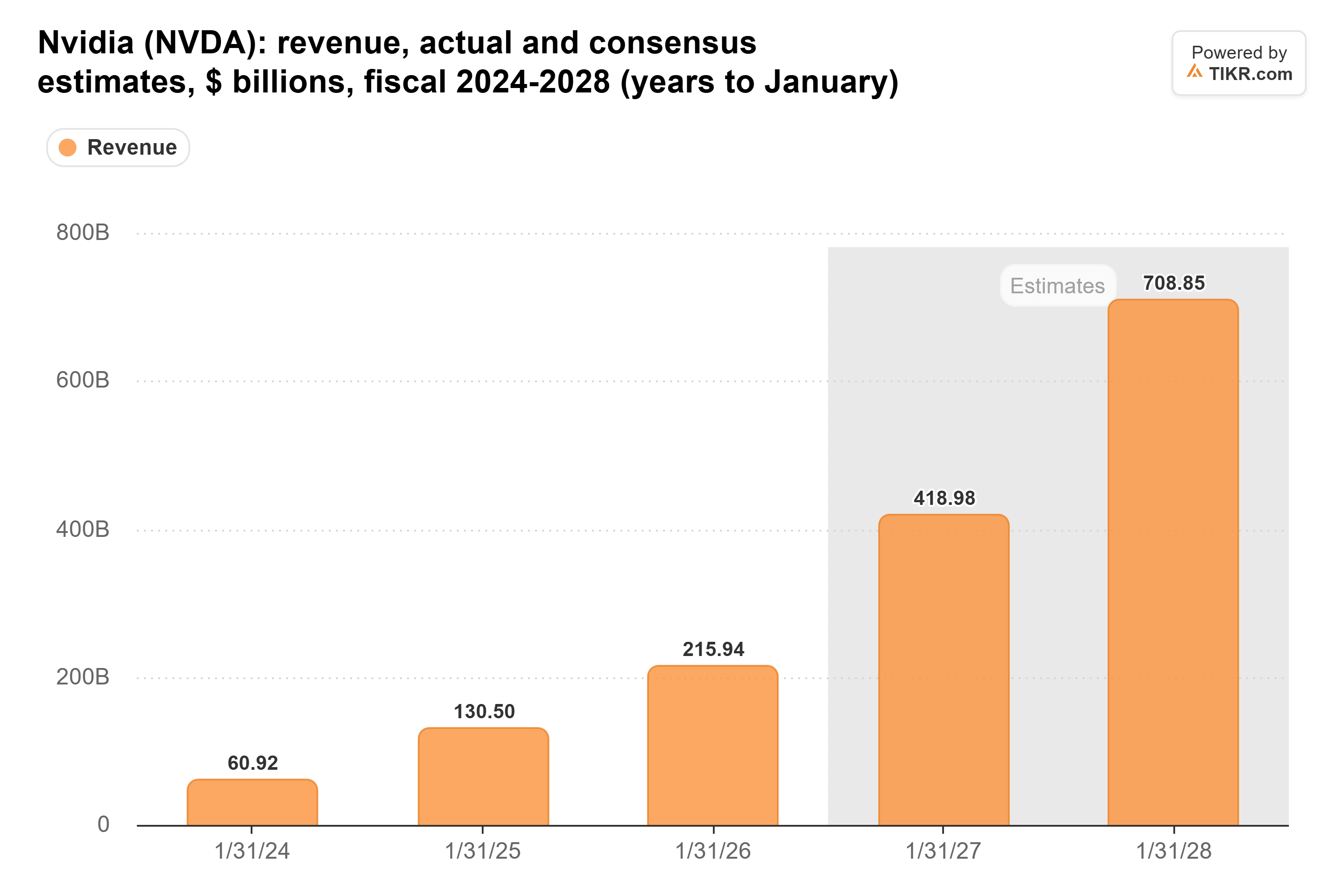
Kress’s outlook beats even that. About 75% growth on this year’s roughly $424 billion puts the year ending January 2028 near $740 billion, above the $709 billion consensus.
The brokers get paid either way
The brokers get paid whether the trade works or not. In the third quarter, Interactive Brokers’ customer margin loans jumped 36% to $105.2 billion, and Schwab’s rose 14% from the second quarter to $187.9 billion. Robinhood’s customers deposited a net $15.1 billion in October, the month Nvidia’s slide began, against $6.1 billion in September. Those margin balances are what I’d watch: buying a dip with borrowed money hurts a lot more when the stock doesn’t bounce.
Don’t count on a repeat
The way I see it, Nvidia’s dip buyers got it right because they bought a falling price with rising estimates under it, and that’s rare. This one hasn’t paid off yet, either: the stock still trades below $173.97, the price the poster recorded for the rule’s entry on Nov. 10. Analysts also can’t put the governance mess behind Huang’s exit into an estimate, especially since Huang has said he’d return and JPMorgan says only a proxy fight gets him there. The real test is the fourth-quarter report in late February: revenue at or above $127.4 billion, the low end of the guide, would keep the estimates intact, and the dip buyers’ case with them.
So what is Nvidia stock actually worth?
TIKR lets you forecast the future price of any stock in less than a minute. Just enter a few assumptions into TIKR’s valuation model and see what Nvidia could be worth. Start from Wall Street consensus estimates, or adjust the inputs to reflect your own view of the business. It’s free to use.
Disclaimer:
Please note that the articles on TIKR are not intended to serve as investment or financial advice from TIKR or our content team, nor are they recommendations to buy or sell any stocks. We create our content based on TIKR Terminal’s investment data and analysts’ estimates. Our analysis might not include recent company news or important updates. TIKR has no position in any of the stocks mentioned. Thank you for reading, and happy investing!