Key Takeaways
- GE Aerospace (GE) fell 3% in October, closing near $302 despite beating earnings expectations and raising its 2026 guidance.
- Boeing (BA) faces aircraft delivery delays, potentially supporting maintenance demand for older engines while threatening GE’s new engine programs.
- FTAI Aviation (FTAI) reaffirmed its 2027 outlook and announced plans for a $500 million accelerated share repurchase.
- Jefferies maintained its Buy rating but lowered its GE price target to $425, implying 41% upside from October 30, compared with approximately 25% for the $378 consensus target.
What Happened?
GE Aerospace stock declined 3% in the month through October 30, falling from approximately $312 to $302 as strong quarterly earnings failed to offset concerns about slower growth in 2027.
On October 20, GE reported adjusted earnings per share of $2.25, up 36% year over year and above analysts’ expectations of approximately $2.01.
Adjusted revenue increased 18% to $13.3 billion, while orders surged 49% to $19 billion, reflecting strong demand across its aerospace businesses.
GE also raised its full-year adjusted EPS guidance to $8.00-$8.10 from $7.65-$7.85. However, subtracting the first nine months’ earnings implies fourth-quarter EPS of approximately $1.87-$1.97, below expectations of $2.04.
Investors also focused on slowing commercial services growth.
Chairman and CEO Larry Culp said, “we now expect 2027 commercial services to grow low-double-digits,” supported by a commercial services backlog exceeding $170 billion.
That would mark a slowdown from the low-20% growth expected in 2026, raising questions about GE’s premium valuation.
Boeing’s delayed 777X program presents another challenge, with its GE9X engine potentially creating an additional $300 million profit headwind in 2027.
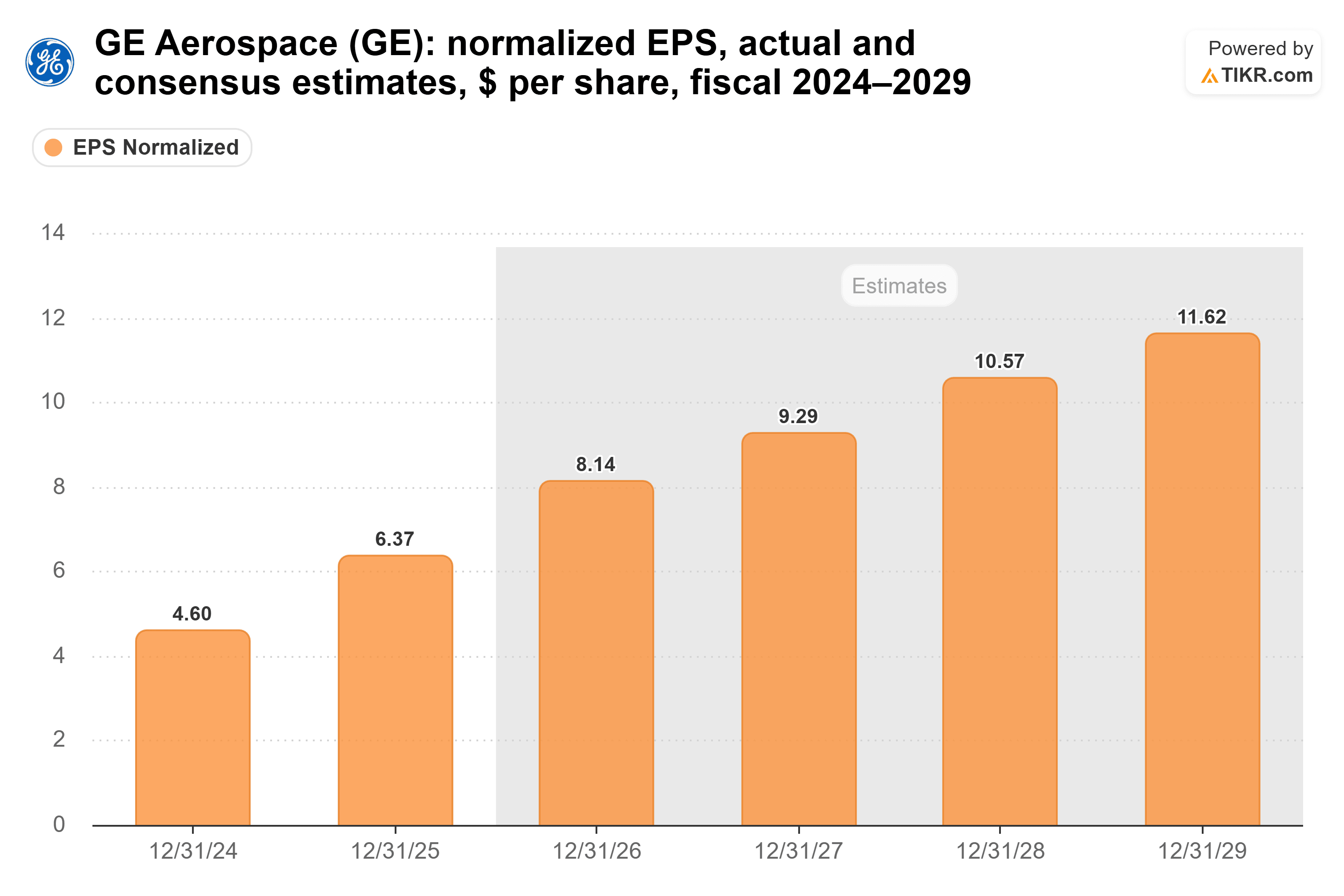
Still, analysts expect normalized EPS to reach $9.29 in 2027 and $10.57 in 2028, suggesting earnings growth could continue despite these pressures.
Boeing’s production difficulties could also support GE’s maintenance operations by keeping older aircraft and engines in service longer.
GE reported that engines awaiting shop visits had increased approximately 20% since the beginning of 2026, highlighting existing aftermarket demand.
Meanwhile, FTAI reported third-quarter adjusted EBITDA of $348 million, up approximately 15% sequentially, and reaffirmed its 2027 outlook.
FTAI’s performance provides additional evidence of aftermarket demand, although its results do not guarantee stronger growth for GE.
Is GE Aerospace Stock Undervalued or Overvalued?
GE Aerospace appears moderately undervalued at its October 30 closing price of approximately $302, although slower commercial services growth could constrain its upside over the next 12 months.
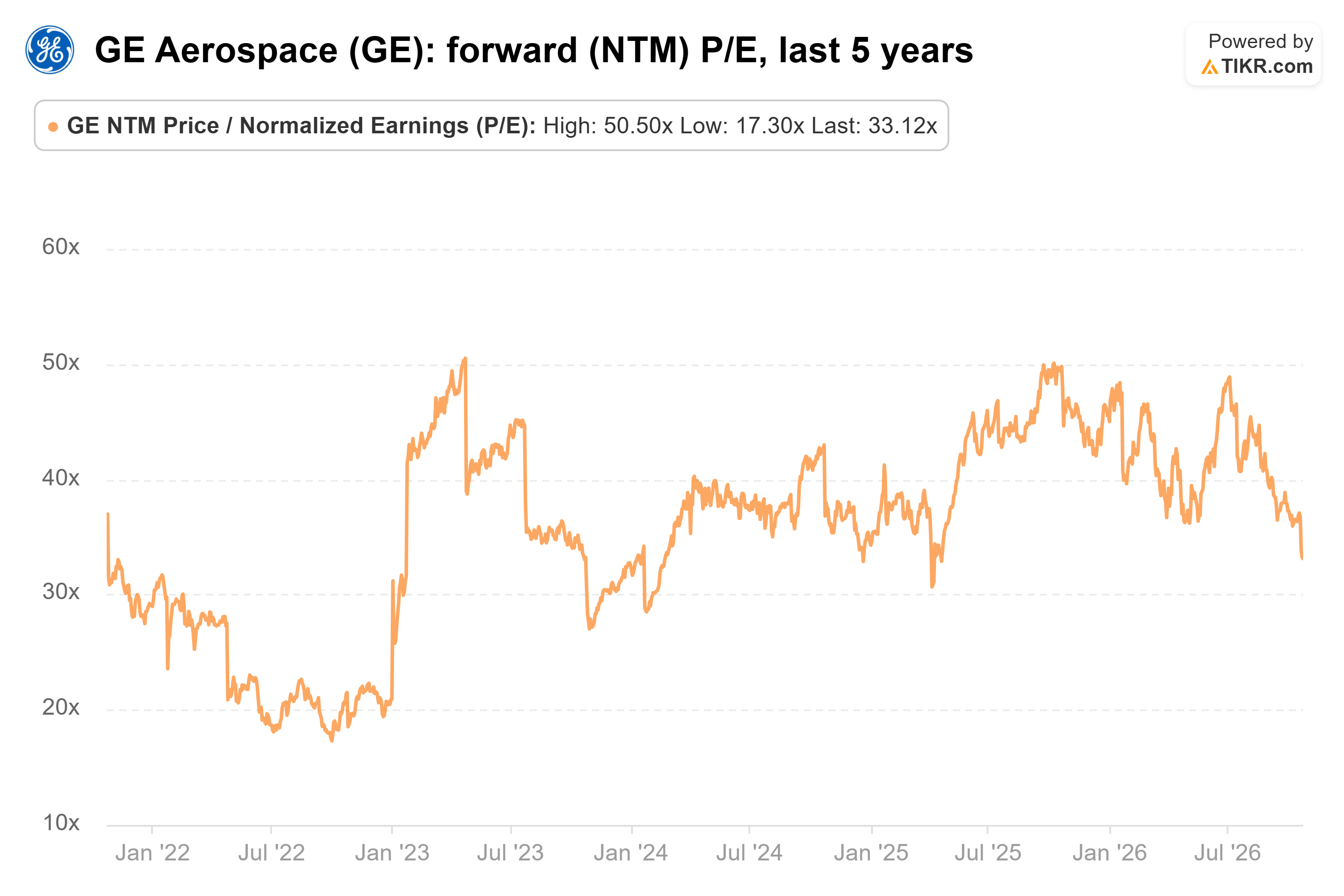
Its forward P/E stood near 33x on October 22, below its five-year average of approximately 36x and significantly lower than the 48x recorded at the end of June.
Jefferies lowered its price target from $435 to $425 while maintaining its Buy rating, implying approximately 41% upside from October 30, compared with roughly 25% for the $378 analyst consensus target.
The $378 consensus target represents approximately 36x projected 2028 earnings, compared with roughly 40x at Jefferies’ $425 target. The higher target depends on stronger earnings execution and investors maintaining a premium valuation for GE.
GE’s substantial services backlog and recurring maintenance demand support its long-term earnings outlook. However, slower services growth, GE9X delays, and weaker cash flow conversion could limit the stock’s upside over the next 12 months.
The takeaway: GE Aerospace appears moderately undervalued at its October 30 price, supported by strong aftermarket demand and continued earnings growth. However, slower services growth and GE9X delays could limit near-term gains, making the $378 consensus target a more reasonable valuation scenario than Jefferies’ $425 forecast.
So what is GE Aerospace stock actually worth?
TIKR lets you forecast the future price of any stock in less than a minute. Just enter a few assumptions into TIKR’s valuation model and see what GE Aerospace could be worth. Start from Wall Street consensus estimates, or adjust the inputs to reflect your own view of the business. It’s free to use.
Disclaimer:
Please note that the articles on TIKR are not intended to serve as investment or financial advice from TIKR or our content team, nor are they recommendations to buy or sell any stocks. We create our content based on TIKR Terminal’s investment data and analysts’ estimates. Our analysis might not include recent company news or important updates. TIKR has no position in any of the stocks mentioned. Thank you for reading, and happy investing!