


Key Takeaways
- President Trump said on Nov. 21 that he would work with the incoming Democratic Congress to cap credit card interest rates at 10%, which would hit card issuers like JPMorgan and Capital One.
- Upstart has more to lose, since unsecured lending brought in $929.2 million of its $950.0 million of fees in 2025.
- A 10% card rate would undercut the reason to take out Upstart’s loans, and SoFi faces a milder version of the same problem.
- Upstart’s 2027 guidance will be the first sign of whether its borrowers are still coming.
President Donald Trump said on Saturday, Nov. 21, that he would work with the incoming Democratic Congress to cap credit card interest rates, the Associated Press reported. “I would do it. These credit card companies have made a lot,” he told Fox News Channel’s “Saturday in America.”
The obvious targets are card issuers like JPMorgan Chase (JPM) and Capital One (COF). But the stock with more to lose is Upstart Holdings (UPST), which earns nearly all of its fees from unsecured lending, led by personal loans it pitches as a way to pay off credit cards. (SoFi Technologies (SOFI) has a smaller version of the same problem.)
A 10% cap finally has a path
Trump first called for a 10% cap in January, but the Republican-controlled Congress did little with it. Democrats take control of both the House and the Senate in January, and Sen. Elizabeth Warren, who’s expected to chair the Senate Banking Committee, has said many times that she wants to cap rates. The median card rate is roughly 22.2%, according to an August survey by the New York Federal Reserve, so a capped card would charge less than half that.
TIKR tracks 16 analysts on Upstart. How many say “Buy”?
See the full breakdown of Buy, Hold, and Sell ratings on Upstart, along with Wall Street’s revenue and earnings estimates, all in one place. More than 500,000 investors use TIKR to research stocks like this one. See Upstart’s Analyst Ratings
Upstart’s business runs on card debt
Unsecured lending brought in $929.2 million of Upstart’s $950.0 million of fees in 2025, according to its annual report. Upstart’s sample loan is $10,000 over five years at a 19.12% interest rate plus an 8.31% origination fee, for a 23.48% APR.
Refinancing only makes sense when the card costs more than the loan. Under a 10% cap, the sample loan’s APR would be more than double the card’s rate. Only borrowers who qualify near the bottom of Upstart’s 6.1% to 35.99% APR range would come out ahead.
That’s a problem, because analysts expect Upstart’s revenue to more than double, from $1.04 billion in 2025 to $2.19 billion in 2028:
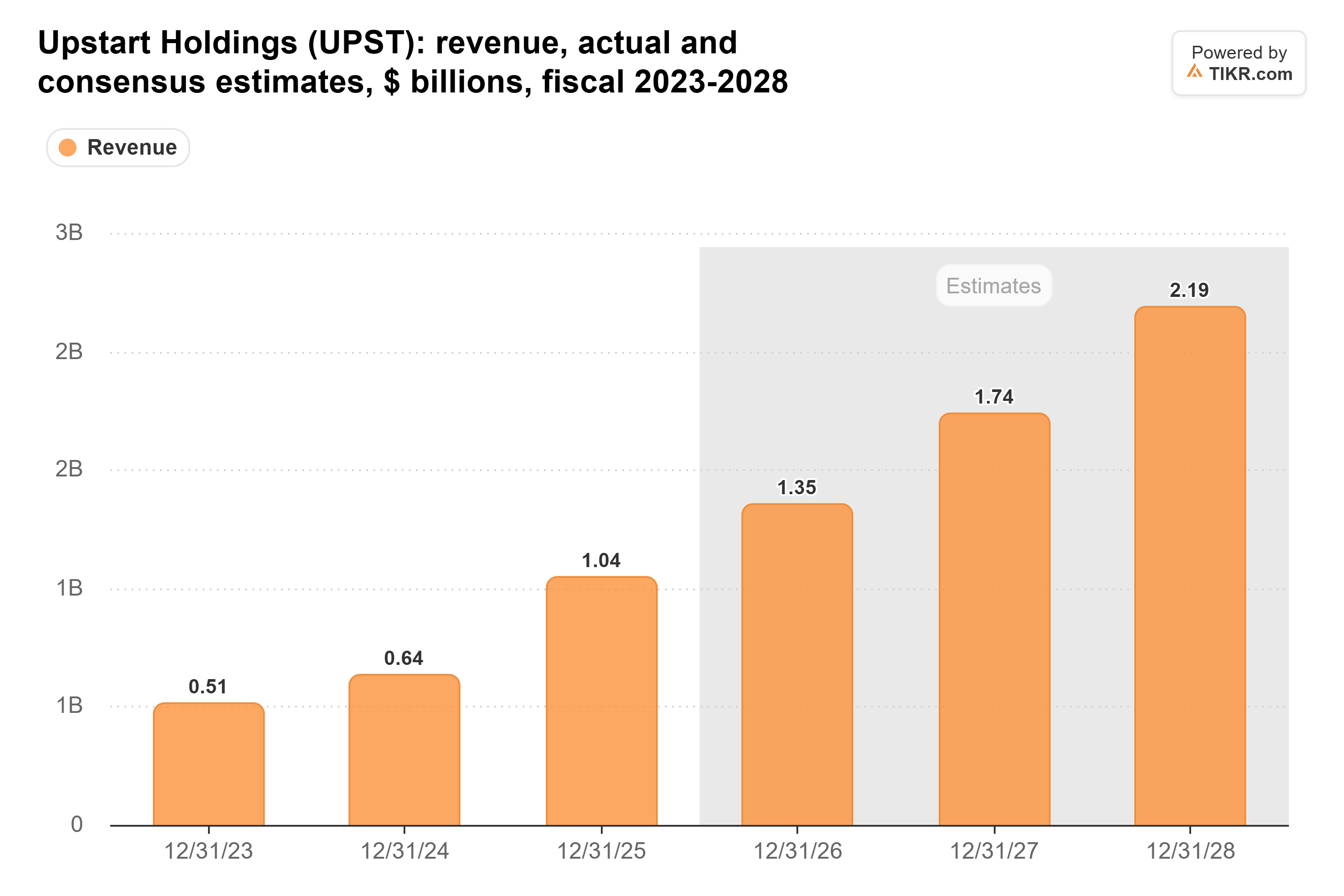
Those estimates came before Trump’s comments, and a cap that became law would push them lower.
The banks have other businesses
JPMorgan’s Card Services & Auto business brought in $28.2 billion of the bank’s $182.4 billion of total net revenue in 2025, a figure that also includes auto loans and card fees. A cap would sting, but JPMorgan has plenty of other businesses to lean on.
Lending brought in $807.4 million of SoFi’s $1.37 billion of adjusted net revenue in the third quarter, and personal loans are its biggest lending product, at $12.6 billion of its $16.9 billion in third-quarter originations. A cap would undercut SoFi’s loans, too, but SoFi has a bank’s deposits behind it. The question for its next report, likely in late January, is how much of its $6.4 billion 2027 adjusted net revenue outlook, set before Trump spoke, depends on personal loans.
Riskier borrowers may still need Upstart
In January, issuers warned that a cap would force them to cancel cards for less creditworthy customers. That would land on lenders like Capital One, whose domestic card loans made up $260.3 billion of its $462.5 billion of loans held for investment at Sept. 30. Some of the borrowers who lose those cards would go looking for a personal loan instead.
That’s cold comfort, since a card issuer would have just decided not to lend to them. They’d show up while the Upstart Macro Index, the company’s own gauge of how much the economy raises default risk, reads 1.53. Upstart’s lowered 2026 outlook assumes it stays at or below 1.55.
Upstart has more to lose
Upstart rose on Nov. 23, the first trading day after the interview, but so did nearly everything else: the S&P 500 jumped 4.7% after Nvidia brought back Jensen Huang as CEO. Even after that bounce, Upstart trades at around 6x the normalized earnings analysts expect over the next year, after it hit a new 52-week low earlier this month. JPMorgan would lose part of one business, while Upstart would lose the main reason people take out its loans.
Of course, a bill still has to move once Democrats take over. The first real test is Upstart’s fourth-quarter report, expected around February: 2027 guidance near the $1.74 billion of revenue analysts expect would show borrowers are still coming.
So what is Upstart stock actually worth?
TIKR lets you forecast the future price of any stock in less than a minute. Just enter a few assumptions into TIKR’s valuation model and see what Upstart could be worth. Start from Wall Street consensus estimates, or adjust the inputs to reflect your own view of the business. It’s free to use.
Disclaimer:
Please note that the articles on TIKR are not intended to serve as investment or financial advice from TIKR or our content team, nor are they recommendations to buy or sell any stocks. We create our content based on TIKR Terminal’s investment data and analysts’ estimates. Our analysis might not include recent company news or important updates. TIKR has no position in any of the stocks mentioned. Thank you for reading, and happy investing!


