Key Takeaways
- President Donald Trump said he would work with the incoming Democratic Congress to cap credit card interest rates, and the standard proposal is a 10% cap.
- SoFi’s core personal loans carried a 12.9% weighted average coupon in the second quarter, so a capped card would cost less than SoFi’s main product.
- SoFi’s CEO says a cap would leave a void its loans could fill, but the borrowers card issuers would drop look more like Upstart’s than SoFi’s.
- The cap still has to pass Congress, and SoFi trades at 1.7x tangible book against a five-year average of 2.7x.
President Donald Trump said Saturday that he would work with the incoming Democratic Congress to cap credit card interest rates. “I would do it. These credit card companies have made a lot,” he told Fox News Channel’s “Saturday in America.”
The standard proposal is a 10% cap, and most of the attention has gone to card issuers like JPMorgan Chase (JPM) and Capital One (COF). But the cap may matter more to lenders whose loans pay off card balances, like SoFi Technologies (SOFI) and Upstart (UPST).
SoFi CEO Anthony Noto has already made the bull case. When Trump first floated the cap in January, Noto wrote on X that card issuers “simply won’t be able to sustain profitability at a 10% rate cap,” which “creates a large void” that SoFi’s personal loans “are well positioned to fill.”
I’m not so sure SoFi is the lender that fills it.
TIKR tracks 25 analysts on SoFi. How many say “Buy”?
See the full breakdown of Buy, Hold, and Sell ratings on SoFi, along with Wall Street’s revenue and earnings estimates, all in one place. More than 500,000 investors use TIKR to research stocks like this one. See SoFi’s Analyst Ratings
A 10% card beats a 12.9% loan
Personal loans are SoFi’s profit engine. They made up $10.7 billion of its record $14.8 billion of originations in the second quarter, and lending earned 64.0% of segment contribution profit that quarter, up from 52.5% a year earlier.
Price is what sells those loans. In January, Noto wrote that they “carry rates (10-12%) that are up to half of typical credit card rates.”
A 10% cap flips that comparison. SoFi’s core personal loan carried a 12.9% weighted average coupon in the second quarter, so a capped card would be about 3 points cheaper. Matching it would hurt: management put the loan’s risk-adjusted margin at about 6.1% after 3.1% of funding costs and 3.7% of losses, and pricing at 10% would cut that roughly in half.
That matters because analysts expect SoFi’s normalized EPS to roughly triple from 2025 to 2028:

Issuers would keep SoFi’s best borrowers
Noto’s case depends on issuers pulling credit once they can’t charge more than 10%, and banks say a cap would force them to cancel cards for less creditworthy customers or cut back on rewards.
But those aren’t SoFi’s borrowers, who averaged a 745 FICO score and $154,000 of income in the first quarter. I suspect those are exactly the customers a capped issuer would fight hardest to keep. JPMorgan alone carried $250.1 billion of average Card Services loans in the third quarter, with a 2.91% net charge-off rate, and a book that clean is worth keeping even at 10%.
The borrowers who do lose their cards look more like Upstart’s, whose unsecured business earned $212 million of contribution profit in the third quarter, up 35%. Capital One held $276.4 billion of card loans at Sept. 30 and earned an 8.41% net interest margin in the third quarter, so whether it reprices that book or cuts credit lines will go a long way toward setting how many borrowers go looking for a loan.
Congress still has to act
The cap isn’t law. Trump first proposed it in January, and the Republican-led Congress did little with it. That could change when Democrats take both chambers in January.
Investors aren’t paying up for SoFi’s lending growth, either. The stock trades at 1.7x tangible book, against a five-year average of 2.7x and a peak of 6.4x in October 2025:
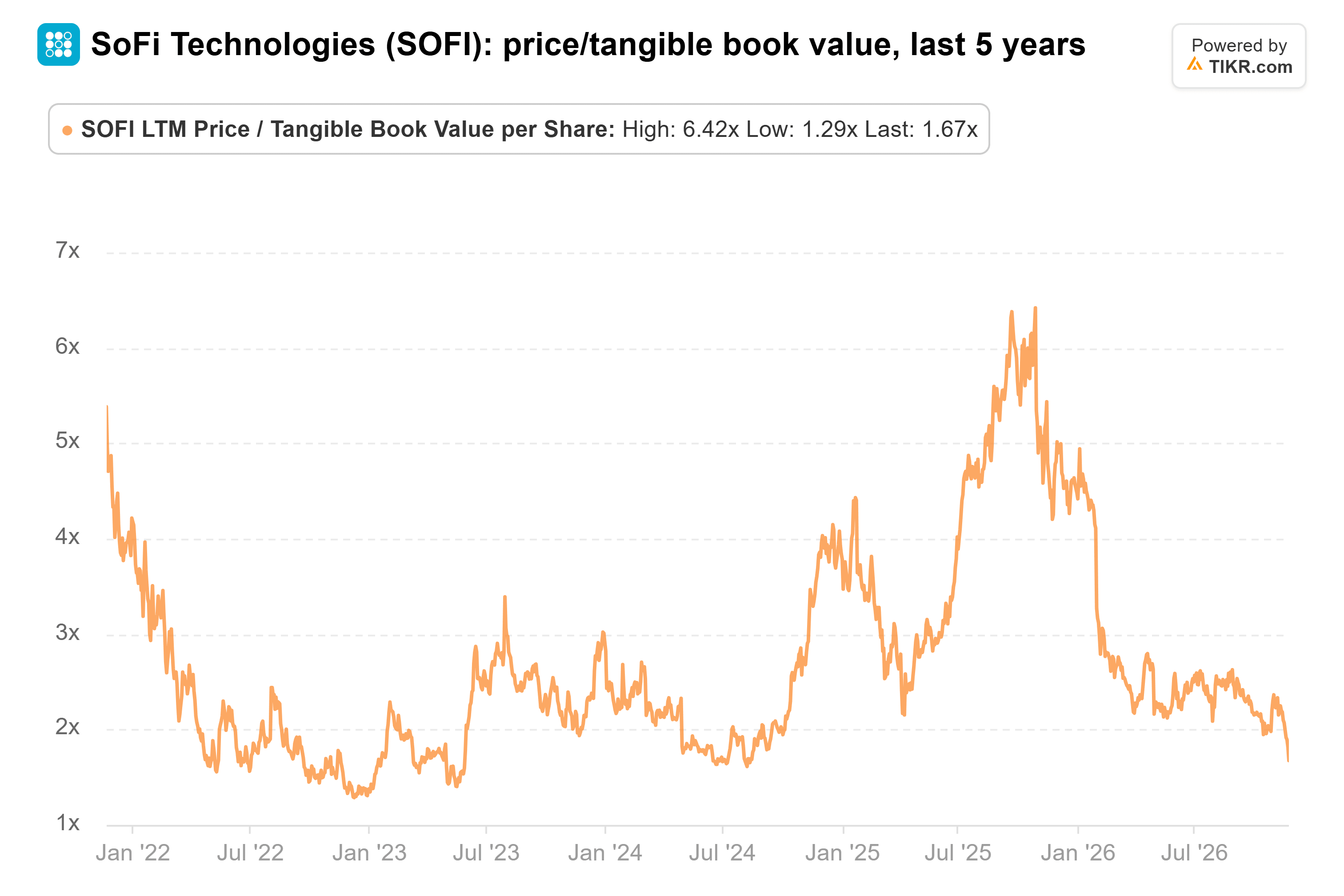
Noto’s “void” is the weakest part of SoFi’s bull case on this cap, since a 10% card would beat SoFi’s loans for the prime borrowers it goes after. Still, at this price I’d hold through the headlines. What matters next is what a bill actually says once the new Congress takes over. SoFi’s fourth-quarter report, expected in late January, should tell us how management plans to compete if cards end up cheaper than its loans.
So what is SoFi stock actually worth?
TIKR lets you forecast the future price of any stock in less than a minute. Just enter a few assumptions into TIKR’s valuation model and see what SoFi could be worth. Start from Wall Street consensus estimates, or adjust the inputs to reflect your own view of the business. It’s free to use.
Disclaimer:
Please note that the articles on TIKR are not intended to serve as investment or financial advice from TIKR or our content team, nor are they recommendations to buy or sell any stocks. We create our content based on TIKR Terminal’s investment data and analysts’ estimates. Our analysis might not include recent company news or important updates. TIKR has no position in any of the stocks mentioned. Thank you for reading, and happy investing!