Key Takeaways
- Upstart shares hit a new 52-week low on Tuesday and are down 14% in a month, after the company cut its 2026 outlook and rising Treasury yields hit consumer lenders including Affirm.
- The outlook cut is Upstart’s own problem: rising defaults are lowering the value of the loans it holds, even as Pagaya raised its 2026 profit forecast.
- Upstart’s third quarter set a record for contribution profit, but analysts have cut their 2027 earnings estimates by nearly a fifth since the report.
- The stock trades well below its usual forward multiple, so selling here looks late, but buying can wait for a turn in the Upstart Macro Index.
Upstart Holdings (UPST) fell 8% on Tuesday after hitting a new 52-week low and is down 14% in a month. A hotter-than-expected October inflation report sent Treasury yields higher and knocked consumer lenders lower. That came a week after Upstart cut its 2026 outlook.
Rates explain part of that: Affirm (AFRM) fell even further over the month, though it raised its own outlook. But Pagaya Technologies (PGY) raised its 2026 profit forecast in late October, too. Upstart’s outlook cut is its own problem.
A record quarter came with a smaller 2026
Upstart’s third quarter, reported Nov. 3, set records:
- Originations of $4.1 billion, up 44% from a year earlier
- Revenue of $371 million, up 34% and ahead of estimates
- Contribution profit of $218 million, an all-time high, up 48%
- A positive contribution margin on secured auto and home loans, a quarter ahead of plan
Then came the cut. Upstart now expects about $1.35 billion of 2026 revenue and $260 million of adjusted EBITDA, down from the $1.4 billion and $294 million it had guided to, and analysts had been looking for $1.42 billion. “Macro is putting pressure on our near-term outlook,” co-founder and CEO Paul Gu said in the release. BofA had already cut its target to $30 from $37 the day before, and at least eight more firms cut theirs by Nov. 4.
TIKR tracks 16 analysts on Upstart. How many say “Buy”?
See the full breakdown of Buy, Hold, and Sell ratings on Upstart, along with Wall Street’s revenue and earnings estimates, all in one place. More than 500,000 investors use TIKR to research stocks like this one. See Upstart’s Analyst Ratings
Defaults are hitting the loans Upstart keeps
The Upstart Macro Index (UMI), the company’s own read on how much the economy raises default risk, hit 1.53 in its latest reading, up from 1.39 at the end of 2025. That hurts Upstart twice: it makes fewer loans, and the loans and loss-sharing stakes it holds lose value. On the call, Gu said the second hit “is actually larger than the impact from reducing new originations.” And Upstart’s maximum exposure under those loss-sharing deals, a worst case it calls remote, reached $1.50 billion at Sept. 30, against $887.4 million of equity.
Borrowers still want these loans, though. Pagaya’s third-quarter network volume rose 28.7% to a record $3.61 billion. And Affirm raised its fiscal 2027 outlook on Nov. 5 to more than $65.25 billion of gross merchandise volume, yet its stock fell 16% over the month. On Tuesday, the 10-year Treasury yield rose about 12 basis points to 4.98%, and the whole group fell with it.
Cheap, but the estimates are still coming down
Analysts have already started cutting. Going into the report, consensus had normalized EPS of $2.29 for 2026 and $3.58 for 2027. It’s now $1.87 and $2.91:
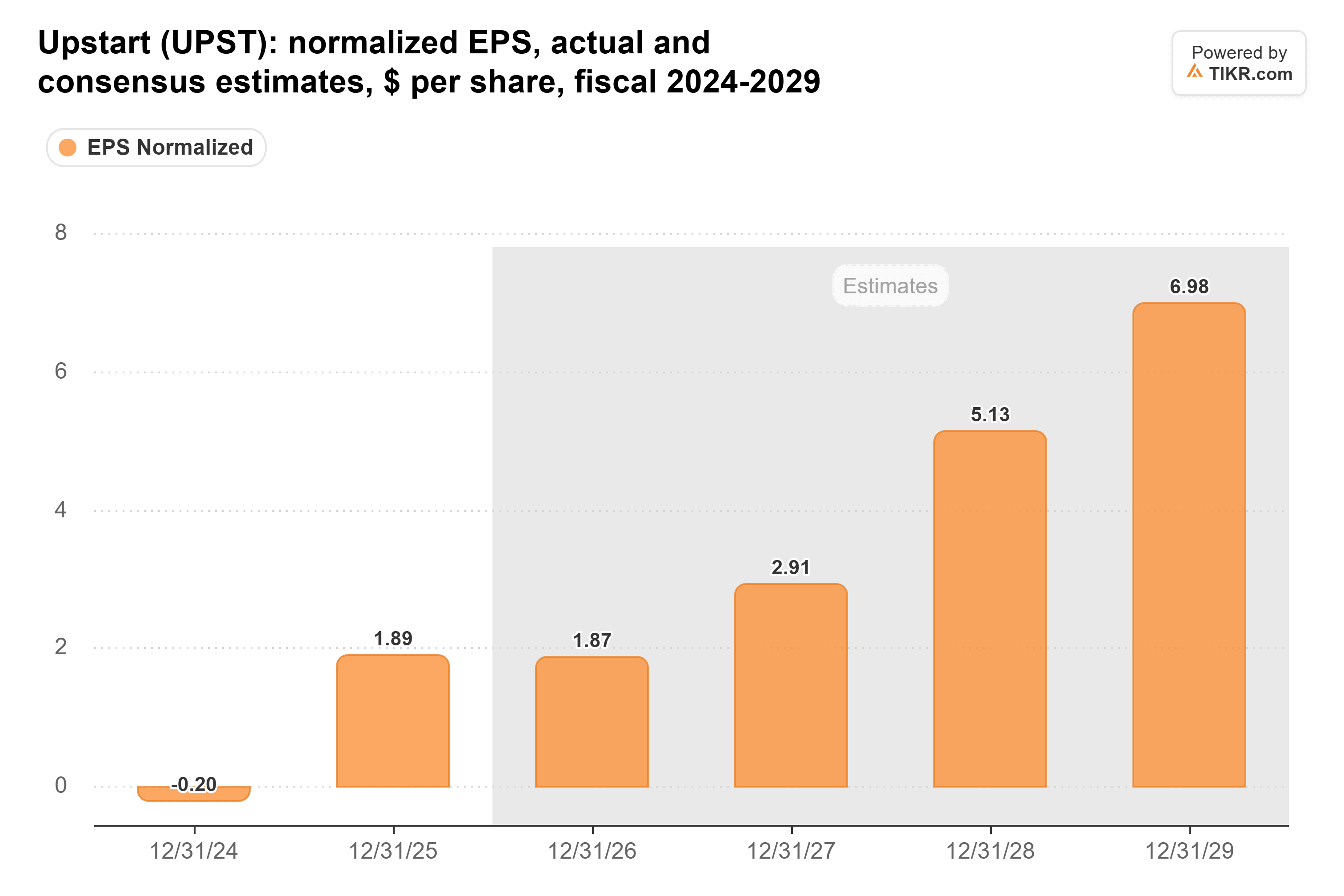
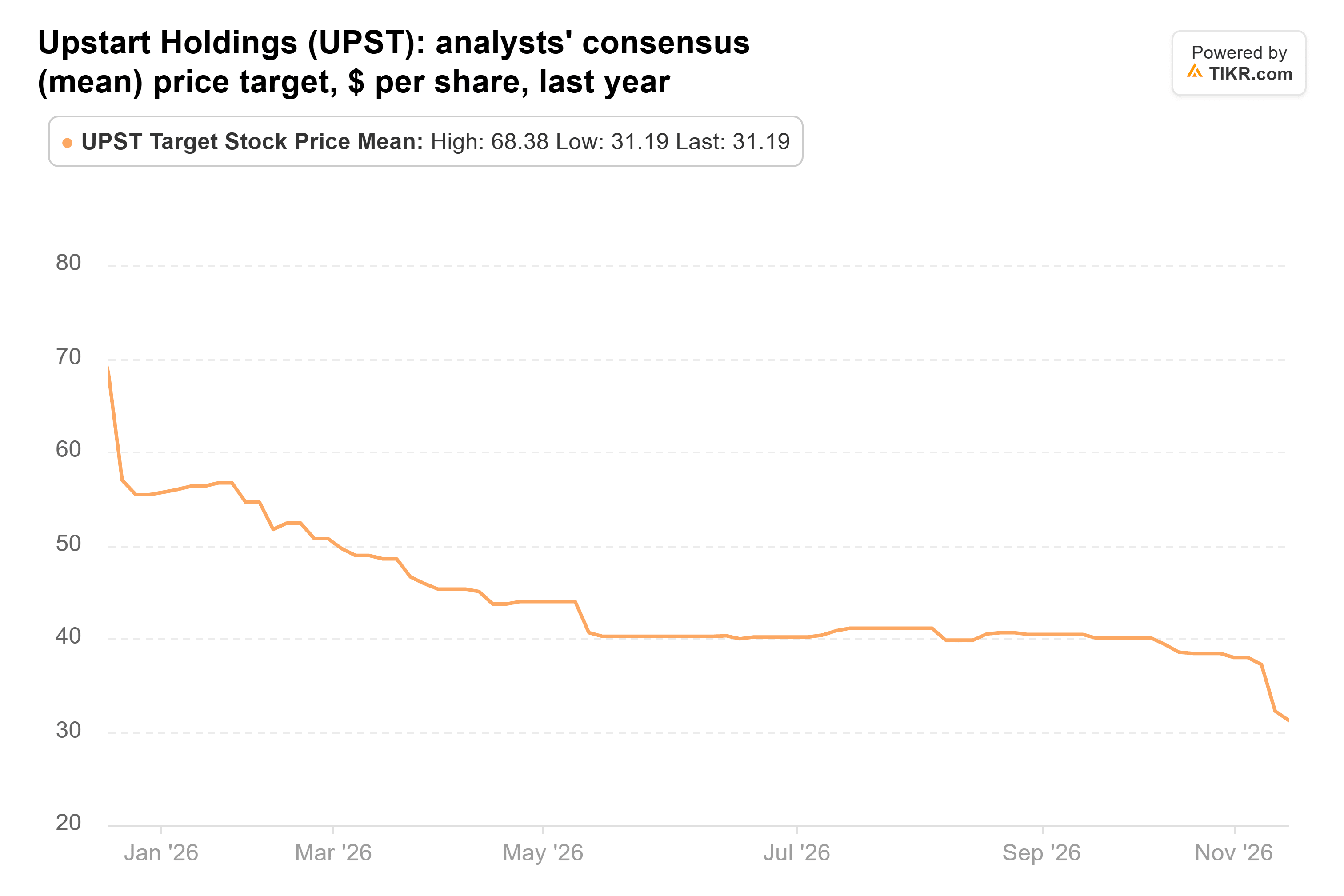
That puts 2027 near BofA’s post-report $2.79, and the GAAP estimate for 2027 is lower still, at $1.88. Wall Street’s average price target has fallen too, to $31 from $68 a year ago:
Before Tuesday’s drop, Upstart traded at 8.2x forward normalized earnings, well under its 14x average over the past year.
Speaking at Citi’s FinTech conference on Tuesday, Gu pointed to record results across the income statement in 2027, with growth that leans less on Upstart’s own equity. Upstart Bank would help there, and Upstart aims to open it in early 2027, once it has its remaining approvals.
The way I see it, selling at under 8x earnings that analysts have already cut looks late. But I’d hold off on buying while the UMI keeps climbing, since every rise lowers the value of the loans Upstart holds and pulls the estimates down with it. Upstart publishes November’s lending figures and a fresh UMI in early December, and the fourth-quarter report, with a first look at 2027, should follow around February. A UMI back toward 1.4 is the signal I’d wait for.
So what is Upstart stock actually worth?
TIKR lets you forecast the future price of any stock in less than a minute. Just enter a few assumptions into TIKR’s valuation model and see what Upstart could be worth. Start from Wall Street consensus estimates, or adjust the inputs to reflect your own view of the business. It’s free to use.
Disclaimer:
Please note that the articles on TIKR are not intended to serve as investment or financial advice from TIKR or our content team, nor are they recommendations to buy or sell any stocks. We create our content based on TIKR Terminal’s investment data and analysts’ estimates. Our analysis might not include recent company news or important updates. TIKR has no position in any of the stocks mentioned. Thank you for reading, and happy investing!