Key Takeaways
- 343 public companies have reported $28.5 billion in tariff refunds received or expected, including $2.9 billion at Walmart. Target, Home Depot and Amazon are on the list too.
- The refunds won’t come back next year, so retail beats that lean on them overstate what the businesses earn.
- Lowe’s third-quarter adjusted EPS of $3.10 included $0.34 from refunds, and without them it missed analysts’ estimate.
- Walmart trades at 41x forward earnings against a five-year average of 30x, so its February outlook has to show profit growth without refunds.
ProPublica’s new database counts 343 public companies reporting $28.5 billion of refunds received or expected since the Supreme Court struck down President Trump’s emergency tariffs in February, and Walmart (WMT) ranks near the top at $2.9 billion.
Target (TGT), Home Depot (HD) and Amazon (AMZN) are among the largest recipients or expected recipients too.
Refunds are one-time money. For Lowe’s (LOW), they were the difference between beating Wall Street’s estimate and missing it.
Lowe’s needed the refund to beat
On Nov. 18, Lowe’s reported third-quarter adjusted EPS of $3.10, including a $0.34 boost from tariff refunds. Analysts polled by FactSet expected $2.88. Take out the $0.34 and adjusted EPS falls to $2.76, a miss and about 10% below the $3.06 Lowe’s earned a year earlier.
CFO Brandon Sink said on the third-quarter call that Lowe’s reinvested about a third of the quarter’s refunds in value for customers and will reinvest the rest in the fourth quarter. “So really it’s net neutral on the year.”
TIKR tracks 44 analysts on Walmart. How many say “Buy”?
See the full breakdown of Buy, Hold, and Sell ratings on Walmart, along with Wall Street’s revenue and earnings estimates, all in one place. More than 500,000 investors use TIKR to research stocks like this one. See Walmart’s Analyst Ratings
Walmart is priced on earnings the refunds boosted
Walmart received nearly all of its roughly $2.9 billion of refunds in the quarter ended July 31, and management said they added a net 7.5 points to that quarter’s 17.4% constant-currency growth in adjusted operating income. Without them, Walmart said underlying growth still reached the top of its 7% to 10% guidance.
Analysts expect Walmart’s normalized EPS to climb from $2.64 in the year ended January 2026 to $3.61 by the year ending January 2029:

The $2.89 expected for the current year includes the refunds, and every year after it has to grow without them.
Walmart trades at 41x forward earnings, close to its five-year high of 47x in February and well above its five-year average of 30x:
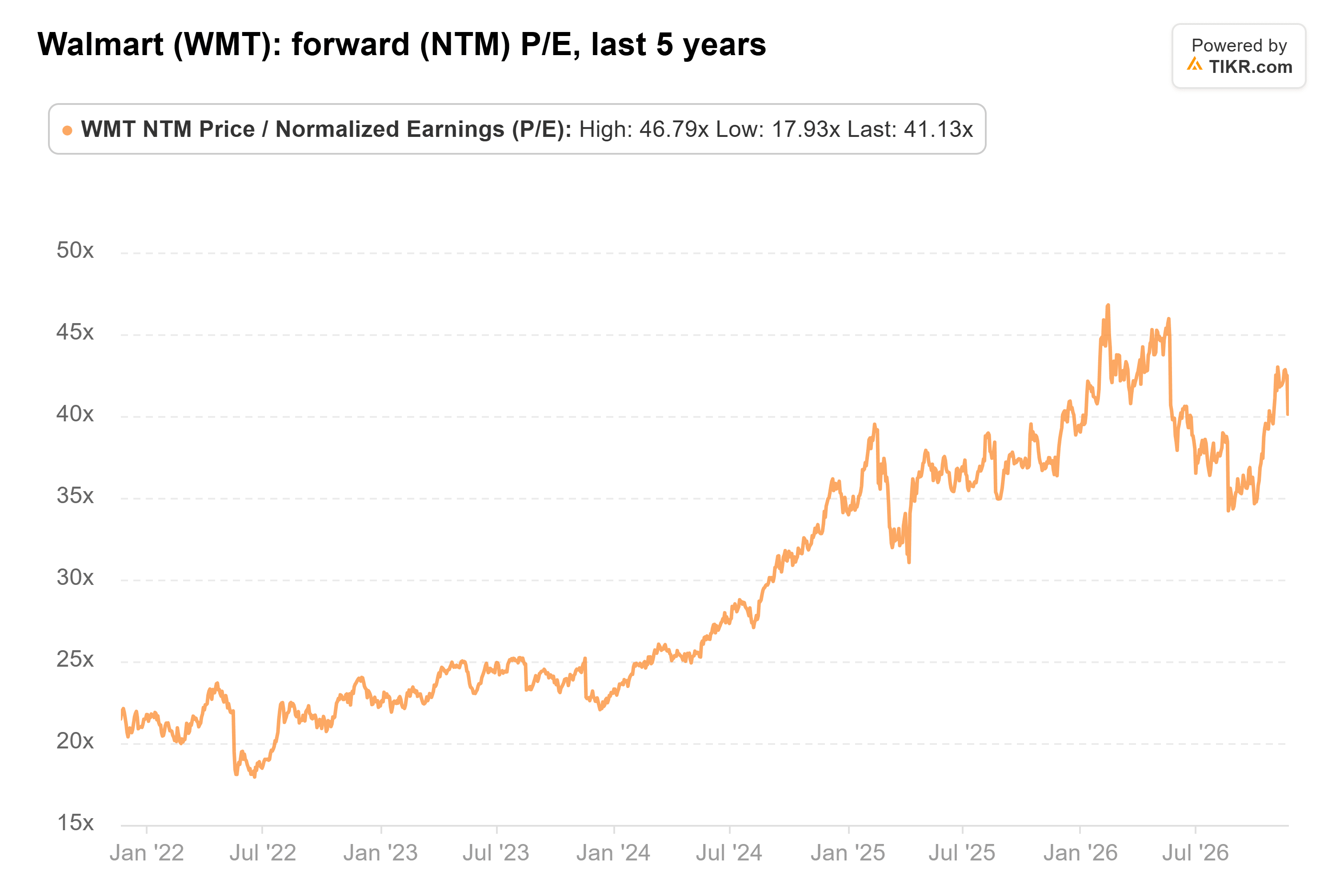
On Nov. 19, Walmart raised its outlook again, to adjusted EPS of $2.84 to $2.89 for the year ending January 2027. That range still carries the refund quarter. Next year’s won’t, and at 41x, the growth has to come from the business itself.
Adjusted earnings keep the refunds in
Target and Home Depot don’t strip the refunds out of adjusted earnings either. Target’s full-year guidance of $10.65 to $11.40 a share is the same on both bases and includes about $2.14 of refunds booked so far. Take those out, and the midpoint falls to $8.89, below the $8.94 Target earned in fiscal 2023 (the year ended February 2024).
Home Depot’s adjusted EPS takes out only acquisition amortization, so any refunds it books stay in. It received about $730 million of refunds near the end of June and said the money would help offset higher fuel, energy and other input costs. Its operating margin fell from 15.3% in the year ended January 2023 to 13.5% two years later:

Only about $55 million of refunds reached Home Depot’s third-quarter cost of sales, and adjusted EPS grew just 3.2%, to $3.86. A quarter helped by refunds can sit on top of that trend without changing it.
Amazon has less riding on all this. It received about $600 million of refunds in its second quarter, and CFO Brian Olsavsky said on the July 30 call that Amazon is “not the importer of record for the large majority of items sold in our store.” Refunds go to the importer of record.
Next year has to stand on its own
The refunds make this year’s retail earnings look better than the businesses behind them. Lowe’s and Walmart are both putting the money back into customers, but Walmart is the stock priced richest on earnings the refunds helped.
Walmart’s outlook for the year ending January 2028 comes in February. Lowe’s investor conference in December will show where its margins settle once the refunds are spent, and if no more refunds arrive, Target’s underlying earnings need to grow about 24% next year just to match this year’s guidance midpoint. Still, about $166 billion of tariffs are due to be refunded in total, so more money could still come in.
So what is Walmart stock actually worth?
TIKR lets you forecast the future price of any stock in less than a minute. Just enter a few assumptions into TIKR’s valuation model and see what Walmart could be worth. Start from Wall Street consensus estimates, or adjust the inputs to reflect your own view of the business. It’s free to use.
Disclaimer:
Please note that the articles on TIKR are not intended to serve as investment or financial advice from TIKR or our content team, nor are they recommendations to buy or sell any stocks. We create our content based on TIKR Terminal’s investment data and analysts’ estimates. Our analysis might not include recent company news or important updates. TIKR has no position in any of the stocks mentioned. Thank you for reading, and happy investing!