


Key Stats for ExxonMobil Stock
- Current Price: $163.54
- Target Price (Mid): ~$170
- Street Target: ~$171
- Potential Total Return: ~4%
- Annualized IRR: ~1% / year
Now Live: Discover how much upside your favorite stocks could have using TIKR’s new Valuation Model (It’s free) >>>
What Happened?
ExxonMobil (XOM) is close to walking back into a country that pushed it out nearly two decades ago, and the stock barely blinked. The Wall Street Journal reported on September 16 that the company is nearing a preliminary deal with state-run Petróleos de Venezuela to explore investing in several developed and undeveloped fields, a return to the Orinoco Belt roughly 19 years after Venezuela nationalized its assets in 2007. Shares slipped less than 1% on the news and still sit near $163.54, up around 37% in 2026.
Investors have already paid up for a record year built on high oil prices and refining margins, and a headline about 50 billion barrels of oil in the ground is not the same thing as cash in hand. The question is whether the next leg of this story is already in the price.
The Venezuela Headline Is Optionality
What ExxonMobil is reportedly close to signing is a memorandum of understanding, and the talks could still collapse or slip past September. This is also a separate, smaller track from the larger US-government arrangement in Venezuela that Exxon was left out of. The fields in Exxon’s own talks reportedly hold a combined 50 billion barrels, but that is a geological estimate of oil in place, not booked reserves and not production. President Trump has publicly said Exxon is “going in,” yet neither the company nor Venezuelan authorities have filed anything describing terms, timing, or scale.
A return would hand ExxonMobil access to a vast, low-cost resource base at a moment when it is already the industry’s benchmark for project execution. It would also drop that resource into one of the highest-risk jurisdictions on earth, the same one that expropriated its assets in 2007. The market’s shrug reflects exactly that: real optionality, no bookable value, and a long road from an MOU to a barrel produced.
CFO Neil Hansen described the company’s discipline on new resource access at the Barclays Energy and Power Conference on September 9. On how ExxonMobil evaluates deals, he said the bar is high: “It really has to be one plus one is three or more. I mean it can’t just be a view on getting the assets or getting the volume.” That is the right lens for Venezuela. The barrels are real, but the value depends on terms Exxon has not yet agreed to.

See historical and forward estimates for ExxonMobil stock (It’s free!) >>>
Guyana and the Permian Are the Cash Engine
Second-quarter results, reported July 31, delivered free cash flow of $17.2 billion. Revenue of $116.0 billion beat the Street’s $97.7 billion by nearly 19%, though adjusted EPS of $3.52 landed just shy of the $3.63 consensus as refinery maintenance and higher costs offset some of the gains from stronger prices. The quarter ran on high crude prices and a refining market squeezed tight by the ongoing Strait of Hormuz disruption, which has kept Brent near $90 to $100 for much of the year.
Underneath the commodity tailwind, two assets do the structural work. In Guyana, ExxonMobil hit a milestone this quarter when its cost-bank recovery, the mechanism that lets it recoup project spending before profit-sharing shifts, desaturated roughly two years ahead of schedule. Hansen spelled out why it matters: the milestone means “double the amount of free cash flow between 2025 and 2030.” The near-term cost is slightly lower entitlement volumes, about 100,000 barrels a day starting in the third quarter, but the trade is more cash, sooner.
The Permian is the second engine, and the Pioneer acquisition has outrun its own plan. Hansen said the company originally targeted about $2 billion a year in synergies and “we’ve been able to double that,” crediting ExxonMobil’s technology and lessons pulled from Pioneer. Both feed a larger goal Hansen said the company is gaining confidence in: roughly $25 billion in earnings growth and $35 billion in cash flow growth by 2030.
See how ExxonMobil performs against its peers in TIKR (It’s free!) >>>
TIKR Advanced Model Analysis
- Current Price: $163.54
- Target Price (Mid): ~$170
- Potential Total Return: ~4%
- Annualized IRR: ~1% / year

See analysts’ growth forecasts and price targets for ExxonMobil stock (It’s free!) >>>
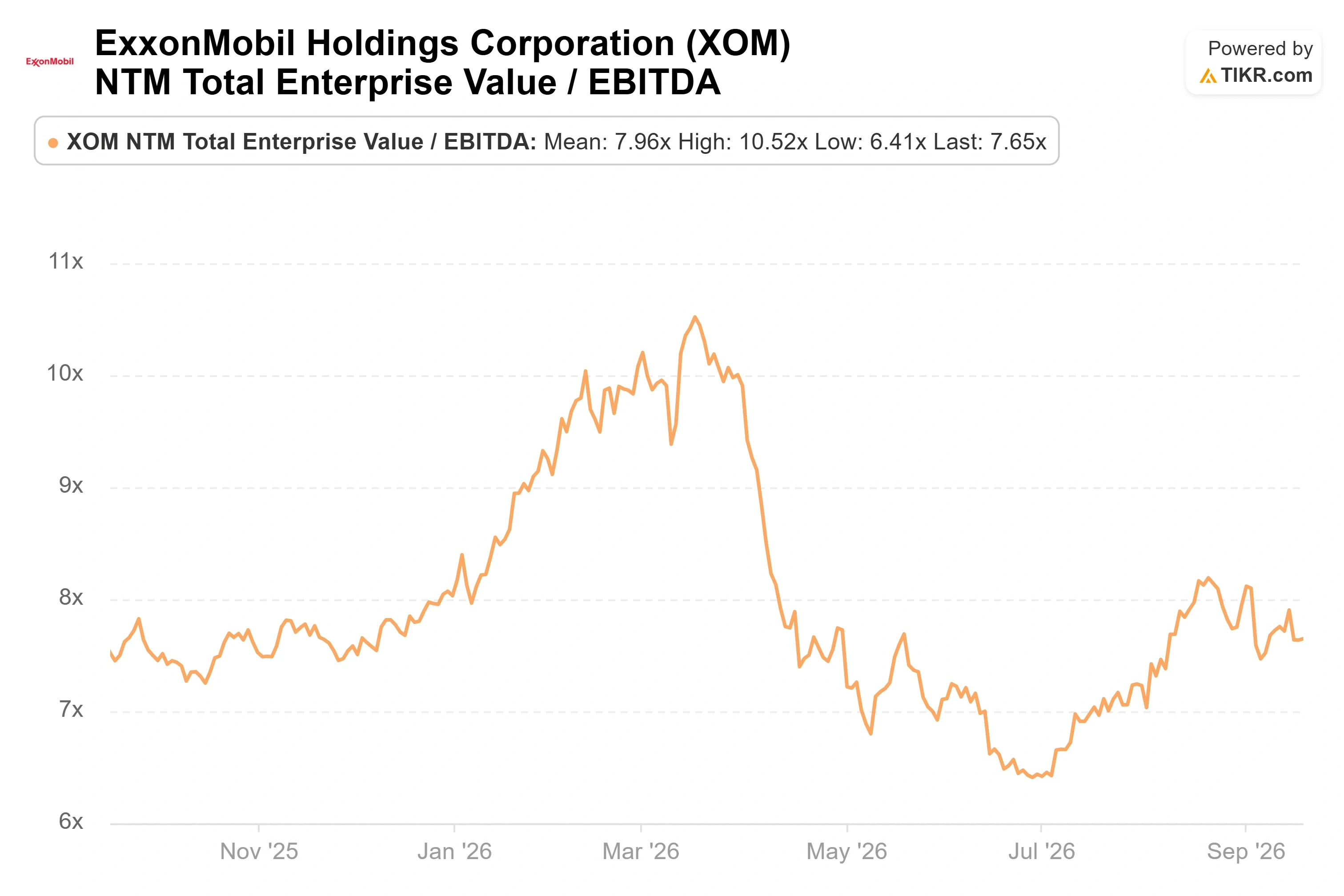
The mid-case runs on a revenue CAGR of around 2%, driven by Permian volume growth and the ramp of Golden Pass LNG, which delivered its first cargo earlier in 2026. Net income margin expands from about 9.6% toward roughly 10.3%, supported by the structural cost-savings program and a richer mix of advantaged barrels. On NTM EV/EBITDA, XOM trades at 7.65x, a premium to majors like TotalEnergies at 4.78x and PetroChina at 4.42x, which its balance sheet and growth assets have so far justified. The high case, on sustained prices and faster margin capture, points toward the high-$240s; even the low case sits near $167, because normalized crude still leaves this a cash-rich business. Venezuela is in none of these numbers, by design: it is optionality the model cannot yet price.
Conclusion
The next real test is whether the MOU becomes a signed agreement with disclosed terms, and whether it lands this month as the reporting suggested it could. Favorable terms would put value on the table the model cannot currently see. A collapse, or terms that echo the risk that burned Exxon in 2007, leaves the thesis where the numbers already have it: a best-in-class operator at a fair price, with most of the 2026 rally already banked. Watch for a filing. Until one appears, a buyer at $164 is paying for quality that is already recognized.
See what stocks billionaire investors are buying so you can follow the smart money with TIKR.
Should You Invest in ExxonMobil?
The only way to really know is to look at the numbers yourself. TIKR gives you free access to the same institutional-quality financial data that professional analysts use to answer exactly that question.
Pull up ExxonMobil, and you’ll see years of historical financials, what Wall Street analysts expect for revenue and earnings in the quarters ahead, how valuation multiples have moved over time, and whether price targets are trending up or down.
You can build a free watchlist to track ExxonMobil alongside every other stock on your radar. No credit card required. Just the data you need to decide for yourself.
Analyze ExxonMobil on TIKR Free →
Looking for New Opportunities?
- See what stocks billionaire investors are buying so you can follow the smart money.
- Analyze stocks in as little as 5 minutes with TIKR’s all-in-one, easy-to-use platform.
- The more rocks you overturn… the more opportunities you’ll uncover. Search 100K+ global stocks, global top investor holdings, and more with TIKR.
Disclaimer:
Please note that the articles on TIKR are not intended to serve as investment or financial advice from TIKR or our content team, nor are they recommendations to buy or sell any stocks. We create our content based on TIKR Terminal’s investment data and analysts’ estimates. Our analysis might not include recent company news or important updates. TIKR has no position in any stocks mentioned. Thank you for reading, and happy investing!


