Key Takeaways
- Eli Lilly’s Q3 revenue rose 39% to $24.4 billion, and Mounjaro and Zepbound brought in about $16.1 billion combined.
- Lilly raised 2026 revenue guidance to $91 billion to $92 billion but trimmed EPS guidance to $35 to $36 on $4.57 per share of IPR&D charges.
- U.S. prices fell 7% in the quarter, and the stock now trades above the Street’s average target of about $1,392.
- The report expected around February 5 will show whether Foundayo’s ramp and wider obesity coverage keep volume ahead of price cuts.
Eli Lilly (LLY) keeps clearing its own bar. Third-quarter revenue rose 39% to $24.4 billion, well above the roughly $22.6 billion Wall Street expected, and the stock gained about 11% this week to $1,418.
The pipeline added fuel. Lilly’s next-generation shot retatrutide beat Ozempic, the diabetes drug from Novo Nordisk (NVO), in a head-to-head Phase 3 trial in type 2 diabetes. That’s a direct hit on the rival that built this market.
CEO David Ricks said the quarter was “exceeding our prior expectations and allowing us to raise our full-year outlook.”
There’s one wrinkle. Lilly’s stock now sits above the Street’s average price target.
Two drugs, $16 billion
Mounjaro and Zepbound brought in about $16.1 billion combined:
- Mounjaro sales rose 65% to $10.72 billion.
- Zepbound climbed 49% to $5.35 billion.
- Adjusted EPS of $7.48 beat the $6.49 consensus.
Newer products in oncology, immunology and neuroscience doubled as well. Revenue did include about $900 million of one-time benefits, mostly $410 million of Jardiance milestone payments that won’t recur.
Here’s the growth curve driving the stock:
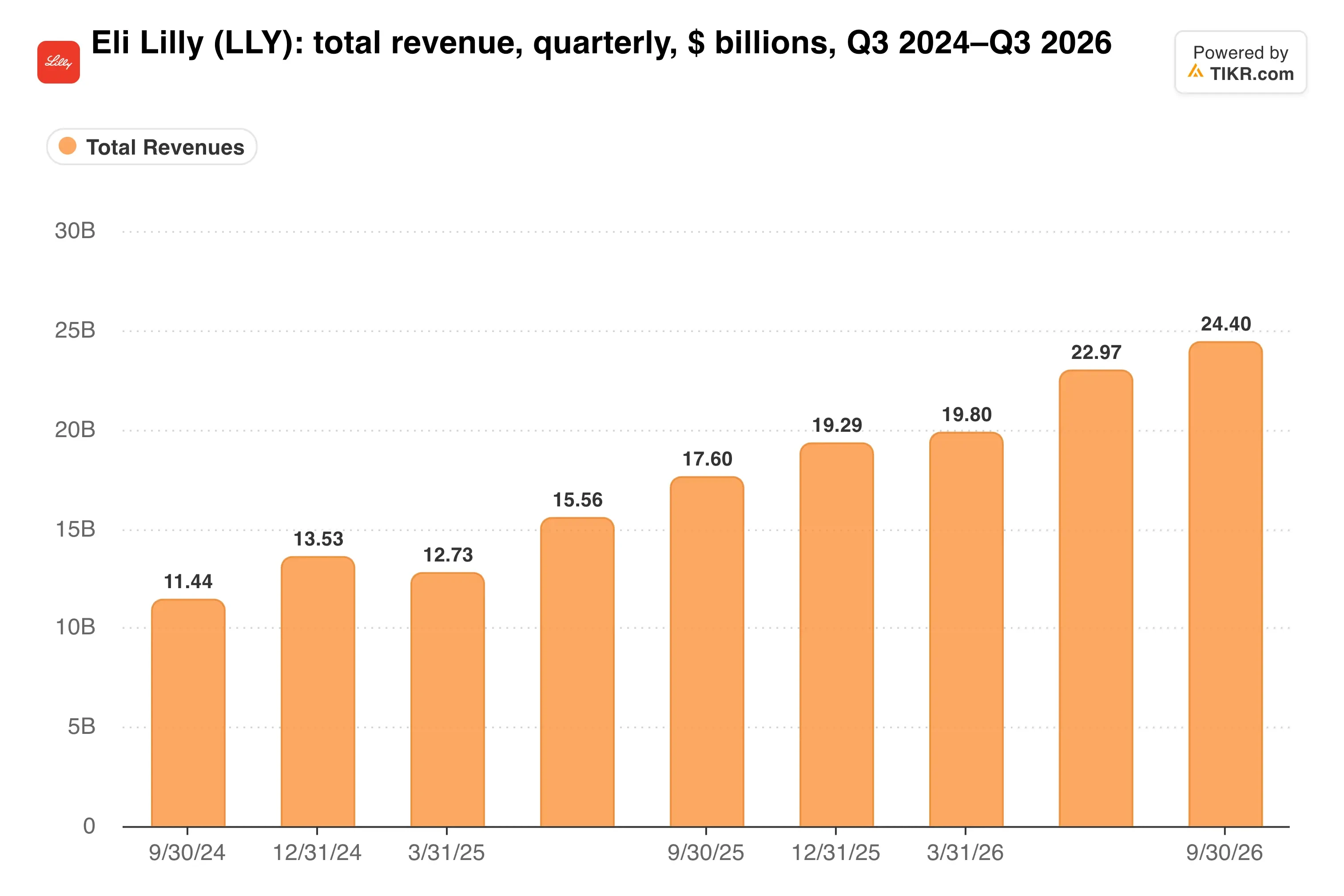
Quarterly revenue has more than doubled in two years, from $11.4 billion in Q3 2024.
Volume is outrunning price
U.S. revenue rose 34% even though realized prices fell 7%. That’s the whole Lilly bull case in one line: more patients at lower prices still adds up to far more money.
Access keeps widening. Medicare’s pilot program now offers obesity drugs to eligible beneficiaries at $50 a month, and Foundayo, the oral GLP-1, is rolling out globally. It brought in $184 million in Q3, short of the $217 million analysts expected, so the pill is still early.
Management raised 2026 revenue guidance to $91 billion to $92 billion from $85 billion to $87 billion, a $5.5 billion lift at the midpoint. It also raised its non-GAAP performance margin outlook by 2.5 percentage points to 52% to 52.5%.
And the Street’s forward numbers keep climbing…

Consensus still points to roughly 27% annual revenue growth over the next two years, a pace few megacaps can match.
TIKR tracks 31 analysts on Eli Lilly. How many say “Buy”?
See the full breakdown of Buy, Hold, and Sell ratings on Eli Lilly, along with Wall Street’s revenue and earnings estimates, all in one place. More than 500,000 investors use TIKR to research stocks like this one. See Eli Lilly’s Analyst Ratings
Priced beyond the Street’s target
The EPS line is less tidy. Lilly trimmed 2026 non-GAAP EPS guidance to $35 to $36 from $35.50 to $36.50 because $4.57 per share of acquired IPR&D charges more than offset a $4.07 underlying increase. Dealmaking is eating reported earnings, and Lilly just closed another deal for Merida Biosciences.
Valuation is the harder question. At $1,418, the stock trades above the Street’s $1,392 average target, at 30.9x forward earnings and a $1.26 trillion market value.
How does that stack up against its closest rival?
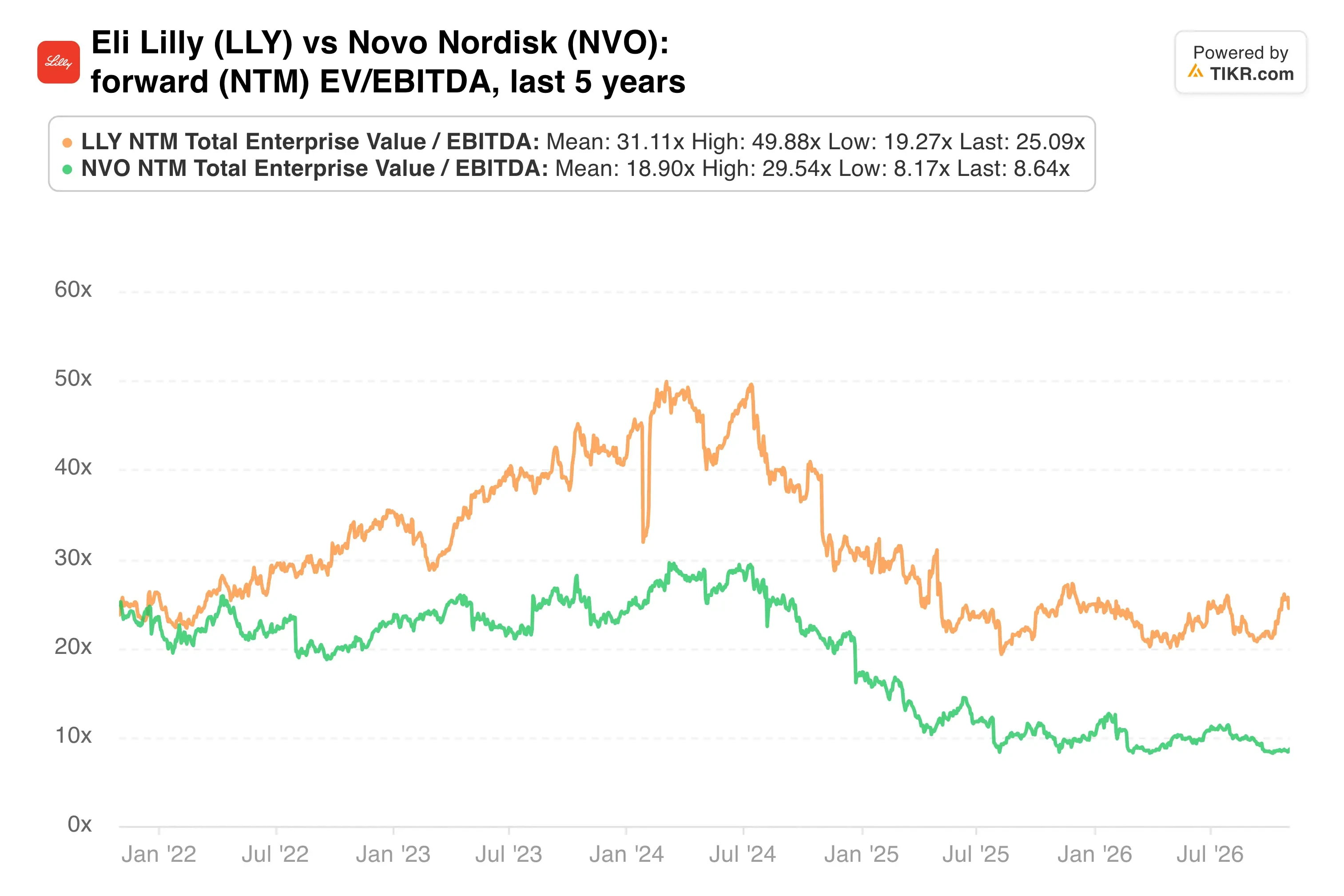
Back in May, Lilly fetched about 20x forward EV/EBITDA against roughly 10x for Novo Nordisk. Lilly’s own multiple has since climbed to 25.1x.
My take: Lilly earned this rally, since volume keeps beating a 7% price decline and the guidance raise was huge. Still, a stock above its average target leaves little room for a soft quarter, and Medicare pricing pressure won’t fade. I’d hold and add on dips rather than chase.
The next checkpoint is the fourth-quarter report, expected around February 5. It will show whether Foundayo’s ramp accelerates and whether U.S. price erosion stays near 7%.
So what is Eli Lilly stock actually worth?
TIKR lets you forecast the future price of any stock in less than a minute. Just enter a few assumptions into TIKR’s valuation model and see what Eli Lilly could be worth. Start from Wall Street consensus estimates, or adjust the inputs to reflect your own view of the business. It’s free to use.
Disclaimer:
Please note that the articles on TIKR are not intended to serve as investment or financial advice from TIKR or our content team, nor are they recommendations to buy or sell any stocks. We create our content based on TIKR Terminal’s investment data and analysts’ estimates. Our analysis might not include recent company news or important updates. TIKR has no position in any stocks mentioned. Thank you for reading, and happy investing!