Key Takeaways
- Meta Platforms (META) could face additional cash flow pressure if Democrats seek to restrict tax deductions for data center equipment during the 2027 debt ceiling negotiations.
- Microsoft (MSFT) recorded approximately $116 billion in fiscal 2026 capital expenditures, nearly five times its fiscal 2022 spending.
- Alphabet (GOOG) recorded negative $9.07 billion in third-quarter free cash flow, according to TIKR, while Amazon (AMZN) expects approximately $220 billion in 2026 cash capital expenditures.
- Meta’s aggressive AI investments and negative credit outlook make potential tax changes particularly relevant, although Democrats have not formally announced a proposal to eliminate the deduction.
What Happened?
Democrats’ victory in the November 3 midterm elections has introduced a new potential risk for technology companies investing billions of dollars in artificial intelligence infrastructure.
With Democrats set to control both chambers of Congress in January, attention is turning toward whether the next federal debt ceiling negotiations could threaten valuable tax deductions for data center equipment.
Daniel Clifton, a policy strategist at Baird Strategas, suggested on the November 6 episode of The Compound and Friends that Democrats could use the debt ceiling as leverage to pressure President Donald Trump into eliminating 100% expensing for qualifying data center equipment.
Clifton predicted that Democrats would seek to “take away 100 percent expensing of capital equipment for data centers.”
However, Democrats have not formally announced such a proposal, meaning Clifton’s comments represent a potential policy scenario rather than confirmed legislation.
The timing could still be significant.
The federal debt ceiling stands at approximately $41.1 trillion following a $5 trillion increase under the 2025 reconciliation law.
In its June 2026 assessment, the Bipartisan Policy Center projected that the government could reach its borrowing limit between late winter and mid-summer 2027.
Treasury’s cash reserves and extraordinary measures could delay the X-date, when the government can no longer meet all its financial obligations, although the timing remains uncertain.
Under legislation signed July 4, 2025, businesses can immediately deduct the full cost of qualifying equipment acquired and placed in service after January 19, 2025, as explained by BDO.
For AI infrastructure companies, eligible servers and networking equipment can qualify for these upfront deductions, while data center buildings generally do not.
Reducing immediate expensing would spread deductions over future years rather than necessarily eliminating them, potentially increasing near-term cash taxes.
That matters because the largest technology companies are already committing unprecedented amounts of money to AI infrastructure.
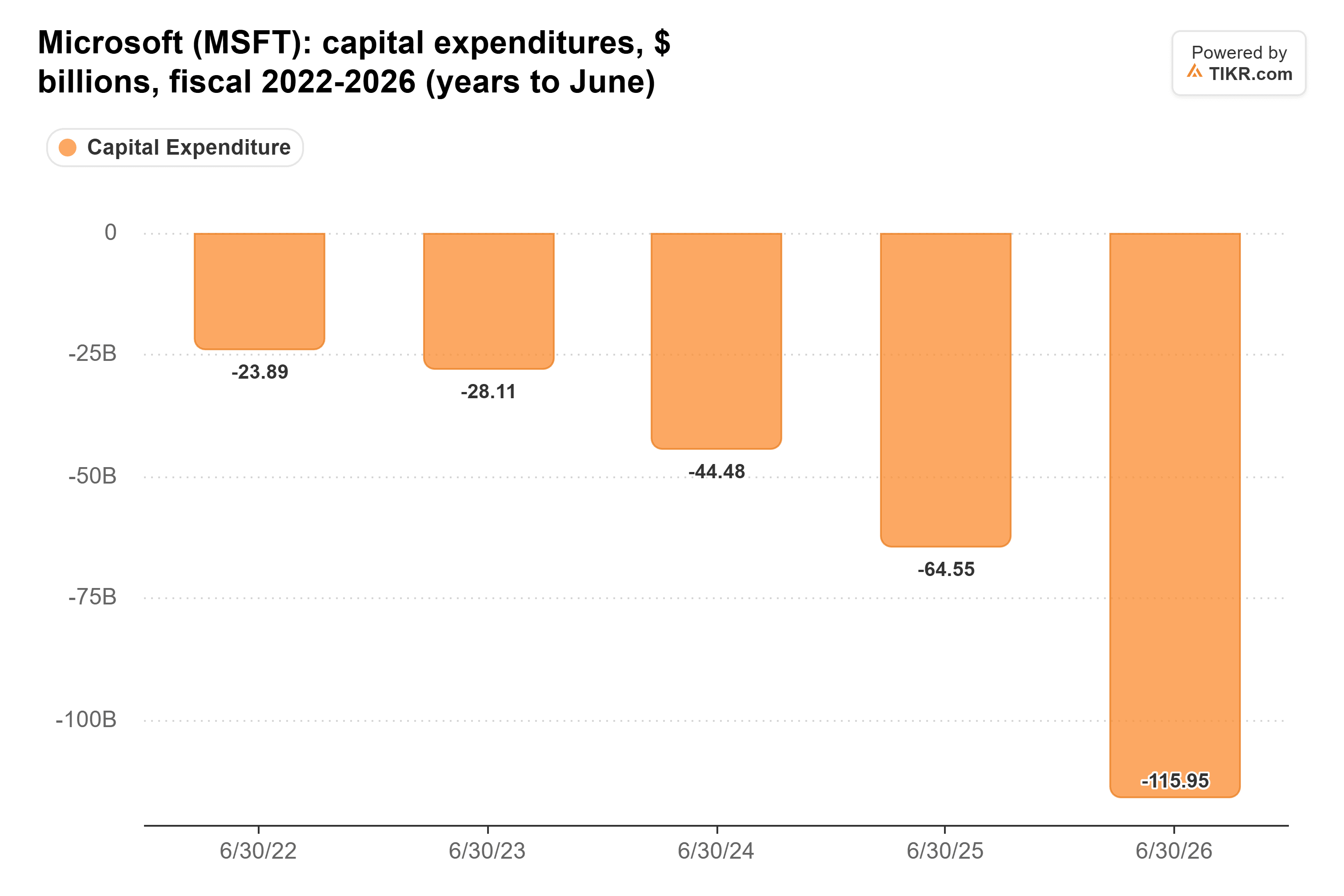
Microsoft’s capital expenditures increased from approximately $23.9 billion in fiscal 2022 to $116 billion in fiscal 2026, representing nearly fivefold growth, according to TIKR data.
As infrastructure investment accelerates, losing immediate deductions could increase the cash required to support future equipment purchases, depending on how much spending qualifies.
Why Big Tech’s Free Cash Flow Could Face More Pressure
Rising AI infrastructure spending is already weighing heavily on Big Tech’s free cash flow, making a potential tax change particularly important.
On the November 4 episode of Animal Spirits, Ritholtz Wealth Management’s Ben Carlson highlighted a chart showing that the combined free cash flow of Amazon, Alphabet, Meta, and Microsoft had turned negative.
The trend is particularly evident in Meta’s recent financial results.
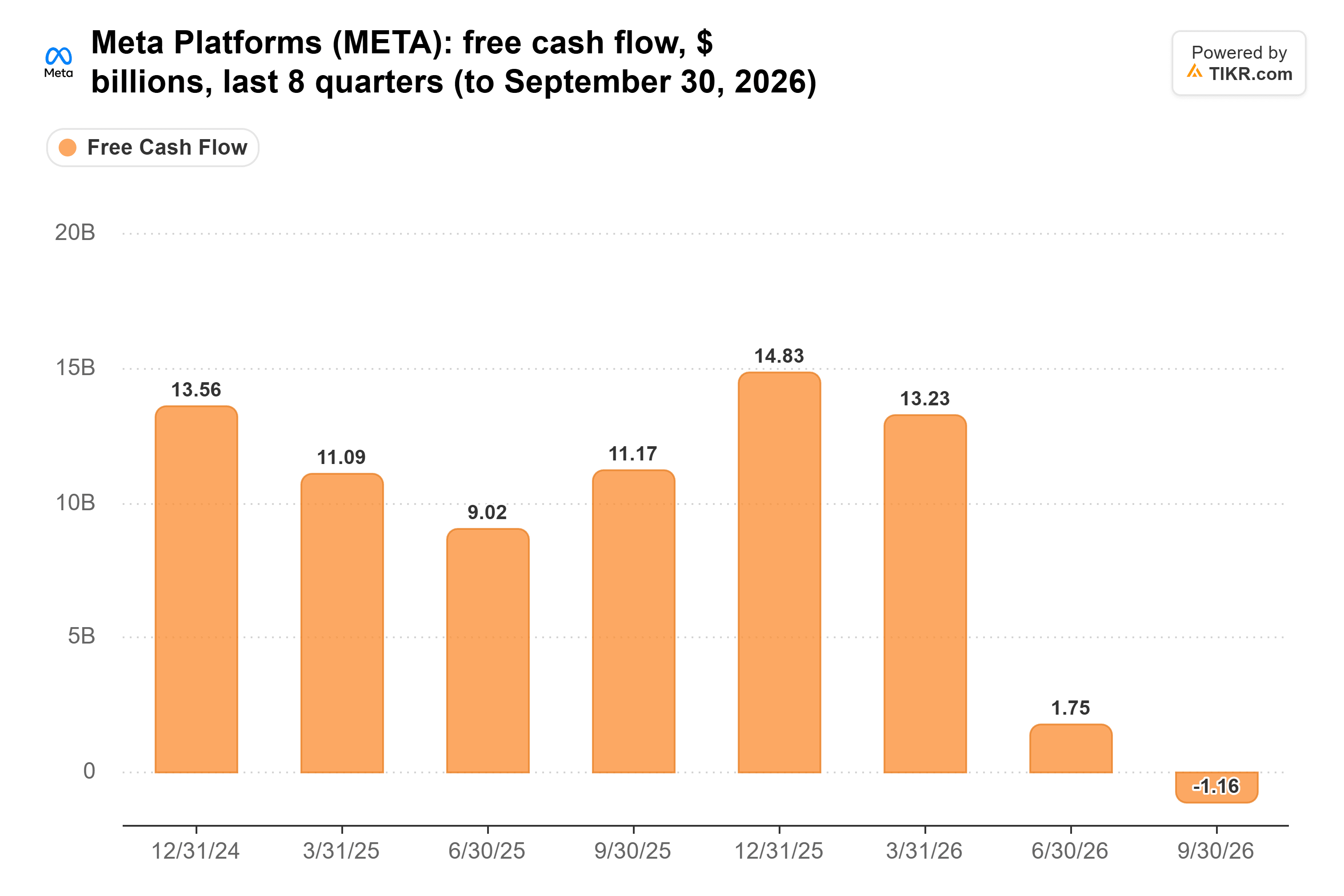
According to TIKR data, Meta’s quarterly free cash flow declined from approximately $14.8 billion in the fourth quarter of 2025 to negative $1.16 billion in the third quarter of 2026.
Meta’s third-quarter earnings release separately reported negative $2.12 billion in free cash flow under the company’s definition.
Both figures highlight the pressure that rising AI infrastructure spending is placing on Meta’s cash generation, although TIKR and the company report different free cash flow amounts for the quarter.
Meanwhile, Meta held approximately $82.45 billion in cash and marketable securities against roughly $83.7 billion in debt at September 30.
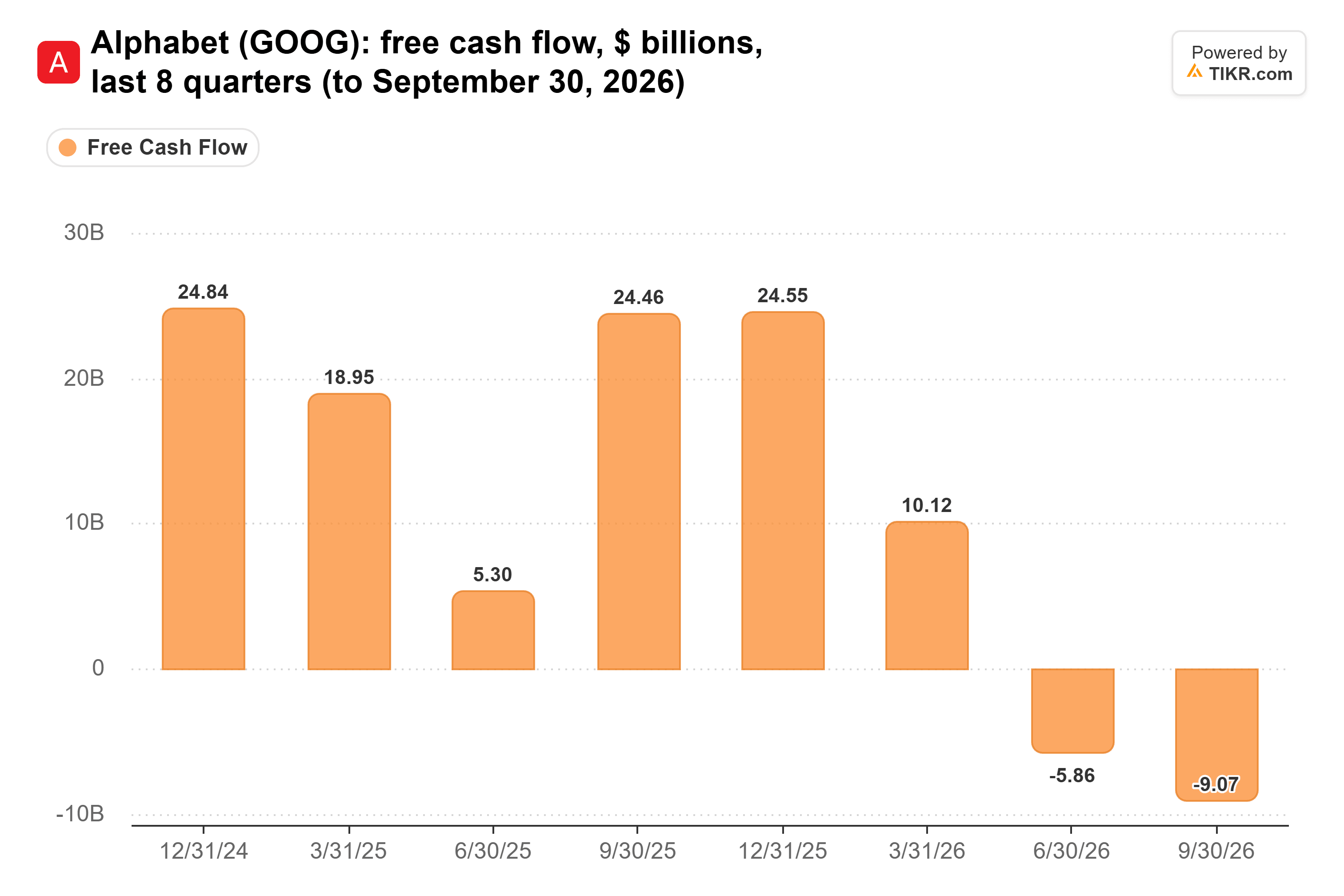
Alphabet’s quarterly free cash flow declined from approximately $24.6 billion in the fourth quarter of 2025 to negative $9.07 billion in the third quarter of 2026, according to TIKR.
Amazon is experiencing similar pressure.
According to its third-quarter earnings results, Amazon expects approximately $220 billion in cash capital expenditures for 2026.
Its trailing-12-month free cash flow declined to negative $42.4 billion, compared with positive $14.8 billion a year earlier, primarily reflecting higher property and equipment investments associated with AI.
However, these companies have different opportunities to monetize their infrastructure.
Microsoft, Amazon, and Alphabet operate major cloud businesses that sell computing services to customers. Meta primarily depends on advertising and does not operate a comparable third-party cloud business.
That makes Meta’s ability to generate returns from its AI investments especially important.
What This Means for Meta and Other AI Stocks
The biggest uncertainty is whether Democrats can translate their potential negotiating leverage into actual tax legislation.
President Trump retains veto authority, and any agreement could preserve existing equipment deductions while gradually reducing benefits for future purchases.
The financial impact would also depend on how legislation treats existing assets, future equipment purchases, and depreciation schedules.
Even if deductions remain available over several years, slower depreciation could weaken near-term cash flow while technology companies continue funding infrastructure expansion.
For Meta, the stakes may be especially high.
The company expects capital expenditures of $135 billion to $145 billion in 2026, according to its latest earnings release, as it continues investing in AI infrastructure and computing capacity.
On October 30, S&P Global Ratings revised Meta’s credit outlook to negative, citing uncertainty surrounding elevated capital expenditures and future free operating cash flow.
An unfavorable tax change could add another layer of pressure if Meta maintains its aggressive investment plans.
However, restrictions on new data center construction could also benefit companies with substantial existing computing capacity if constrained supply makes that capacity more valuable.
Microsoft, Alphabet, and Amazon could be better positioned to capitalize on that scenario through their established cloud businesses.
Meta faces a different challenge because its ability to generate returns depends heavily on using AI to strengthen advertising performance, engagement, and future products.
Meta appears particularly sensitive to the potential policy change, although that does not automatically make it the least attractive stock.
Its longer-term valuation will depend on whether advertising growth and AI monetization can offset rising infrastructure costs and support stronger future free cash flow.
Until policymakers introduce concrete legislation, the proposed tax change remains a risk to monitor rather than a confirmed financial headwind.
The next developments to watch are the incoming Congress’s fiscal priorities, negotiations surrounding the 2027 debt ceiling, and updated AI capital spending guidance from the major technology companies.
So what is Meta stock actually worth?
TIKR lets you forecast the future price of any stock in less than a minute. Just enter a few assumptions into TIKR’s valuation model and see what Meta could be worth. Start from Wall Street consensus estimates, or adjust the inputs to reflect your own view of the business. It’s free to use.
Disclaimer:
Please note that the articles on TIKR are not intended to serve as investment or financial advice from TIKR or our content team, nor are they recommendations to buy or sell any stocks. We create our content based on TIKR Terminal’s investment data and analysts’ estimates. Our analysis might not include recent company news or important updates. TIKR has no position in any of the stocks mentioned. Thank you for reading, and happy investing!