Key Takeaways
- At today’s prices, $1,000 a month in dividends takes 4,919 shares of General Mills (about $168,200), 7,500 shares of Kraft Heinz (about $181,900) or 10,257 shares of Hormel Foods (about $225,300).
- Kraft Heinz’s check is the one I’d want, since its dividend takes 50% of its free cash flow, though it paid $1.60 a share in fiscal 2020 and the same in fiscal 2025.
- General Mills is the cheapest and the least covered, at 85% of free cash flow, and plans to hold its dividend flat while it pays down debt.
- Hormel has the lightest debt, but its fiscal 2025 dividends were bigger than its free cash flow, and it’s borrowing for a $1.055 billion acquisition.
Any retiree hunting for dividend income is going to look hard at General Mills (GIS), Hormel Foods (HRL) and Kraft Heinz (KHC) right now. All three yield more than 5% at today’s prices.
Here’s what it takes to collect $12,000 a year in dividend checks, or $1,000 a month, from just one of them:
| Stock | Shares needed | Cost | Yield | Income a month | Cash dividend payout ratio (TTM / forward) |
|---|---|---|---|---|---|
| General Mills (GIS) | 4,919 | $168,230 | 7.1% | $1,000 | 85% / 76% |
| Hormel Foods (HRL) | 10,257 | $225,346 | 5.3% | $1,000 | 82% / – |
| Kraft Heinz (KHC) | 7,500 | $181,875 | 6.6% | $1,000 | 50% / 64% |
Source: TIKR and StockAnalysis, at today’s prices; dividends at each company’s current annual rate, whole shares only.
With a higher yield, you pay less for the same income, and the gap between the cheapest and the priciest here is about $57,100. But a retiree also needs the check to keep coming.
6 safe dividend stocks paying retirees 6%+ yields
There are over 100 stocks paying 6%+ annual dividends today.
But after an extensive investment review leveraging TIKR’s proprietary data, we now believe only six of them are truly safe for retirees.
They’re all yours for free as part of our new investment report, which you can access right here.
General Mills is the cheapest, and the most stretched
General Mills is slimming down. The sale of its US yogurt business cut first-quarter net sales (the quarter to Aug. 30) 3% from a year earlier, to $4.4 billion.
Free cash flow fell from $2.29 billion in fiscal 2025 to $1.63 billion in fiscal 2026 (the year to May), against $1.32 billion of dividends:
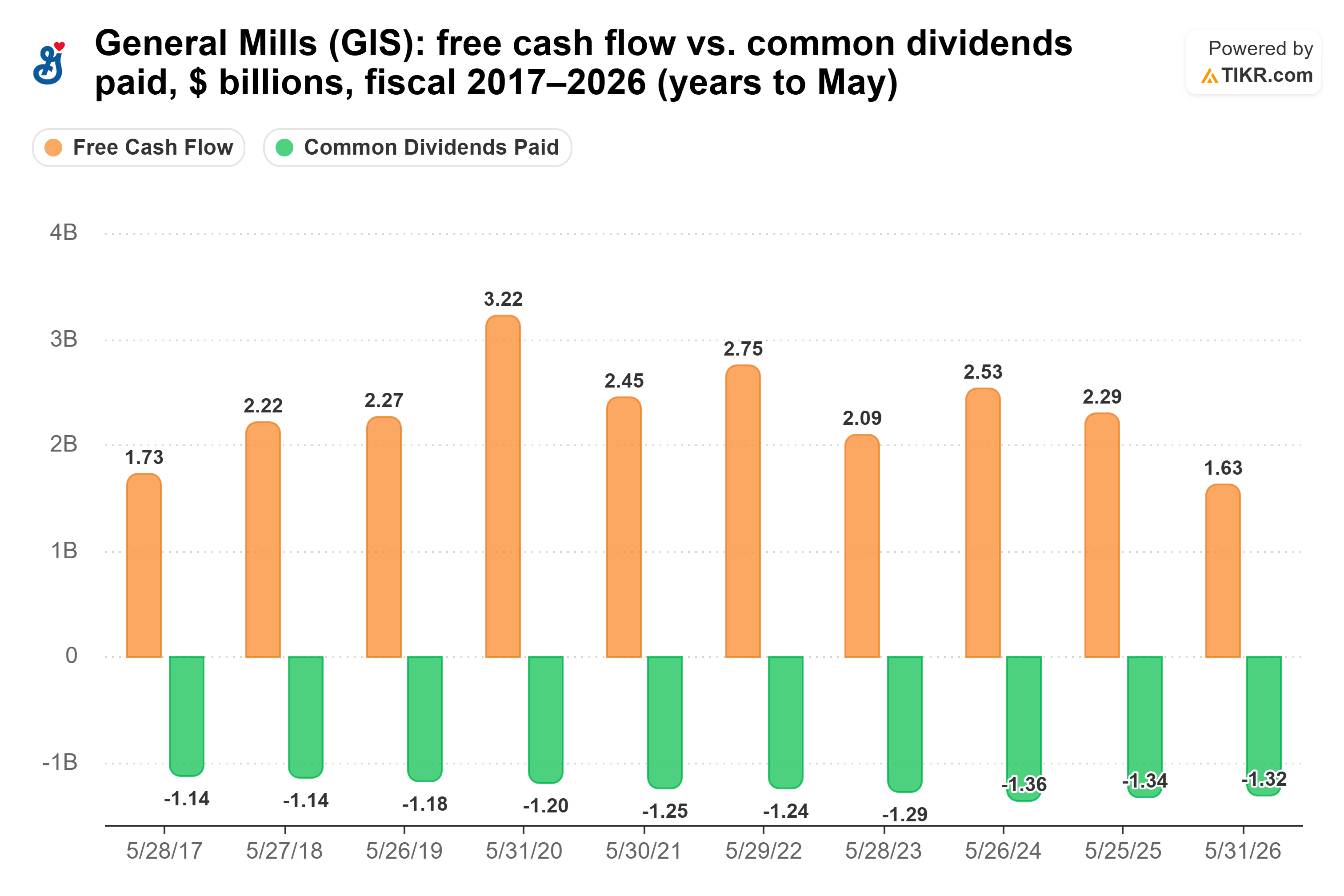
That took the cash dividend payout ratio from 50.8% in fiscal 2021 to 80.9% in fiscal 2026, and to 85% over the twelve months to Aug. 30.
CFO Kofi Bruce said “we remain fully committed to our dividend, and in the near term, we expect to maintain the current rate per share while we prioritize deleverage.” The board held the quarterly dividend at $0.61 on Sept. 29. Net debt is 3.7x EBITDA, and Bruce expects “at least a couple of years” to get back to the company’s 3x target.
Hormel has the least debt and the priciest check
Hormel is the opposite case. Net sales slipped to $2.96 billion in its fiscal third quarter (to July 26), from $3.03 billion a year earlier, as it exited whole-bird turkey and private-label nuts and pressured shoppers bought less.
Free cash flow covered the dividend every year from fiscal 2016 to fiscal 2024, then fell short in fiscal 2025 (the year to October):
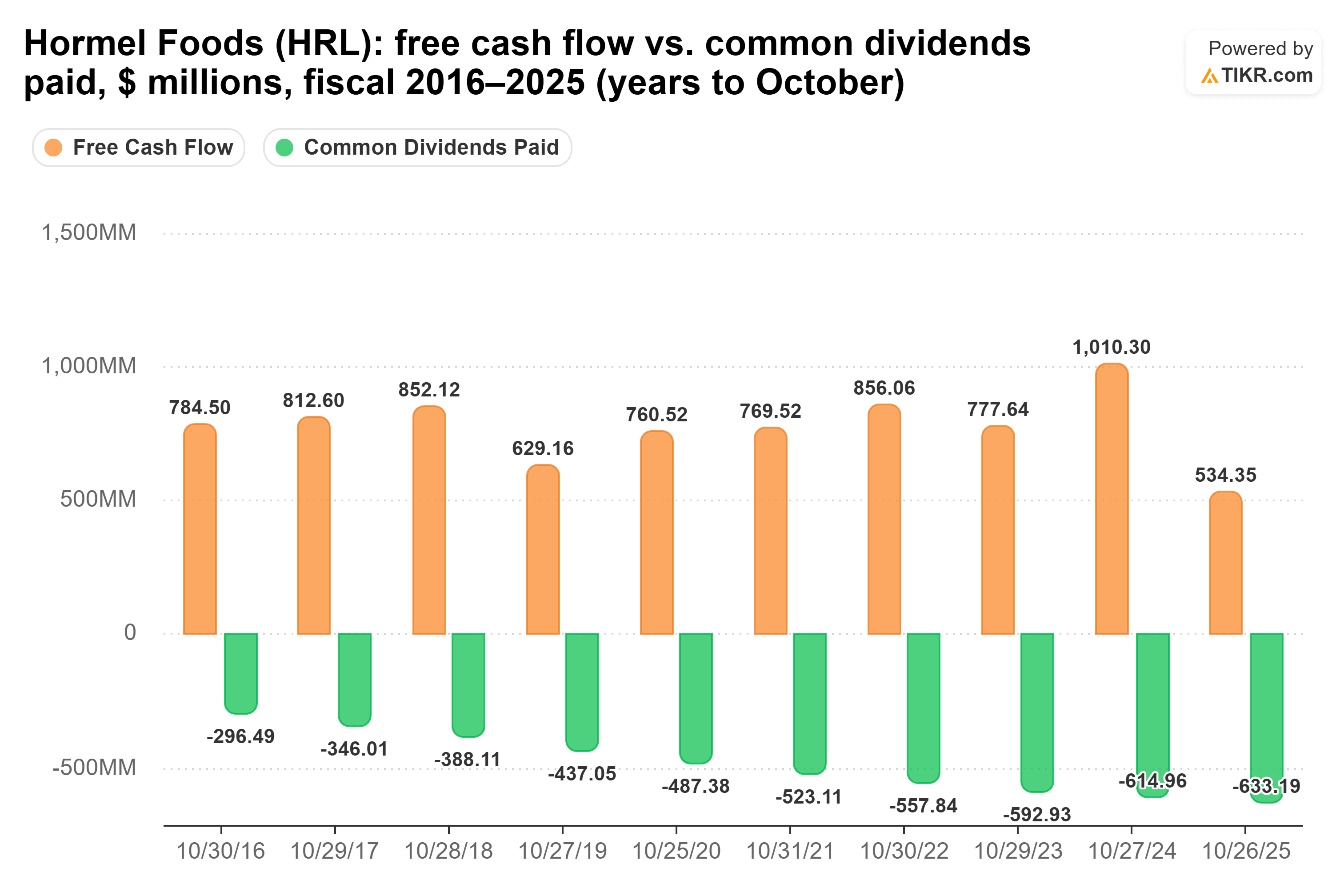
Free cash flow dropped from $1.01 billion in fiscal 2024 to $534 million in fiscal 2025, against $633 million of dividends, a cash dividend payout ratio of 118.5%. It’s back to 82% over the twelve months to July 26.
Net debt is just 1.2x EBITDA. But on Sept. 30, Hormel agreed to buy chicken company Brakebush Brothers for $1.055 billion, paid with cash on hand and new debt, and doesn’t expect the deal to add to adjusted EPS until fiscal 2028. On Sept. 28, Hormel declared its 393rd consecutive quarterly dividend, after raising it from $0.93 a share in fiscal 2020 to $1.16 in fiscal 2025, 4.5% a year.
Kraft Heinz has the most cash to spare
Kraft Heinz’s third quarter (to Sept. 26) beat analysts’ estimates, and the company raised its 2026 adjusted EPS guidance to $2.07-$2.13, from $2.03-$2.09. On Nov. 4, it agreed to sell its North American coffee business at a $650 million enterprise value, keeping a 30% stake and putting about $500 million of after-tax proceeds toward debt.
Since fiscal 2019, free cash flow has covered the dividend every year except fiscal 2022:
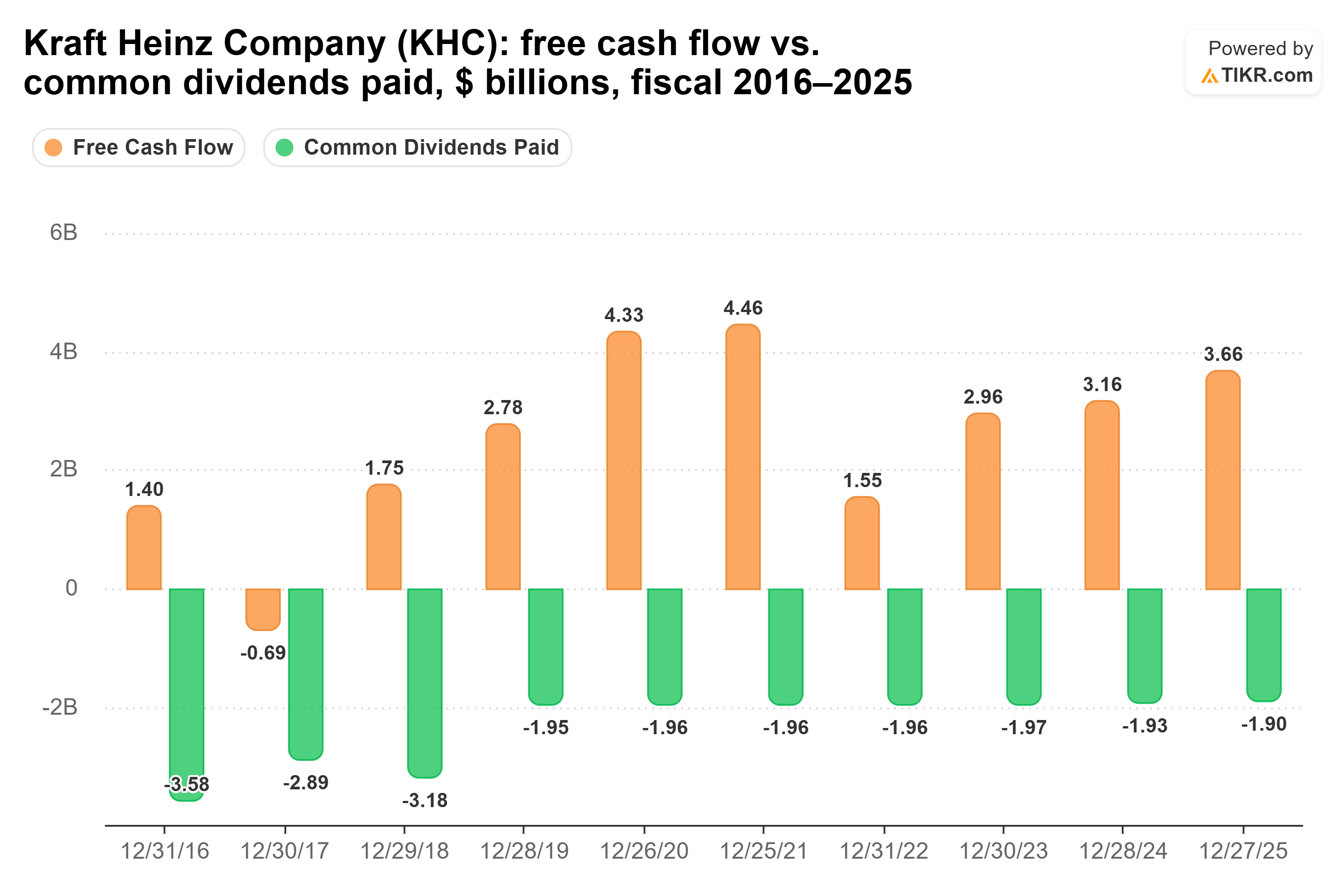
Before that, dividends paid dropped from $3.18 billion in fiscal 2018 to $1.95 billion in fiscal 2019, after free cash flow fell short of them three years running. Today the cash dividend payout ratio is 50% over the twelve months to June 27. Analysts expect 64% for 2026, as free cash flow falls 19% with the company guiding adjusted operating income down 16%-18% in constant currency. Net debt is 2.7x EBITDA, and the dividend was $1.60 a share in fiscal 2020 and the same $1.60 in fiscal 2025.
I’d take Kraft Heinz’s check
If I needed $1,000 a month from just one of these, I’d buy Kraft Heinz. Its dividend takes half its free cash flow today and 64% on this year’s estimates, a cushion neither of the others comes close to. For a retiree, a check that can survive a bad year matters more than a slightly cheaper one. The price is growth: with no raises, those shares still pay about $12,000 in year 10, where Hormel’s would pay about $17,900 at its five-year pace.
Hormel’s case is a good one: the least debt, 393 straight quarterly payouts and the only dividend here still rising. But it costs about $57,100 more than General Mills for the same income.
General Mills, at 85%, is the least covered and the most at risk. That doesn’t make it truly risky, since management has committed to the dividend and analysts see the ratio easing to 76%. The likelier cost is a check stuck at $0.61 a quarter while the company pays down debt, and for the lowest price of the three, plenty of retirees will take that trade.
Of course, Kraft Heinz still has to get its US business growing again, and CEO Steve Cahillane said “you’ll see more pricing in ’27.” If shoppers push back, that 64% is the number to watch.
Forget Kraft Heinz: 6 safe 6%+ dividend yields you can buy right now
Dividends can hold the key to enormous wealth. But only if you buy the right ones.
Picking the right high-yield dividend stock can be the difference between a dream retirement…and scraping by every month, waiting for the next Social Security check to clear.
We’ve identified six stocks yielding 6%+ that we believe every retiree should know about right now. (And Kraft Heinz isn’t one of them.)
Disclaimer:
Please note that the articles on TIKR are not intended to serve as investment or financial advice from TIKR or our content team, nor are they recommendations to buy or sell any stocks. We create our content based on TIKR Terminal’s investment data and analysts’ estimates. Our analysis might not include recent company news or important updates. TIKR has no position in any of the stocks mentioned. Thank you for reading, and happy investing!