Key Takeaways
- Kimberly-Clark closed its Kenvue acquisition on Nov. 2, while Colgate-Palmolive raised its 2026 earnings outlook on Oct. 30.
- Kimberly-Clark yields 4.6% and Colgate-Palmolive 2.2%, and both raised their dividends 3.3% a year from fiscal 2020 to fiscal 2025.
- Colgate-Palmolive’s dividend used 48% of its free cash flow over the twelve months to Sept. 30, against 87% at Kimberly-Clark.
- Kimberly-Clark’s new debt and shares from the Kenvue deal are the thing to watch for its dividend from here.
Kimberly-Clark (KMB) closed the biggest deal in its history on Nov. 2. It bought Kenvue and its Tylenol and Zyrtec brands with billions in new debt and about 281.1 million new shares.
Whereas three days earlier, Colgate-Palmolive (CL) raised its 2026 earnings outlook after a third quarter that beat expectations. For anyone buying for income, that sets up a real choice. Kimberly-Clark yields 4.6% today, more than twice Colgate’s 2.2%, but Colgate’s dividend has far more cash behind it.
So which one pays you more over the next 10 years?
| Metric | Kimberly-Clark (KMB) | Colgate-Palmolive (CL) |
|---|---|---|
| Yield at current dividend | 4.6% | 2.2% |
| Annual dividend | $5.12 | $2.12 |
| Dividend growth, fiscal 2020-2025 | 3.3% a year | 3.3% a year |
| Cash dividend payout ratio (TTM to Sept. 30, 2026) | 87% | 48% |
| Net debt/EBITDA (LTM) | 1.2x | 1.2x |
| Interest coverage (LTM) | 13.1x | 17.6x |
Source: TIKR and StockAnalysis, prices as of Nov. 9, 2026.
6 safe dividend stocks paying retirees 6%+ yields
There are over 100 stocks paying 6%+ annual dividends today.
But after an extensive investment review leveraging TIKR’s proprietary data, we now believe only six of them are truly safe for retirees.
They’re all yours for free as part of our new investment report, which you can access right here.
Kimberly-Clark pays a big check from a tight cushion
Kimberly-Clark’s third quarter was soft on sales and strong on profit. Organic sales fell 1.3% from a year earlier, while adjusted EPS from continuing operations rose 17.2% to $1.70. North America tissue is growing, and so is e-commerce, at north of 20%. Management says diaper demand in China has stabilized after a social media scare, though the recovery will take time.
The dividend is tightly covered. Over the twelve months to Sept. 30, $1.69 billion of dividends used 87% of its $1.94 billion of free cash flow. In fiscal 2025 the dividend took slightly more than all of it, at 101%. Free cash flow has swung from year to year since fiscal 2016, while the dividend has climbed every year:
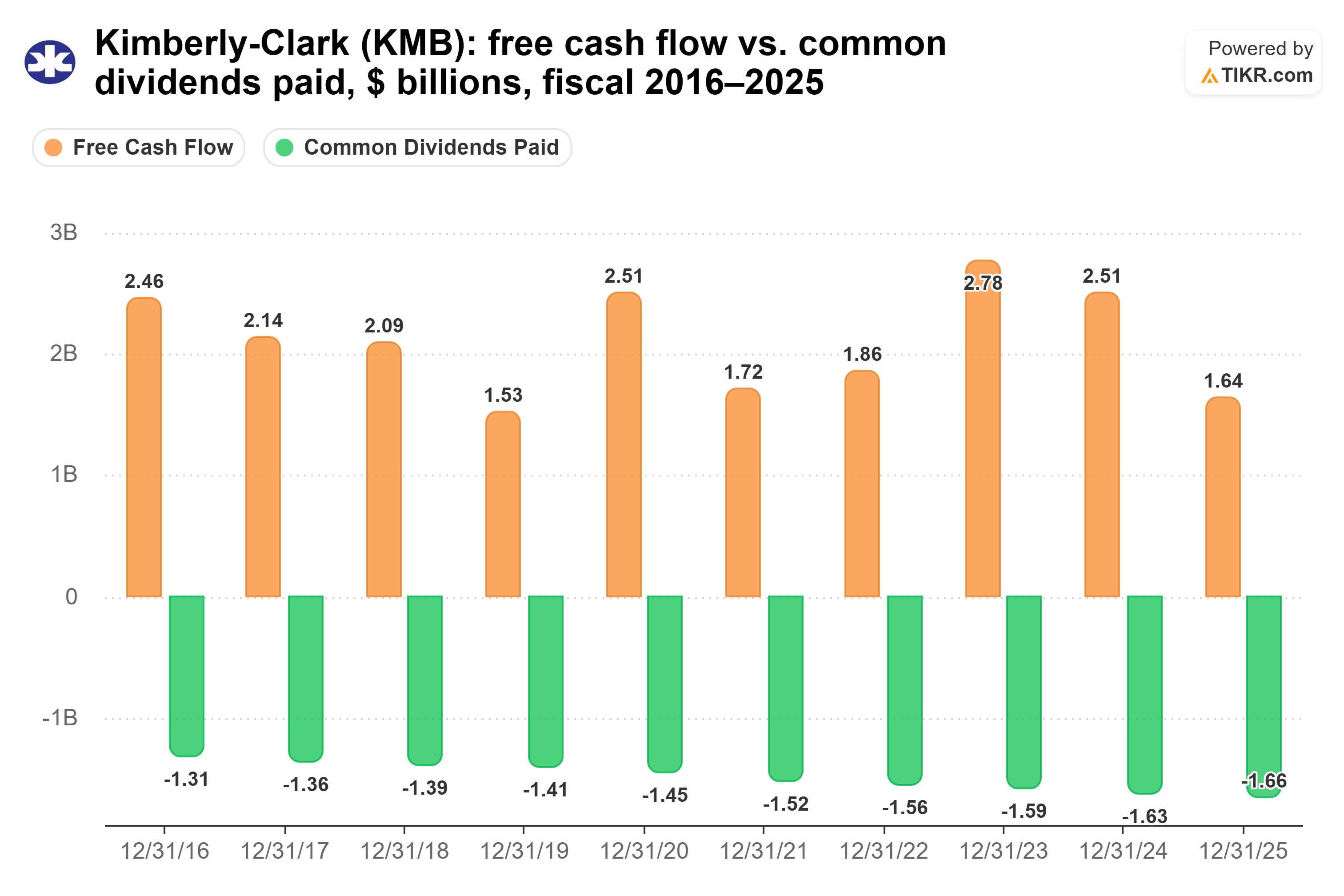
Cash from operations is recovering, at $2.4 billion for the first nine months of 2026, up from $1.8 billion a year earlier.
Kenvue changes the picture from here. Kimberly-Clark priced $4.9 billion of new notes on Oct. 20 and borrowed about $1.0 billion of commercial paper. By Nov. 4 it had also swapped about $6.4 billion of Kenvue’s notes for its own. Every one of those roughly 281.1 million new shares collects the $1.28 quarterly dividend too. Management expects mid-single-digit dilution to 2027 EPS against Kimberly-Clark on its own, and it’s counting on $2.1 billion of run-rate synergies to get leverage to about 2x by the end of the deal’s second year.
Colgate-Palmolive has room to spare
Colgate is the mirror image: a smaller check with plenty of cash behind it. Third-quarter organic sales rose 3.6%, and base business EPS rose 7% to $0.97. On Oct. 30, it raised its 2026 base business EPS growth outlook to 5%-7%, up from mid-single digits, and the stock jumped 5% on the report. Latin America and Hill’s Pet Nutrition led the growth. North America is still a turnaround, with organic sales down 1.6% and operating profit down 11% in the quarter.
Over the twelve months to Sept. 30, Colgate’s $1.83 billion of dividends used a comfortable 48% of its $3.79 billion of free cash flow. Free cash flow grew from $2.55 billion in fiscal 2016 to $3.63 billion in fiscal 2025, and fiscal 2022 was the one tight year:
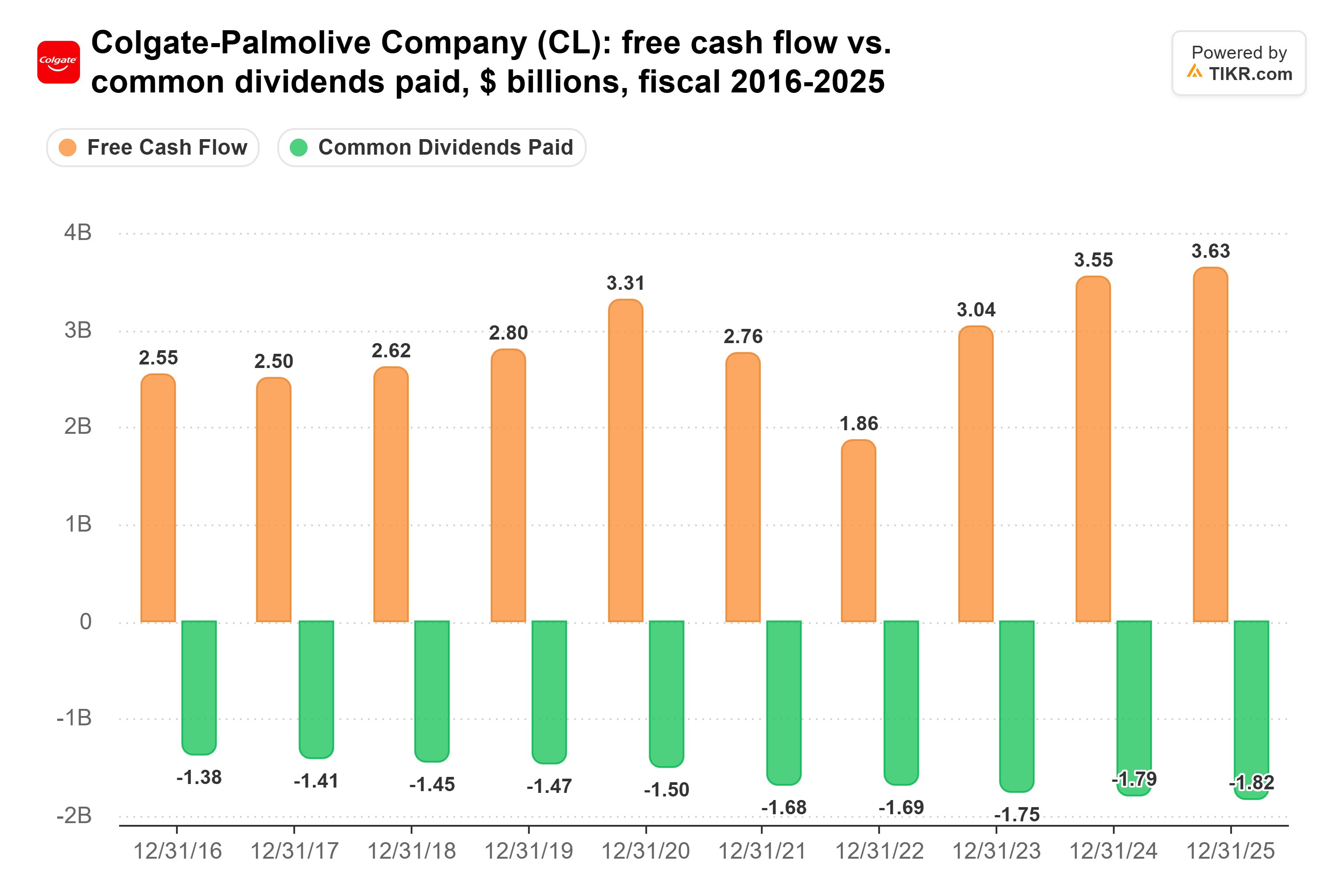
Management expects resin, pulp and paper costs to stay elevated into early 2027, which could squeeze that cushion.
So which dividend wins?
Kimberly-Clark pays you more over the next 10 years, by a wide margin. Put $10,000 in each today and grow both dividends at their 5-year rate of 3.3% a year. Kimberly-Clark pays about $5,364 over the decade, against about $2,559 for Colgate-Palmolive, or about $2,805 more. By year 10, Kimberly-Clark’s check is about $619, a 6.2% yield on your $10,000. Colgate’s is about $295, or 3.0%.
Coverage is Kimberly-Clark’s weak spot, but the yield gap leaves a lot of slack. Even if it never raised its dividend again, $461 a year for 10 years comes to $4,610, still well ahead of Colgate. Only a cut would close the gap. The company says it has raised its dividend for 54 consecutive years, and it stood by its 2026 outlook on Oct. 15 and again with results on Nov. 5.
Colgate’s case is a strong one. Its dividend has far more coverage, its business is growing, and its outlook just went up. That’s why investors pay 24x forward earnings for it, against 16x for Kimberly-Clark. But at these rates, Colgate’s income never catches up.
Of course, the Kenvue integration is just getting started. If the synergies come slower than planned and Kimberly-Clark’s board ever has to cut, Colgate’s steadier check would win out.
Forget Kimberly-Clark: 6 safe 6%+ dividend yields you can buy right now
Dividends can hold the key to enormous wealth. But only if you buy the right ones.
Picking the right high-yield dividend stock can be the difference between a dream retirement…and scraping by every month, waiting for the next Social Security check to clear.
We’ve identified six stocks yielding 6%+ that we believe every retiree should know about right now. (And Kimberly-Clark isn’t one of them.)
Disclaimer:
Please note that the articles on TIKR are not intended to serve as investment or financial advice from TIKR or our content team, nor are they recommendations to buy or sell any stocks. We create our content based on TIKR Terminal’s investment data and analysts’ estimates. Our analysis might not include recent company news or important updates. TIKR has no position in any of the stocks mentioned. Thank you for reading, and happy investing!