Key Takeaways
- ExxonMobil raised its quarterly dividend 4% to $1.07 on Oct. 30, extending its record to 44 straight years of higher annual dividends, while Chevron counts 39 straight years of raises.
- Chevron yields 3.5% against ExxonMobil’s 2.6%, and its dividend per share grew faster from fiscal 2020 to fiscal 2025.
- Both dividends are well covered over the twelve months to Sept. 30, 2026, using 40% of ExxonMobil’s free cash flow and 41% of Chevron’s.
- Coverage was much thinner in fiscal 2025, at 73% for ExxonMobil and 77% for Chevron, so a weaker year for cash flow is the main risk to both.
ExxonMobil (XOM) raised its quarterly dividend 4% to $1.07 a share on Oct. 30, alongside its third-quarter results. That makes 44 straight years of higher annual dividends.
Chevron (CVX) reported the same day, and told investors on its call that it has raised its dividend for 39 consecutive years. Its streak is shorter, but it pays the bigger check: a 3.5% yield to Exxon’s 2.6%.
So for an income investor buying today, which oil dividend pays more over the next 10 years?
| Metric | ExxonMobil (XOM) | Chevron (CVX) |
|---|---|---|
| Dividend yield | 2.6% | 3.5% |
| Annual dividend | $4.28 | $7.12 |
| Dividend growth, fiscal 2020-2025 | 2.8% a year | 5.8% a year |
| Straight years of raises (company’s count) | 44 | 39 |
| Cash dividend payout ratio, TTM to Sept. 30, 2026 | 40% | 41% |
| Net debt/EBITDA, LTM | 0.3x | 0.4x |
Source: TIKR and StockAnalysis, Nov. 9, 2026; streaks from each company’s third-quarter results and call.
6 safe dividend stocks paying retirees 6%+ yields
There are over 100 stocks paying 6%+ annual dividends today.
But after an extensive investment review leveraging TIKR’s proprietary data, we now believe only six of them are truly safe for retirees.
They’re all yours for free as part of our new investment report, which you can access right here.
Exxon’s buybacks keep the dividend bill level
Exxon CEO Darren Woods was blunt on the third-quarter call: “we’re not going to ever cut our dividend.” He says buybacks help Exxon keep the total it pays out fairly level while the per-share dividend grows.
The record backs him up. Exxon paid $14.9 billion in dividends every fiscal year from 2020 to 2023, even as its dividend per share kept rising. Here’s its free cash flow against the dividends it paid each fiscal year since 2016:
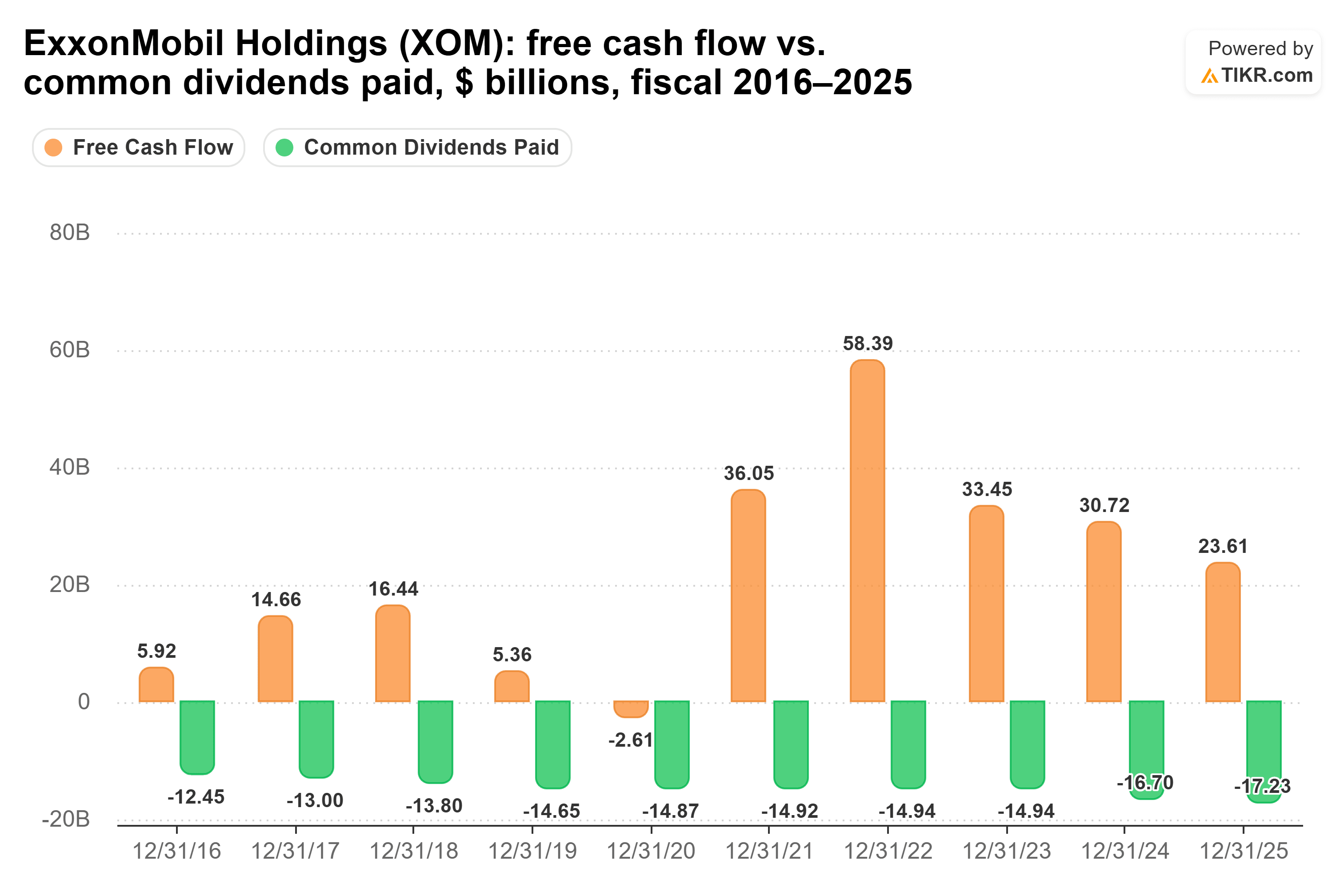
The cushion is thinner now than at the peak. The dividend ate up 25.6% of free cash flow in fiscal 2022 and 73.0% in fiscal 2025. The twelve months to Sept. 30, 2026, look much better, at a well-covered 40%.
Exxon is growing in Guyana, the Permian and LNG. It cut net debt by nearly $11 billion in the first nine months of 2026 and plans $20 billion of buybacks in 2027.
The main risk is the Middle East: damage to a Qatar LNG train and shipping limits in the Strait of Hormuz have cut into Exxon’s upstream volumes.
Chevron’s raises come faster
Chevron puts its dividend first, too. CFO Eimear Bonner said on the third-quarter call that growing the dividend consistently is still the company’s first priority for its cash.
And it has grown faster: 5.8% a year from fiscal 2020 to fiscal 2025 ($5.16 to $6.84 a share), against Exxon’s 2.8% ($3.48 to $4.00). Chevron’s total dividend bill rose every fiscal year from 2016 to 2025, from $8.03 billion to $12.8 billion, including years when free cash flow fell well short of it:
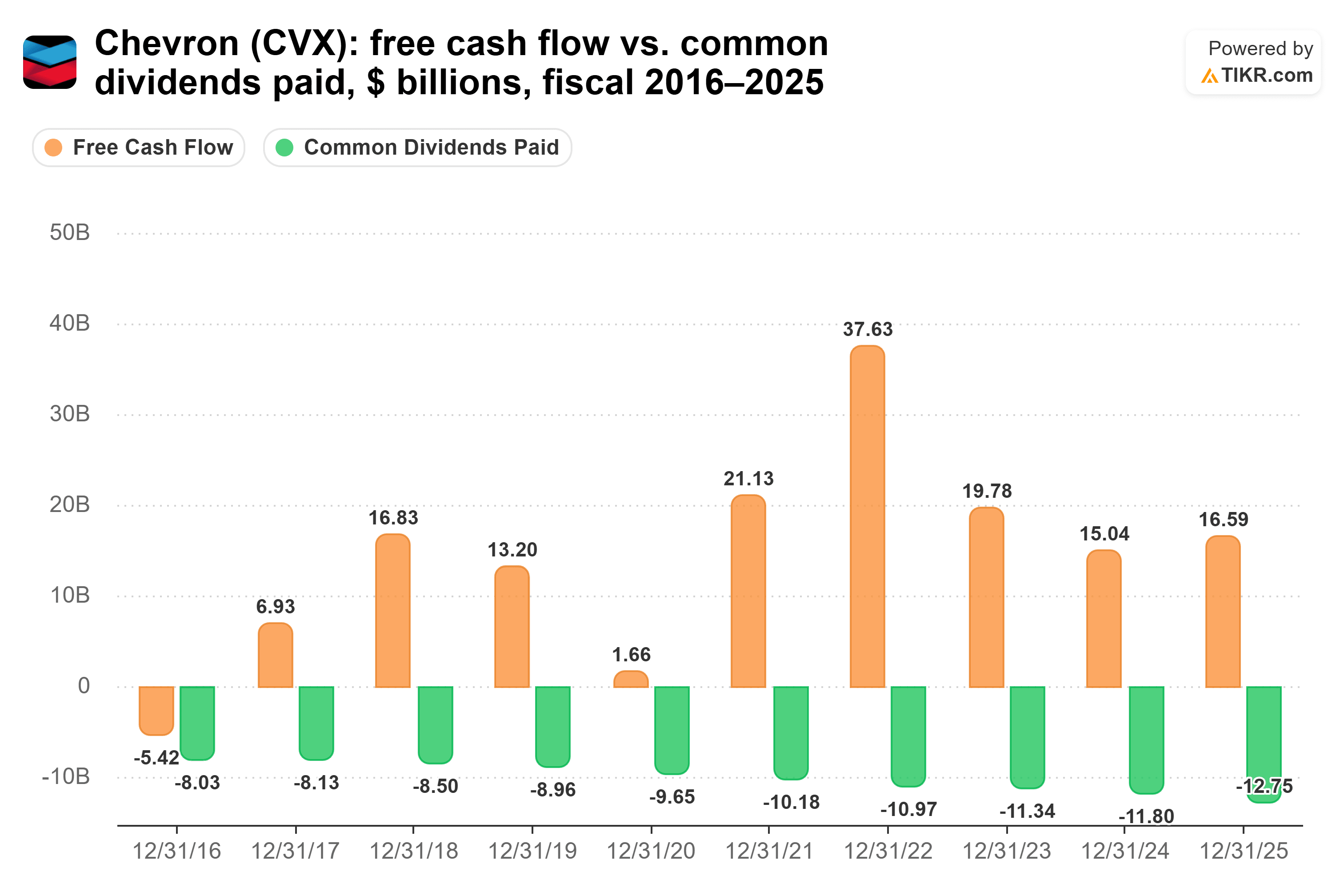
Its dividend used 78.4% of free cash flow in fiscal 2024 and 76.9% in fiscal 2025, a thinner cushion than Exxon’s in both years. Over the twelve months to Sept. 30, 2026, it’s a well-covered 41%, after third-quarter free cash flow of $12.0 billion, up from $4.9 billion a year earlier.
Chevron is on track for about 300,000 barrels a day of gross production from its Venezuela joint ventures by year-end, and plans to roughly double that by 2031.
The risk is volume. Chevron’s net production slipped to 3,980 thousand barrels of oil equivalent a day in the third quarter of 2026, from 4,086 a year earlier.
So which dividend wins?
Chevron’s dividend wins the next decade. Put $10,000 in Chevron at its 3.5% yield, and it pays $350 a year now. Growing at its 5-year rate of 5.8% a year, it pays about $4,570 over the 10 years. The same $10,000 in Exxon pays $260 now and, at its 2.8% rate, about $2,957 over the decade. That’s about $1,613 more from Chevron.
Can Chevron keep up that pace? Its 10-year rate, 4.8% a year from fiscal 2015 to fiscal 2025 ($4.28 to $6.84), is slower, but it still beats Exxon’s 3.3% ($2.88 to $4.00), and since Chevron starts from the bigger check, Exxon’s income doesn’t catch up at either pace. With its dividend using 41% of free cash flow over the trailing-12 months, Chevron has room to keep raising.
Exxon’s dividend is still a great one, with the longer streak, a CEO on record saying it won’t be cut, and a lighter debt load, but it’s just that coverage is level today, so the tiebreaker is the money, and Chevron pays the bigger check while raising it faster.
Of course, Chevron plans to lift exploration spending 50% from 2025’s level, and it’ll share more on its 2027 capital program in December. If that spending outruns its cash flow, its payout ratio could climb back toward fiscal 2025’s 77%.
Forget Chevron: 6 safe 6%+ dividend yields you can buy right now
Dividends can hold the key to enormous wealth. But only if you buy the right ones.
Picking the right high-yield dividend stock can be the difference between a dream retirement…and scraping by every month, waiting for the next Social Security check to clear.
We’ve identified six stocks yielding 6%+ that we believe every retiree should know about right now. (And Chevron isn’t one of them.)
Disclaimer:
Please note that the articles on TIKR are not intended to serve as investment or financial advice from TIKR or our content team, nor are they recommendations to buy or sell any stocks. We create our content based on TIKR Terminal’s investment data and analysts’ estimates. Our analysis might not include recent company news or important updates. TIKR has no position in any of the stocks mentioned. Thank you for reading, and happy investing!