

Key Stats for KO Stock
- Past week performance: -2.0%
- 52-week range: $66 to $92
- Valuation model target price: $92
- Implied upside: 6.8% over 2.2 years
Measure Coca-Cola’s remaining upside against Wall Street’s targets with TIKR’s free Valuation Model (It’s free) >>>
India, Infrastructure and a New North America Chief
The Coca-Cola Company (KO) eased about 2.0% over the past week, closing near $86 on Thursday. The dip barely dented a strong year, since shares delivered a 30.2% total return over the past 12 months. Investors are not worried about the business. They are rethinking how much further the stock can climb.
The most interesting headline is a possible listing of Hindustan Coca-Cola Beverages, its Indian bottling arm. Coca-Cola is reportedly considering a December filing for an IPO that could raise about $1 billion at a valuation near $10 billion. A bottler packages and distributes drinks, while Coca-Cola mainly sells concentrate. A listing would put a market price on one of its biggest growth markets.
Closer to home, Coca-Cola plans to invest $10 billion in U.S. infrastructure through 2030. That figure covers the whole system, including independent bottlers, and funds sites in states like California, Indiana and Florida. Leadership is shifting too. Rob Gehring, who ran Monster Energy’s Americas business, will lead North America from December 1.

All of this follows a strong Q2. Net revenue rose 7% to $13.4 billion, unit case volume grew 5%, and comparable EPS climbed 11% to $0.97. Comparable EPS strips out one-time items to show underlying profit. CEO Henrique Braun credited “staying close to the changing needs of our consumers” as the company raised full-year guidance. Going forward, the stock’s path depends on whether earnings can catch up to its price.
Dig into Coca-Cola’s guidance history and consensus estimates on TIKR at no cost (It’s free) >>>
A Blue Chip Priced Near Perfection
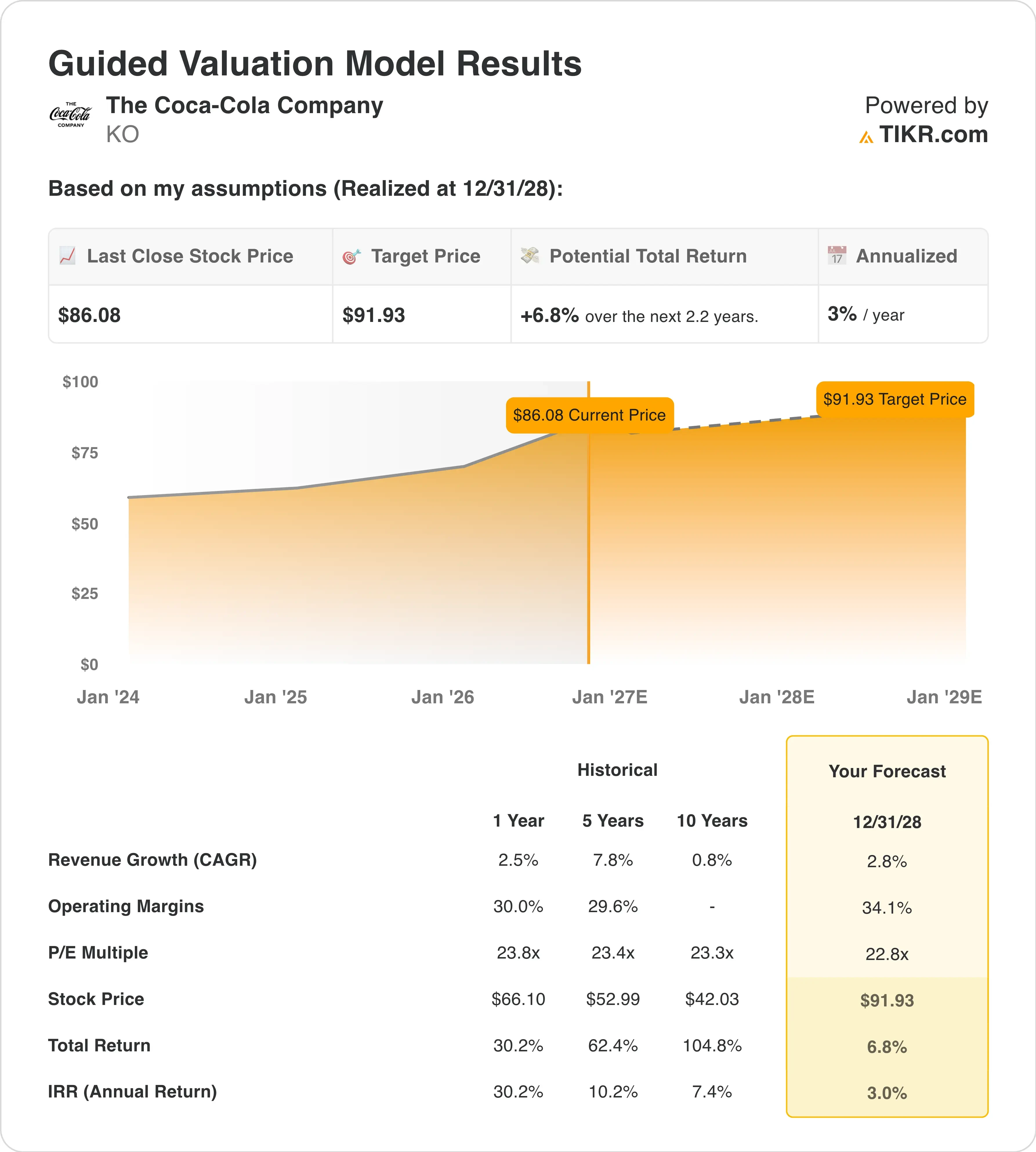
Under valuation model assumptions realized through 12/31/28, the stock is modeled using:
- Revenue Growth (CAGR): 2.8%
- Operating Margins: 34.1%
- Exit P/E Multiple: 22.8x
Based on these inputs, the model estimates a target price of $92, implying 6.8% total upside from the current share price of $86 and a 3.0% annualized return over the next 2.2 years.
A 3.0% annual return sits well below the 10% threshold that makes a stock attractive. In plain terms, the market has already priced in most of Coca-Cola’s good news. Shares trade near 25.3x forward earnings, above their 23.4x five-year average. So the 22.8x exit multiple implies some compression, and that eats most of the earnings growth.
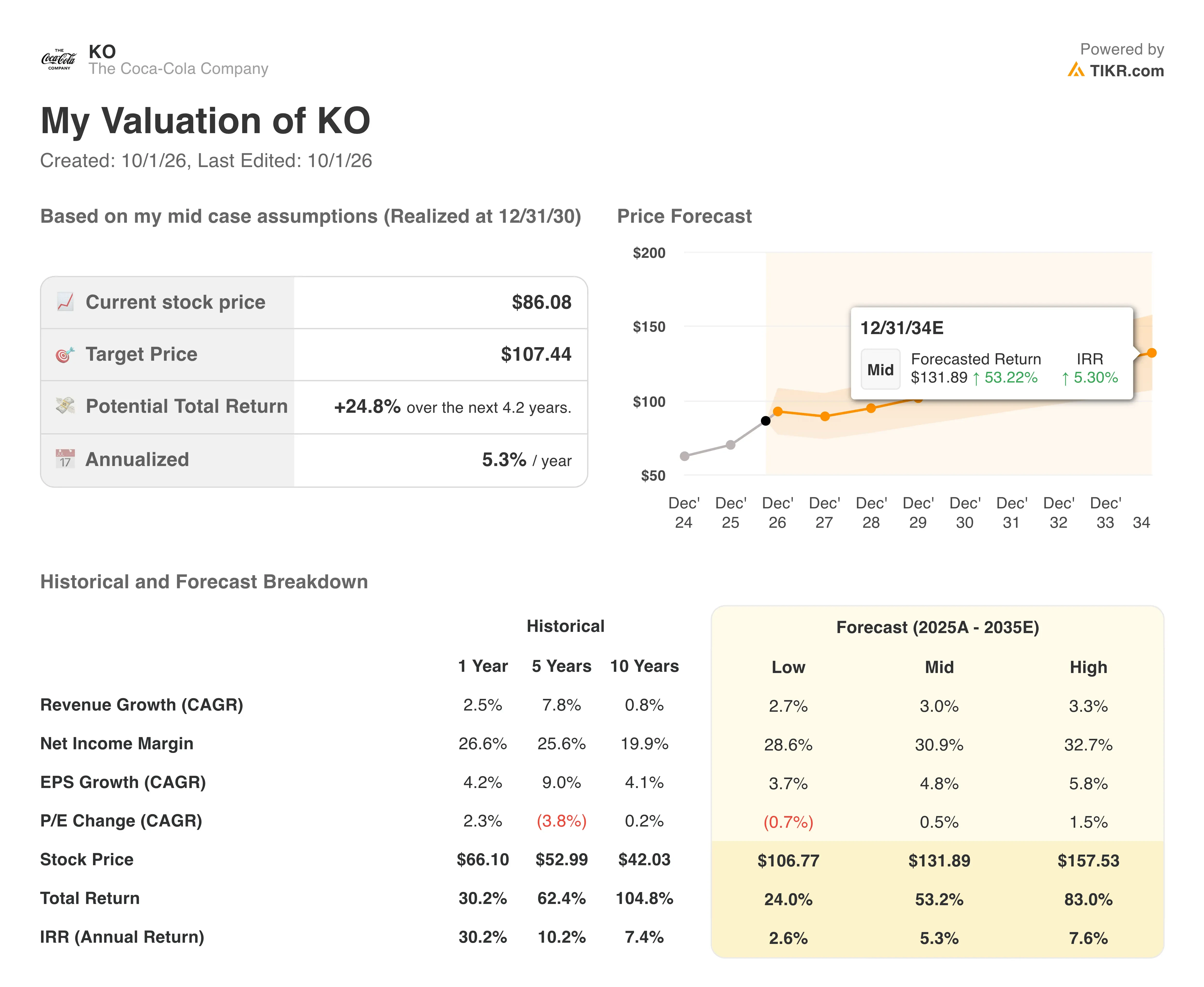
This is a multiple re-rating story that may have run its course. The 30.2% one-year gain came mostly from investors paying more for each dollar of profit. Earnings now need to do the heavy lifting. That is harder when analysts expect only 1.8% annual revenue growth over the next two years.
Margins look realistic, though. The model’s 34.1% target compares with 30.0% over the past year, and comparable operating margin already hit 35.6% in Q2. Pending bottler sales, like its African operations, shrink revenue but lift margins. Coca-Cola is a margin and pricing story, not a volume rocket.
Against PepsiCo’s 14.6x forward P/E, Coca-Cola’s premium is steep but earned. Its asset-light model and 77.2% payout ratio make it a capital return story first. Still, a premium this wide leaves little cushion if growth slows.
Test what Coca-Cola is worth at a lower exit multiple (Free with TIKR) >>>
Why Coke Commands a Premium Over Its Rivals
PepsiCo is the obvious comparison, and the gap is wide. PepsiCo grew organic revenue 2.4% in Q2, while Coca-Cola grew 6%. Coca-Cola’s operating margin of 31.8% over the last twelve months is nearly double PepsiCo’s 16.0%. Its forward P/E of 25.3x also towers over PepsiCo’s 14.6x.
Business mix explains the gap. PepsiCo runs snack factories and delivery fleets, while Coca-Cola mostly sells concentrate to bottlers. That asset-light model needs less capital and produces steadier margins. PepsiCo’s snack exposure also leaves it more sensitive to input costs, which is why it is now raising some chip prices.
Mondelez International (MDLZ), the Oreo maker, offers a broader staples benchmark. It posted 2.2% organic growth in Q2 and expects at least 2% for 2026. Coca-Cola’s 5% volume growth stands out against that sluggish backdrop. Investors pay up for the rare staple still growing units, not just prices.
Monster Beverage (MNST) is the rival to watch in energy drinks. Hiring Gehring from Monster signals how seriously Coca-Cola takes functional and energy categories. That matters because shoppers keep shifting toward lower-sugar, functional drinks.
What’s Driving KO Stock Going Forward?
Q3 results on October 27 are the next checkpoint. Investors will check whether volume held up after the World Cup boost. The FIFA World Cup campaign helped Trademark Coca-Cola grow volume 5% in Q2. Repeating that without a global tournament is a tougher ask.
The India IPO could reach the calendar in December. A filing would show how investors value Coca-Cola’s bottling base in a fast-growing drinks market. Timing, size and valuation could still change. Coca-Cola would not necessarily exit the business fully.
Regulation in India is a watch item. India’s Supreme Court has pressed the food regulator on timelines for warning labels, while companies push back on red labels. Stricter labels could weigh on sugary drink demand there. That makes Coca-Cola’s low and zero-sugar lineup more important.
Capital returns anchor the story. Coca-Cola pays a quarterly dividend of 53 cents per share, and its payout ratio sits near 77%. Meanwhile, the pending African bottling sale should simplify the business. If earnings keep outpacing sales, the premium may hold, but returns from here look modest.
Follow Coca-Cola’s dividend and margin trends in one place (Free with TIKR) >>>
What is Coca-Cola stock actually worth?
TIKR lets you forecast the future price of any stock in less than a minute. Just enter a few assumptions into TIKR’s valuation model and see what Coca-Cola could be worth. Start from Wall Street consensus estimates, or adjust the inputs to reflect your own view of the business. It’s free to use. Value KO for free.
Disclaimer:
Please note that the articles on TIKR are not intended to serve as investment or financial advice from TIKR or our content team, nor are they recommendations to buy or sell any stocks. We create our content based on TIKR Terminal’s investment data and analysts’ estimates. Our analysis might not include recent company news or important updates. TIKR has no position in any stocks mentioned. Thank you for reading, and happy investing!


