Key Takeaways
- AMD fell 10% on Nov. 24 after Jensen Huang returned to Nvidia, but CNBC’s David Faber says AMD is taking clients.
- SemiAnalysis puts AMD’s MI355X ahead of Nvidia’s B200 and GB200 on tokens per dollar of total cost, as Nvidia’s own rental rates rise.
- Wedbush’s Matt Bryson says AI customers want second and third sources, which leaves room for AMD.
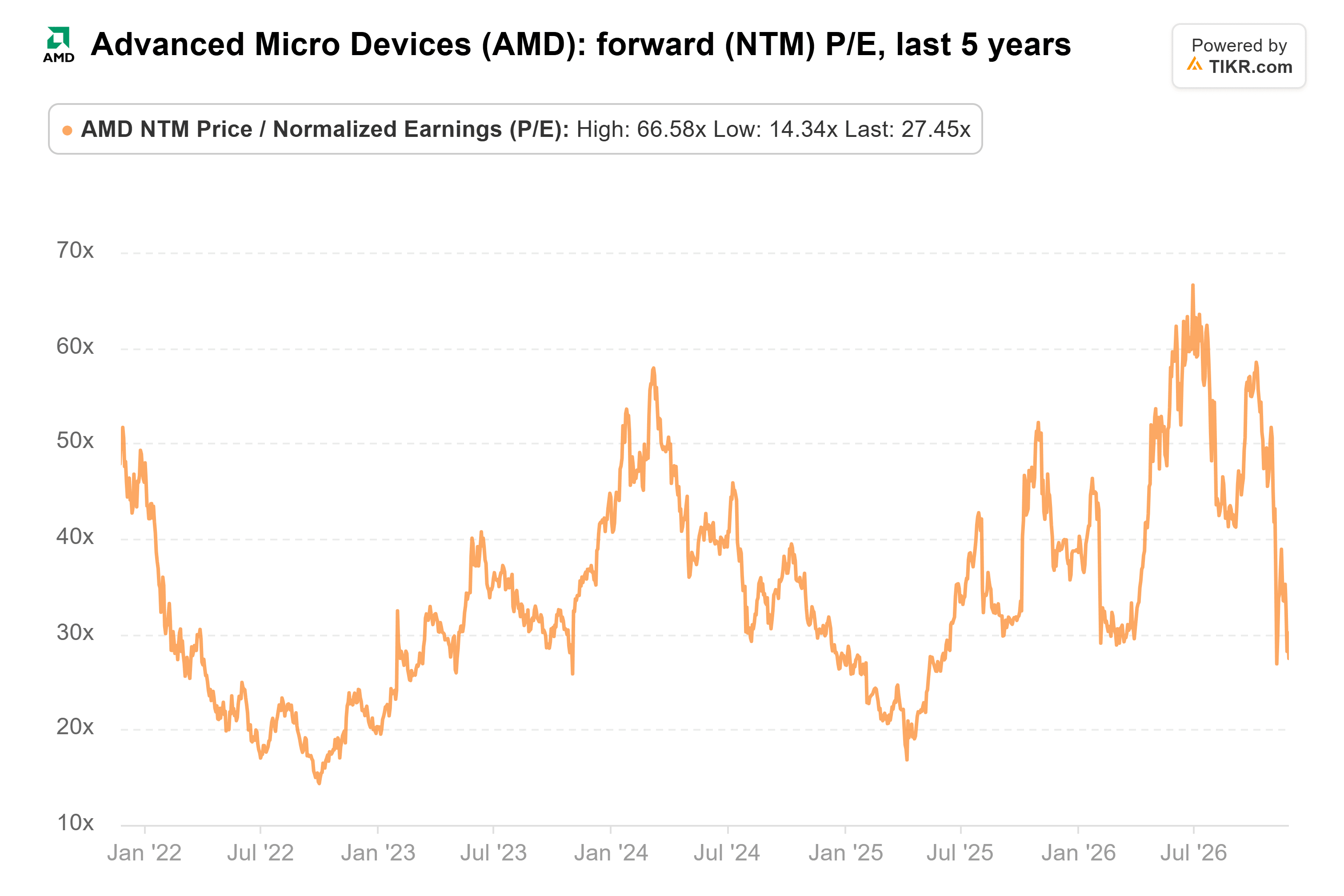
- AMD trades at 28x forward earnings, below its five-year average of 34x, but one benchmark still has to turn into shipments.
Advanced Micro Devices (AMD) fell 10% on Nov. 24 as chip stocks gave back the rally that followed Jensen Huang’s return as CEO of Nvidia (NVDA).
CNBC’s David Faber saw it differently that morning on Squawk on the Street. The hosts were discussing whether Nvidia’s investments in neoclouds were partly meant to keep AMD out, and Faber said:
“Well, AMD has got a very competitive chip for the first time. Very competitive chip.”
When the talk turned to Nvidia’s next generations of chips, he added: “No, but AMD is taking clients.”
A day later, SemiAnalysis put numbers behind it.
TIKR tracks 54 analysts on AMD. How many say “Buy”?
See the full breakdown of Buy, Hold, and Sell ratings on AMD, along with Wall Street’s revenue and earnings estimates, all in one place. More than 500,000 investors use TIKR to research stocks like this one. See AMD’s Analyst Ratings
AMD wins on cost per token
On Nov. 25, research firm SemiAnalysis weighed in on a LightSeek test that ran Moonshot AI’s Kimi K3.1 Pro model on eight of AMD’s MI355X GPUs. SemiAnalysis’ read: MI355X is “ahead of B200/GB200 on tokens per $ TCO and close to B300 at the high concurrency end.”
So for every dollar a lab spends to own and run the chips, AMD’s part produced more output than two of Nvidia’s.
That matters more because Nvidia’s chips are getting more expensive to rent: on Nvidia’s third-quarter call, Colette Kress said B300 rates have risen more than 60% since the chip came out. And AMD has already signed some big clients: OpenAI and Meta plan to deploy up to 6 gigawatts of AMD GPUs each, and Anthropic up to 2.
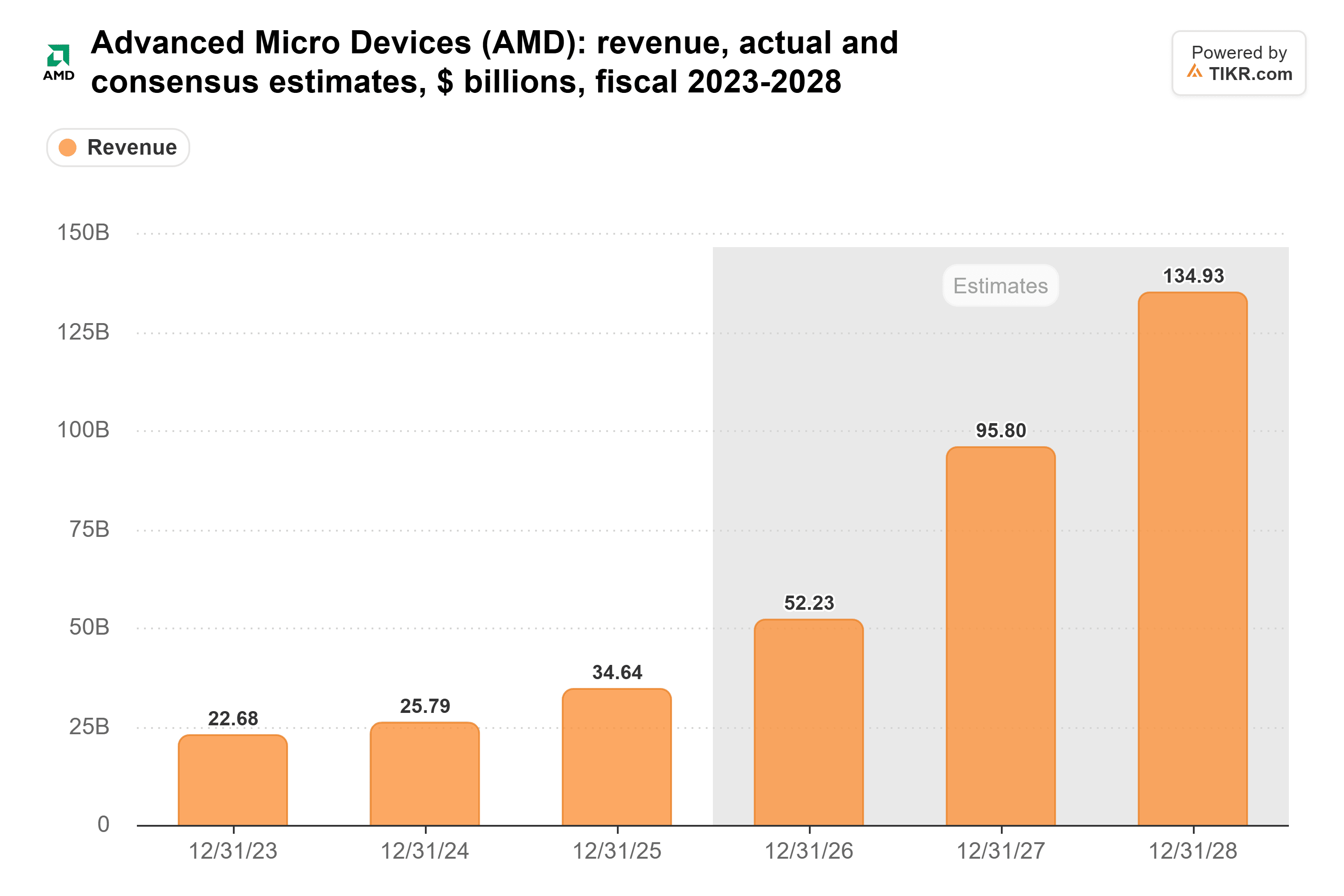
Analysts expect AMD’s revenue to climb from $52.2 billion this year to $95.8 billion in 2027 and $135 billion in 2028:
Cheaper, without giving away the margin
AMD can price below Nvidia partly because it has never needed Nvidia’s margins. Its gross margin stayed between 48% and 53% from 2021 to 2025:

That’s a long way below Nvidia’s 75% in its October quarter. Even so, AMD’s non-GAAP gross margin was 56% in the second quarter of 2026, inside its long-term target of 55% to 58%. Nvidia already guides its own margin down to 71% to 72% for the January quarter.
Room for a second source, and a third
Matt Bryson of Wedbush made a related point on CNBC’s Closing Bell on Nov. 23, the day Huang came back. He said “everyone is looking for second and third sources,” so “there’s still room for AMD to grow.”
Bryson expects Broadcom (AVGO) to keep growing too, and its numbers support him. Broadcom’s AI semiconductor revenue reached $16.7 billion in its fiscal third quarter, up 221%, and it guided to $21.7 billion for the fourth. When it reports Dec. 9, the figure to watch is whether management sticks with its outlook of about $115 billion of AI semiconductor revenue in fiscal 2027.
Faber’s right, and the stock isn’t priced for it
After the drop, AMD trades at 28x forward earnings, below its five-year average of 34x and far under its 67x peak on June 30, 2026:
The way I see it, Faber has it right. AMD now has a chip that wins on cost, and buyers who want a second source have a real reason to sign. Huang’s return makes Nvidia a tougher rival, but it doesn’t change what a token costs on an MI355X.
Still, SemiAnalysis tested one large open model on one serving stack, and hyperscalers don’t rewrite their orders off a single benchmark. AMD has also paid for its biggest clients in stock, and on Nov. 23 it registered about 337 million shares, roughly 20.5% of the company, for resale.
With the 2027 consensus already assuming revenue grows about 84%, AMD has to prove it in shipments. Its fourth-quarter report, due in early February, is the first with meaningful volume from its Helios racks, and a non-GAAP gross margin at or above 55% would show AMD can win clients without giving the margin away.
So what is AMD stock actually worth?
TIKR lets you forecast the future price of any stock in less than a minute. Just enter a few assumptions into TIKR’s valuation model and see what AMD could be worth. Start from Wall Street consensus estimates, or adjust the inputs to reflect your own view of the business. It’s free to use.
Disclaimer:
Please note that the articles on TIKR are not intended to serve as investment or financial advice from TIKR or our content team, nor are they recommendations to buy or sell any stocks. We create our content based on TIKR Terminal’s investment data and analysts’ estimates. Our analysis might not include recent company news or important updates. TIKR has no position in any of the stocks mentioned. Thank you for reading, and happy investing!