Key Takeaways
- SpaceX gave up about $738 million of federal BEAD subsidies and will give free Starlink equipment to new subscribers at the 476,000 rural locations it won.
- In return, SpaceX skips most of BEAD’s audits and paperwork, and the money it gave up is about 1.5% of the revenue analysts expect from it this year.
- Charter Communications, building subsidized rural networks of its own, now faces a satellite rival giving away equipment.
- The risk is how many households sign up: states can still rebid SpaceX’s locations, and Starlink’s average revenue per user is already falling.
SpaceX (SPCX) just walked away from about $738 million of federal broadband money, and it’s giving away Starlink dishes to do it.
That’s a new headache for cable companies building subsidized rural networks of their own, like Charter Communications (CHTR).
What exactly happened
This week, the National Telecommunications and Information Administration (NTIA) published a new model agreement for satellite providers that turn down their awards under BEAD, the federal rural broadband program. SpaceX is the first to take it. By Connected Nation’s count, SpaceX had been in line for about $738 million to serve 476,000 rural homes and businesses.
It still has to serve them. Here’s the NTIA’s language, which Sawyer Merritt posted on X (a “BSL” is a home or business the program covers):
“To ensure that no consumer at a Covered BSL is left behind, the provider (SpaceX) will serve the covered BSLs as this agreement provides. This includes providing customer premises equipment at no cost to new subscribers, so that households at covered BSL do not face the upfront equipment costs.”
Per Merritt’s summary, SpaceX also commits to download speeds of at least 100 Mbps and uploads of at least 20 Mbps, a low-cost monthly plan and 10 years of service. In exchange, it skips most of BEAD’s financial audits, procurement requirements and administrative reporting.
Elon Musk’s response? “Starlink.”
TIKR tracks 41 analysts on SpaceX. How many say “Buy”?
See the full breakdown of Buy, Hold, and Sell ratings on SpaceX, along with Wall Street’s revenue and earnings estimates, all in one place. More than 500,000 investors use TIKR to research stocks like this one. See SpaceX’s Analyst Ratings
$738 million is small change for SpaceX
SpaceX can afford to give the money back. Analysts expect its revenue to climb from $49.1 billion this year to $336 billion in 2028:
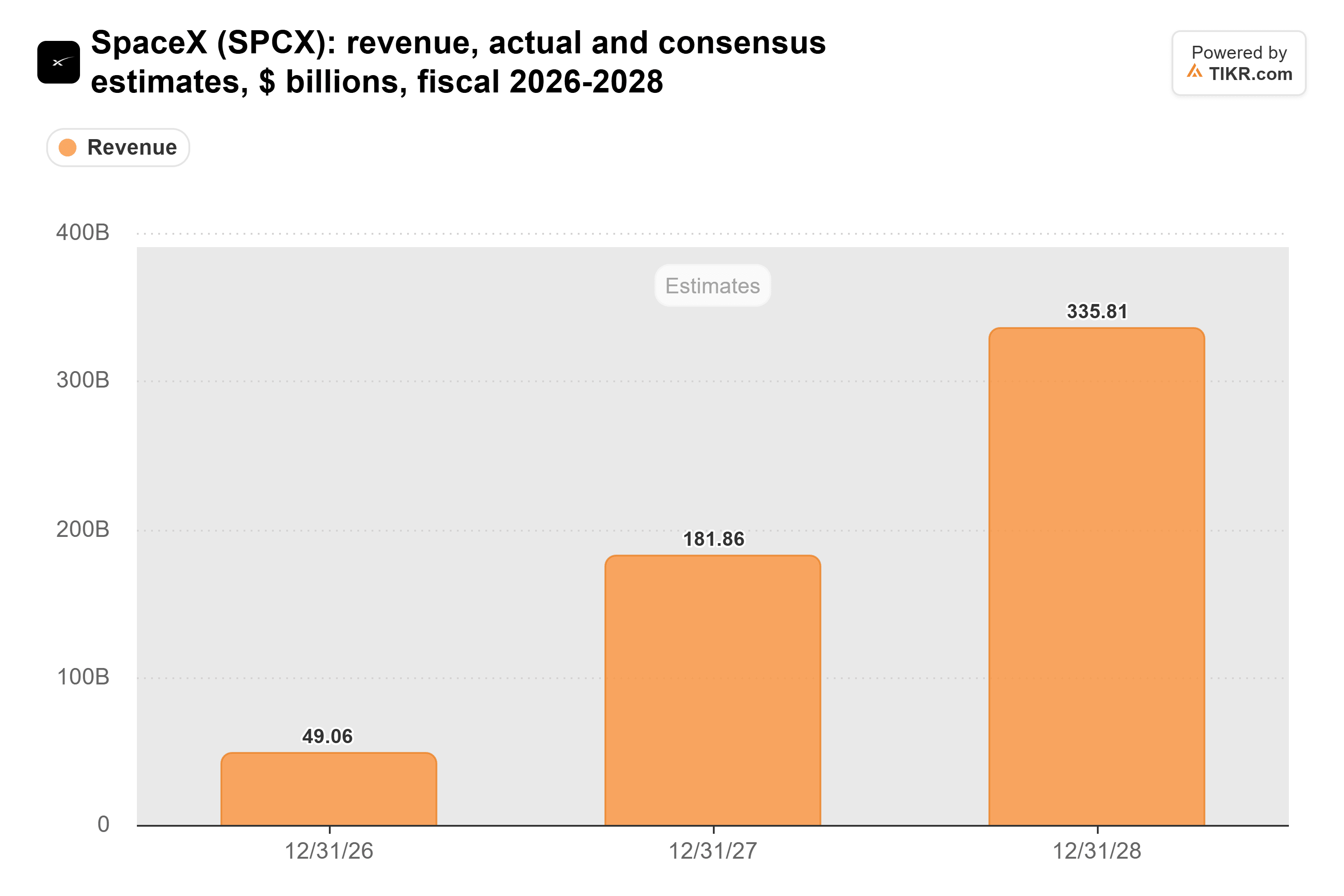
That makes $738 million about 1.5% of this year’s expected revenue. This deal shouldn’t move those estimates, which rest mostly on renting out AI compute.
The money still matters, though. SpaceX’s free cash flow has fallen further below zero each year as its spending has climbed:
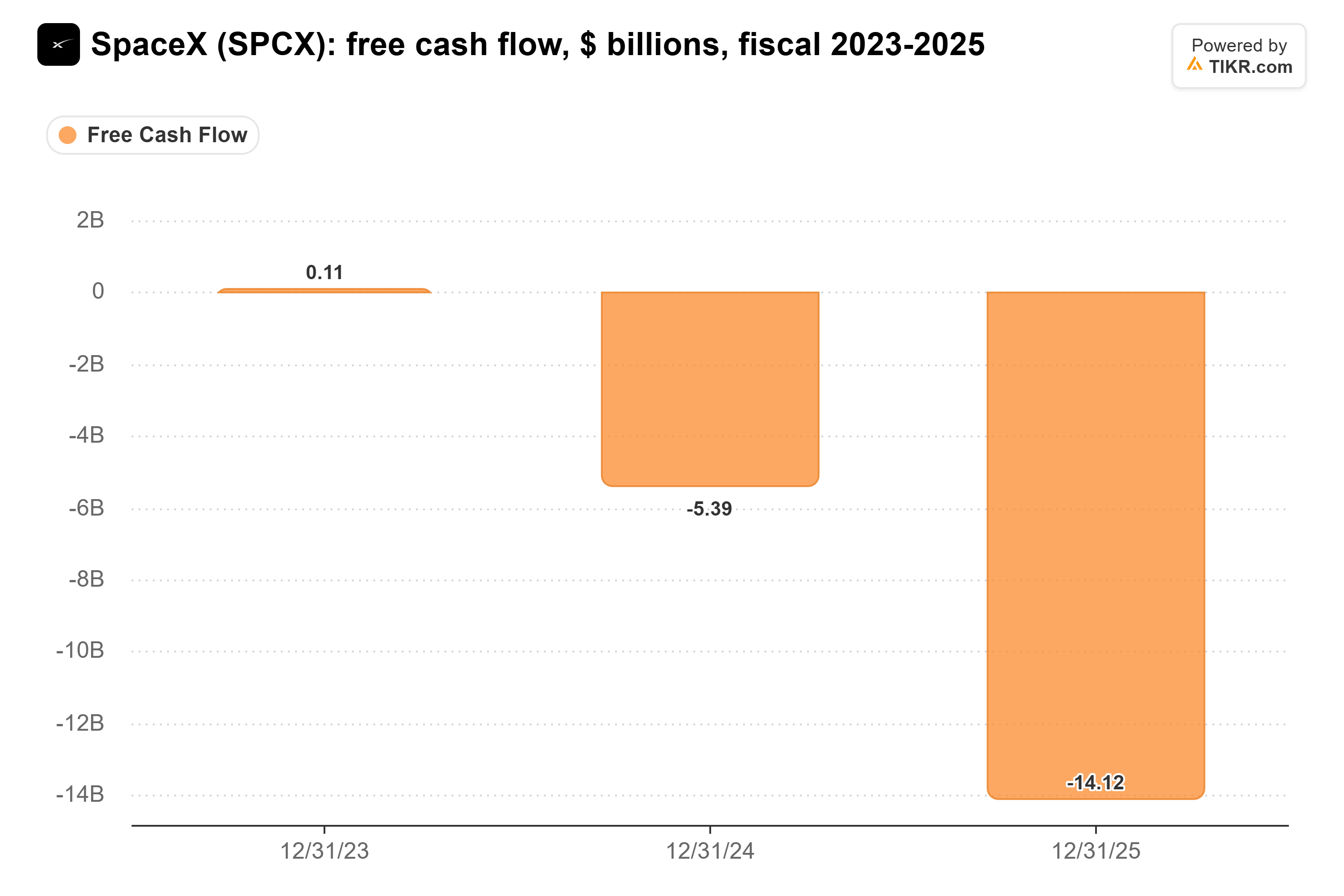
Still, SpaceX held $89.9 billion of cash and marketable securities at Sept. 30. With capex of $35 billion to $40 billion expected in the fourth quarter alone, the subsidy covers about two days of that spending.
Charter has a new rural rival
According to Charter’s third-quarter release, legacy Charter (before its Cox Communications deal) connected 116,000 new subsidized rural homes and businesses in the quarter, and customer relationships there grew by 48,000. Charter needs that growth: it lost 233,000 Internet customers overall in the quarter on a pro forma basis. It’s also slowing the build, with spending on subsidized rural construction down to $292 million in the third quarter from $580 million a year earlier.
Now Charter competes for rural customers against a provider charging nothing upfront at 476,000 locations. Will that slow its pace of 48,000 new rural customers a quarter? Its fourth-quarter report, due early next year, is the first place to look.
A cheap way to win rural customers
This looks like a smart trade for SpaceX: it swaps one-time grant money for 10 years to sign up rural households with no equipment bill in their way. The dishes are cheaper to make than they used to be, too: SpaceX says it has cut the average cost of a Starlink kit by 59% since 2022.
The catch is what each new customer pays. Starlink’s consumer subscribers grew to 13.6 million at Sept. 30 from 7.2 million a year earlier, while average revenue per user fell to $69 a month from $83. A low-cost rural plan pushes that the same way.
And the NTIA told state broadband offices they can sign the agreement or rebid the locations SpaceX won. The agreement’s twice-yearly reports on subscriptions will show how many of those 476,000 locations actually sign up.
So what is SpaceX stock actually worth?
TIKR lets you forecast the future price of any stock in less than a minute. Just enter a few assumptions into TIKR’s valuation model and see what SpaceX could be worth. Start from Wall Street consensus estimates, or adjust the inputs to reflect your own view of the business. It’s free to use.
Disclaimer:
Please note that the articles on TIKR are not intended to serve as investment or financial advice from TIKR or our content team, nor are they recommendations to buy or sell any stocks. We create our content based on TIKR Terminal’s investment data and analysts’ estimates. Our analysis might not include recent company news or important updates. TIKR has no position in any of the stocks mentioned. Thank you for reading, and happy investing!