Key Takeaways
- Goldman Sachs expects Brent and WTI crude to fall about $10 over the next year on an oil surplus of about 2 million barrels a day.
- Consensus estimates for ExxonMobil, Chevron and ConocoPhillips still reflect this year’s wartime oil prices.
- Each $1 move in Brent is worth about $700 million of yearly earnings to ExxonMobil and about $600 million to Chevron.
- Low inventories and attacks near the Strait of Hormuz are the main risks to Goldman’s call, and OPEC+ meets on Nov. 29.
Oil had a brutal November, and Goldman Sachs thinks the slide has further to go. That’s bad news for ExxonMobil (XOM), Chevron (CVX) and ConocoPhillips (COP), whose earnings estimates still reflect wartime oil.
Brent has fallen more than $20 a barrel this month as the Iran war winds down, and it traded around $92 on Wednesday.
On CNBC’s Power Lunch, Goldman Sachs’ Daan Struyven was asked whether a lasting peace could mean much lower prices. He said Goldman’s “base case looks for a roughly $10 decline in Brent and WTI prices over the next year as we believe the market is likely going to be in a 2MBD, roughly 2% surplus.”
Not great if you own oil stocks.
Exxon’s estimates have room to fall
ExxonMobil’s annual report says each $1 change in Brent moves its yearly earnings by about $700 million. So Goldman’s $10 drop would cost about $7 billion a year, roughly $1.70 a share, or nearly 14% of the $12.49 analysts expect Exxon to earn in 2027.
Analysts expect Exxon’s normalized EPS to nearly double this year and stay high for years:

Exxon earned $6.99 a share on that basis in 2025, when its realized Brent price averaged $69.06. Even the $10.33 analysts expect for 2028 is nearly 50% higher. And refining won’t make up the gap right now, since margins have come down sharply to an 8-month low.
TIKR tracks 26 analysts on Chevron. How many say “Buy”?
See the full breakdown of Buy, Hold, and Sell ratings on Chevron, along with Wall Street’s revenue and earnings estimates, all in one place. More than 500,000 investors use TIKR to research stocks like this one. See Chevron’s Analyst Ratings
Chevron and ConocoPhillips are just as exposed
Chevron is in the same boat. It says each $1 change in Brent moves its full-year after-tax earnings and cash flow by about $600 million, so Goldman’s call is worth about $6 billion a year. Analysts expect Chevron’s free cash flow to jump to $44.0 billion this year, from $16.6 billion in 2025:
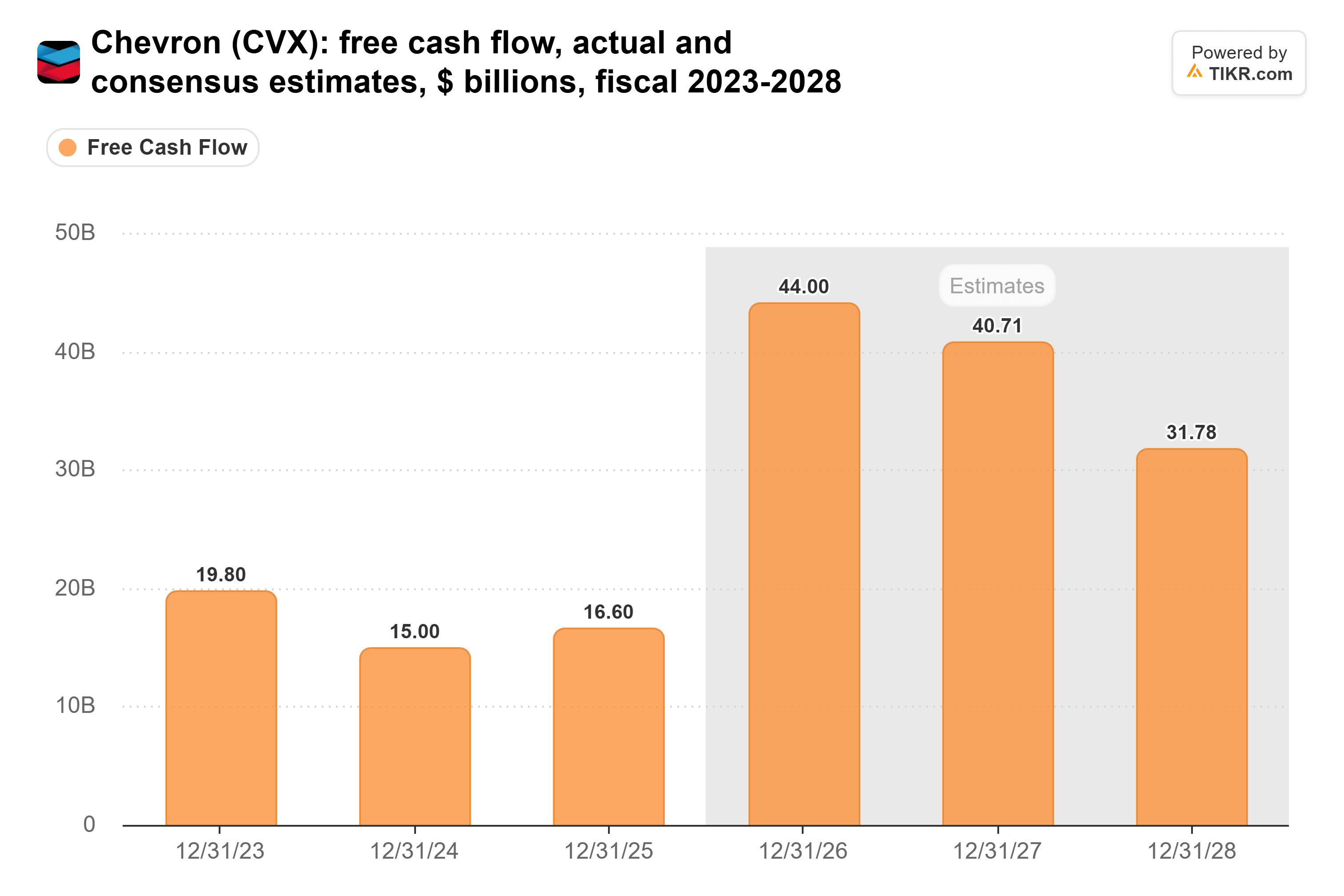
The 2027 estimate of $40.7 billion is nearly 2.5x what Chevron generated in 2025, and losing $6 billion a year would make it much harder to reach.
ConocoPhillips has even less to lean on, since it has no refining or chemicals business at all. Its third-quarter adjusted EPS roughly doubled to $3.27 from $1.61 a year earlier, primarily on higher prices, with its realized price up 32% to $61.40 per barrel of oil equivalent. Yet analysts expect its EPS to slip only about 5% in 2027, to $11.33, a smaller cut than the 9% they expect for Exxon. For a pure producer, that looks generous if Goldman is right.
Exxon only looks cheap on wartime earnings
At first glance, Exxon’s valuation looks reasonable:
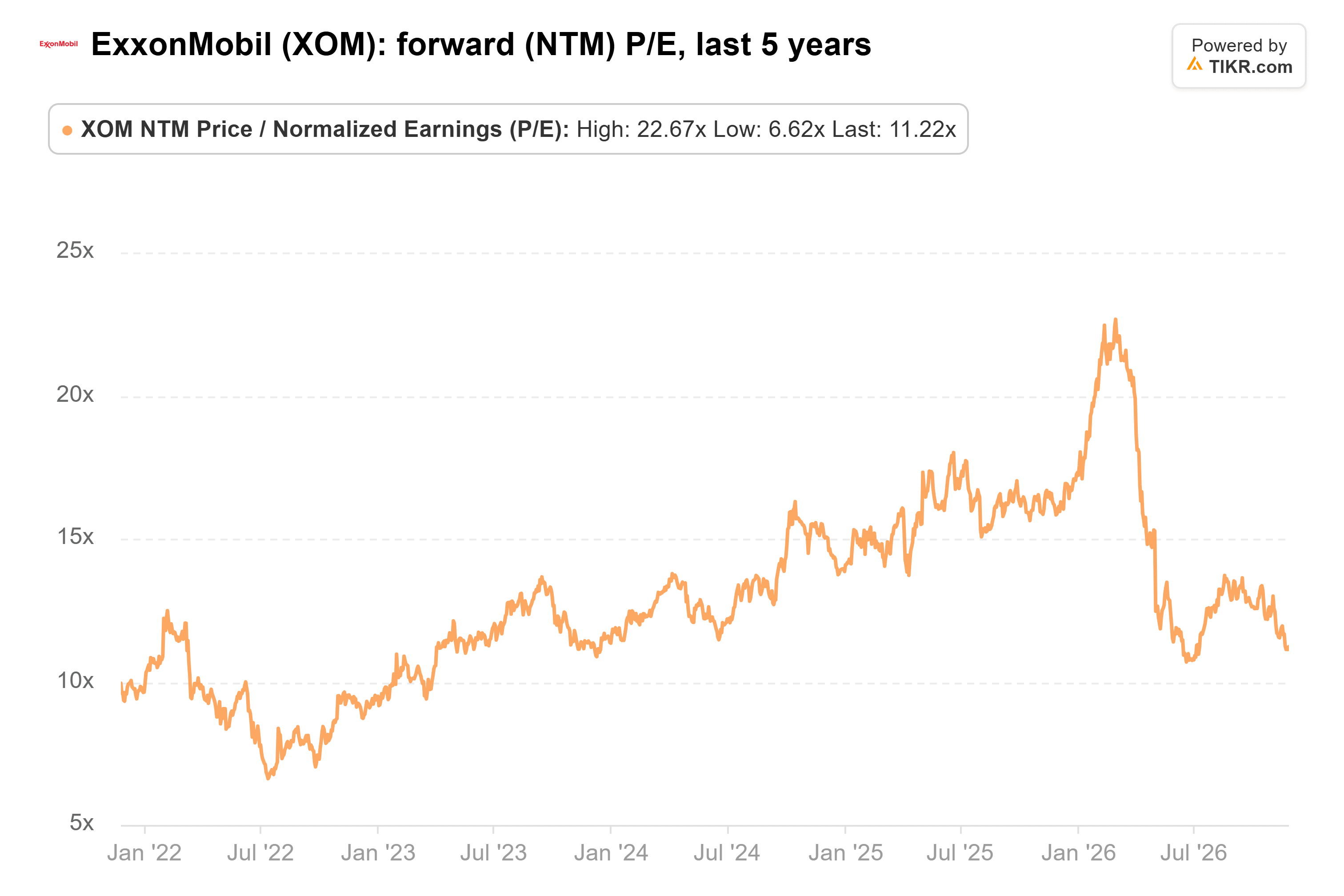
At 11x forward earnings, Exxon trades below its 5-year average of 13x. But those forward earnings still carry this year’s prices. Value Exxon on 2028’s $10.33 instead, and the stock trades at closer to 14x, above that average.
Low inventories keep the bulls in the game
On Bloomberg Surveillance, longtime commodities strategist Jeff Currie said oil held up last week because “there’s no inventory of oil to liquidate.” He thinks “you definitely want to tiptoe back in oil,” since he reads the stocks as priced for oil in the $65 to $75 range. And Brent rose on Wednesday after Yemen’s Houthis said they had attacked Saudi Arabia’s Ras Tanura refinery, while ships near the Strait of Hormuz keep getting hit.
Struyven doesn’t dismiss the inventory point. He noted that “the starting point for stocks is low,” and Goldman’s base case uses the surplus for “a healthy stock rebuild.”
The estimates have to come down
I think Goldman has the better of this argument. Currie may be right that the stocks already price in cheaper oil, but the earnings estimates under them don’t. I’d expect ConocoPhillips to see the deepest cuts.
The next test comes on Nov. 29, when OPEC+ ministers meet to set their 2027 output policy. Quotas high enough to rebuild inventories would put Brent on Goldman’s path toward the low $80s, while more attacks near Hormuz could keep it above $90 and give the estimates more time.
So what is ExxonMobil stock actually worth?
TIKR lets you forecast the future price of any stock in less than a minute. Just enter a few assumptions into TIKR’s valuation model and see what ExxonMobil could be worth. Start from Wall Street consensus estimates, or adjust the inputs to reflect your own view of the business. It’s free to use.
Disclaimer:
Please note that the articles on TIKR are not intended to serve as investment or financial advice from TIKR or our content team, nor are they recommendations to buy or sell any stocks. We create our content based on TIKR Terminal’s investment data and analysts’ estimates. Our analysis might not include recent company news or important updates. TIKR has no position in any of the stocks mentioned. Thank you for reading, and happy investing!