Key Takeaways
- Cantor Fitzgerald’s CJ Muse says Sandisk could buy back 60% of its outstanding shares over the next six quarters at today’s valuation.
- Analysts expect about $52 billion of free cash flow over those six quarters, close to 60% of Sandisk’s roughly $89 billion market value.
- Sandisk trades at 2.6x forward earnings, the lowest in a year, as investors doubt the price floors in its contracts will hold.
- Dell’s record quarter shows big buyers still need memory, and Sandisk’s late-January report will test its contract backlog.
Memory stocks fell again on Tuesday, and Sandisk (SNDK) sank 14% as the group gave back its rally on Jensen Huang’s return to Nvidia. Less than a week earlier, TrendForce had forecast NAND contract prices falling 0% to 5% in the first quarter of 2027.
After the close, Dell Technologies (DELL), one of the biggest buyers of memory around, reported record quarterly revenue.
Cantor Fitzgerald analyst CJ Muse thinks the selloff has gone too far. On Tuesday’s episode of CNBC’s Squawk on the Street, he said half of Sandisk’s bits are under contract, “so the pricing there will hold at least flat.” Then he added:
“But you’re still talking about at this valuation, Sandisk over the next six quarters buying 60% of the outstanding shares back.”
The analysts haven’t budged
Wall Street’s estimates haven’t followed the stock down. Analysts expect Sandisk’s normalized EPS to more than triple in fiscal 2027 and keep climbing in fiscal 2028:
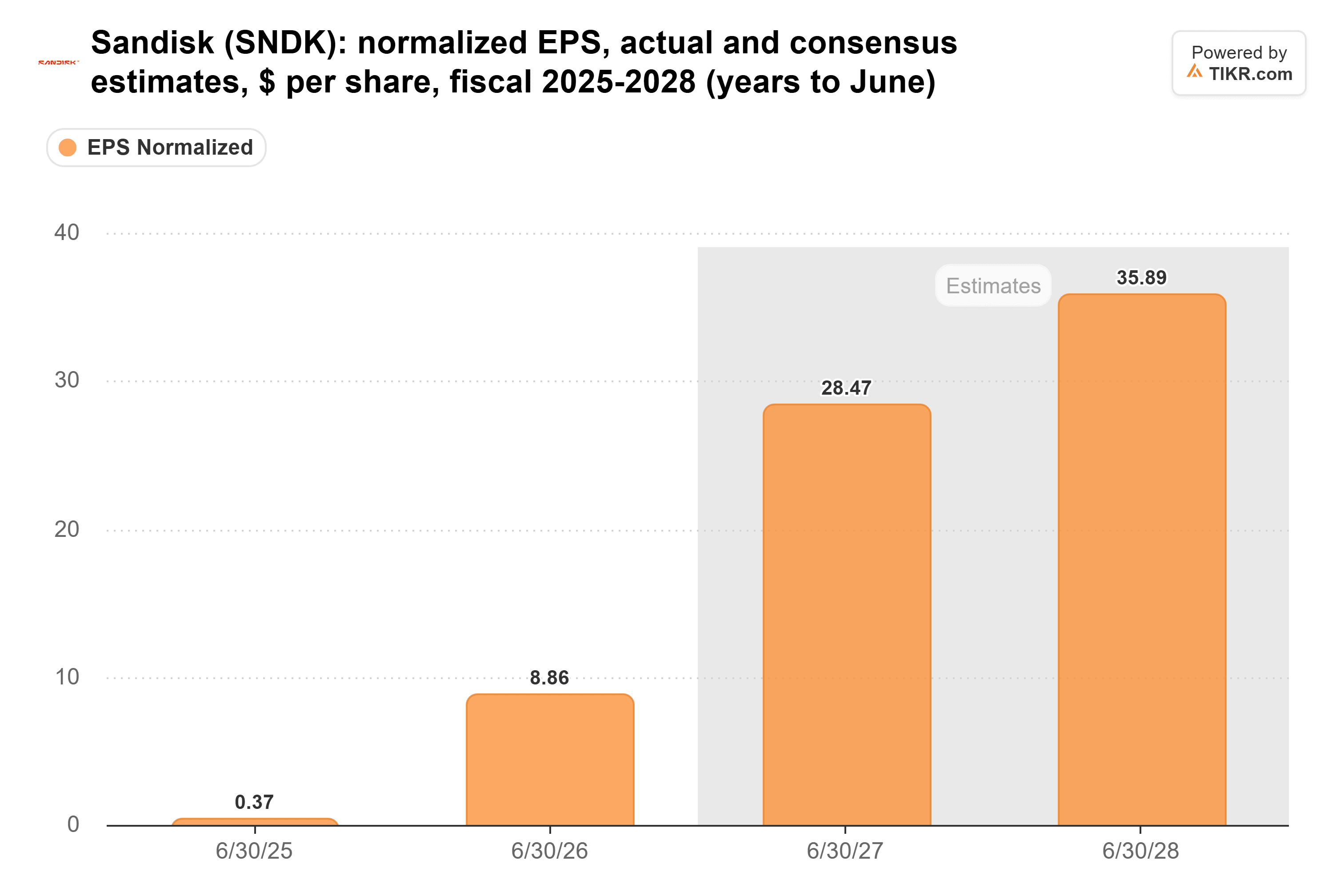
Those estimates have barely moved since TrendForce’s forecast. Meanwhile the stock has kept falling, and Sandisk now trades at 2.6x forward earnings:
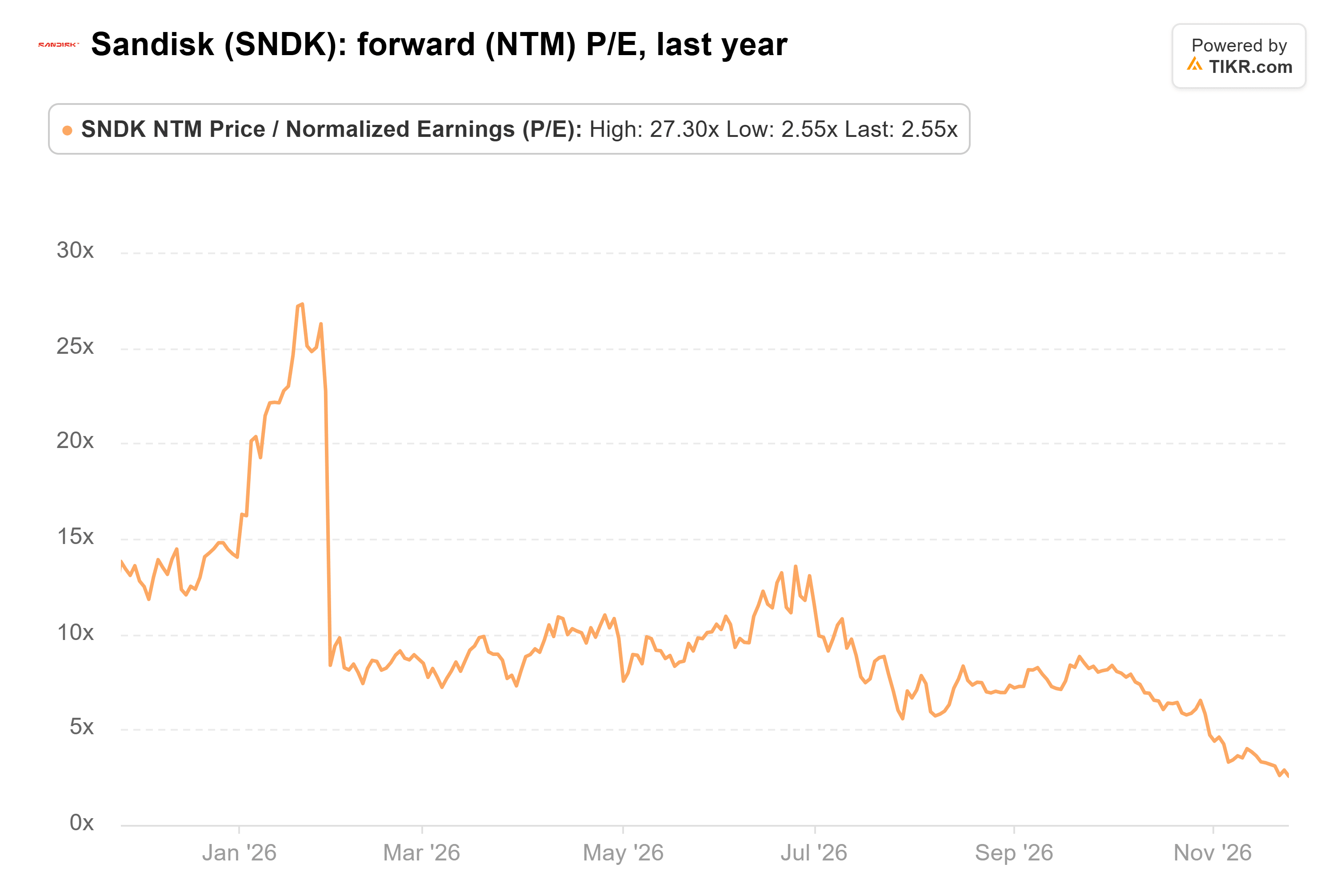
Over the past year, its forward P/E has averaged 9.8x and peaked at 27.3x in January. Investors are treating these earnings as a peak that won’t last.
TIKR tracks 25 analysts on Sandisk. How many say “Buy”?
See the full breakdown of Buy, Hold, and Sell ratings on Sandisk, along with Wall Street’s revenue and earnings estimates, all in one place. More than 500,000 investors use TIKR to research stocks like this one. See Sandisk’s Analyst Ratings
The cash is there
Sandisk’s free cash flow has exploded over the past two years:
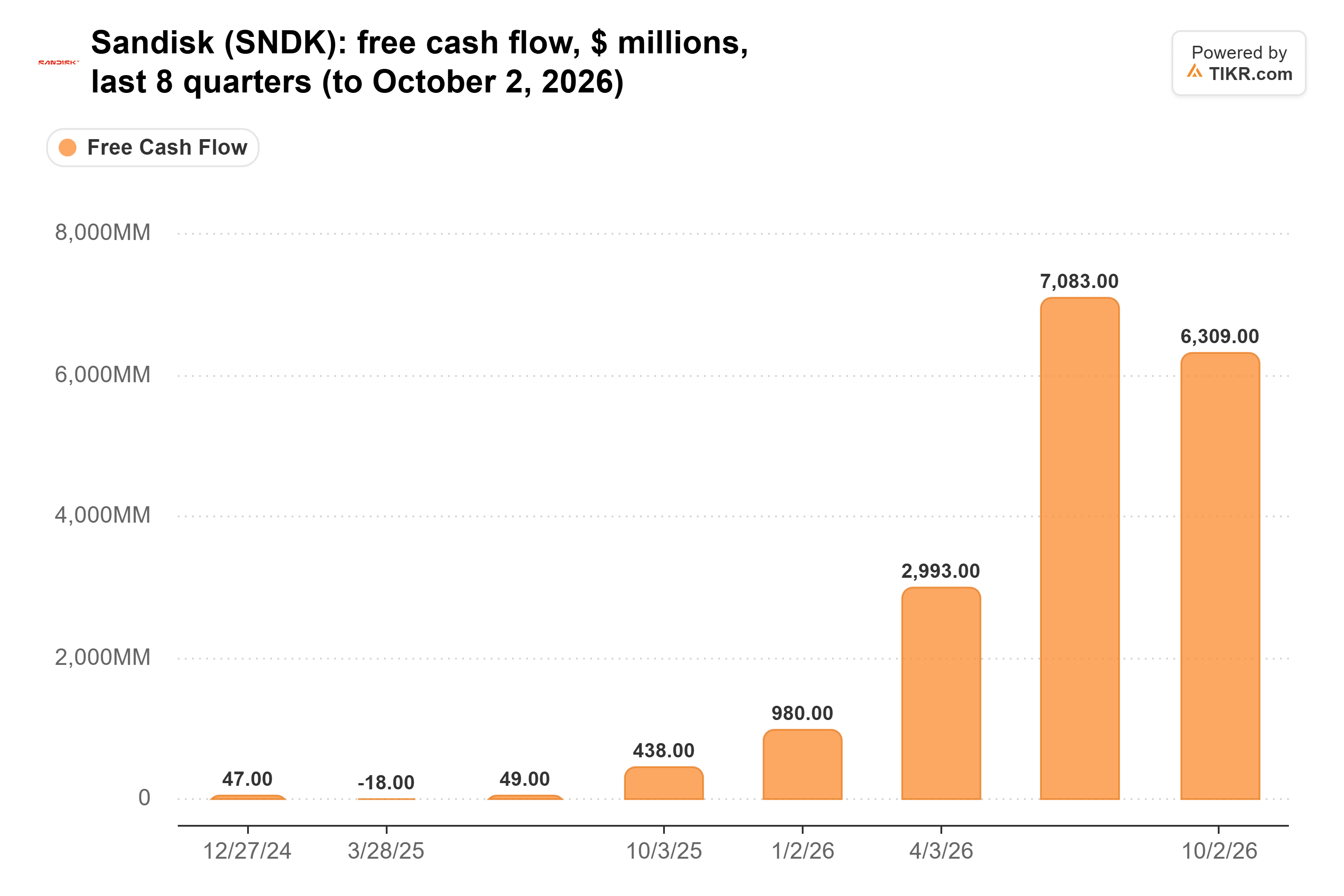
It generated $13.4 billion of free cash flow in its two most recent quarters alone. Analysts expect $30.7 billion in fiscal 2027 and $37.5 billion in fiscal 2028. Take out the $6.3 billion Sandisk already generated in the first quarter of fiscal 2027 and add three-quarters of fiscal 2028, and the six quarters come to about $52 billion. So Muse has the arithmetic right.
Management has said it will return 100% of excess cash, and Sandisk has no debt. It bought back $9.5 billion of stock over its last two reported quarters and had $10.5 billion left on its authorization on Oct. 2, so a buyback on Muse’s scale would need more from the board. And the lower the stock goes, the more shares each dollar retires.
The floors have to hold
Investors paying 2.6x earnings for Sandisk are betting against its contracts. Its multiyear supply deals carry price floors that management says deliver at least 80% gross margin every year, and it had $88.9 billion of contracted revenue still to deliver on Oct. 2. Its non-GAAP gross margin was 85.1% in its latest quarter, so the floor sits only a few points below today’s margins.
The risk is that the floors have never been tested. The oldest contract dates to January 2026, the guarantees behind the contracts covered less than a fifth of their $93.9 billion minimum value in August, and buyers facing falling spot prices will have every reason to ask for better terms.
Dell’s quarter is a good sign on that front. Its revenue rose 103% to $54.9 billion in the quarter to Oct. 30, and it ended with a record $132.3 billion AI backlog. A buyer with that kind of backlog needs every bit of memory it can get, which makes this a hard time to lean on a supplier. If memory prices do fall, though, Dell is exactly the kind of big buyer that could be first in line to ask.
Muse has the better side of this
At 2.6x forward earnings, Sandisk is priced as if its earnings are about to collapse, and its contracts were built to prevent exactly that. Even if NAND prices fall as much as the 5% TrendForce forecasts, the contracted bits stay above the floor, and the cash they bring in can retire stock at today’s prices. I think Muse is right that the selloff is overdone.
The first real test is Sandisk’s fiscal second-quarter report in late January. Contracted revenue at or above $88.9 billion and a gross margin inside the 84.5% to 85.5% guide would be a strong sign the floors are holding.
So what is Sandisk stock actually worth?
TIKR lets you forecast the future price of any stock in less than a minute. Just enter a few assumptions into TIKR’s valuation model and see what Sandisk could be worth. Start from Wall Street consensus estimates, or adjust the inputs to reflect your own view of the business. It’s free to use.
Disclaimer:
Please note that the articles on TIKR are not intended to serve as investment or financial advice from TIKR or our content team, nor are they recommendations to buy or sell any stocks. We create our content based on TIKR Terminal’s investment data and analysts’ estimates. Our analysis might not include recent company news or important updates. TIKR has no position in any of the stocks mentioned. Thank you for reading, and happy investing!