


Key Stats for Cisco Stock
- Latest-Day Performance: -8%
- 52-Week Range: $66 to $130
- Valuation Model Target Price: around $132
- Implied Upside: around 17%
Analyze your favorite stocks like Cisco Systems with TIKR (It’s free) >>>
What Happened?
Cisco Systems stock fell about 8% to $113 per share after fiscal fourth-quarter earnings as investors weighed booming AI infrastructure demand against weaker margins. Cisco sells switches, routers, and optical networking equipment that move data between thousands of processors inside and across AI data centers, putting it directly against Arista Networks and Nvidia for a growing share of AI networking spending. Hyperscaler AI infrastructure orders reached $9.3 billion in fiscal 2026, while Cisco shares had risen more than 60% in 2026 heading into earnings, leaving a high bar for the report to clear.
Cisco stock fell because investors focused on weaker gross margins and questioned how much profit its rapidly growing AI hardware business can generate, even after revenue, earnings, and fiscal 2027 sales guidance beat expectations. Fiscal Q4 revenue reached $17.25 billion, up 17.6% year over year, while non-GAAP EPS increased 23% to $1.22. Cisco guided fiscal 2027 revenue to $72.2 billion to $73.4 billion, above Wall Street’s roughly $69 billion consensus, but Q1 non-GAAP gross-margin guidance of 65% to 66% came in slightly below the roughly 66% consensus as a more hardware-intensive mix and higher costs pressured profitability. The reaction makes the market’s concern clear: AI demand remains strong, but investors now care more about how much of that growth reaches profit.
This week, Cisco reported that product orders increased 35%, Networking orders rose 40%, and hyperscaler AI infrastructure orders reached $4 billion in Q4, bringing the fiscal-year total to $9.3 billion, approximately 4.5 times fiscal 2025 levels. Management expects hyperscaler AI infrastructure revenue to reach $7.5 billion in fiscal 2027, while data-center networking orders increased more than 35% and Cisco secured three new hyperscaler design wins during the quarter. CEO Chuck Robbins said, “We believe we are in the early stages of a networking super cycle,” as hyperscalers, enterprises, telecom providers, and other customers expand networks to handle increasingly large AI workloads.
Wall Street remained constructive despite the selloff. UBS raised its Cisco price target to $138, while Evercore ISI maintained a $150 target and Citi kept a $139 target as analysts weighed stronger AI demand against margin pressure. The competitive bar is high as well: Arista Networks, one of Cisco’s closest cloud and AI networking rivals, recently reported 37.7% revenue growth and a 49.9% non-GAAP operating margin. Cisco therefore needs more than strong AI orders to drive sustained upside, with the next phase depending on turning that demand into profitable market-share gains against Arista, Nvidia, and other networking competitors.

Value Cisco Systems instantly (Free with TIKR) >>>
Is Cisco Fairly Valued?
Under valuation assumptions, the stock is modeled using:
- Revenue Growth (CAGR): around 9%
- Operating Margins: around 36%
- Exit P/E Multiple: around 17x
Cisco’s roughly 9% revenue-growth assumption depends increasingly on converting its record AI order pipeline into shipments. Management expects hyperscaler AI infrastructure revenue to reach $7.5 billion in fiscal 2027, up from approximately $4 billion in fiscal 2026, while continued data-center, campus, and telecom upgrades provide additional growth beyond the largest cloud customers.
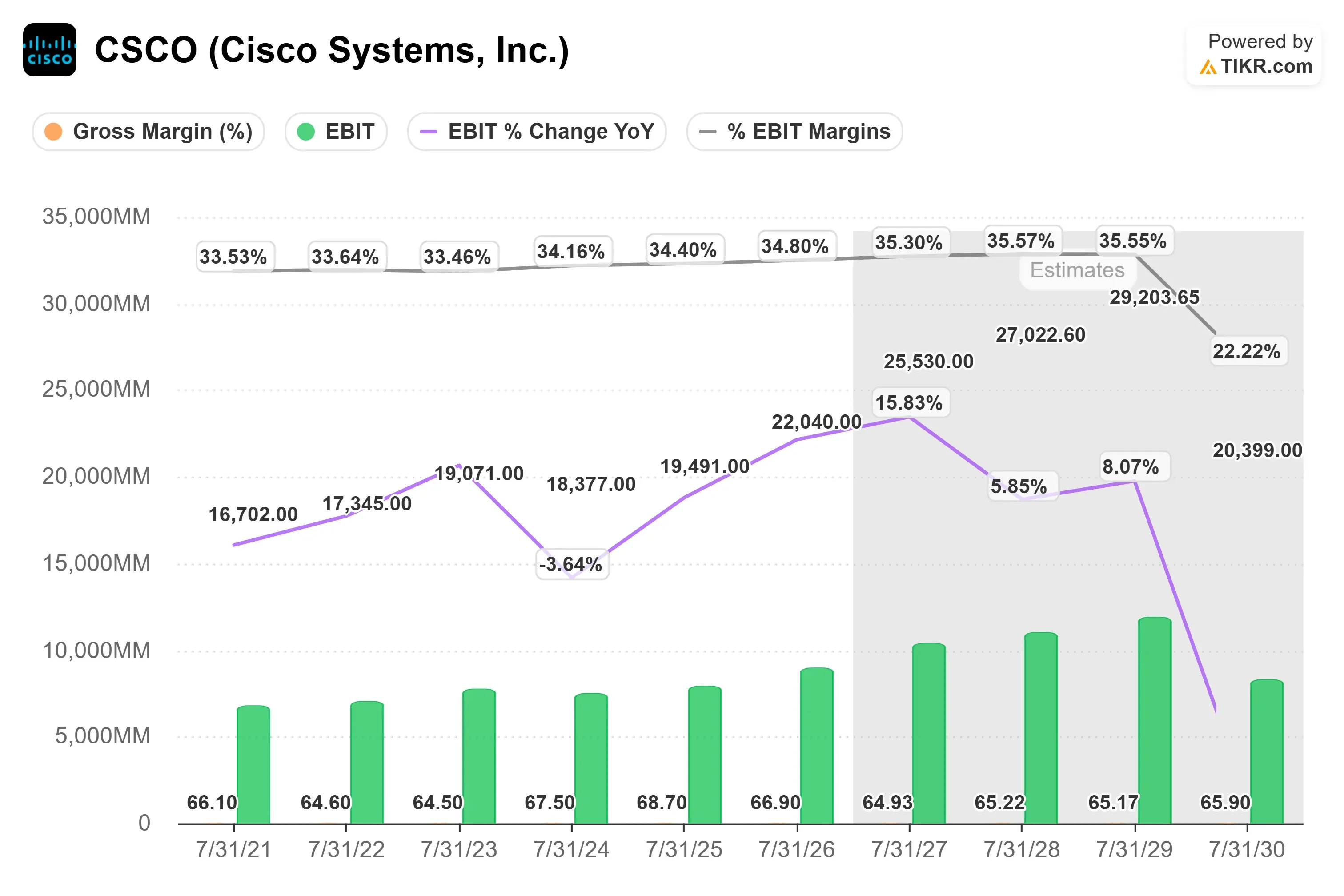
The margin chart captures the fundamental issue behind the selloff. Cisco’s gross margin was about 67% in fiscal 2026, while TIKR estimates point to roughly 65% over the next several years, suggesting a larger mix of AI hardware could keep gross profitability below recent peaks even as revenue grows.
See analysts’ growth forecasts and price targets for Cisco Systems (It’s free) >>>
At the same time, TIKR estimates EBIT margins around 35% to 36% through fiscal 2029, supporting the model’s roughly 36% operating-margin assumption. Cisco delivered a 35.9% non-GAAP operating margin in Q4 even as non-GAAP gross margin declined to 66.3% from 68.4% a year earlier. Management explained that hyperscaler deployments require relatively little incremental operating expense, meaning lower-gross-margin AI hardware can still produce attractive operating profit at sufficient scale.
Using around 9% revenue growth, 36% operating margins, and a 17x exit P/E, TIKR’s valuation model estimates Cisco stock could reach around $132 per share, representing around 17% total upside from a share price near $113 over roughly three years. That translates into only a mid-single-digit annualized return, so the model does not suggest Cisco is deeply discounted.
At current levels, Cisco appears fairly valued rather than deeply undervalued, with stronger performance through the rest of 2026 likely requiring continued AI order conversion, additional data-center networking share gains, and enough operating leverage to offset the margin pressure created by a more hardware-heavy sales mix.
How Much Upside Does CSCO Stock Have From Here?
Investors can estimate Cisco Systems’ potential share price, or what any stock could be worth, in under a minute using TIKR’s New Valuation Model tool.
All it takes is three simple inputs:
- Revenue Growth
- Operating Margins
- Exit P/E Multiple
From there, TIKR calculates the potential share price and total returns under Bull, Base, and Bear scenarios so you can quickly see whether a stock looks undervalued or overvalued.
If you’re not sure what to enter, TIKR automatically fills in each input using analysts’ consensus estimates, giving you a quick, reliable starting point.
Value Cisco Systems in under 60 seconds with TIKR (It’s free) >>>


