Key Takeaways
- The US is considering a rule that would stop Chinese AI companies from renting advanced chips in data centers in Malaysia, Singapore, Thailand and other countries, and Congress looks likely to add chip provisions to this year’s defense bill.
- Chris McGuire, a China hawk, argues that export controls haven’t cost NVIDIA any sales so far, because every chip it makes still finds a buyer.
- NVIDIA’s real exposure is Southeast Asia, where McGuire says $80 billion of AI chips went this year, and the same curbs would hit Oracle’s Chinese cloud customers.
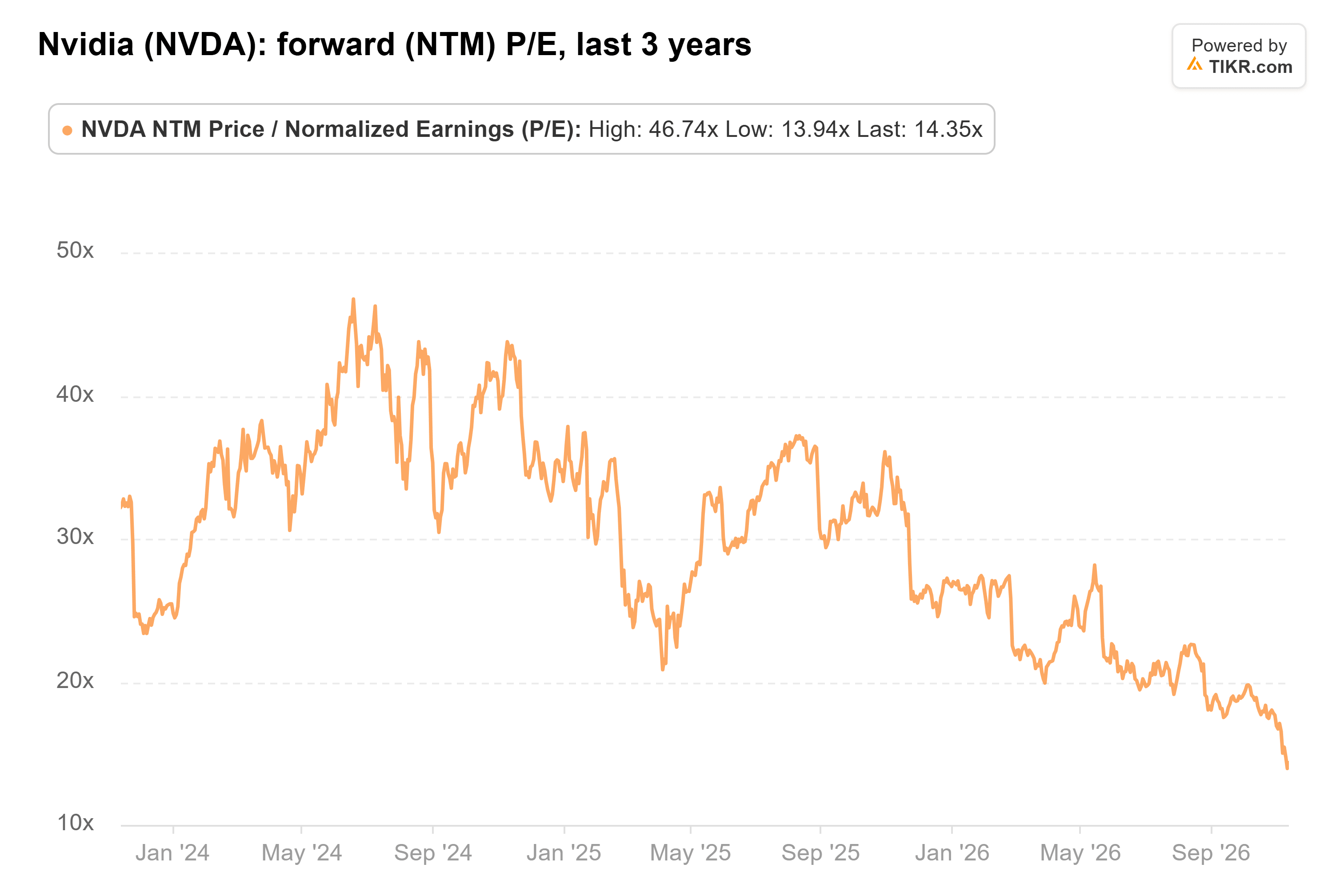
- With its chips sold out and its stock at 14x forward earnings, NVIDIA looks less exposed to the curbs than Oracle does.
Washington wants to close the route Chinese AI companies use to reach NVIDIA (NVDA) chips, and Oracle (ORCL) could get caught up in it too.
Chris McGuire was deputy senior director for technology and national security at the National Security Council from 2022 to 2024. He’s now a senior fellow for China and emerging technologies at the Council on Foreign Relations. On this week’s episode of Prof G Markets, he was asked whether the Megaspeed smuggling case could cut off a big chunk of NVIDIA’s revenue. He said it’s “the tip of the iceberg on the smuggling,” but he’s less worried about NVIDIA’s sales:
“the export controls so far, I would argue, have cost NVIDIA exactly zero sales”
And McGuire wants the controls tighter.
TIKR tracks 62 analysts on Nvidia. How many say “Buy”?
See the full breakdown of Buy, Hold, and Sell ratings on Nvidia, along with Wall Street’s revenue and earnings estimates, all in one place. More than 500,000 investors use TIKR to research stocks like this one. See Nvidia’s Analyst Ratings
Southeast Asia is NVIDIA’s real exposure
McGuire is right about the official numbers. Customers based in China, including Hong Kong, brought NVIDIA $19.7 billion of revenue in the year ended January 2026, down from $25.0 billion the year before. Management’s outlook assumes no China data center compute revenue at all. NVIDIA also took a $4.5 billion charge on the H20, the chip it designed for China, and its total revenue still rose 65% that year to $215.9 billion.
But NVIDIA’s China figures don’t show where its chips end up. McGuire said trade data show $80 billion of AI chips went to Singapore, Thailand and Malaysia this year. That’s about half of all the AI chips that don’t go to the US. “And these are countries that don’t have robust AI industries,” he said. US companies run some of the data centers there, but others are cloud providers selling compute to China. The Information reported that Tencent, Alibaba and ByteDance have deals with data-center operators abroad that give them access to advanced NVIDIA chips.
Washington is going after the rentals
Renting chips abroad is legal today. The Information also reported that the Commerce Department is preparing a rule to stop Chinese AI companies from remotely accessing advanced chips in other countries. The rule would extend existing chip controls to seven more countries, including Malaysia, Singapore and Thailand. It could come as soon as this month, though it’s still under review by several agencies.
Bloomberg’s Mackenzie Hawkins explained the stakes on Odd Lots: “this is sort of nightmare scenario for NVIDIA if remote access were to be restricted. It’s also a nightmare scenario for some hyperscalers like Oracle that counts, you know, Chinese offtakers as a significant portion of its business.”
Congress is moving too. On Wednesday’s Bloomberg Surveillance, Jeannette Lowe noted that chip provisions in the Senate’s version of the National Defense Authorization Act didn’t make the House version after some companies pushed back. Then she said: “This new situation with NVIDIA is going to propel those provisions to likely be included as part of the bill when it gets done by the end of the year.” She added that lawmakers are also looking at remote access through the cloud.
Sold-out chips still find buyers
McGuire himself makes the best case for NVIDIA. Chips that stop going to cloud providers serving China would probably be bought by SpaceX, Meta, Google, Amazon or Microsoft, he said. NVIDIA sells everything it makes: “They don’t have excess supply.”
Analysts expect NVIDIA’s revenue to rise from $215.9 billion in the year ended January 2026 to $412 billion this fiscal year and $691 billion the year after:
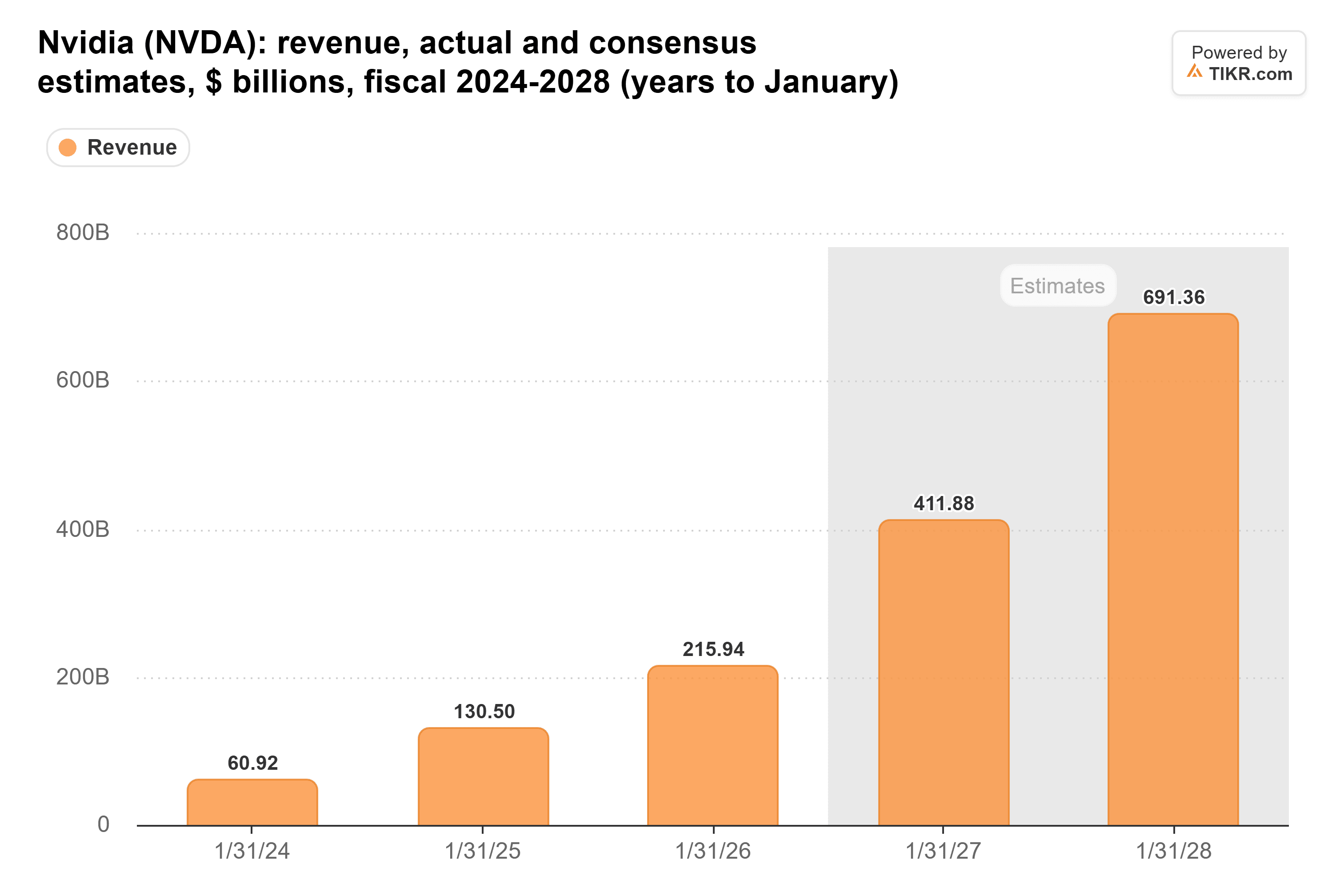
Management says supply is what limits its growth through fiscal 2028. A rule about who can rent NVIDIA’s chips doesn’t change how many it can make.
The stock is already priced for a lot of bad news. NVIDIA trades at about 14x forward earnings. That’s near its lowest point in three years and well below its three-year average of 30x:
Oracle has more to lose
Oracle is in a tougher spot. Hawkins pointed to Financial Times reporting that the Trump administration stepped in to kill an Oracle cloud deal with Tencent, even though the deal was legal. Meanwhile, analysts expect Oracle’s revenue to nearly double, from $67.4 billion in the year ended May 2026 to $132 billion in fiscal 2028:
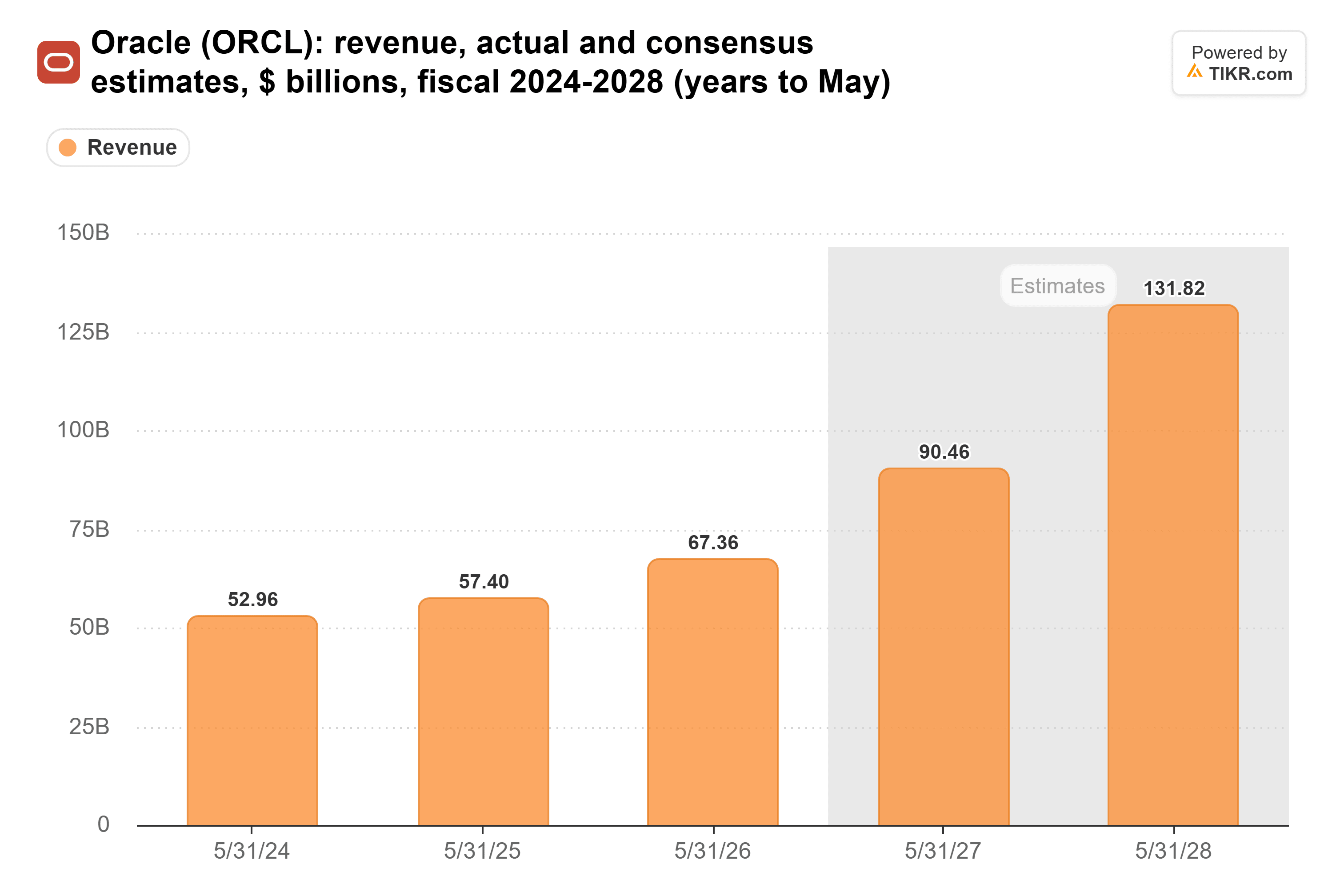
If a rule cuts off Chinese customers, Oracle has to find new tenants for that capacity. The “voracious” demand McGuire describes should help, but signing new customers takes time.
Bottom line: between Commerce’s rule and the defense bill, Washington looks ready to close the Southeast Asian route. That will cost NVIDIA some customers. But as long as it sells out every chip, I expect the curbs to cost it far less than the $80 billion figure suggests, and at 14x forward earnings, the stock already reflects plenty of bad news. Oracle is the one I’d watch more closely, since Chinese customers are part of the business it’s building.
Of course, McGuire’s point depends on demand staying that strong. NVIDIA reports on Nov. 17, and that will show how sold out it really is.
So what is NVIDIA stock actually worth?
TIKR lets you forecast the future price of any stock in less than a minute. Just enter a few assumptions into TIKR’s valuation model and see what NVIDIA could be worth. Start from Wall Street consensus estimates, or adjust the inputs to reflect your own view of the business. It’s free to use.
Disclaimer:
Please note that the articles on TIKR are not intended to serve as investment or financial advice from TIKR or our content team, nor are they recommendations to buy or sell any stocks. We create our content based on TIKR Terminal’s investment data and analysts’ estimates. Our analysis might not include recent company news or important updates. TIKR has no position in any of the stocks mentioned. Thank you for reading, and happy investing!