Key Takeaways
- Procter & Gamble yields 2.7% and Johnson & Johnson 1.9%, and P&G has raised its dividend for 70 consecutive years.
- J&J’s dividend took 62% of its free cash flow over the last 12 months, against 67% for P&G, and analysts expect 56% and 69% going forward.
- P&G has raised its dividend 5.6% a year over five years, against 5.2% a year for J&J.
- What to watch: J&J’s talc settlement, which needs at least 95% of the remaining ovarian claims to sign on, and the $1.9 billion of after-tax cost headwinds P&G expects this fiscal year.
Procter & Gamble (PG) declared its quarterly dividend of $1.0885 a share on Oct. 13, the same rate as the quarter before, and noted that it “has been paying a dividend for 136 consecutive years since its incorporation in 1890 and has increased its dividend for 70 consecutive years.”
That same day, Johnson & Johnson (JNJ) raised its 2026 guidance. A $5.5 billion pre-tax charge for its proposed talc settlement also cut its third-quarter net earnings to $210 million, from $5.15 billion a year earlier.
So which one actually pays you more over the next 10 years?
| Metric | Johnson & Johnson (JNJ) | Procter & Gamble (PG) |
|---|---|---|
| Forward yield | 1.9% | 2.7% |
| Annual dividend | $5.36 a share | $4.35 a share |
| Dividend growth, 5 years | 5.2% a year (fiscal 2020-2025) | 5.6% a year (fiscal 2021-2026) |
| Cash dividend payout ratio, TTM | 62% | 67% |
| Cash dividend payout ratio, forward | 56% (fiscal 2026) | 69% (fiscal 2027) |
| Net debt/EBITDA | 0.8x | 0.9x |
| Interest coverage | 26.8x | 24.2x |
6 safe dividend stocks paying retirees 6%+ yields
There are over 100 stocks paying 6%+ annual dividends today.
But after an extensive investment review leveraging TIKR’s proprietary data, we now believe only six of them are truly safe for retirees.
They’re all yours for free as part of our new investment report, which you can access right here.
J&J has room to spare
J&J’s growth is coming from its drugs. Innovative Medicine sales rose 7.7% to $16.76 billion in the third quarter of 2026, as new cancer, immunology and neuroscience launches gained ground on an older blockbuster that’s losing sales to biosimilars. MedTech grew just 2.5%.
Free cash flow has covered the dividend every year for a decade, rising from $15.5 billion in fiscal 2016 to $19.7 billion in fiscal 2025 as dividends paid went from $8.62 billion to $12.4 billion:
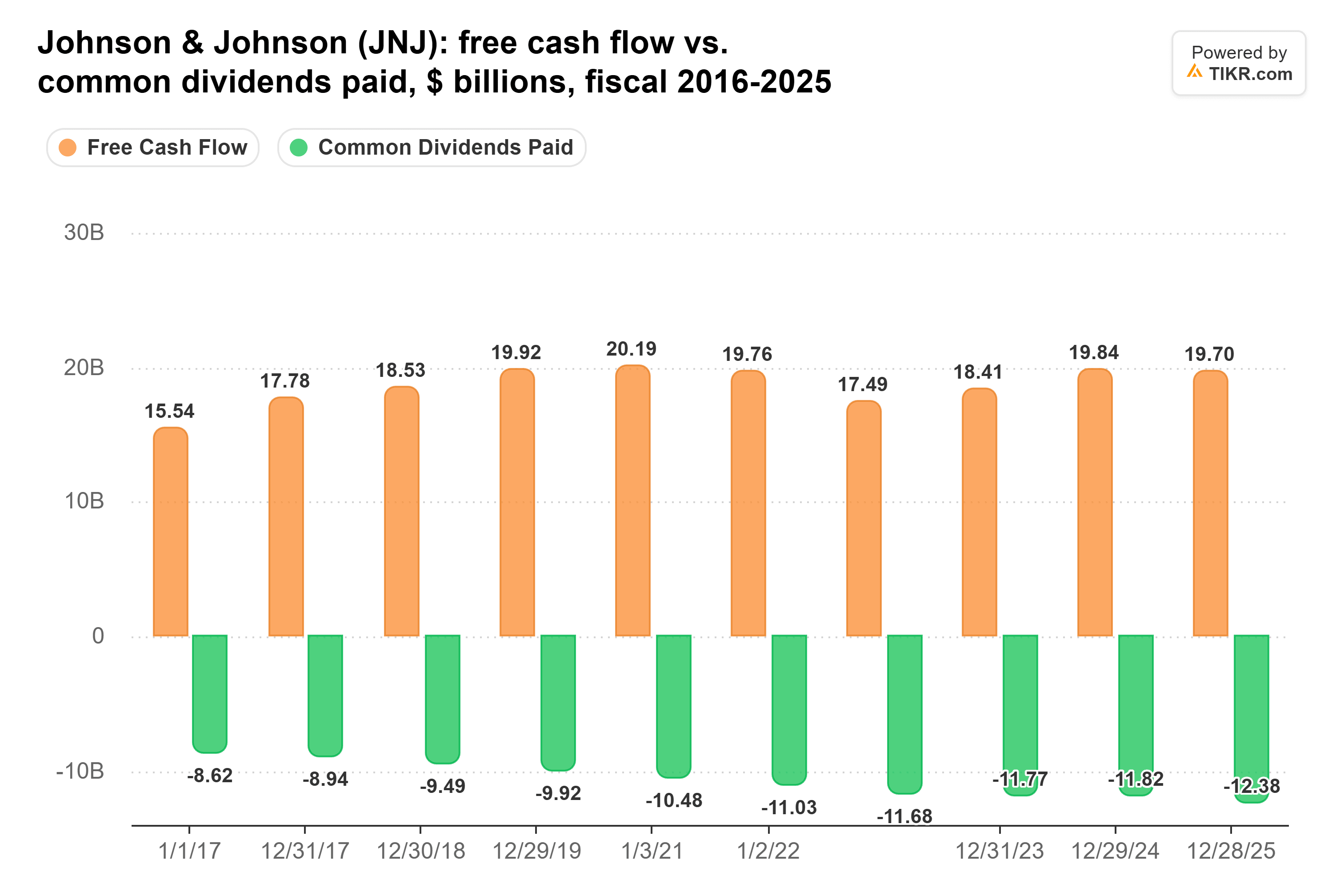
Over the 12 months to Sept. 27, 2026, dividends took a well-covered 62% of free cash flow, and analysts expect 56% for 2026. Only three analysts make that estimate, and their $23.1 billion of free cash flow is above J&J’s own guidance of about $21 billion. Either way, that leaves room to keep raising.
The main risk is the talc settlement behind that $5.5 billion charge. CFO Joseph Wolk said on the third-quarter call that it needs “the express participation of at least 95% of the remaining ovarian claims,” and added, “We are trending to meet the 95% threshold.”
P&G’s cushion is thinner
In the three months to Sept. 30, 2026, the first quarter of its fiscal 2027, P&G’s organic sales rose 4.0%. Core EPS rose 1% to $2.00. Even so, P&G still guides to core EPS growth of up to 3% for the year, from fiscal 2026’s $6.89. It also expects about $1.9 billion of after-tax cost headwinds.
And its dividend already takes a bigger share of its cash. Dividends took 53.0% of free cash flow in fiscal 2021 and 67.6% in fiscal 2026 (the year to June 2026):
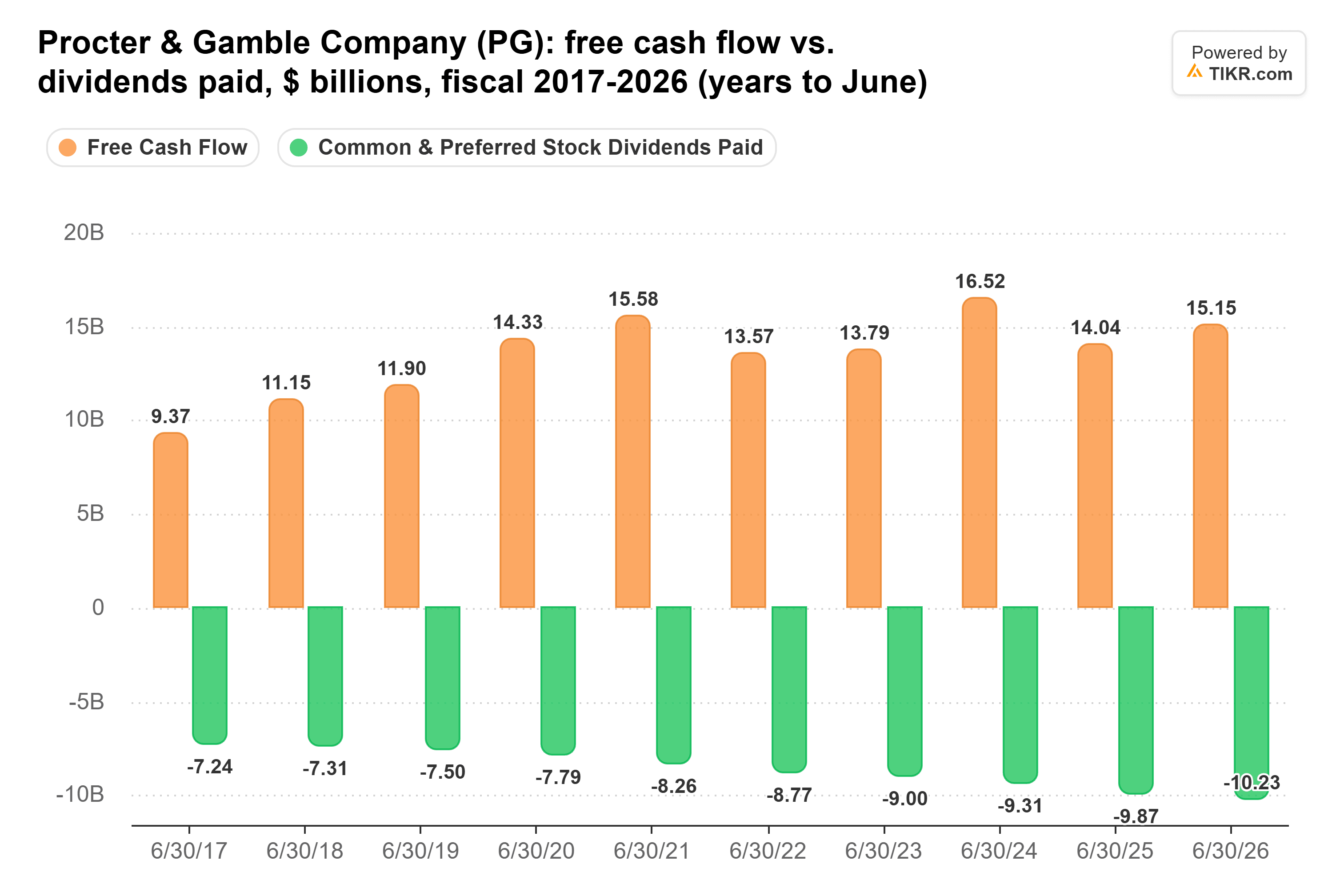
The ratio was 67% over the 12 months to Sept. 30, 2026, and five analysts expect 69% for fiscal 2027. Their estimate has a good track record: last year’s consensus landed within 1% of the actual. That’s still covered, just with less room than J&J’s.
So which dividend wins?
I’d take P&G, the one that pays you more over the next decade. Put $10,000 into each at today’s yields and grow each dividend at its five-year rate. P&G pays about $3,497 over 10 years, against about $2,418 for J&J, or about $1,079 more.
The open question is whether P&G can keep raising its dividend 5.6% a year when it guides to earnings growth of 3% or less. Analysts expect its free cash flow to keep climbing:
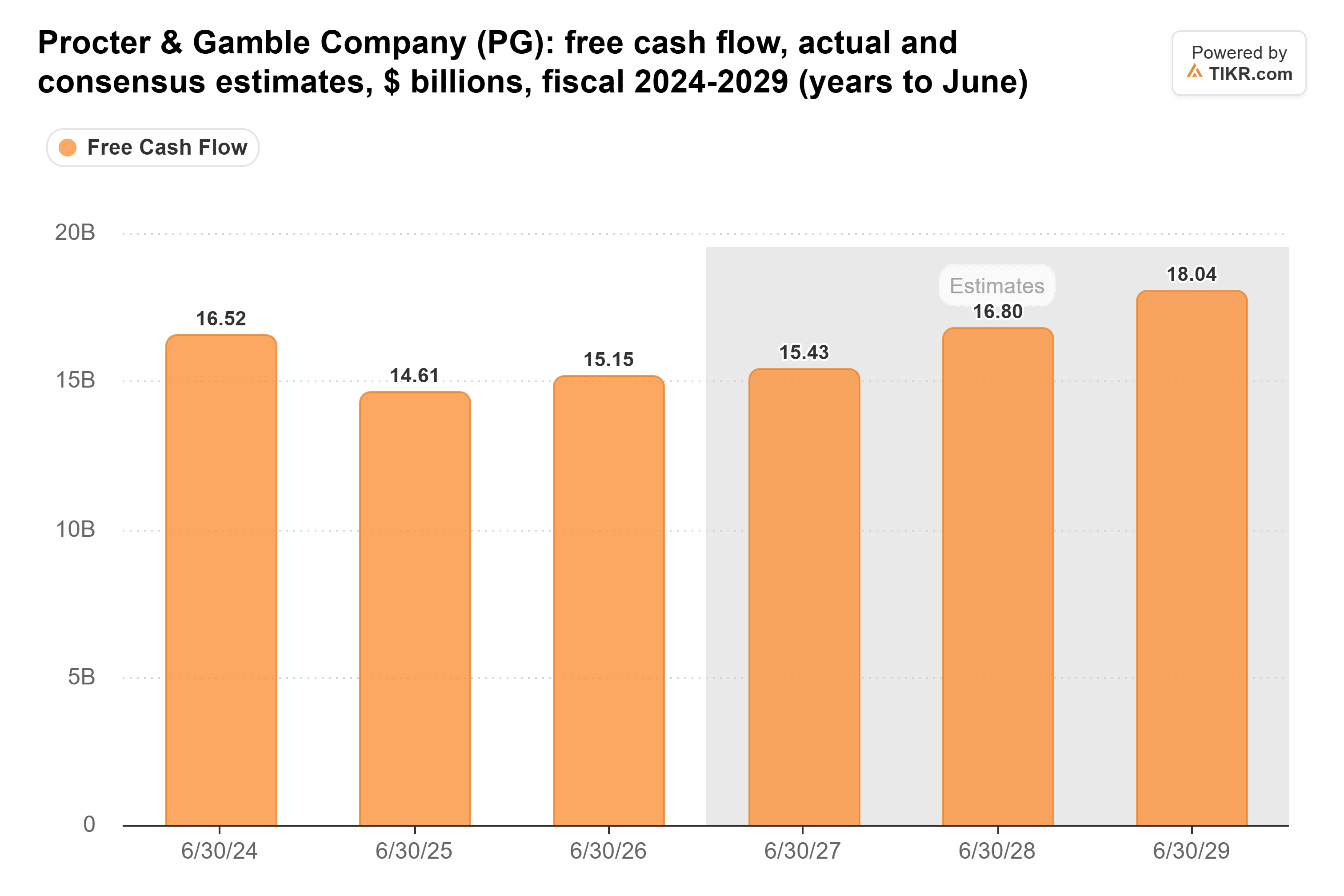
Estimates run from $15.4 billion in fiscal 2027 to $18.0 billion by fiscal 2029, though only two analysts forecast that far out. That’s enough for the raises to keep coming, even if they slow. And even if P&G never raised its dividend again, $270 a year for 10 years is $2,700. That’s still more than J&J pays with its raises.
J&J has a real case. Its dividend has more cushion and it carries less debt. But P&G’s dividend is covered too, and its bigger check today is too much income to leave on the table over a decade.
Of course, P&G’s next raise will show whether this year’s cost pressure slows its pace.
Forget Procter & Gamble: 6 safe 6%+ dividend yields you can buy right now
Dividends can hold the key to enormous wealth. But only if you buy the right ones.
Picking the right high-yield dividend stock can be the difference between a dream retirement…and scraping by every month, waiting for the next Social Security check to clear.
We’ve identified six stocks yielding 6%+ that we believe every retiree should know about right now. (And Procter & Gamble isn’t one of them.)
Disclaimer:
Please note that the articles on TIKR are not intended to serve as investment or financial advice from TIKR or our content team, nor are they recommendations to buy or sell any stocks. We create our content based on TIKR Terminal’s investment data and analysts’ estimates. Our analysis might not include recent company news or important updates. TIKR has no position in any of the stocks mentioned. Thank you for reading, and happy investing!