Key Takeaways
- Truist cut its Caterpillar price target to $1,027 from $1,100 on Oct. 30 and kept its Buy rating, a target 65% above the current share price.
- Caterpillar shares are 42% below their June high, even after record quarterly sales and a record $78 billion backlog.
- Analysts’ earnings estimates for 2026 and 2027 have risen over the past three months, so the selloff has come from the multiple investors will pay.
- Truist’s $1,027 needs investors to pay 34x forward earnings, a multiple Caterpillar hasn’t seen since the summer and far above its 19x five-year average, so the call looks too optimistic.
Caterpillar (CAT) just had its biggest sales quarter ever, and the stock keeps sliding: shares are 42% below their June high.
On Oct. 30, Truist’s Jamie Cook cut the firm’s price target to $1,027 from $1,100 but kept a Buy rating. That’s still 65% above the current price of $623.
The power trade cooled, then the outlook disappointed
Caterpillar’s run rode data-center power demand, and that trade has turned shaky. The stock slid with other power equipment stocks on Oct. 22, and on Oct. 26, Wells Fargo cut its target to $840 from $1,155, citing mounting stress around AI funding. This $840 target was subsequently reduced to $805.
Then came the Oct. 29 report. Sales rose 17% to $20.7 billion, and adjusted earnings per share jumped to $7.20 from $4.95, beating expectations.
But management guided to moderate Q4 sales growth, short of the $21.42 billion analysts had expected.
It also expects dealers to cut roughly $1.6 billion of construction inventory, about a $1 billion hit to that segment’s sales volume year over year.
TIKR tracks 31 analysts on Caterpillar. How many say “Buy”?
See the full breakdown of Buy, Hold, and Sell ratings on Caterpillar, along with Wall Street’s revenue and earnings estimates, all in one place. More than 500,000 investors use TIKR to research stocks like this one. See Caterpillar’s Analyst Ratings
Truist’s $1,027 tops the day’s target cuts
Seven other firms cut targets that day, from JPMorgan’s $1,000, with an “Overweight” rating, to Morgan Stanley’s $675, with Equal Weight.
Truist’s $1,027 sits 11% above the $926 consensus target, which is nearly up 73% from $535 a year earlier.
Thirty-one analysts cover the stock, with targets from $575 to $1,150, and the consensus climbed through mid-August and has eased since:

Does $1,027 add up?
The backlog hit a record $78 billion, up 96% in a year, and CEO Joe Creed said the company is “now taking some large reciprocating orders as far out as 2029 and turbine orders into 2030.”
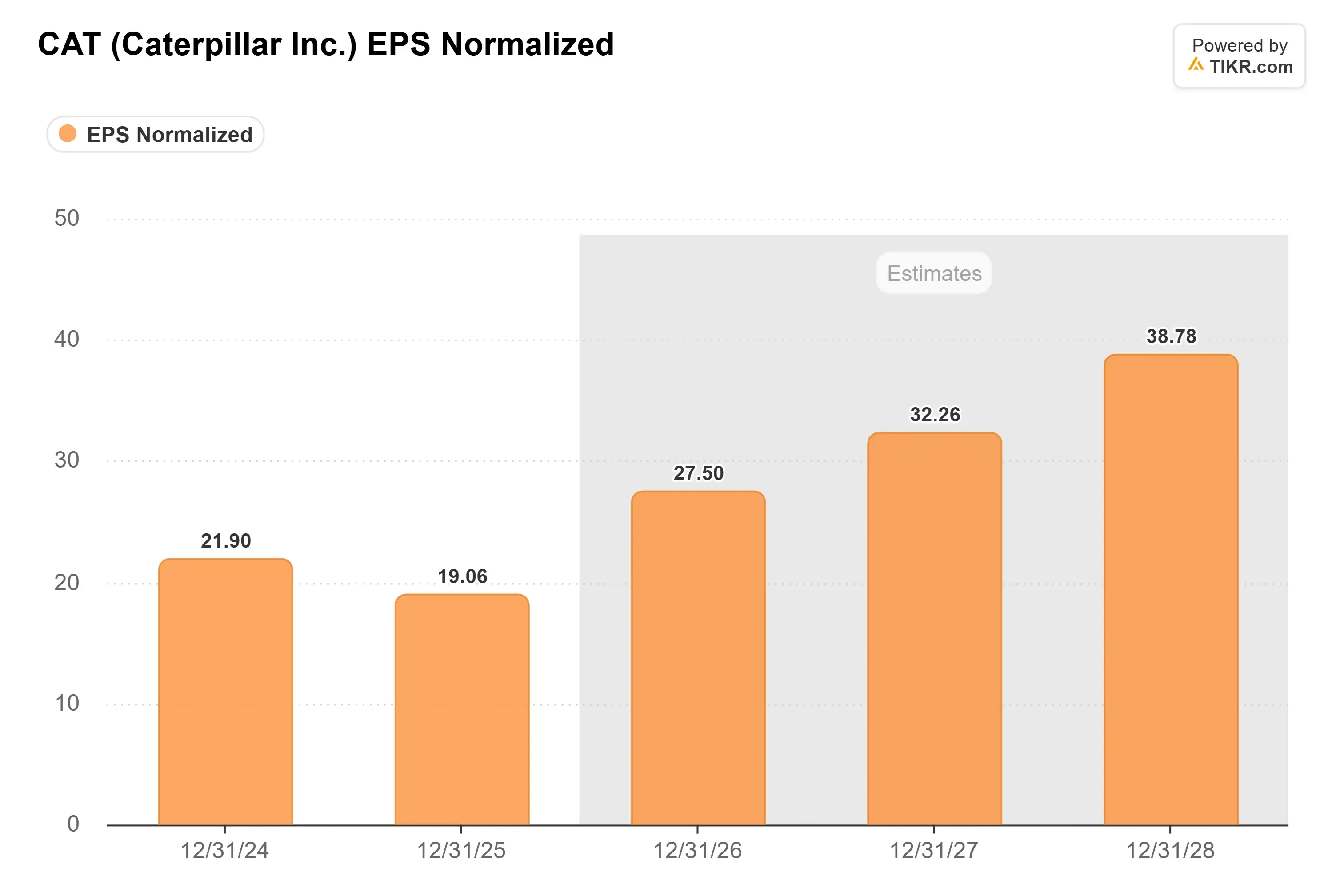
Estimates have climbed even as the stock fell: 2026’s consensus is $27.50 a share, up from $24.72 three months ago, and 2027’s is $32.26, up from $30.45. Analysts see $38.78 by 2028, more than double 2025’s $19.06:
So the selloff has come from the price investors will pay. Caterpillar traded at 21x forward earnings at Friday’s close, a bit above its five-year average of 19x and down from 42x on June 30:

Truist’s $1,027 works out to 34x the earnings analysts expect over the next twelve months. The stock hasn’t traded that richly since the summer.
Even against 2028’s $38.78 estimate, $1,027 is a richer multiple than the five-year average.
Margins could still disappoint: excluding tariff refunds, management expects this year’s adjusted operating margin near the bottom of its target range, as tariffs, freight and spending on new capacity add to costs.
The stock is a lot cheaper than it was in June, and it can probably rise with its earnings. But a 65% gain within a year needs investors to pay up again the way they did on the run to the June peak, and I wouldn’t count on that while worries about AI funding hang over the power trade.
The late-January report is the next test: Caterpillar’s first view of 2027, and whether construction sales to end users hold up while dealers cut inventory.
So what is Caterpillar stock actually worth?
TIKR lets you forecast the future price of any stock in less than a minute. Just enter a few assumptions into TIKR’s valuation model and see what Caterpillar could be worth. Start from Wall Street consensus estimates, or adjust the inputs to reflect your own view of the business. It’s free to use.
Disclaimer:
Please note that the articles on TIKR are not intended to serve as investment or financial advice from TIKR or our content team, nor are they recommendations to buy or sell any stocks. We create our content based on TIKR Terminal’s investment data and analysts’ estimates. Our analysis might not include recent company news or important updates. TIKR has no position in any of the stocks mentioned. Thank you for reading, and happy investing!