Key Takeaways
- Amazon’s third-quarter revenue rose 12% to $201.9 billion and AWS grew 39% to $46.0 billion, but EPS of $1.89 missed the $1.96 estimate.
- Capex hit $77.3 billion in the quarter against a $58.7 billion consensus, and trailing free cash flow swung to negative $42.4 billion.
- Fourth-quarter revenue guidance of $240 billion to $247 billion trails consensus at the midpoint, and Amazon plans to spend meaningfully more on capex in 2027.
- The expected February 4 report needs to show AWS growth holding near 40% and a credible path back to positive free cash flow.
Amazon (AMZN) just printed the highest operating margin in its history. The stock slipped anyway, closing Friday at $240, down 1.4% and 16% below its 52-week high of $287.
Blame the cash flow statement. Amazon spent $77.3 billion on capex in the third quarter, and trailing free cash flow fell to negative $42.4 billion.
A big share of that spending lands at Nvidia (NVDA), which plans to deploy 2 million more of its GPUs across AWS in 2027 and 2028. Amazon also has company in the red. Meta Platforms (META) reported the first negative free cash flow quarter of its public life a week earlier, at negative $2.12 billion.
So AWS growth no longer settles the debate. Investors want to know when all this spending turns back into cash.
A record margin with a miss attached
Revenue rose 12% to $201.9 billion, just under the $202.3 billion consensus. EPS of $1.89 missed the $1.96 estimate, and net income fell 2% because the year-ago quarter included a $9.5 billion pre-tax gain on Amazon’s Anthropic stake.
Higher up the income statement, the quarter was excellent:
- Operating income jumped 61% to $28.1 billion, a record 13.9% margin.
- AWS revenue grew 39% to $46.0 billion, its fastest pace in nearly five years.
- The AWS backlog reached $496 billion.
Guidance was softer. Amazon sees fourth-quarter revenue of $240 billion to $247 billion, and the $243.5 billion midpoint sits below the $244.5 billion consensus. Its operating income range of $28.5 billion to $33.5 billion still compares well with $25.0 billion a year earlier.
Profitability has stepped up quickly…
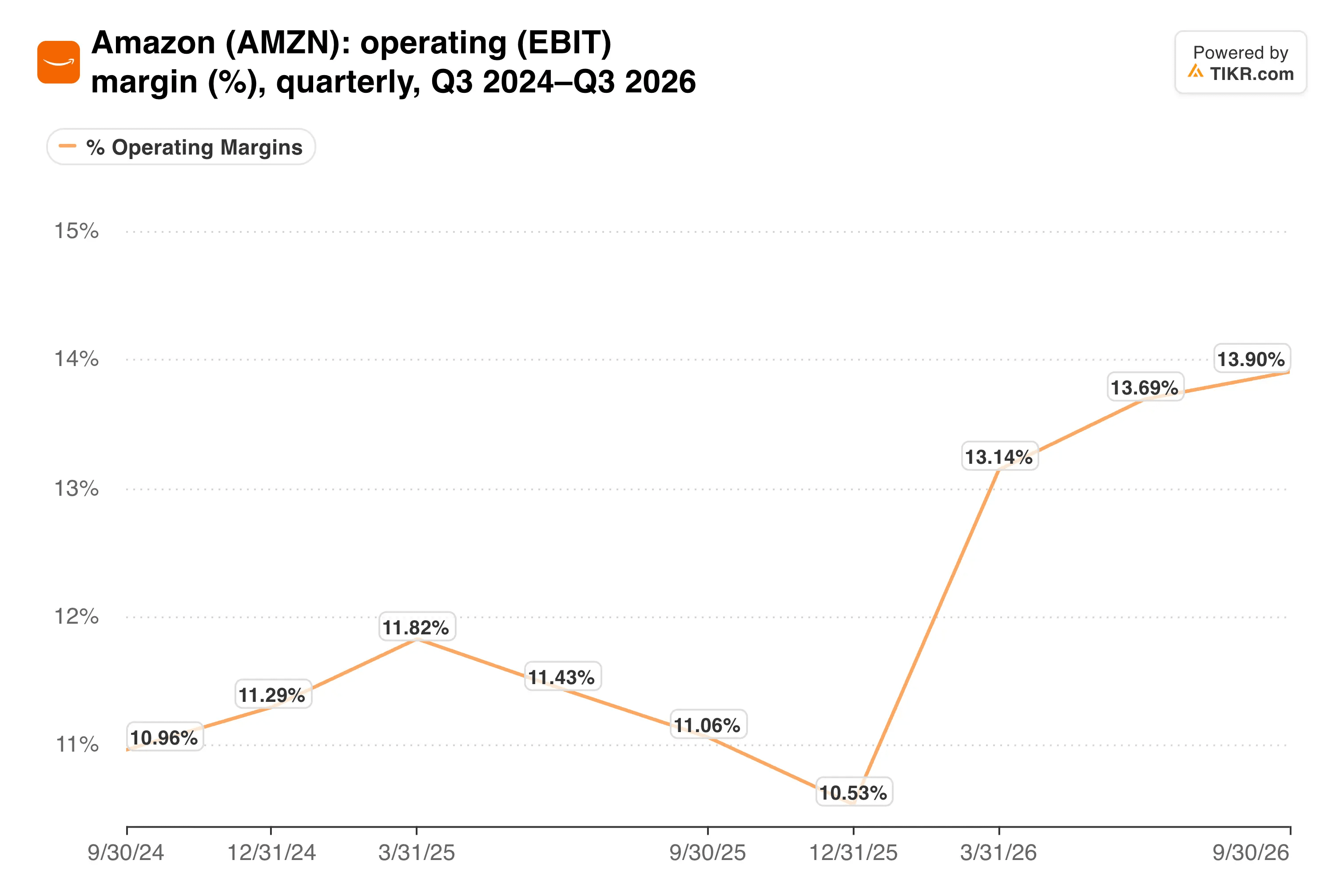
The earnings miss came from a tough comparison below the operating line. The profit engine itself keeps getting stronger.
TIKR tracks 60 analysts on Amazon. How many say “Buy”?
See the full breakdown of Buy, Hold, and Sell ratings on Amazon, along with Wall Street’s revenue and earnings estimates, all in one place. More than 500,000 investors use TIKR to research stocks like this one. See Amazon’s Analyst Ratings
AWS is doing the heavy lifting
AWS now runs at a $184 billion annualized pace with a 38.7% operating margin. Bedrock token volume grew roughly 17 times year over year, while Fortune 500 spending on AWS rose about sevenfold.
On the earnings call, CEO Andy Jassy said he expects AWS to grow more than 40% in both 2027 and 2028. He also sketched a path to $1 trillion of annual AWS revenue within five to 10 years.
That outlook is the case for the capex. Amazon kept its 2026 forecast at about $220 billion, mostly for AWS and AI infrastructure, and expects to spend meaningfully more next year.
So how big is AWS inside Amazon?
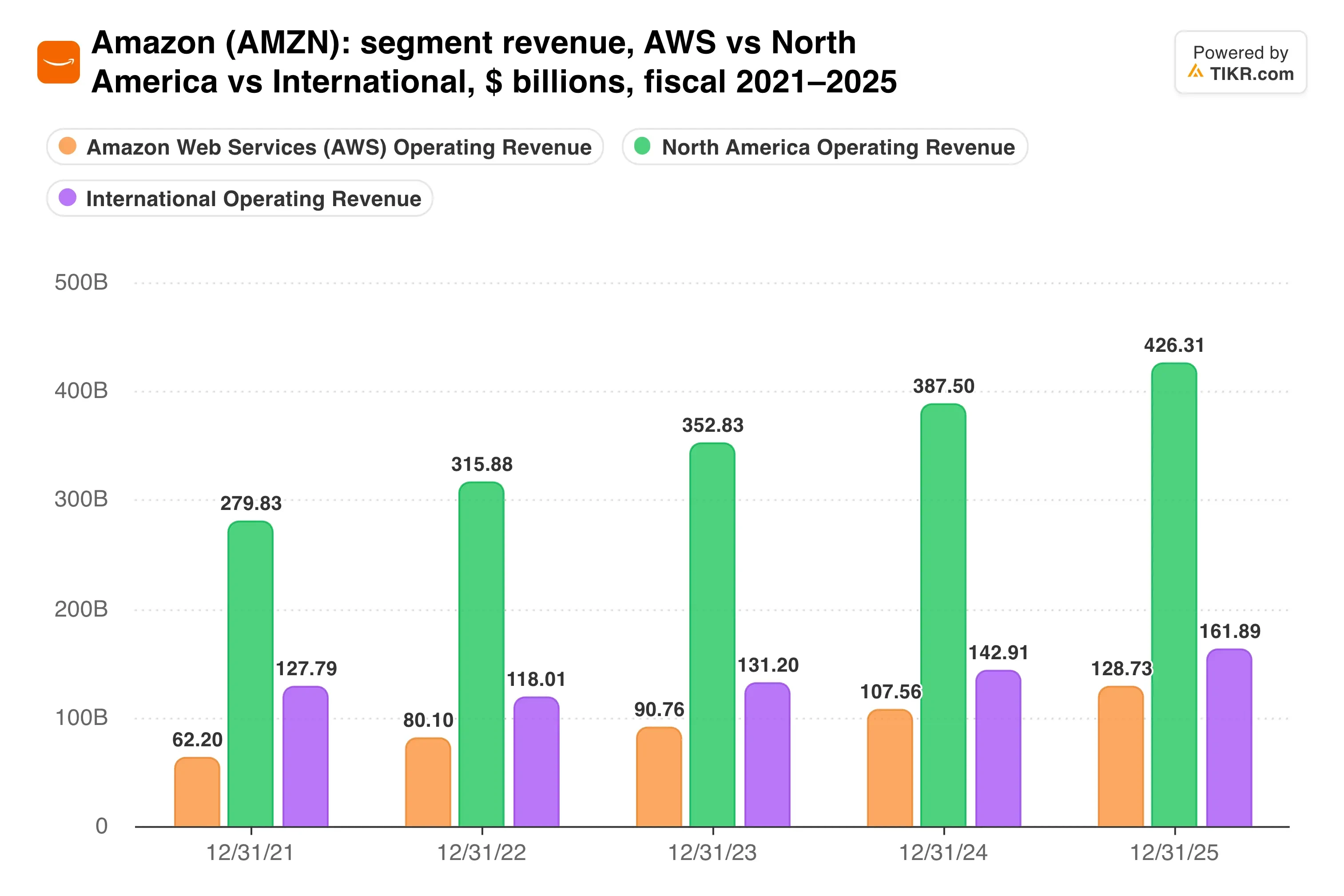
By my math, AWS produced about 23% of third-quarter revenue but roughly 63% of operating income. Retail still drives the sales, while AWS drives the profit.
The cash bill keeps rising
Third-quarter capex of $77.3 billion landed far above the $58.7 billion consensus. Trailing free cash flow swung to negative $42.4 billion, from positive $14.8 billion a year earlier.
Debt is bridging the gap. Amazon’s $25 billion bond sale in July drew $62 billion of orders, so lenders still want exposure.
Meta faces the same squeeze at a smaller scale, with third-quarter capex of $34.9 billion, less than half of Amazon’s.
Operating cash flow and capex tell the story side by side.
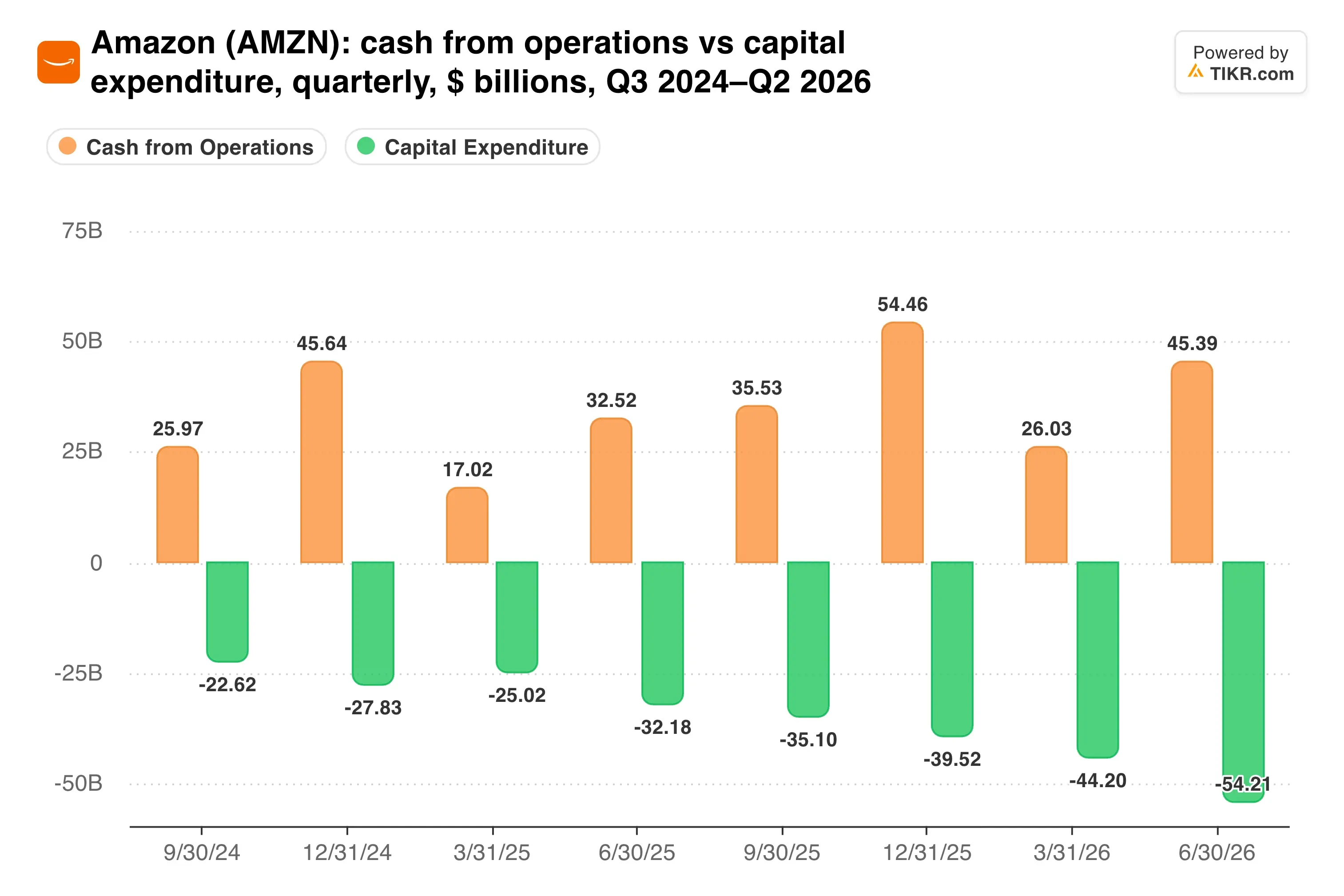
Spending has outrun operating cash flow over the past year, and management just signaled that 2027 capex will be higher still.
Regulators add friction. The FTC and more than 20 states sued Amazon in August over alleged hidden ad surcharges, and the EU is preparing to bring AWS under its tech rules.
The stock trades at 24.3x forward earnings, and the Street’s $333 average target implies 38% upside.
My take: The operating business has never looked better, and a $496 billion backlog suggests AWS demand is real. Still, I can’t value Amazon on earnings alone while free cash flow sits at negative $42.4 billion and the 2027 budget is going up. At $240, I’d hold and wait for proof that the spending earns its keep.
The next checkpoint is the full-year report, expected February 4. Watch whether AWS growth holds near 40% and whether the 2027 capex number arrives with a cash flow path attached.
So what is Amazon stock actually worth?
TIKR lets you forecast the future price of any stock in less than a minute. Just enter a few assumptions into TIKR’s valuation model and see what Amazon could be worth. Start from Wall Street consensus estimates, or adjust the inputs to reflect your own view of the business. It’s free to use.
Disclaimer:
Please note that the articles on TIKR are not intended to serve as investment or financial advice from TIKR or our content team, nor are they recommendations to buy or sell any stocks. We create our content based on TIKR Terminal’s investment data and analysts’ estimates. Our analysis might not include recent company news or important updates. TIKR has no position in any stocks mentioned. Thank you for reading, and happy investing!