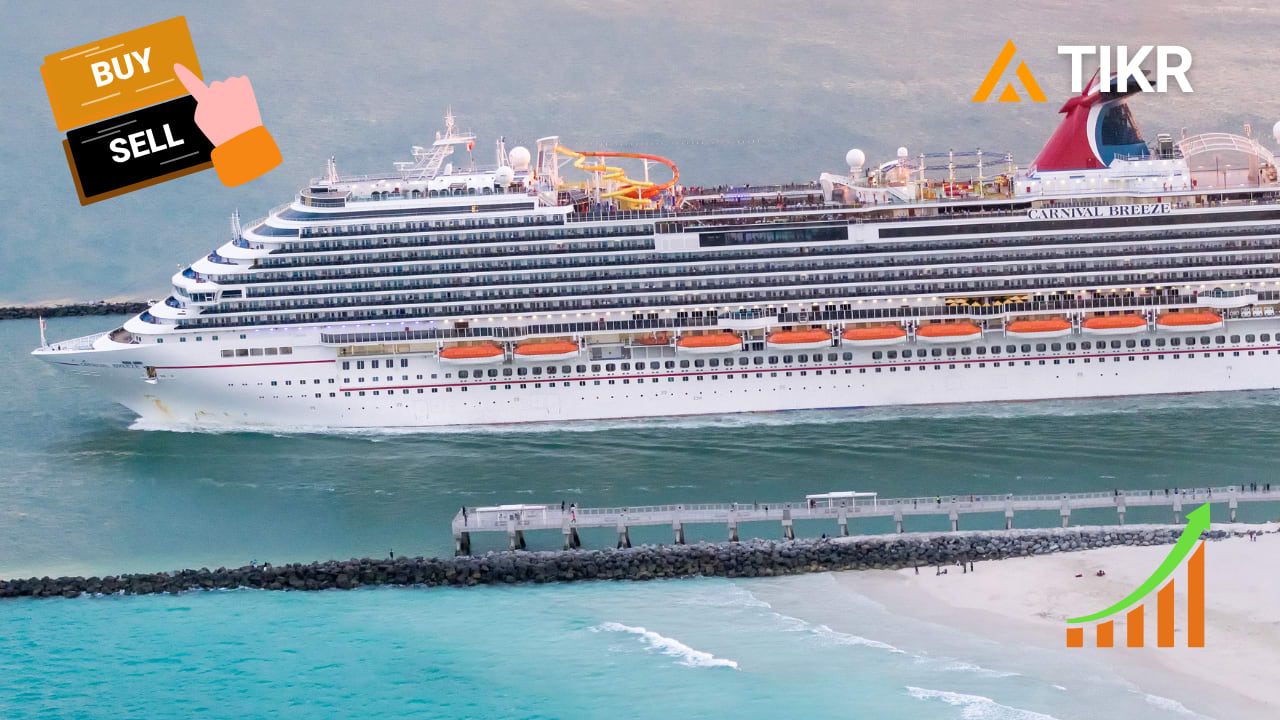
Now Live: Discover how much upside your favorite stocks could have using TIKR’s new Valuation Model (It’s free) >>>
Key Stats for Carnival Corporation Stock
- 52-Week Range: $22.58 – $34.03
- Current Price: $30.90
- Street Mean Target: $35.05
- TIKR Model Target (Mid Case): $80.13
- Annualized IRR: ~14%
What’s Driving the Rally
Carnival’s (CCL) stock has climbed from the high $20s back toward $31 over the past few months, and the first-quarter print explains why.
Revenue hit a first-quarter record of $6.2 billion, up 6% year over year, while adjusted EPS jumped 50% to $0.20. Net yields rose 2.7% in constant currency, beating the company’s own guidance, and customer deposits reached a first-quarter record of nearly $8 billion.

The EBITDA chart tells the bigger story here, as Carnival posted negative EBITDA through 2021 and 2022 as the pandemic shut down cruising entirely, then clawed its way to $7.1 billion by fiscal 2025. That recovery is the foundation for everything management announced alongside earnings.
CEO Josh Weinstein introduced PROPEL, a new multiyear plan targeting more than 16% return on invested capital, over 50% adjusted EPS growth from 2025 levels, and roughly $14 billion returned to shareholders through 2029. The board also authorized an initial $2.5 billion share buyback.
See historical and forward estimates for Carnival Corporation stock (It’s free!) >>>
The Debt Question Behind the Buyback
The complication is that Carnival is still working through one of the most leveraged balance sheets in the consumer travel sector. Net debt sits at roughly $25 billion, putting net debt-to-EBITDA at about 3.27 times, well above what most investors would consider comfortable for a business this exposed to fuel prices and discretionary spending.
PROPEL’s own targets acknowledge this, with management aiming to bring leverage down to 2.75 times adjusted EBITDA even as it ramps up buybacks and dividends.
That is a genuinely difficult balancing act. Fuel costs alone are expected to be a headwind of more than $500 million for the remainder of the year under the company’s Brent crude assumptions, and any further spike would eat directly into the cash available for both debt paydown and shareholder returns.
Carnival is betting that record bookings and pricing power, nearly 85% of 2026 capacity was already sold as of the earnings call, give it enough visibility to fund all three priorities at once. If demand holds at this level, the math works. If it softens, something on that list gives way first.
See how Carnival Corporation performs against its peers in TIKR (It’s free!) >>>
What the Valuation Model Says
At $30.90, Carnival trades at roughly 14 times forward earnings, which is not an expensive multiple for a company guiding to double-digit EPS growth. TIKR’s model puts the mid-case target at $80.13 by late 2030, implying a total return of around 159% and an annualized return near 12%.

That case assumes revenue growth slows to a more modest 3%-4% range, while net income margins expand into the mid-teens as the post-pandemic cost structure continues to pay off.
The spread between the low and high cases is wide, ranging from roughly 9% to over 14% annualized, reflecting how much of this thesis depends on execution rather than the macro cruise demand backdrop.
Carnival has already shown it can outperform its own guidance for several consecutive quarters. The valuation model is essentially betting that the streak continues for several more years.
See analysts’ growth forecasts and price targets for Carnival Corporation stock (It’s free!) >>>
Should You Invest in Carnival Corporation
Carnival is in a genuinely better position than it has been at almost any point since the pandemic. Record bookings, expanding margins, and a credible long-term plan all point in the right direction, and the buyback signals real confidence from management about free cash flow generation going forward.
The risk is that the company is layering an aggressive return-of-capital strategy onto a balance sheet that still has meaningful deleveraging to do.
For investors comfortable with cyclical exposure to fuel prices and consumer travel demand, the current setup offers a reasonable entry point against a business that has consistently beaten its own targets.
The PROPEL plan provides a clear scorecard to track over the next several years, and the first test will simply be whether Carnival can keep growing EBITDA and paying down debt while it ramps up buybacks.
Wall Street’s best ideas don’t stay hidden for long. Catch analyst upgrades, earnings beats, and revenue surprises on thousands of stocks the moment they happen with TIKR for free →
Looking for New Opportunities?
- See what stocks billionaire investors are buying so you can follow the smart money.
- Analyze stocks in as little as 5 minutes with TIKR’s all-in-one, easy-to-use platform.
- The more rocks you overturn… the more opportunities you’ll uncover. Search 100K+ global stocks, global top investor holdings, and more with TIKR.
Disclaimer:
Please note that the articles on TIKR are not intended to serve as investment or financial advice from TIKR or our content team, nor are they recommendations to buy or sell any stocks. We create our content based on TIKR Terminal’s investment data and analysts’ estimates. Our analysis might not include recent company news or important updates. TIKR has no position in any stocks mentioned. Thank you for reading, and happy investing!