
Key Takeaways
- Upstart stock is 58% below its January high, and BTIG kept its Buy rating on Nov. 3 while cutting its price target to $40 from $43, 89% above the share price.
- Third-quarter contribution profit hit a record $218 million, up 48%, but Upstart cut its 2026 revenue and adjusted EBITDA outlook because weaker borrowers hurt the value of the loans it holds.
- BTIG’s target works out to 13x forward earnings, a bit below the stock’s average of 14x over the past year.
- BTIG’s $40 is a fair one-year target if credit stops getting worse, though the losses Upstart shares with its funding partners are the main risk.
Upstart Holdings (UPST) has lost 58% since its January high, and its third-quarter report this morning came with a lower outlook for the year. BTIG still sees a big rebound: it kept its Buy rating and set a $40 price target, 89% above today’s $21.14.
Strong quarter, softer outlook
Credit has been getting worse for Upstart’s borrowers all year. The Upstart Macro Index, the company’s gauge of how much the economy raises default risk, rose from 1.39 at the end of 2025 to 1.49 by Oct. 5, and Upstart lent more cautiously as it climbed. Third-quarter originations of $4.1 billion came in a bit below the second quarter’s $4.2 billion.
Contribution profit from new loans still hit a record $218 million, up 48% from a year earlier.
But Upstart cut its 2026 outlook to $1.35 billion of total revenue and $260 million of adjusted EBITDA, down from the $1.4 billion and $294 million it had guided to. Analysts had expected $1.42 billion of revenue.
On the call, CEO Paul Gu said borrower health and interest rates “became a sizable headwind in Q3 and have gotten worse to start Q4.” Management blamed the cut on the loans Upstart keeps on its balance sheet, whose values fall as expected defaults rise. It still expects fee revenue to beat its original plan.
TIKR tracks 16 analysts on Upstart. How many say “Buy”?
See the full breakdown of Buy, Hold, and Sell ratings on Upstart, along with Wall Street’s revenue and earnings estimates, all in one place. More than 500,000 investors use TIKR to research stocks like this one. See Upstart’s Analyst Ratings
BTIG trimmed, but stayed bullish
BTIG analyst Andrew Harte kept his Buy rating today and cut his target to $40 from $43. That’s well above the targets Piper Sandler and Needham set today, $35 and $30, though both of them kept their Buy ratings too.
Is 13x too much to ask?
Sixteen analysts cover Upstart, and their average target has roughly halved over the past year, to $38 from $75:

BTIG’s $40 sits just above that average.
Earnings estimates have moved the other way. Analysts expect normalized EPS to grow from $1.89 in 2025 to $3.58 in 2027, and three months ago they had $3.37 for 2027:
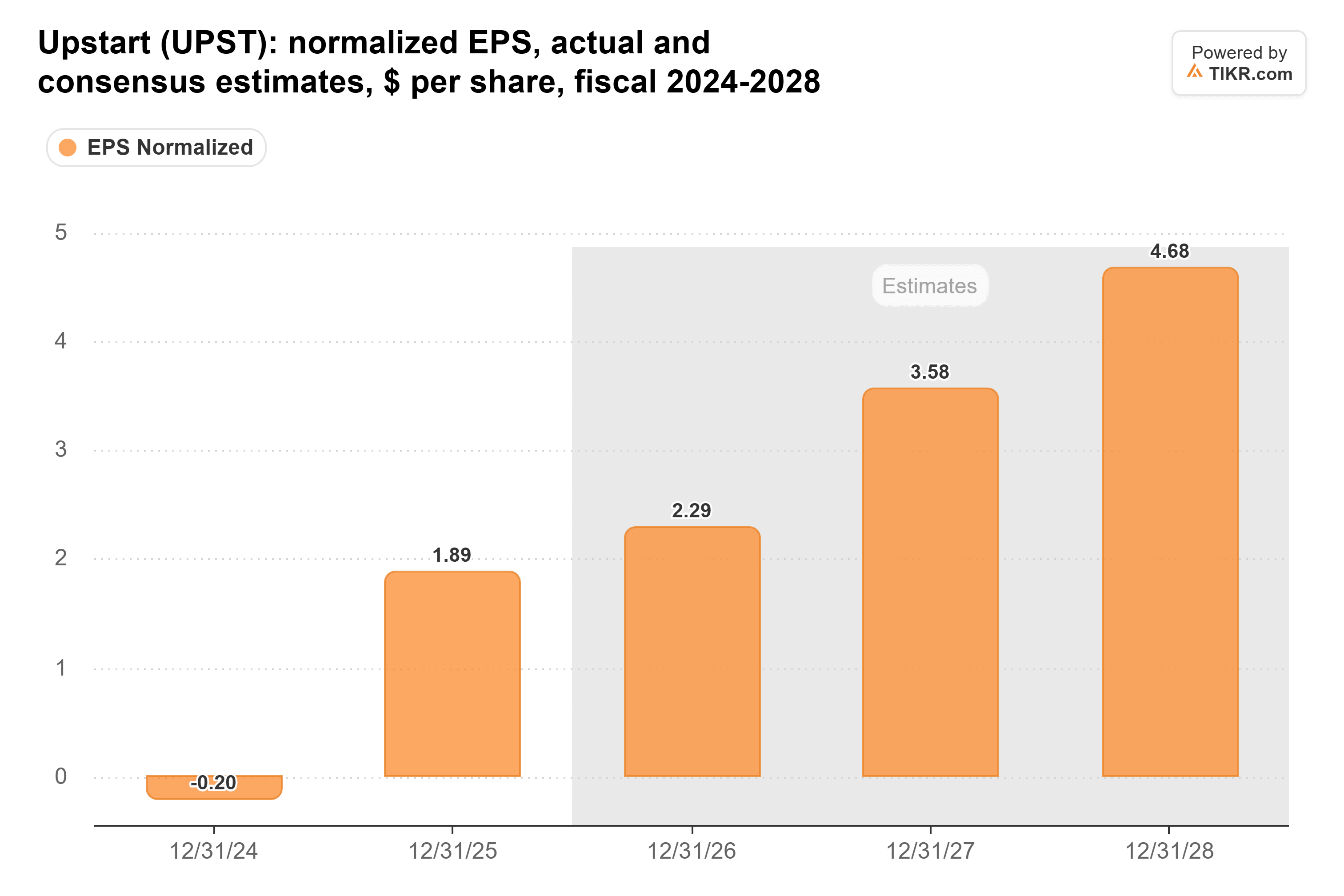
Today’s cut falls mostly on the balance sheet, so the 2026 estimate could slip, while fee revenue running ahead of plan supports 2027.
At Monday’s close, Upstart traded at 7.0x forward earnings. BTIG’s $40 works out to 13x, a bit below the stock’s 14x average over the past year. On a GAAP basis, though, analysts expect only $1.88 a share for 2027.
$40 looks fair to me
The biggest risk is on Upstart’s own books. To keep its loans funded, it shares in its partners’ losses, and its maximum exposure was $1.29 billion at the end of June, against $797.5 million of equity.
Still, I’d side with BTIG. Upstart kept growing through a tougher credit market than it planned for, and its multiple leaves plenty of room for a rebound once that market steadies. $40 within a year is a fair target.
The Upstart Macro Index, out early each month, is the number to watch, along with the approvals Upstart Bank still needs before its planned launch in early 2027.
So what is Upstart stock actually worth?
TIKR lets you forecast the future price of any stock in less than a minute. Just enter a few assumptions into TIKR’s valuation model and see what Upstart could be worth. Start from Wall Street consensus estimates, or adjust the inputs to reflect your own view of the business. It’s free to use.
Disclaimer:
Please note that the articles on TIKR are not intended to serve as investment or financial advice from TIKR or our content team, nor are they recommendations to buy or sell any stocks. We create our content based on TIKR Terminal’s investment data and analysts’ estimates. Our analysis might not include recent company news or important updates. TIKR has no position in any of the stocks mentioned. Thank you for reading, and happy investing!