Key Takeaways
- Broadcom stock is down 6.6% over the past year, closing at $321.68 on October 23, and sits 32.9% below its June 3 close of $479.23.
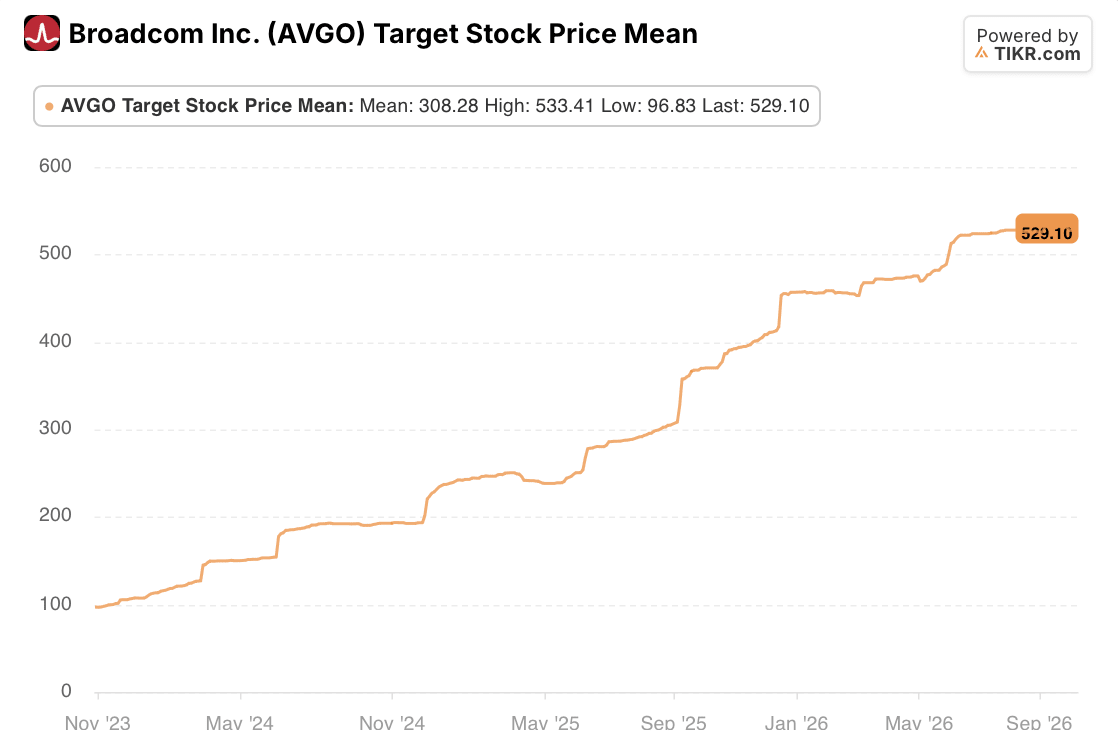
- The Street’s mean price target is $529.10, 64.5% above the latest close.
- Analysts expect normalized EPS to climb from $6.82 in fiscal 2025 to $30.38 in fiscal 2028, right in line with CEO Hock Tan’s call for more than $30.
- Next up is Broadcom’s fiscal Q4 report, which the company plans to release on December 9, against guidance of $34.8B in revenue and $21.7B in AI chip sales.
Broadcom (AVGO) stock is down 6.6% over the past year, closing at $321.68 on October 23. A 12.59% one-day drop in June and an October chip selloff erased a spring rally that had been built on a long-term chip deal with Alphabet (GOOGL) unit Google.
By my math, that leaves Broadcom stock 32.9% below its June 3 close. Over the same stretch, the company raised its AI revenue outlook and told investors it expects AI chip sales to double in each of the next two fiscal years. Since June, the business and the share price have moved in opposite directions.
How Broadcom Stock Got to $479
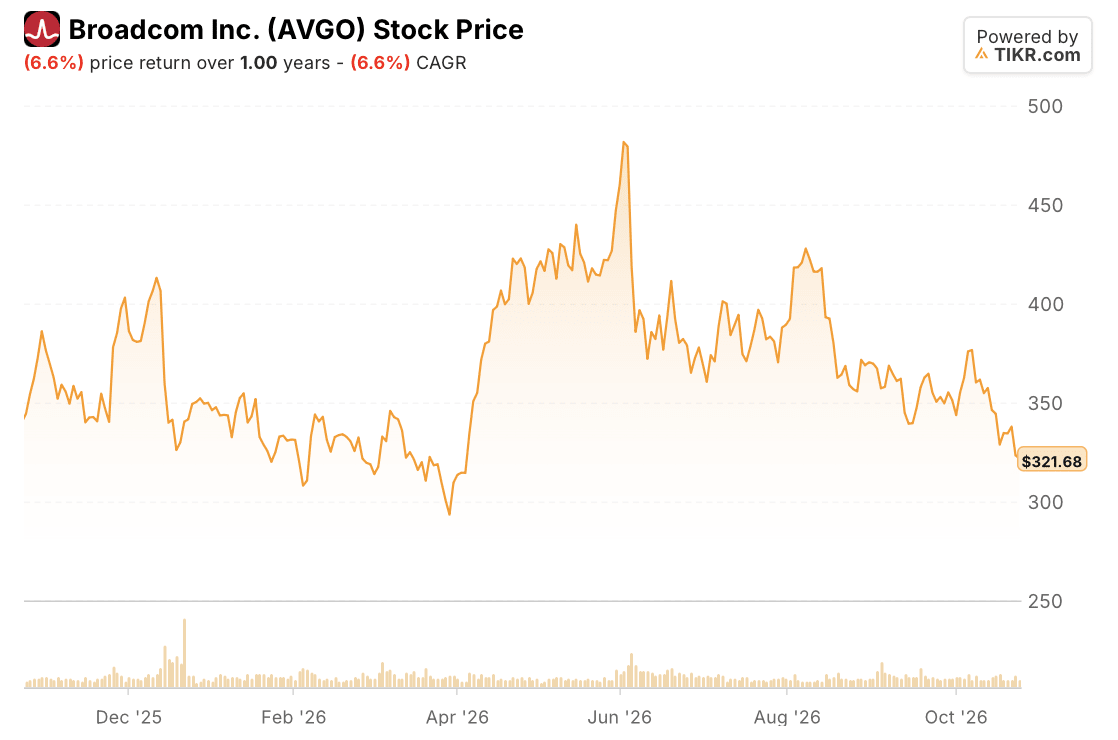
The first months of the period went the wrong way. Broadcom shares fell more than 11% on December 12, 2025, after the company warned that a bigger mix of lower-margin custom AI processors would squeeze profitability, Reuters reported. The stock kept drifting lower and dipped below $300 in early April.
Then the deal arrived. On April 6, Broadcom disclosed in an 8-K filing a long-term agreement to develop and supply future generations of Google’s Tensor Processing Units (TPUs, Google’s custom AI chips). The agreement also covers networking parts for Google’s next-generation AI racks through up to 2031. The same filing said Anthropic would access approximately 3.5 gigawatts of TPU-based compute through Broadcom beginning in 2027. The climb that followed carried Broadcom stock to a $479.23 close on June 3.
Two Days That Undid AVGO’s Spring Rally
The second-quarter report that evening broke the run. Revenue of $22.19 billion landed just short of the $22.27 billion analysts expected, and management kept its AI chip forecast unchanged instead of raising it. The stock fell 12.59% on June 4 to $418.91, giving back $60.32 a share in one session.
The next hit came from a rival. On August 19, Marvell Technology (MRVL) disclosed a custom chip agreement with Google and issued Google a warrant to buy up to 58,970,907 Marvell shares at $206.58 each. Broadcom has built every generation of Google’s TPU for over 10 years, so a second supplier inside that account landed hard: Broadcom stock fell about 5% that day
TIKR Tracks 53 Analysts on Broadcom. How Many Say “Buy”?
See the full breakdown of Buy, Hold, and Sell ratings on Broadcom, along with Wall Street’s revenue and earnings estimates, all in one place. More than 500,000 investors use TIKR to research stocks like this one. See Broadcom’s Analyst Ratings
A Record Quarter Broadcom Stock Couldn’t Rally On
Broadcom’s fiscal third-quarter report on September 2 was its biggest yet. Revenue rose 86% to $29.6 billion, with AI semiconductor revenue more than tripling to $16.7 billion. Adjusted EPS of $3.32 beat the $3.24 estimate.
Management also raised its fiscal 2026 AI revenue outlook to $58 billion from $56 billion. It said AI sales should double to approximately $115 billion in fiscal 2027, then double again to $230 billion in fiscal 2028. Still, the fourth-quarter revenue guide of $34.8 billion came in a touch under the Street’s consensus of just over $35.0 billion, and the stock fell about 3% the next day.
CEO Hock Tan put the earnings math plainly on the Q3 fiscal 2026 earnings call: “I got to say we are very much on target to exceed $30 in earnings per share in fiscal 2028.”

The Street’s estimates line up with him. Analysts’ normalized EPS estimates run from $11.66 in fiscal 2026 to $19.43 in fiscal 2027 and $30.38 in fiscal 2028, compared with $6.82 in fiscal 2025. That’s 4.5 times the fiscal 2025 figure in three years, by my math.
October’s Chip Rout Pushed AVGO to $321.68
On October 12, at a panel in Singapore, Tan likened many AI investors to casino gamblers and said capital, not chip supply, would be the biggest constraint on AI growth. Broadcom shares ended 0.7% higher the next day.
The bigger blow came from the wider market. Reuters reported that the Philadelphia Semiconductor Index fell 11.4% in the week to October 16, its biggest weekly drop since March 2025. Hot US inflation had raised the odds of Federal Reserve rate hikes, and debt worries at CoreWeave (CRWV) spread across AI stocks. Broadcom closed up 1.78% at $334.59 in the October 19 bounce, then slid again to close at $321.68 on October 23.
Why the Street Hasn’t Followed Broadcom Stock Down
The mean price target is $529.10, 64.5% above the October 23 close. It kept rising through 2026 while the stock went the other way, climbing from the mid-$450s in January. By my math, it’s up 446.4% from $96.83 three years ago. That fits with analysts’ earnings estimates holding steady through the selloff. Analysts are anchoring on the order book, and an 11.4% week in the chip index hasn’t moved them.
What Broadcom Stock Needs From Its December Report
At $321.68, Broadcom trades at 16.6 times the Street’s fiscal 2027 EPS and 10.6 times its fiscal 2028 EPS, by my math. That’s a low multiple for a company guiding to double AI revenue twice. It also means the next two reports matter far more than the next swing in the chip index.
December 9 is the first check. Broadcom has guided to $34.8 billion in fourth-quarter revenue, $21.7 billion of it from AI chips, at an operating margin near 66%. Management said it won’t update the fiscal 2027 and 2028 AI targets each quarter, so that $21.7 billion is the number that either confirms the path or puts it in doubt. The board also makes its yearly capital allocation decision in December. At a Goldman Sachs conference on September 8, Tan named a stock buyback as one of the two likely uses for the cash.
The first check is the fiscal fourth-quarter report, which Broadcom said on its September call it plans to release on December 9. Broadcom has guided to $34.8 billion in fourth-quarter revenue, $21.7 billion of it from AI chips, at a non-GAAP operating margin near 66%. Management said it won’t update the fiscal 2027 and 2028 AI targets each quarter, so that $21.7 billion is the number that either confirms the path or puts it in doubt. The board also makes its yearly capital allocation decision in December. At a Goldman Sachs (GS) conference on September 8, Tan named a stock buyback as one of the two likely uses for the cash.
So what is Broadcom stock actually worth?
TIKR lets you forecast the future price of any stock in less than a minute. Just enter a few assumptions into TIKR’s valuation model and see what AVGO stock could be worth. Start from Wall Street consensus estimates, or adjust the inputs to reflect your own view of the business. It’s free to use.
Disclaimer:
Please note that the articles on TIKR are not intended to serve as investment or financial advice from TIKR or our content team, nor are they recommendations to buy or sell any stocks. We create our content based on TIKR Terminal’s investment data and analysts’ estimates. Our analysis might not include recent company news or important updates. TIKR has no position in any of the stocks mentioned. Thank you for reading, and happy investing!