Key Takeaways
- TotalEnergies raised its 2026 dividend 5.9% in October, a day before Bristol Myers Squibb raised its 2026 revenue guidance after a 7% jump in third-quarter sales.
- Both dividends are well covered, taking 55% of Bristol Myers Squibb’s free cash flow and 51% of TotalEnergies’ over their latest twelve months.
- Bristol Myers Squibb’s sales have barely grown since fiscal 2021, and its dividend rose 2.9% in fiscal 2025.
- Over 20 years, the better income depends on whether Bristol Myers Squibb’s dividend growth gets back to its 6.2% five-year rate.
TotalEnergies (TTE) gave its shareholders a raise on Oct. 28. Its board set a third interim dividend for 2026 of €0.90 a share, 5.9% above its payments for fiscal 2025.
A day later, Bristol Myers Squibb (BMY) reported a strong quarter of its own. Sales rose 7% to $13.1 billion in the third quarter of 2026, and management raised its 2026 revenue guidance to between $49.75 billion and $50.25 billion.
If you could only hold one of them for the next 20 years, which should it be?
| Metric | Bristol Myers Squibb (BMY) | TotalEnergies (TTE) |
|---|---|---|
| Dividend yield | 4.1% | 4.5% |
| Annual dividend | $2.52 | $4.00 (in US dollars at today’s exchange rate) |
| Dividend growth, fiscal 2020-2025 | 6.2% a year | 4.9% a year |
| Cash dividend payout ratio, TTM | 55% (to Sept. 30, 2026) | 51% (to June 30, 2026) |
| Net debt/EBITDA | 1.7x | 0.5x |
| Interest coverage | 9.9x | 10.2x |
Source: TIKR, StockAnalysis, at today’s prices.
6 safe dividend stocks paying retirees 6%+ yields
There are over 100 stocks paying 6%+ annual dividends today.
But after an extensive investment review leveraging TIKR’s proprietary data, we now believe only six of them are truly safe for retirees.
They’re all yours for free as part of our new investment report, which you can access right here.
Bristol Myers is running to stand still
Bristol Myers Squibb’s Growth Portfolio sales rose 12% to $7.7 billion in the third quarter of 2026 from a year before. But generics keep eating its older drugs: Revlimid fell 47% and Pomalyst 81% in the quarter. Eliquis loses exclusivity in Europe this quarter, and management expects Eliquis revenue to step down by $1.5 billion to $2 billion in 2027.
From fiscal 2020 to fiscal 2025, free cash flow ran between $12.0 billion and $15.2 billion a year, while dividends paid rose from $4.08 billion to $5.05 billion.
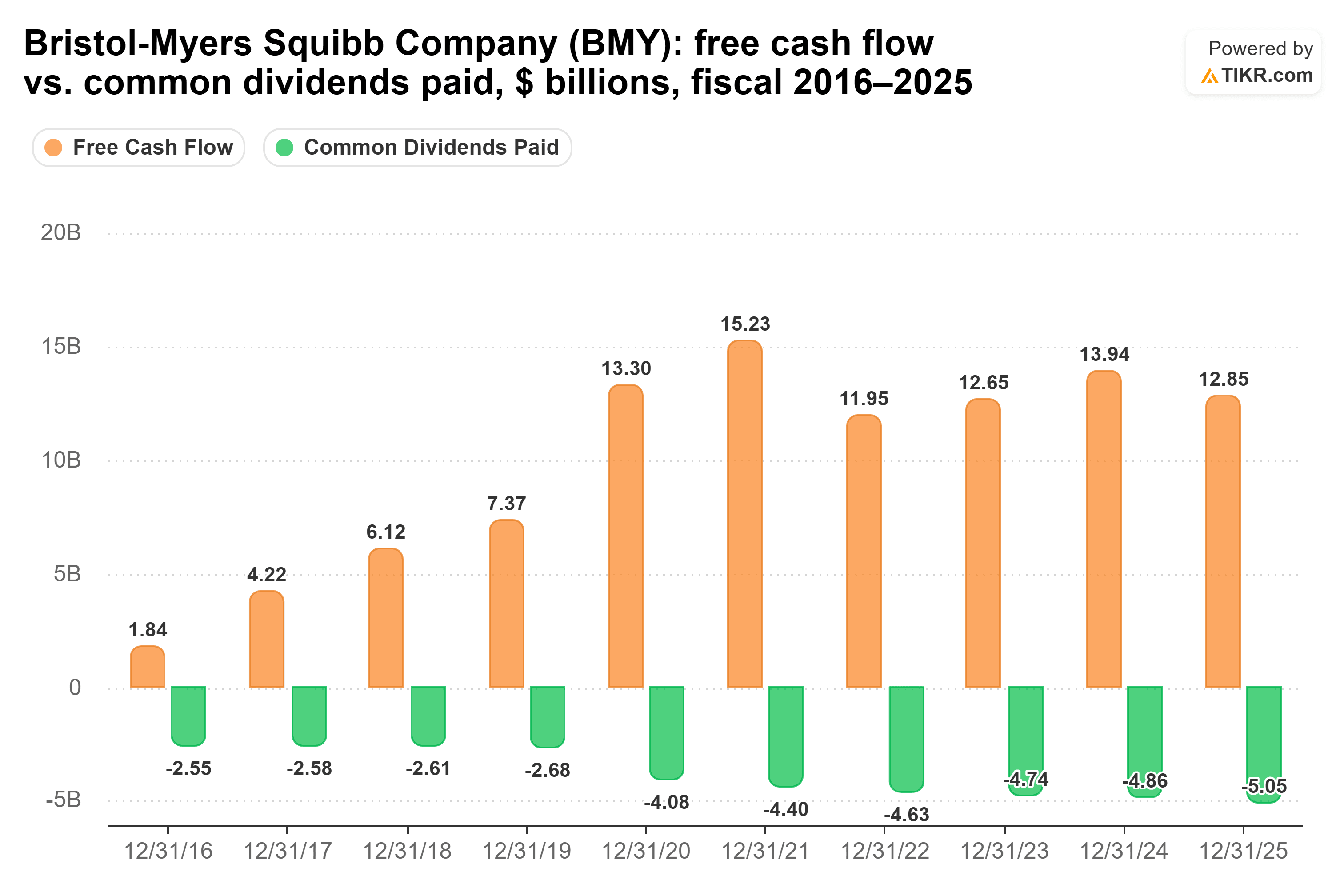
That left a well-covered payout of 39.3% in fiscal 2025. Free cash flow came in lower over the twelve months to Sept. 30, 2026, at $9.29 billion, so the dividend took 55%, which still leaves plenty of room.
CFO David Elkins said on the third-quarter call that “business development remains a priority,” alongside “our commitment to the dividend.” For a 20-year holder, the cash Bristol Myers spends buying drugs to replace its fading ones is cash it can’t spend on raises.
TotalEnergies rides oil, with a cushion
Bristol Myers fights patent cliffs, and TotalEnergies lives with oil and gas prices. CEO Patrick Pouyanné said on the third-quarter call: “Our strategy is fundamentally oil and gas upstream.”
That strategy made $12.3 billion of cash flow from operations in the third quarter of 2026. On Oct. 29, the company raised its full-year 2026 cash flow guidance to above $42 billion.
Its free cash flow swings far more than Bristol Myers’. It ran from negative $1.59 billion in fiscal 2016 to $33.7 billion in fiscal 2022 and $11.6 billion in fiscal 2025, while dividends paid rose from $2.79 billion to $8.42 billion.
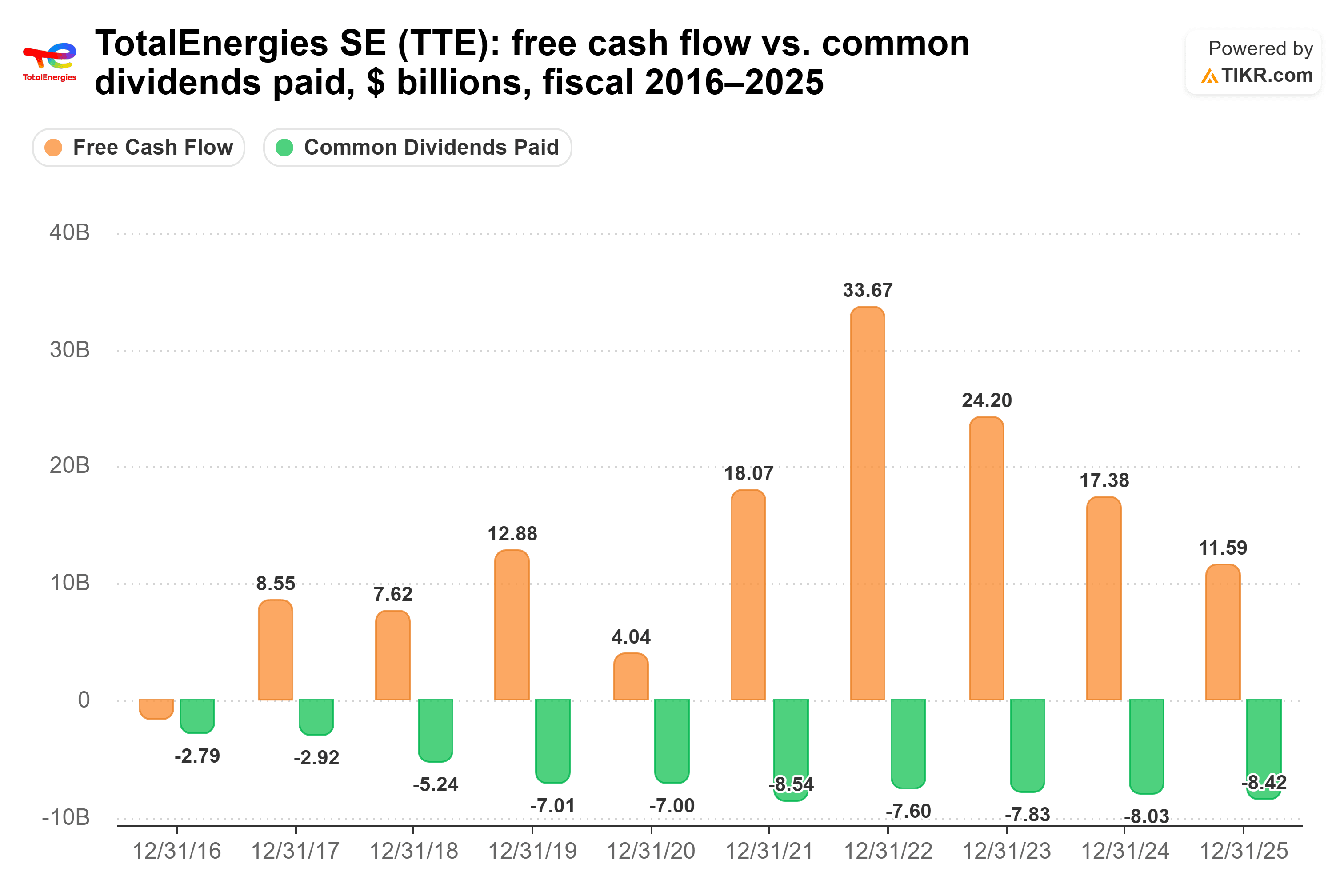
The fiscal 2025 dip pushed the payout to a tight 72.7%. Over the twelve months to June 30, 2026, the payout fell back to 51%.
Management said on the call that it’s committed to returning 40% of cash flow to shareholders, buybacks included, and could raise the final 2026 dividend to get there. TotalEnergies sets its dividend in euros, so its US-dollar value moves with the exchange rate, and France withholds tax on dividends paid to US holders.
So which dividend wins?
I’d hold TotalEnergies for the next 20 years. It pays the bigger check, its dividend is still growing at its usual pace, and its net debt is 0.5x EBITDA, against 1.7x for Bristol Myers.
What tips it for me is dividend growth. At each company’s five-year rate, $10,000 in Bristol Myers pays $410 a year today. It would pass TotalEnergies’ $450 around 2034 and pay about $15,472 over 20 years, about $824 more. But Bristol Myers raised its dividend just 2.9% in fiscal 2025, and its sales show why:
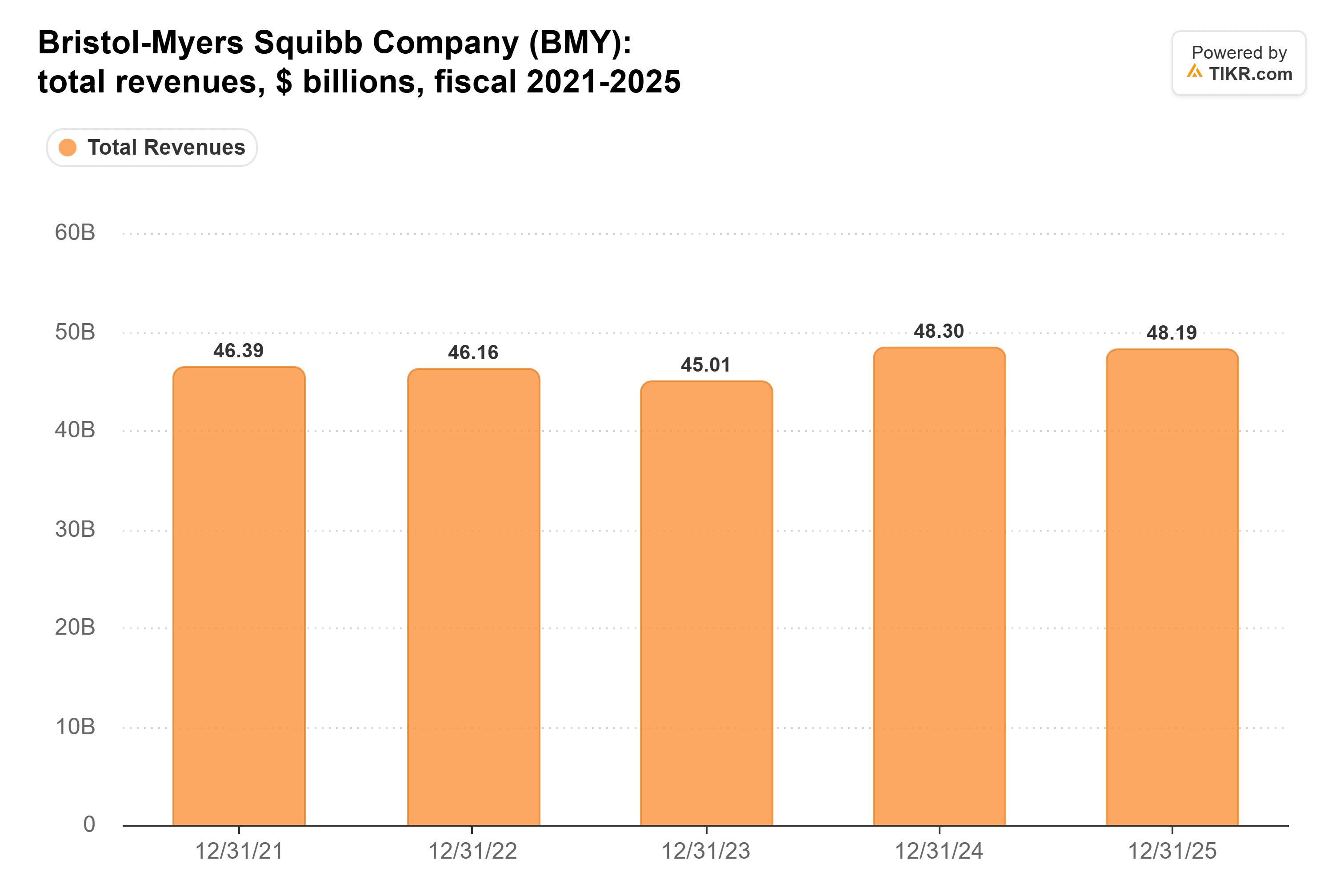
Total revenues went from $46.4 billion in fiscal 2021 to $48.2 billion in fiscal 2025, as generics took back much of what the new drugs added. At each dividend’s pace now (2.9% for Bristol Myers and 4.9% for TotalEnergies in fiscal 2025), Bristol Myers never catches up. TotalEnergies pays about $14,713 over the 20 years, about $3,816 more.
That doesn’t make Bristol Myers’ dividend shaky; it has years of steady free cash flow behind it. Over 20 years, though, I’d rather own a dividend that’s still growing on schedule than count on a drugmaker to keep replacing its blockbusters.
Of course, Bristol Myers expects AFib data in the first quarter of 2027 on milvexian, the drug it’s testing against Eliquis. A win there could put its raises back on a faster track.
Forget TotalEnergies: 6 safe 6%+ dividend yields you can buy right now
Dividends can hold the key to enormous wealth. But only if you buy the right ones.
Picking the right high-yield dividend stock can be the difference between a dream retirement…and scraping by every month, waiting for the next Social Security check to clear.
We’ve identified six stocks yielding 6%+ that we believe every retiree should know about right now. (And TotalEnergies isn’t one of them.)
Disclaimer:
Please note that the articles on TIKR are not intended to serve as investment or financial advice from TIKR or our content team, nor are they recommendations to buy or sell any stocks. We create our content based on TIKR Terminal’s investment data and analysts’ estimates. Our analysis might not include recent company news or important updates. TIKR has no position in any of the stocks mentioned. Thank you for reading, and happy investing!