Key Takeaways for Boeing Stock
- Boeing (BA) posted revenue of $22.2 billion in Q1 2026, up 14% year-over-year, beating Wall Street’s estimate of $21.9 billion.
- Operating income reached $448 million at a 2% operating margin, recovering from an operating loss of $222 million in Q2 2025 and marking a sustained positive inflection across three of the past four quarters.
- TIKR’s model values Boeing at around $3,240 by year-end 2030, implying roughly 1,379% total return from the current price of $219.
If you want to see what the income statement recovery actually looks like quarter by quarter, TIKR gives you eight years of Boeing’s financials in one place. Pull up Boeing stock on TIKR for free →
Boeing Stock Posts 14% Revenue Growth in Q1 2026 as the Production Recovery Compounds
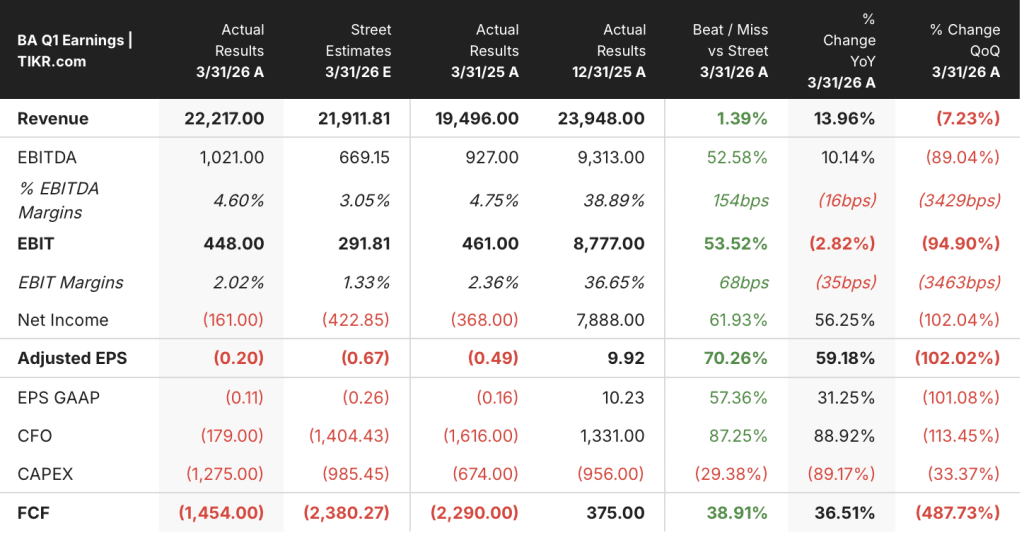
The Boeing Company (BA) delivered $22.2 billion in consolidated Q1 2026 revenue, a 14% year-over-year jump that beat Street expectations, as CEO Kelly Ortberg declared the company “off to a really good start and headed in the right direction.”
Boeing operates three segments: Boeing Commercial Airplanes (BCA), which builds commercial jetliners; Boeing Defense, Space and Security (BDS), which produces military aircraft and weapons; and Boeing Global Services (BGS), the aftermarket arm.
The headline Q1 number was built on solid segment contributions from all three divisions.
BCA delivered 143 airplanes in the quarter and generated $9.2 billion in revenue, up 13%, as the 737 MAX production rate stabilized at 42 per month.
The company reworked all 25 airplanes affected by a wiring nonconformance finding discovered in the quarter and confirmed those aircraft did not threaten the full-year delivery target of 500 units.
CFO Jay Malave said the quarter was “a good start to the year and a clean quarter,” with the 737 program driving “a nearly 20% reduction in final assembly rework hours as compared to the first quarter of 2025.”
On the 787 Dreamliner, Boeing delivered 15 airplanes and maintained its full-year guidance of 90 to 100 units, despite seat certification delays holding back finished aircraft from delivery.
BDS grew revenue 21% to $7.6 billion, led by higher volume on the KC-46 tanker, missiles and weapons, and classified programs, with BDS backlog reaching a record $86 billion.
BGS generated $5.4 billion in revenue and an 18% operating margin, anchored by government demand and the largest landing gear exchange contract in Boeing’s history with Singapore Airlines.
Total backlog reached nearly $700 billion, with BCA backlog alone at a record $576 billion and more than 6,100 airplanes.
At the Bernstein conference in May, Ortberg disclosed Boeing had passed the FAA capstone review for 47 aircraft per month and was already running the Renton line at that rate heading into summer stabilization.
He framed the 737 North Line in Everett as the critical enabler for the step to 52 per month, stating: “the rate increase at 52, we’ll have to watch that because I think that’s more going to be more of a strain than going to 47 because of the inventory.”
The 737 production ramp and the margin inflection it unlocks are exactly the kind of catalyst that TIKR’s financial models are built to capture. See how the income statement projects forward for Boeing stock on TIKR for free →
Boeing’s Operating Margin Turns Positive, But the Gap to Full Recovery Remains Wide
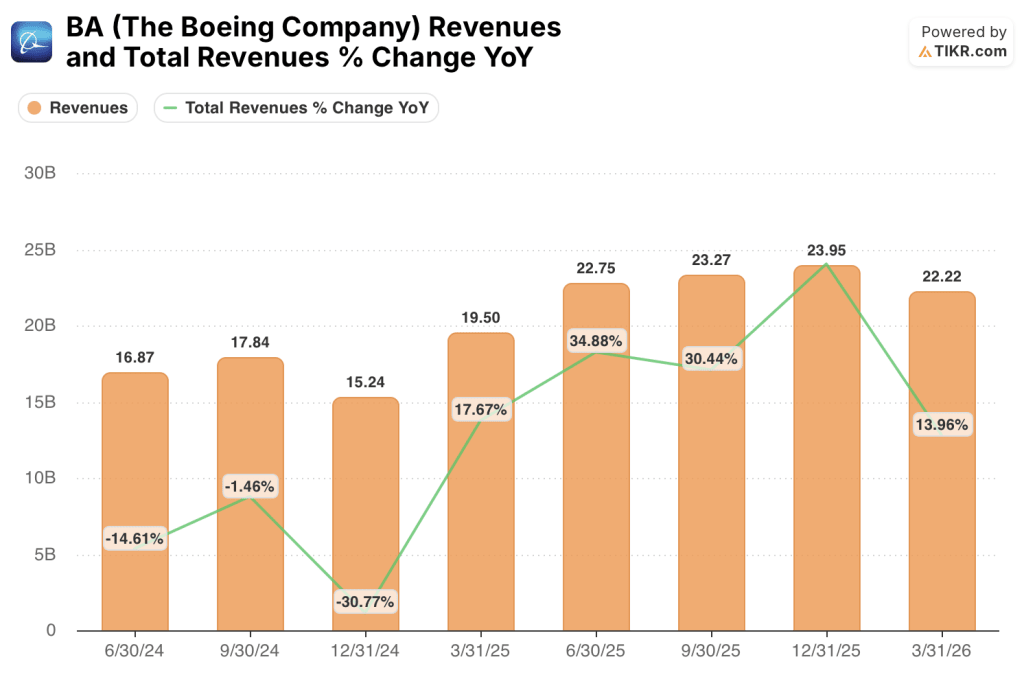
Boeing’s revenue grew 14% year-over-year in Q1 2026, beating Wall Street’s estimate for the fourth consecutive quarter of positive top-line growth.

Gross profit reached $2.55 billion, recovering from negative territory as recently as Q3 2024.
Total operating expenses fell to $2.17 billion, the lowest reading in the past four quarters.
SG&A dropped to $1.26 billion, down from a peak of $1.75 billion in Q2 2025.
Operating income turned positive at $380 million, the first positive reading after three consecutive quarters of deep losses.
The gap between gross margin and operating margin remains roughly ten percentage points, absorbed by SG&A and R&D, meaning the cost structure has stabilized but not yet compounded.
Revenue is growing faster than the cost base, and that spread widens with every step up in 737 production rate.
Boeing Trades at a Fraction of RTX’s Operating Margin as the Recovery Gap Narrows
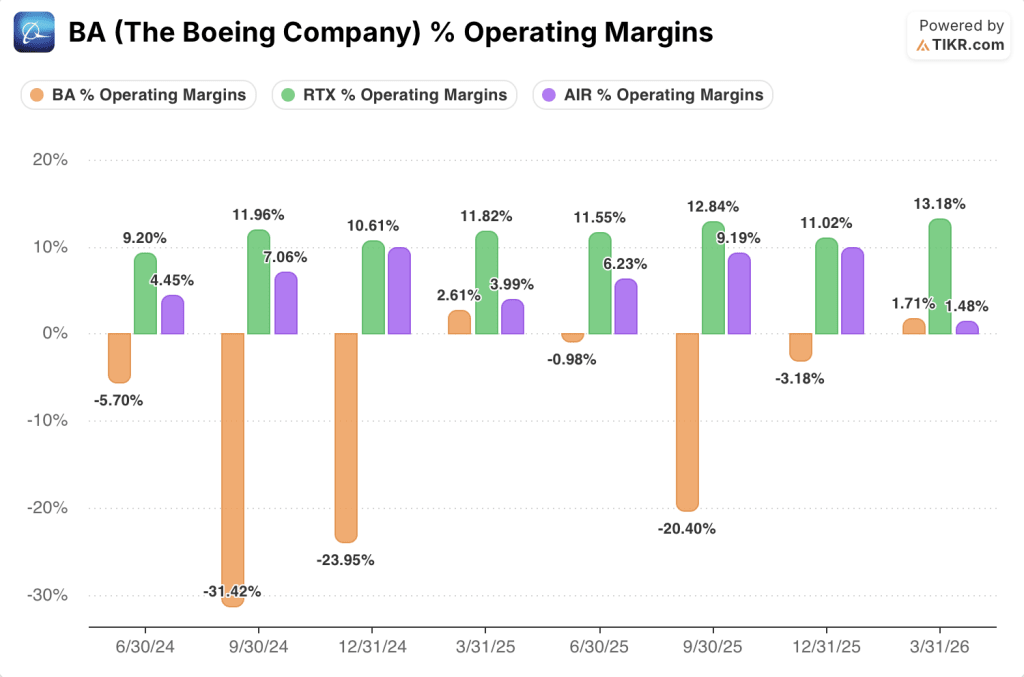
Boeing’s operating margin reached 2% in Q1 2026, its first positive reading in six quarters, while RTX Corporation (RTX) held 13% in the same period.
RTX has printed above 9% operating margin in every quarter shown, reaching a high of 13% in Q1 2026 as Boeing was still climbing out of a negative 31% trough in Q3 2024.
Airbus (AIR) posted 1% operating margin in Q1 2026, meaning Boeing has now pulled even with its direct commercial rival on this metric after years of deep losses.
The more telling comparison is the trajectory: Boeing moved from negative 20% in Q3 2025 to positive 2% in Q1 2026, a 22-percentage-point swing in two quarters.
RTX’s margin held in a tight band between 9% and 13% across all eight quarters, reflecting a mature, diversified defense and aerospace services business with no equivalent recovery drag.
Airbus swung between negative 1% and 6% over the same period, suggesting its own margin instability, though none approaching Boeing’s depth.
The gap between Boeing and RTX at the operating margin line remains roughly 11 percentage points, and closing it requires sustained delivery volume growth, not just cost discipline.
TIKR’s $3,240 Target on Boeing Stock Hinges on the Production Ramp Holding
TIKR’s model values Boeing at around $3,240 by December 2030, implying roughly 1,379% total return from the current price of $219, or roughly 81% per year.
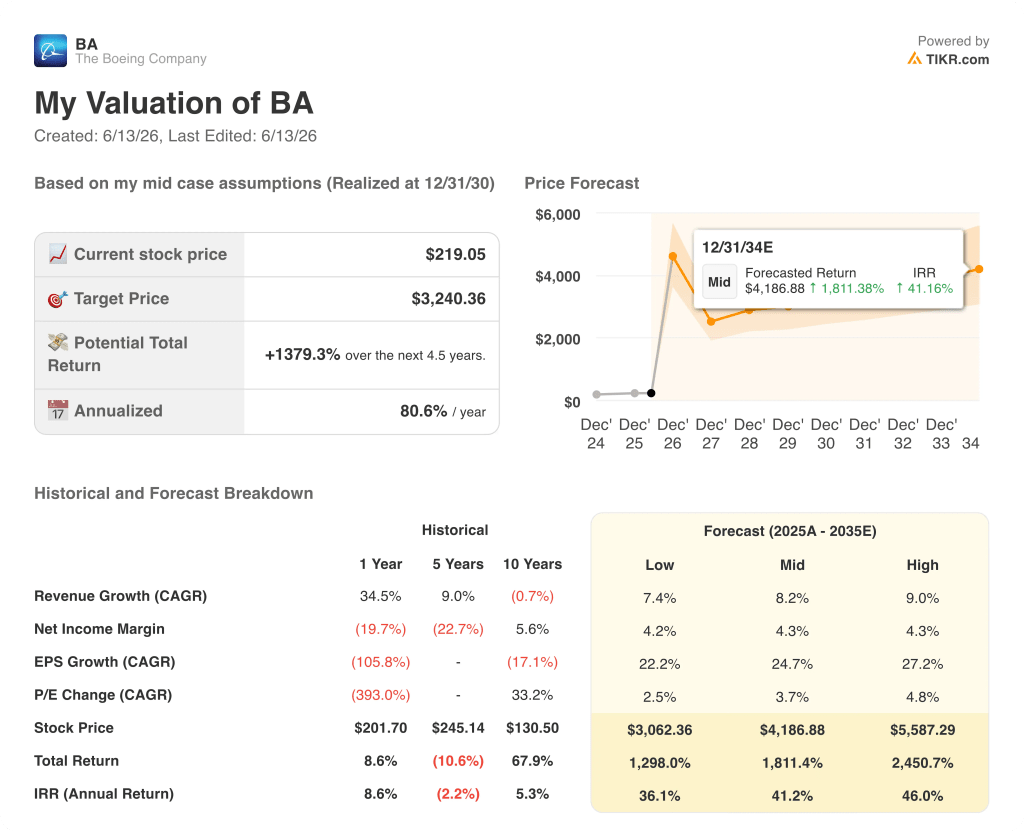
That target is underwritten by the same mechanism the income statement just confirmed: revenue growing faster than a cost base that is beginning to compress, producing operating leverage that compounds as delivery volumes climb.
For the model to hold, the 737 production ramp to 47 per month must stabilize on schedule, the 787 seat certification backlog must clear without disrupting full-year delivery guidance, and BDS must continue its march toward high single-digit operating margins from the 3% it printed in Q1.
Boeing’s margin story is moving in the right direction, but the distance to profitability is still real. TIKR’s model lets you stress-test every assumption. Access Professional Tools to Analyze BA stock on TIKR for Free →
Should You Invest in The Boeing Company?
The only way to really know is to look at the numbers yourself. TIKR gives you free access to the same institutional-quality financial data that professional analysts use to answer exactly that question.
Pull up The Boeing Company stock and you’ll see years of historical financials, what Wall Street analysts expect for revenue and earnings in the quarters ahead, how valuation multiples have moved over time, and whether price targets are trending up or down.
You can build a free watchlist to track The Boeing Company alongside every other stock on your radar. No credit card required. Just the data you need to decide for yourself.
Access Professional Tools to Analyze BA stock on TIKR for Free →
Is Boeing stock a buy right now?
Boeing stock is a recovery play contingent on production execution: revenue grew 14% in Q1 2026 and operating income turned positive at $380 million, but the stock carries deep losses and $47 billion in debt.
What is Boeing’s free cash flow outlook for 2026?
Boeing guided to $1 billion to $3 billion in free cash flow for full-year 2026, a return to positive cash generation after years of outflows, with the second half weighted heavier on delivery volumes.
How much debt does Boeing carry and is the balance sheet improving?
Boeing ended Q1 2026 with $47.2 billion in debt, down $6.9 billion from the prior quarter on matured debt repayments, with $20.9 billion in cash and access to $10 billion in undrawn credit facilities.