Key Stats for Block Stock
- Current Price: $69.17
- Target Price (Mid): ~$141
- Street Consensus Target: ~$90
- Potential Total Return (Mid): ~103%
- Annualized IRR (Mid): ~17% / year
- Q1 2026 Earnings Reaction: +6.72% (reported 5/7/26)
- Max Drawdown: 39.48% on 2/12/26
Now Live: Discover how much upside your favorite stocks could have using TIKR’s new Valuation Model (It’s free) >>>
What Happened?
Block, Inc. (XYZ) spent Q1 2026 doing something few fintech companies have managed: it cut 40% of its workforce, posted record adjusted profitability, and convinced most of Wall Street the two facts are connected. Then, on May 19, CEO Jack Dorsey walked into the J.P. Morgan Global Technology, Media and Communications Conference and pushed the argument further.
Block isn’t trying to be a more efficient payments company. Dorsey’s case is that it’s becoming what he calls an “intelligence streaming company” one that anticipates what sellers and consumers need before they ask. The Q1 numbers gave him credibility to say it. A $240 million Department of Justice reserve and a GAAP net loss give bears a reason to push back. With the stock sitting about 16% below its 52-week high of $82.50 per TIKR, the market is genuinely undecided.
What Dorsey Said at JPMorgan
“In the old world, we would deliver products,” Dorsey told J.P. Morgan analyst Tien-Tsin Huang. “In the future, it feels more like streaming intelligence and streaming interface.” He described a near-term reality where Square sellers and Cash App users don’t navigate menus to find features the system builds what they need inside the interface they already use. “It’s a this year thing,” he said.
That language is grounded in Block’s own investor relations materials. Production code changes per engineer were up more than 2.5x from January to April, and non-engineers’ production code changes rose nearly 60% over the same period.
Two AI products sit at the center of this. Moneybot is live across Cash App, watching inflows and outflows and acting proactively. Managerbot is the seller-side equivalent: it helps sellers catch problems like food costs creeping up or staffing costs rising faster than revenue before they become bigger issues. Dorsey called both “protectors” rather than assistants, AI that watches and alerts without being prompted. If that works at scale, the stickiness it creates is something a standard payment processor cannot easily replicate.
Dorsey also said Block currently operates with five management layers below him, and plans to compress that to two or three by year-end, with every manager now required to contribute code. Fewer layers and AI handling routine work are the operating model behind the productivity numbers, and the margin path analysts are modeling.
See historical and forward estimates for Block stock (It’s free!) >>>
What Q1 Actually Showed
Q1 2026 gross profit reached $2.91 billion, up 27% year over year. Adjusted operating income hit $728 million, a 56% increase at a 25% margin. Adjusted EBITDA reached $1 billion, an all-time high. Adjusted EPS came in at $0.85, up 52% year over year, also a record. The stock gained 6.72% the day after the release, per TIKR’s Beats & Misses data.
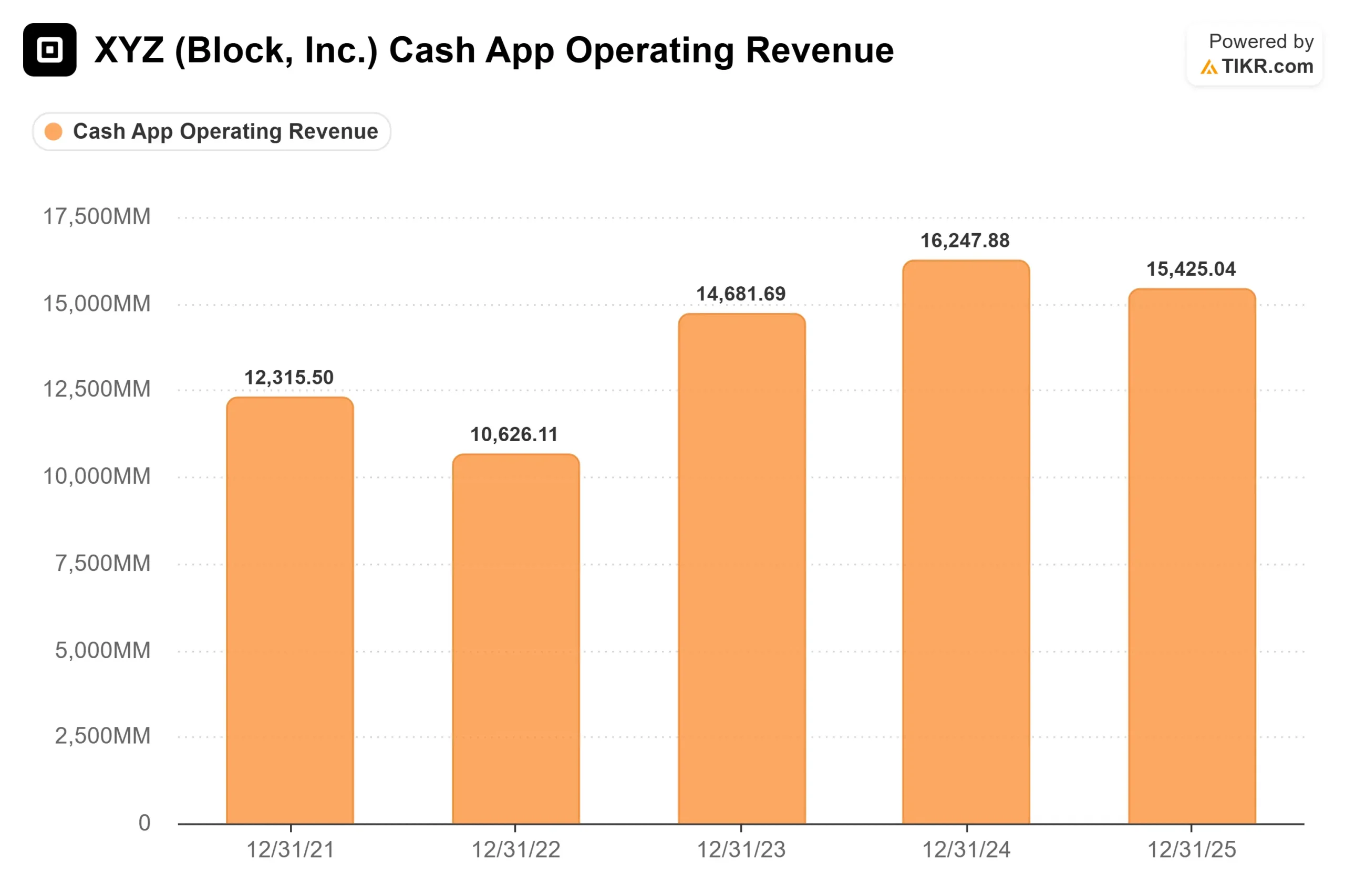
Cash App monthly transacting actives grew 4% year over year, with inflows per active up 10% and primary banking actives rising 18% to 9.7 million. Engagement depth is growing faster than raw user count, which is the right direction for a platform trying to capture more free cash flow per customer. On the Square side, gross payment volume reached $61.2 billion, up 13% year over year.
Per Block’s Q1 2026 shareholder letter, management raised full-year gross profit guidance to $12.33 billion (19% growth) and adjusted EPS to $3.85, implying 62% year-over-year growth. Q2 guidance calls for $3.04 billion in gross profit (20% growth) and $740 million in adjusted operating income.
The GAAP picture is harder. Block swung to a net loss of $308.7 million, driven by $495.3 million in restructuring charges, $500.1 million in transaction and loan losses, and a $172.8 million bitcoin remeasurement loss. These charges are largely one-time. The DOJ matter is not: Block set aside $240 million as a reserve for an ongoing DOJ inquiry into Cash App’s compliance practices, with the final settlement amount potentially exceeding that figure. This disclosure came directly from Block’s own 10-Q filing, and it is the single most important risk item on the table.

See how Block performs against its peers in TIKR (It’s free!) >>>
TIKR Advanced Model Analysis
- Current Price: $69.17
- Target Price (Mid): ~$141
- Potential Total Return: ~103%
- Annualized IRR: ~17% / year

See analysts’ growth forecasts and price targets for Block stock (It’s free!) >>>
The mid-case uses around 9% annual revenue CAGR, driven by Cash App’s expanding financial services suite, lending through Cash App Borrow, banking, and buy now, pay later via Afterpay, alongside Square’s steady gross payment volume growth in mid-market and international markets. The margin driver is Block’s structurally lower cost base after the workforce reduction, with net income margins forecast to reach around 12% under the mid case, per the TIKR model.
The downside in one sentence: if the DOJ settlement exceeds $240 million materially, or free cash flow generation disappoints as one-time charges persist, the multiple stays compressed and the thesis stalls. The upside in one sentence: at the current NTM EV/EBITDA of 8.66x per TIKR, Block trades at a discount to its own recent history for a company growing adjusted EBITDA at double-digit rates, and if the AI productivity gains hold, the Street’s ~$90 consensus target looks conservative relative to the TIKR mid-case.
Conclusion
The clearest near-term test is Block’s Q2 report, expected in August 2026. Management has set gross profit guidance at $3.04 billion and adjusted operating income at $740 million. If Block hits those numbers with restructuring charges largely behind it, the AI productivity story becomes structurally credible, not a one-quarter cost cut. If Cash App’s primary banking active growth decelerates from 18%, or the DOJ settlement lands materially above $240 million, the thesis breaks.
Dorsey’s own words at JPMorgan set the benchmark: “It’s this year, like it’s this year.” He was talking about delivering AI-native product experiences to customers. That’s either the most important thing he said in 2026, or the thing he has to answer for when Q2 numbers drop in August.
See what stocks billionaire investors are buying so you can follow the smart money with TIKR.
Should You Invest in Block?
The only way to really know is to look at the numbers yourself. TIKR gives you free access to the same institutional-quality financial data that professional analysts use to answer exactly that question.
Pull up Block, and you’ll see years of historical financials, what Wall Street analysts expect for revenue and earnings in the quarters ahead, how valuation multiples have moved over time, and whether price targets are trending up or down.
You can build a free watchlist to track Block alongside every other stock on your radar. No credit card required. Just the data you need to decide for yourself.
Looking for New Opportunities?
- See what stocks billionaire investors are buying so you can follow the smart money.
- Analyze stocks in as little as 5 minutes with TIKR’s all-in-one, easy-to-use platform.
- The more rocks you overturn… the more opportunities you’ll uncover. Search 100K+ global stocks, global top investor holdings, and more with TIKR.
Disclaimer:
Please note that the articles on TIKR are not intended to serve as investment or financial advice from TIKR or our content team, nor are they recommendations to buy or sell any stocks. We create our content based on TIKR Terminal’s investment data and analysts’ estimates. Our analysis might not include recent company news or important updates. TIKR has no position in any stocks mentioned. Thank you for reading, and happy investing!