Key Takeaways
- Bill Gates said stopping data centers “isn’t going to slow this thing one iota,” as Amazon pledged more than $1 billion over five years to the communities where it runs data centers.
- Local opposition is raising the cost of each data center, and that cost falls on the companies building them, like Amazon and Microsoft.
- Amazon’s pledge comes to less than a tenth of a percent of the $220 billion it expects to spend on capital this year, but its free cash flow has already fallen to $7.7 billion.
- Analysts still expect Nvidia’s revenue to reach nearly $1.1 trillion in the year to January 2030, so project delays are the thing to watch.
Data centers have become one of the biggest political fights in the country.
Sen. Elizabeth Warren wants a national moratorium on them. Amazon Web Services CEO Matt Garman says more than 100 moratoriums on data centers are being considered across the country. And last Friday, Amazon (AMZN) said it will put more than $1 billion over the next five years into the communities where it runs data centers.
Microsoft (MSFT) co-founder Bill Gates doesn’t think any of it will slow AI down. As he put it on The Ezra Klein Show:
“Stopping data centers isn’t going to slow this thing one iota.”
And then: “The data centers are going to get built somewhere.”
I think he’s right. The backlash changes where AI capacity gets built and what each site costs, and that cost falls on the companies doing the building.
Who pays for “somewhere”
Even Warren’s plan points that way. On Squawk Pod, she said her moratorium would last until data centers can show that the costs of hooking up, expanding the grid and using local water are “going to be absorbed by the data center and not pushed off on the folks who live there.”
Put differently, her answer is for the builders to pay more. And so far, paying more hasn’t stopped Amazon from building more…

Its capital spending dipped to $52.7 billion in 2023, then rose to $132 billion in 2025. In July, Amazon said it now expects to spend $220 billion in 2026, up from its earlier estimate of $200 billion.
Of course, compared to that…what’s a $1 billion promise to a community over five years? It’s not even a rounding error.
Gates’s old company is paying a similar bill. In January, Microsoft pledged that its new AI data centers will pay their full power and infrastructure costs.
Of course, all of this adds up. Sites that can handle the power, water and community concerns can cost more to build, and Amazon’s free cash flow has already shrunk as its spending soared…
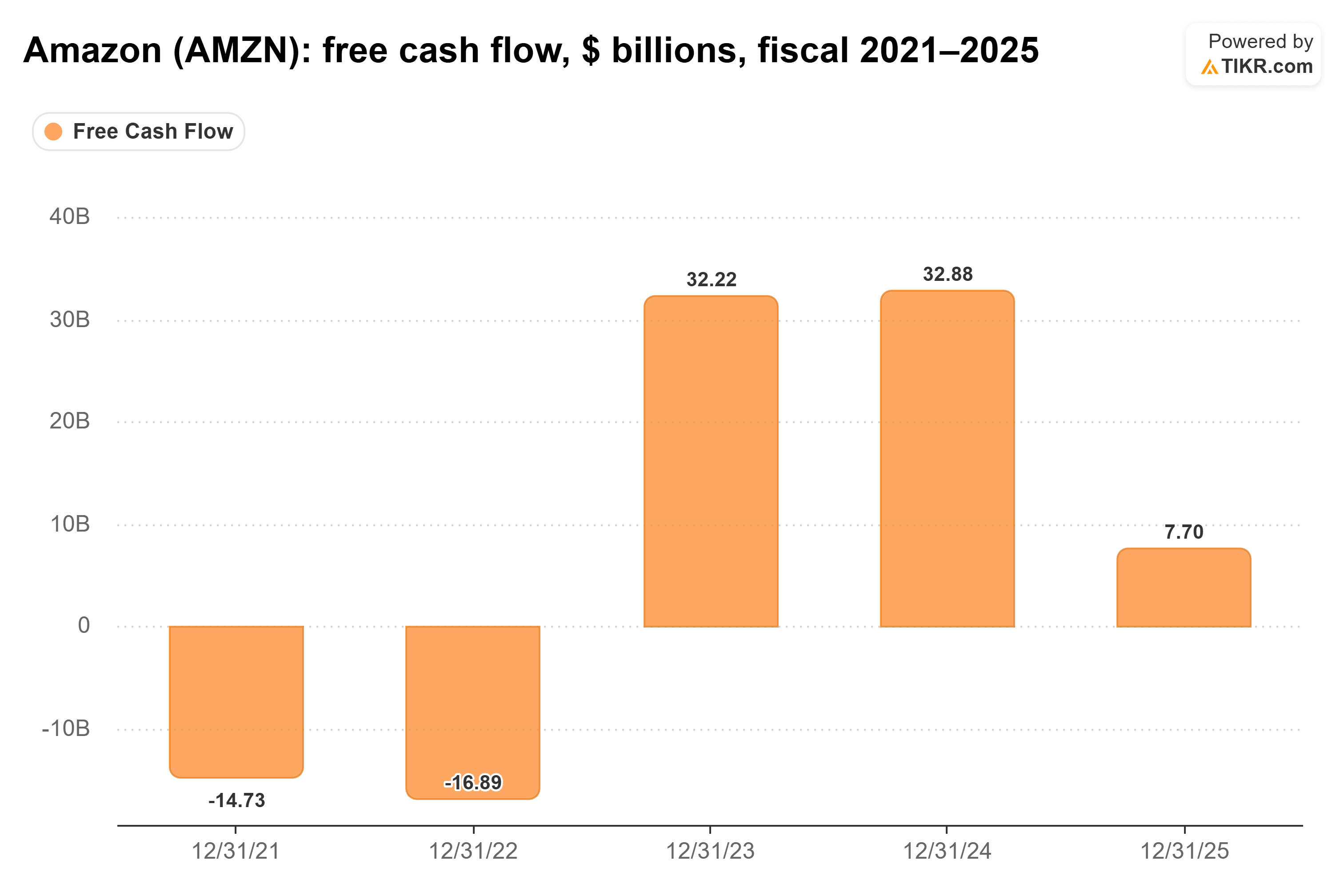
It fell from $32.9 billion in 2024 to $7.7 billion in 2025.
But what about the delays?
Ecolab (ECL) CEO Christophe Beck said on TBPN that “60% of the projects are being either paused or delayed.” (Chances are good you’re hearing about other delays or blockages on the news.)
Delays like that could push some revenue at Nvidia (NVDA) into later years, even if no project is ever cancelled. That’s a fair worry.
Same spending, different map
Morgan Stanley’s Ariana Salvatore laid out the bank’s base case on its Thoughts on the Market podcast: “the expected level of AI capex can continue, but likely it’s going to increasingly concentrate in locations where developers can address concerns around things like electricity costs, infrastructure, water, and community impacts.”
Analysts are betting the same way. They expect Nvidia’s revenue to grow from $216 billion in the year to January 2026 to $687 billion two years later, and to nearly $1.1 trillion in the year to January 2030…

Nothing in the delay counts makes me expect big cuts to those estimates: a project that moves still needs the same chips once it’s built.
So is Gates right?
I think so. Amazon’s spending keeps rising, the money keeps flowing to Nvidia, and the backlash shows up as a bigger bill for Amazon, Microsoft and the other builders, one community payment and pricier site at a time.
Of course, if those pauses stretch from months into years, some of Nvidia’s growth could come later than analysts expect. And since states and utility commissions set many of the rules, as Salvatore pointed out, the midterms could redraw that map again.
So what is Nvidia stock actually worth?
TIKR lets you forecast the future price of any stock in less than a minute. Just enter a few assumptions into TIKR’s valuation model and see what Nvidia could be worth. Start from Wall Street consensus estimates, or adjust the inputs to reflect your own view of the business. It’s free to use.
Disclaimer:
Please note that the articles on TIKR are not intended to serve as investment or financial advice from TIKR or our content team, nor are they recommendations to buy or sell any stocks. We create our content based on TIKR Terminal’s investment data and analysts’ estimates. Our analysis might not include recent company news or important updates. TIKR has no position in any of the stocks mentioned. Thank you for reading, and happy investing!