Key Takeaways
- Seven famous investors held Microsoft on Sept. 30. Dan Loeb’s Third Point and Peter Thiel’s Thiel Macro opened new stakes, while Bill Ackman’s Pershing Square and George Soros’ fund each cut about a third of theirs.
- AI spending has cut into Microsoft’s cash, and analysts expect $32.0 billion of free cash flow in fiscal 2027, down from $67.0 billion in fiscal 2026. Amazon’s spending has already turned its free cash flow negative.
- Analysts expect earnings per share to grow 16% in fiscal 2027 and 21% in fiscal 2028, and the stock trades at 24x forward earnings, against a five-year average of 29x.
- The numbers side with the buyers. The December-quarter report in late January will show whether the cash holds up.
Seven famous investors held Microsoft (MSFT) at the end of September, according to their 13Fs for the quarter ended Sept. 30, filed from Nov. 6 to Nov. 16. They didn’t agree on it: Bill Ackman’s Pershing Square and George Soros’ Soros Fund Management cut their stakes, while Dan Loeb’s Third Point and Peter Thiel’s Thiel Macro bought in.
The split comes as Microsoft’s AI build-out eats into its cash. Amazon (AMZN) has the same problem, and its free cash flow has already gone negative.
Ackman and Soros sold, Loeb and Thiel bought
The biggest move in dollars was a sale. Pershing Square cut its stake 35% in the third quarter, to 4.06 million shares from 6.21 million, which is about $1.10 billion of stock at quarter-end prices. Even after the cut, Microsoft was still Pershing’s fourth-largest holding at $2.08 billion, or 6.8% of its 13F stocks. Soros Fund Management cut 36%, to 122,166 shares, and what’s left is 1.0% of its 13F stocks.
On the buying side, Third Point opened a 450,000-share stake worth $231 million. That made Microsoft its sixth-largest holding, at 5.1% of its 13F stocks. Thiel Macro’s new stake is a token one: 2,000 shares worth about $1 million, or 0.2% of the $460 million its 13F holds in US stocks.
TIKR tracks 58 analysts on Microsoft. How many say “Buy”?
See the full breakdown of Buy, Hold, and Sell ratings on Microsoft, along with Wall Street’s revenue and earnings estimates, all in one place. More than 500,000 investors use TIKR to research stocks like this one. See Microsoft’s Analyst Ratings
Everyone else mostly held on
The other three holders barely moved. Ken Fisher’s Fisher Investments is by far the biggest of the seven, with 27.14 million shares worth $13.92 billion on Sept. 30 after adding 2%. Brad Gerstner’s Altimeter Capital trimmed 7% and still held $607 million, its eighth-largest position. Cathie Wood’s ARK Invest cut 8%, to just 5,693 shares. Microsoft stock is down 3% from its quarter-end price, so it has barely moved since the filings’ snapshot.
The cash is the weak spot
The case against Microsoft is its cash. Cash capital spending jumped to $115.9 billion in fiscal 2026 (the year ended June 30) from $64.6 billion, and free cash flow fell to $67.0 billion. Analysts have cut their fiscal 2027 free cash flow estimate three times since late October, to $32.0 billion. On top of that, Microsoft added $7.4 billion of finance leases in the September quarter, and free cash flow as usually measured leaves those out.
Microsoft’s spending looks modest next to its biggest cloud rival’s. Amazon’s free cash flow swung to a $42.4 billion outflow over the 12 months to Sept. 30, as its spending on property and equipment rose $94.8 billion, mostly for AI. Amazon is getting growth for that money: AWS sales rose 39% in the third quarter, its fastest growth in nearly five years. So Amazon shareholders are betting on a payback that hasn’t shown up in the cash yet. Microsoft is still paying for its build-out out of what it earns, and it brought in $18.6 billion of free cash flow in the September quarter alone.
The earnings back the buyers
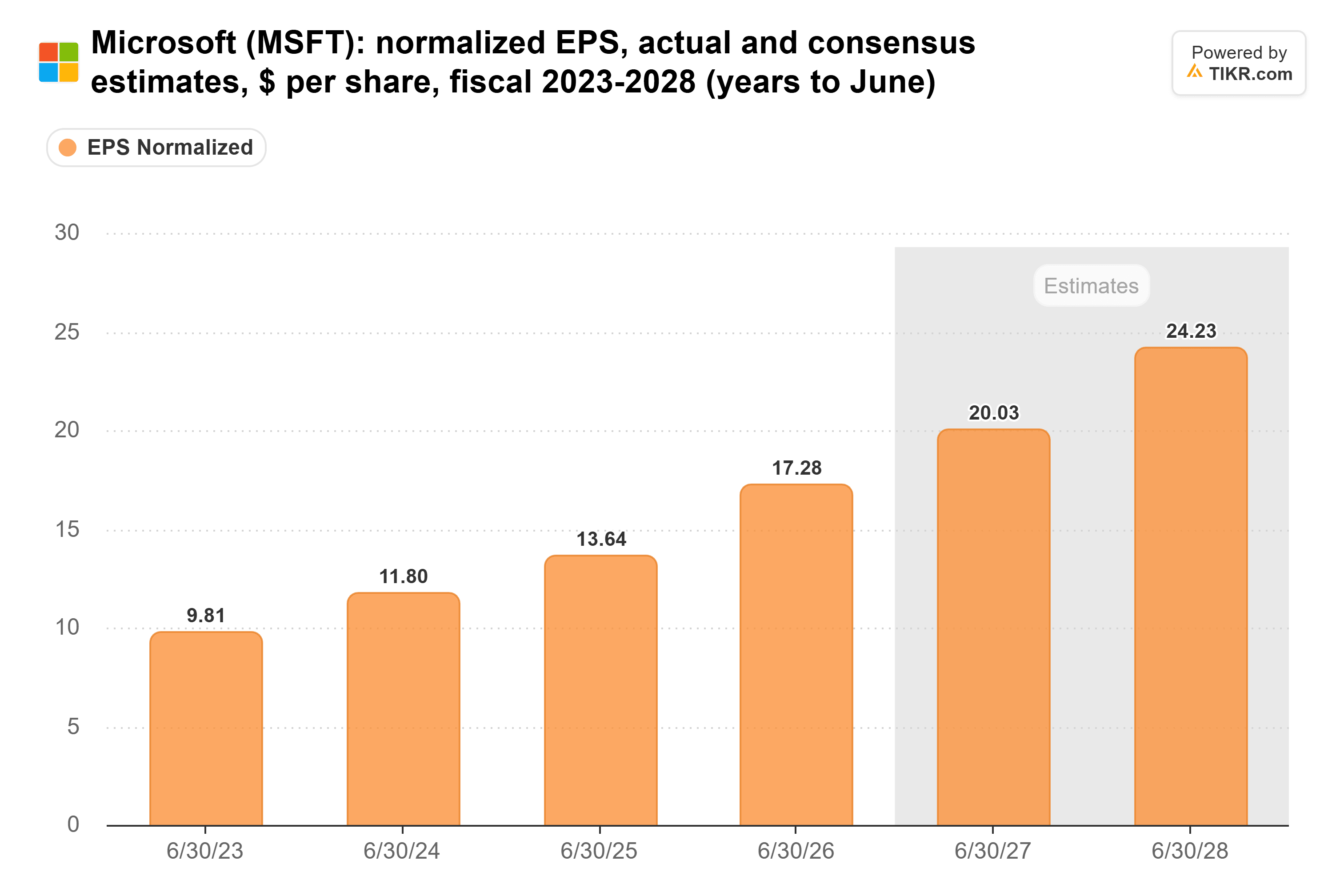
Meanwhile, analysts keep raising their earnings estimates. They expect normalized EPS to rise 16% to $20.03 in fiscal 2027, then 21% to $24.23 in fiscal 2028. Both figures are up since late October, when they stood at $19.76 and $23.70. Here’s Microsoft’s normalized EPS, reported and expected, through fiscal 2028:
Investors are also paying less for those earnings than they usually do. Microsoft trades at 24x forward earnings, well below its five-year average of 29x and its peak of 37x in July 2024:
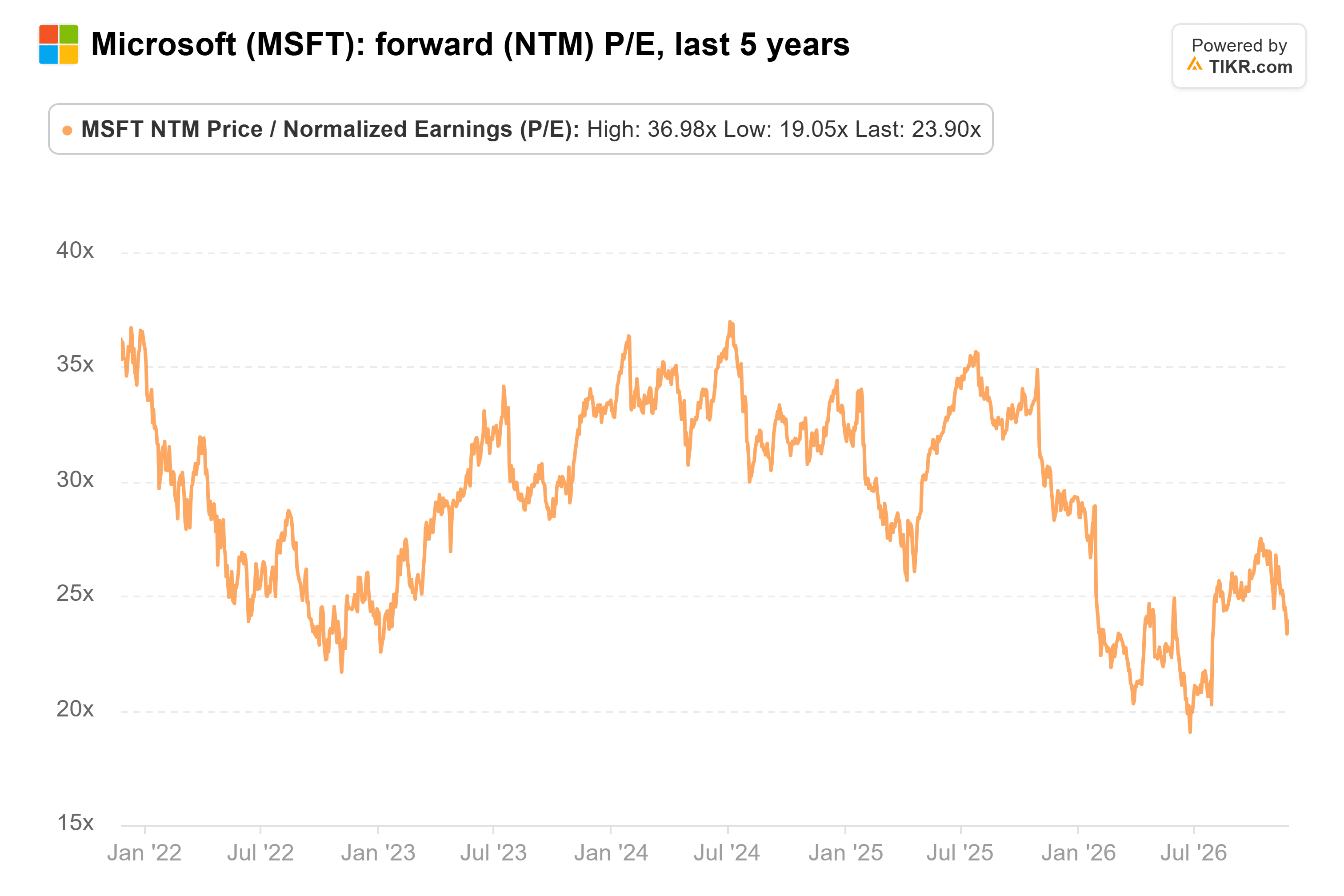
(It got as low as 19x in June, so it has been cheaper.)
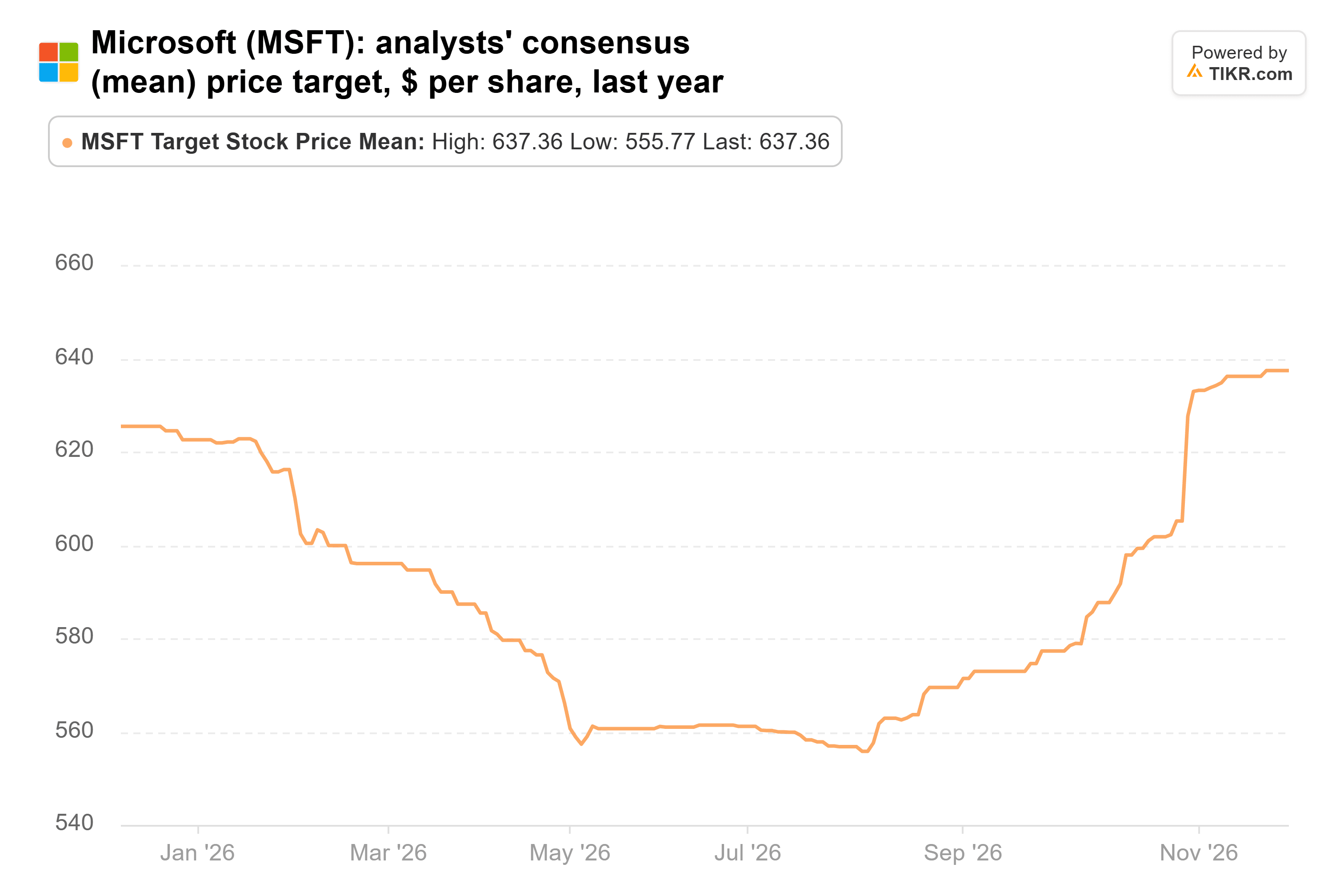
Wall Street’s average price target has crept up over the past year, to $637 from $625, which is about 28% above the last close:
I’d side with Loeb
At the end of the day, I’d side with the buyers. Paying 24x for earnings expected to grow 16% and then 21% looks reasonable for a company that still pays for its build-out from its own cash. The risk is that spending keeps rising faster than the payoff, and the free cash flow estimate has already come down three times. The next test is the December-quarter report in late January. Microsoft needs about $13.4 billion of free cash flow over the rest of fiscal 2027 to reach the consensus, and a solid quarter would keep it on track. The 13Fs for the December quarter, due in mid-February, will then show whether Ackman kept selling or Loeb kept buying.
So what is Microsoft stock actually worth?
TIKR lets you forecast the future price of any stock in less than a minute. Just enter a few assumptions into TIKR’s valuation model and see what Microsoft could be worth. Start from Wall Street consensus estimates, or adjust the inputs to reflect your own view of the business. It’s free to use.
Disclaimer:
Please note that the articles on TIKR are not intended to serve as investment or financial advice from TIKR or our content team, nor are they recommendations to buy or sell any stocks. We create our content based on TIKR Terminal’s investment data and analysts’ estimates. Our analysis might not include recent company news or important updates. TIKR has no position in any of the stocks mentioned. Thank you for reading, and happy investing!