Key Takeaways
- Microsoft offered buyouts to 60,000 employees, and Jim Cramer says Satya Nadella told him it’s determined to keep positive operating cash flow.
- Three other hyperscalers all reported negative free cash flow in their latest quarters, while Microsoft’s stayed positive.
- The buyouts help Microsoft’s operating margin more than its cash, since its capex dwarfs its whole operating expense line.
- Analysts expect free cash flow to fall to $32.0 billion in fiscal 2027, with the December quarter the next test.
Microsoft (MSFT) offered buyouts to 60,000 employees in October, in place of another big round of layoffs.
CEO Satya Nadella explained why at The New York Times DealBook Summit on Nov. 18, and a day later Jim Cramer posted what Nadella had told him about the money side:
“Microsoft is determined to maintain positive operating cash flow. That’s what Satya tells me. Does that make it the smartest of the hyperscalers???”
It’s a fair question. Amazon (AMZN), Meta Platforms (META) and Oracle (ORCL) all reported negative free cash flow in their latest quarters, as AI data center spending outran the cash their businesses brought in.
The buyouts are about how the work gets done
Nadella didn’t pitch the buyouts as a cost cut. He told Andrew Ross Sorkin the offer was “to make sure that at least everyone felt like they had agency in making choices,” as Microsoft reorganizes so that every employee uses AI and manages it. Still, fewer people doing more of the work shows up in the cost line. In fiscal 2026 (the year to June), headcount fell 2% and operating expenses grew 7%, against 18% revenue growth.
TIKR tracks 58 analysts on Microsoft. How many say “Buy”?
See the full breakdown of Buy, Hold, and Sell ratings on Microsoft, along with Wall Street’s revenue and earnings estimates, all in one place. More than 500,000 investors use TIKR to research stocks like this one. See Microsoft’s Analyst Ratings
Positive operating cash flow is the easy part
Microsoft brought in $58 billion of operating cash in the September quarter alone. Free cash flow is the harder bar, and management said in July it expects it to stay positive in fiscal 2027. Analysts agree, but they expect it to fall by more than half this fiscal year before it recovers:
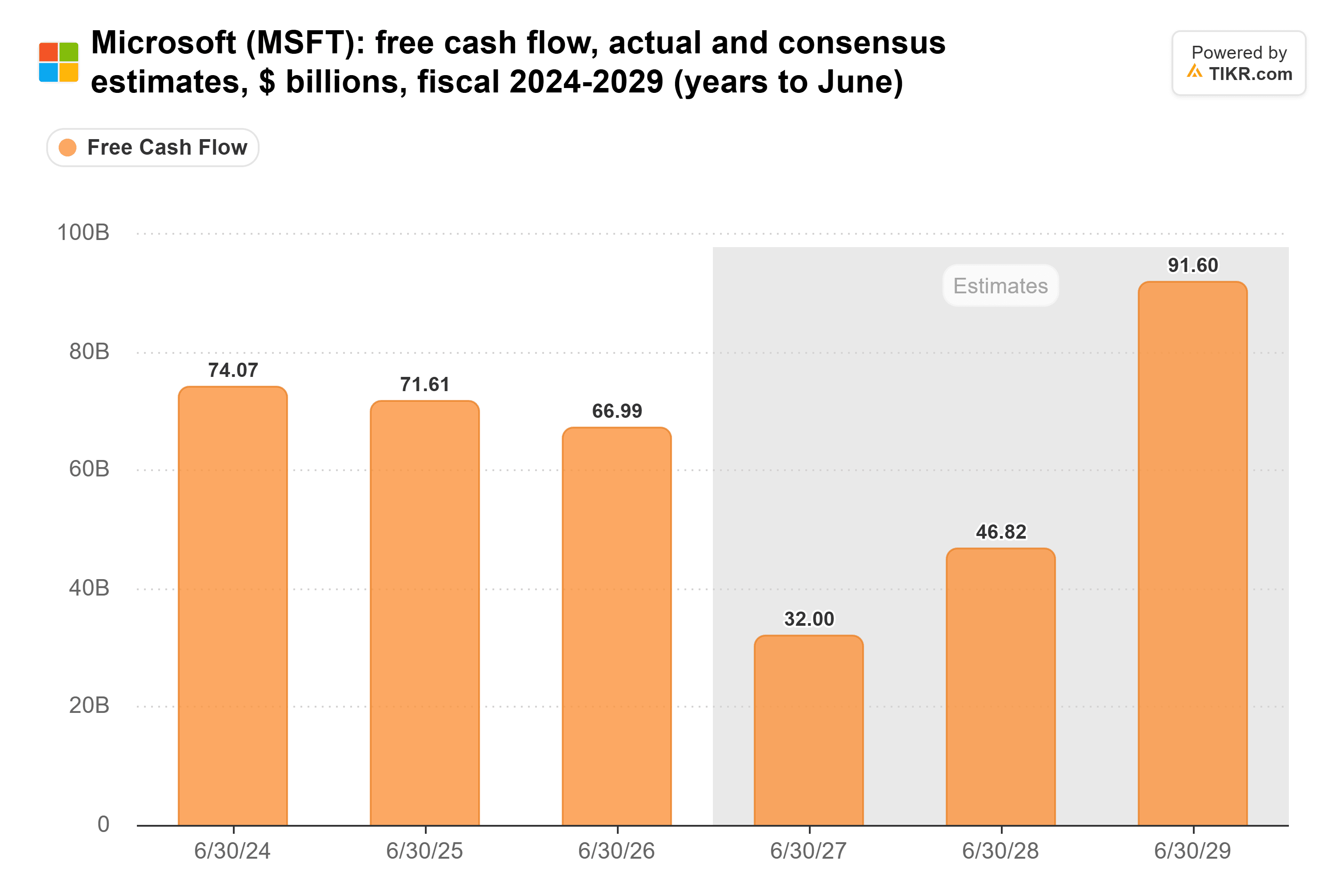
The September quarter brought in $18.6 billion of free cash flow, down 27% from a year earlier, so Microsoft needs about $13.4 billion more from the next three quarters combined to reach the $32.0 billion consensus.
The drop comes from capex, which grew nearly 5x in four fiscal years while operating cash flow roughly doubled:
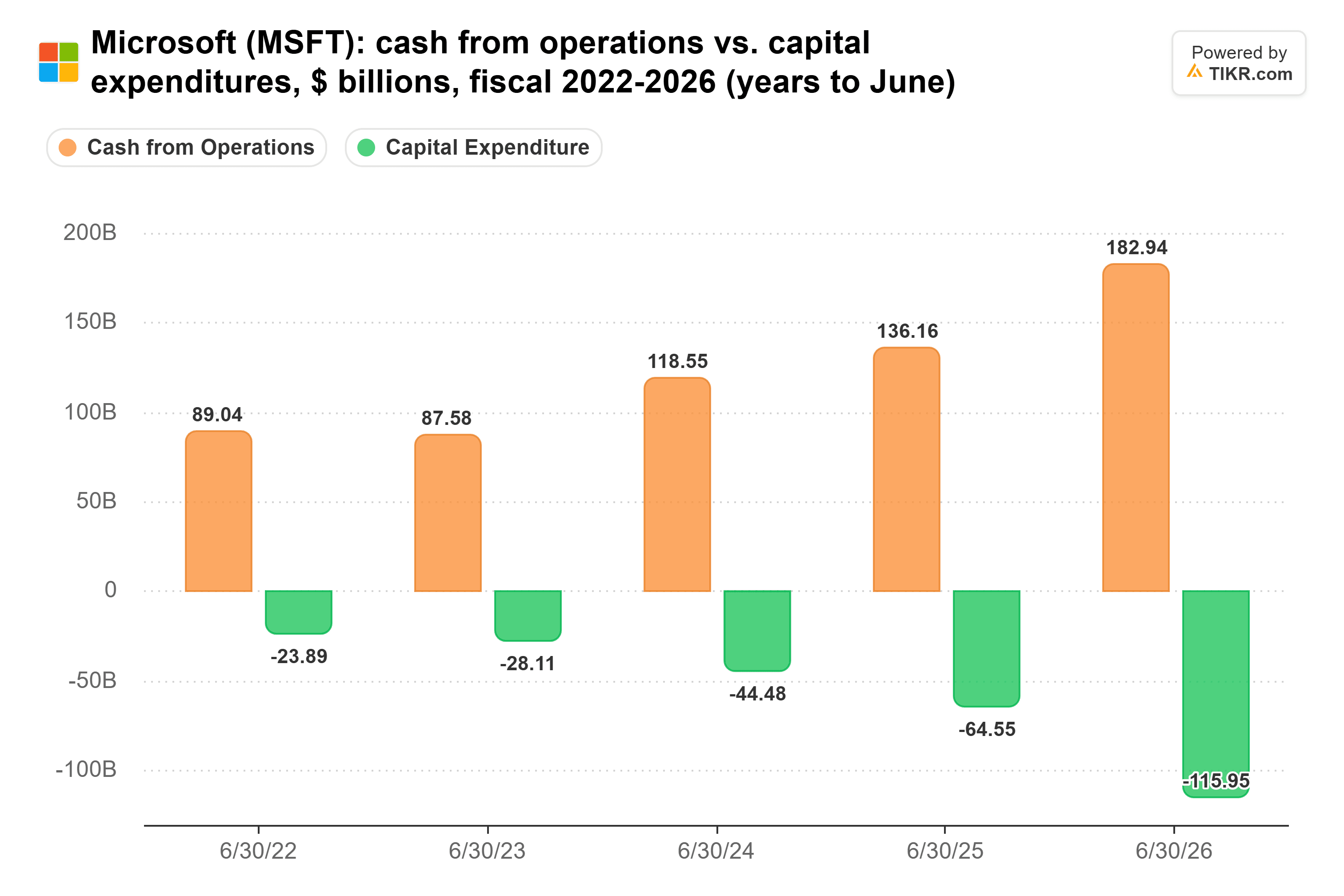
In fiscal 2026 alone, capex rose $51.4 billion and operating cash flow rose $46.8 billion, so free cash flow fell for a second straight year.
Amazon is already below zero
Amazon shows what happens once spending gets ahead of cash. This week, a poster on the r/ValueInvesting subreddit put Amazon’s owner earnings at plus $89 billion using depreciation as the cost of upkeep, and minus $47 billion counting all of its capex. TIKR’s figures back that up, with Amazon’s free cash flow negative for three straight quarters:
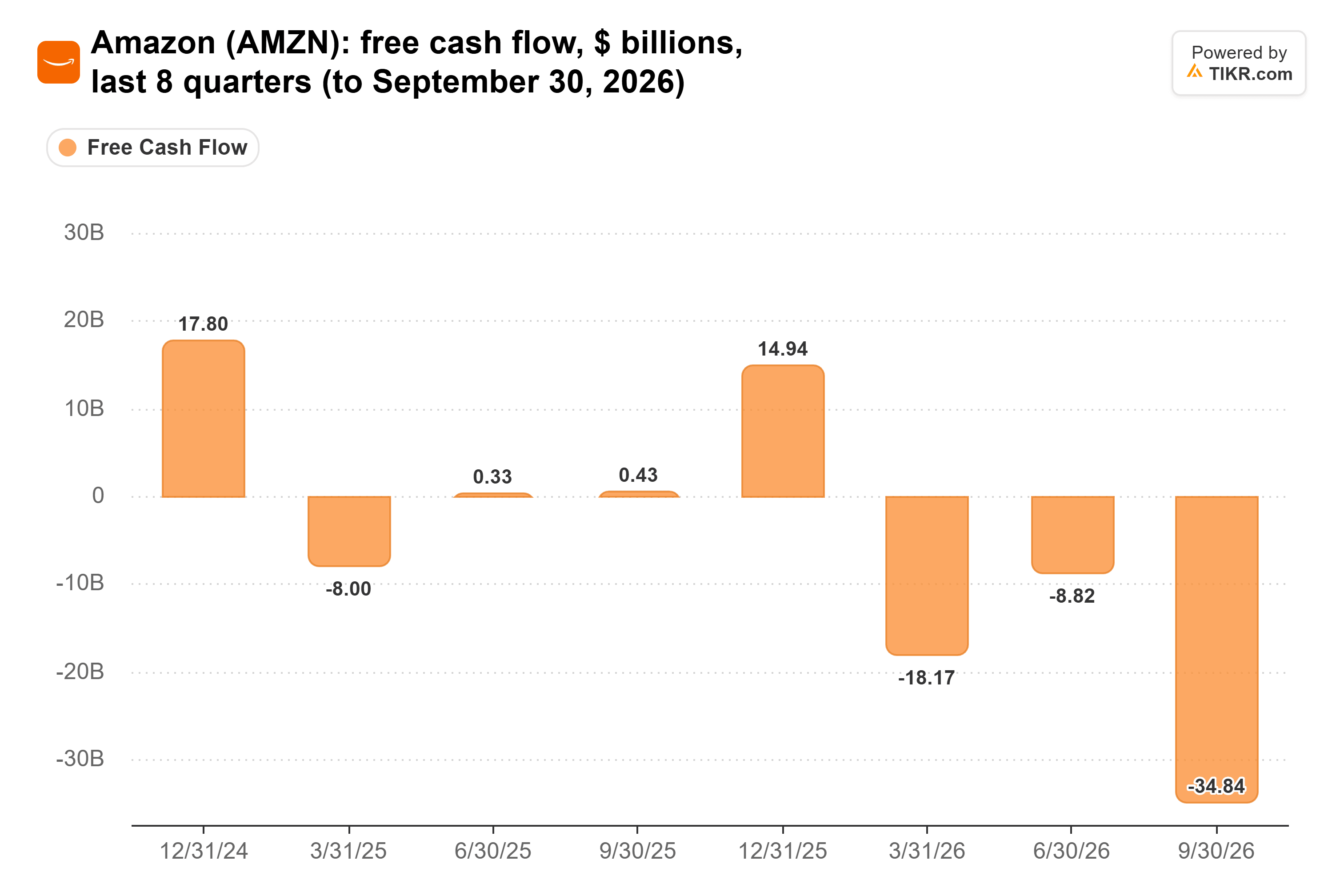
Over the four quarters to Sept. 30, Amazon’s free cash flow added up to negative $46.9 billion.
Payroll can’t pay for data centers
Microsoft’s entire operating expense line was $70.2 billion in fiscal 2026, against $115.9 billion of cash capex. Meta cut headcount 15% over the year to Sept. 30, and its free cash flow was still negative $2.12 billion in the September quarter, as $34.91 billion of capex, including finance-lease principal, topped its $32.79 billion of operating cash flow. Oracle sold $20 billion of stock through an at-the-market program in the quarter to Aug. 31, while its free cash flow was negative $5 billion.
So the exits matter most for Microsoft’s operating margin, which management expects to fall by less than 1 point in fiscal 2027. Free cash flow is staying positive because of the business itself: operating cash flow rose 29% in the September quarter.
The smartest spender, for now
On cash, Microsoft is the smartest of the hyperscalers right now. Still, the full bill is bigger than the cash line shows: free cash flow leaves out finance leases, which came to $7.4 billion in the September quarter alone.
Microsoft reports its December quarter in late January, with capex guided above $50 billion. A year earlier, that quarter’s free cash flow was just $5.9 billion. Another positive quarter would put Microsoft well on its way to the $32.0 billion consensus, and a negative one would cast doubt on management’s call.
So what is Microsoft stock actually worth?
TIKR lets you forecast the future price of any stock in less than a minute. Just enter a few assumptions into TIKR’s valuation model and see what Microsoft could be worth. Start from Wall Street consensus estimates, or adjust the inputs to reflect your own view of the business. It’s free to use.
Disclaimer:
Please note that the articles on TIKR are not intended to serve as investment or financial advice from TIKR or our content team, nor are they recommendations to buy or sell any stocks. We create our content based on TIKR Terminal’s investment data and analysts’ estimates. Our analysis might not include recent company news or important updates. TIKR has no position in any of the stocks mentioned. Thank you for reading, and happy investing!