Key Takeaways
- General Mills yields 7.7% and Realty Income yields 6.1%, but General Mills plans to hold its dividend flat while it pays down debt.
- General Mills’s cash dividend payout ratio rose to 85% over the twelve months to Aug. 30, 2026, from 58% in fiscal 2025, and analysts expect 76% in fiscal 2027.
- Realty Income paid out 75% of its AFFO in fiscal 2025, down from 83% in fiscal 2016, and analysts expect 73% in 2026.
- General Mills expects adjusted EPS of $3.00 to $3.20 in fiscal 2027, and analysts expect Realty Income’s AFFO per share to rise to $4.44 in 2026.
Any investor hunting for a yield north of 6% is going to come across Realty Income (O) and General Mills (GIS). At the Oct. 9 close, Realty Income yielded 6.1% and General Mills 7.7%, after General Mills’s stock fell almost 22% in September.
That bigger yield comes with a catch. On Sept. 23, General Mills reported the first quarter of its fiscal 2027 and stuck with its plan to keep the dividend flat while it pays down debt. Realty Income, meanwhile, raised its 2026 AFFO guidance in August and keeps lifting its monthly dividend every quarter.
So which is the better high-yield dividend stock?
| Metric | Realty Income (O) | General Mills (GIS) |
|---|---|---|
| Dividend yield | 6.1% | 7.7% |
| Dividend growth, 5 years | 2.9% a year (fiscal 2020–2025) | 3.9% a year (fiscal 2021–2026) |
| Coverage measure | AFFO payout ratio | Cash dividend payout ratio |
| Payout ratio, last reported | 75% (fiscal 2025) | 85% (TTM to Aug. 30, 2026) |
| Payout ratio, forward | 73% (fiscal 2026 consensus) | 76% (fiscal 2027 consensus) |
| Net debt/EBITDA | 5.74x | 3.67x |
Realty Income’s cushion keeps widening
Realty Income, a REIT, paid $3.22 a share in dividends in fiscal 2025 against $4.28 of AFFO per share: a comfortable 75% AFFO payout ratio. Analysts expect 73% in 2026, on AFFO of $4.44 a share.
That cushion has been growing for a decade. Dividends per share rose from $2.39 in fiscal 2016 to $3.22 in fiscal 2025, while AFFO per share grew faster, from $2.88 to $4.28.

…which took the payout ratio from 83% to 75%.
The company says it has raised its dividend for over 31 consecutive years, but the raises are small: 2.9% a year from fiscal 2020 to fiscal 2025.
The business is still adding property. Realty Income invested $2.6 billion in the second quarter of 2026 at an initial cash yield of 7.3%, and raised its 2026 investment guidance to $10 billion.
The risk is debt. Net debt runs 5.74x EBITDA over the last twelve months, and EBIT covers interest just 2.35x, so growth still depends on the capital markets.
General Mills is paying out more of its cash
Where Realty Income’s cushion has widened, General Mills’s has narrowed. Over the twelve months to Aug. 30, 2026, it paid $1.31 billion of dividends against $1.55 billion of free cash flow, a stretched 85% cash dividend payout ratio.
That’s a recent jump. From fiscal 2021 to fiscal 2025, the ratio ran between 45% and 62%. Then free cash flow fell from $2.29 billion in fiscal 2025 to $1.63 billion in fiscal 2026 while dividends held at $1.32 billion,…
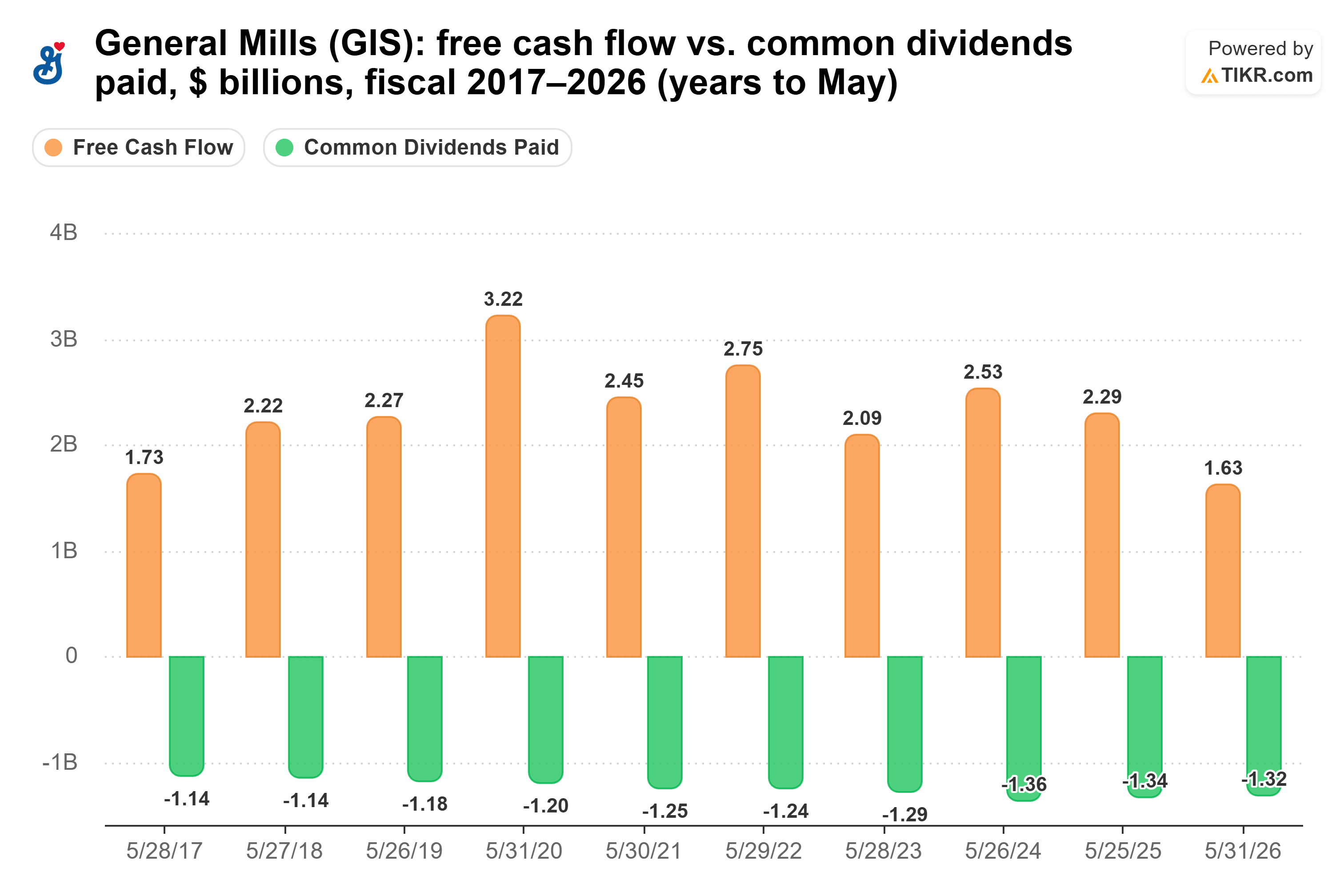
…pushing the ratio to 81%. Analysts expect it to ease to 76% in fiscal 2027, on $1.75 billion of free cash flow.
Sales are soft. Organic sales were flat in the quarter ended Aug. 30, 2026, with North America Retail down 3% organically on weak cereal and snacks.
So management is holding the line. As CFO Kofi Bruce put it: “we remain fully committed to our dividend, and in the near term, we expect to maintain the current rate per share while we prioritize deleverage.” Net debt is 3.67x EBITDA on TIKR’s figures and a little over 4x on the company’s own, Bruce confirmed. He expects it to take “at least a couple of years” to get back to the company’s 3x target.
So which dividend wins?
Realty Income is the better high-yield dividend stock. It pays out a smaller share of its cash on its own measure, that share has been falling for a decade, and the dividend still rises every quarter.
General Mills’s earnings are heading the other way. TIKR’s normalized EPS fell from $4.52 in fiscal 2024 to $3.55 in fiscal 2026, and 19 analysts expect $3.08 in fiscal 2027, within management’s guidance of $3.00 to $3.20 for adjusted EPS…

…with only a slight recovery, to $3.15, expected in fiscal 2028.
This isn’t to say General Mills’s dividend is in danger. Analysts see free cash flow covering it in fiscal 2027, and $10,000 in its stock pays $770 a year today against $610 from Realty Income. Even at each dividend’s pace now, General Mills would still pay more in year 10, about $894 against $787, and Realty Income’s income wouldn’t pass it until around 2046. But that assumes General Mills keeps raising 1.7% a year, which it says it won’t in the near term.
What decides it for me is direction. I’d rather own a check that’s still growing, from a business that’s still growing, than a bigger one held flat while earnings fall.
Of course, if General Mills’s $750 million in fiscal 2027 cost savings gets earnings growing again and leverage back to 3x, the raises could return, and a 7.7% yield would be hard to pass up.
So what is Realty Income stock actually worth?
TIKR lets you forecast the future price of any stock in less than a minute. Just enter a few assumptions into TIKR’s valuation model and see what Realty Income could be worth. Start from Wall Street consensus estimates, or adjust the inputs to reflect your own view of the business. It’s free to use.
Disclaimer:
Please note that the articles on TIKR are not intended to serve as investment or financial advice from TIKR or our content team, nor are they recommendations to buy or sell any stocks. We create our content based on TIKR Terminal’s investment data and analysts’ estimates. Our analysis might not include recent company news or important updates. TIKR has no position in any of the stocks mentioned. Thank you for reading, and happy investing!