Key Takeaways
- Realty Income yields 6.1% and Amcor yields 6.3%, so $10,000 in either pays a little over $600 a year today.
- Realty Income paid out 75% of its AFFO in fiscal 2025, while Amcor’s dividends used 97% of its free cash flow over the twelve months to June 30, 2026.
- Amcor’s finance chief expects to recover more than $500 million in cash over the next 12 months, mostly from working capital tied up by the Middle East conflict.
- Realty Income trades at 12x forward AFFO, below its five-year average of 15x.
Amcor (AMCR) declared a quarterly dividend of 65.0 cents a share on Aug. 12, up from 63.75 cents a year earlier, after adjusting for its 1-for-5 reverse stock split in January. That works out to a 6.3% yield.
Realty Income (O) pays a little less, at 6.1%, but it raises its dividend far more often. On Sept. 8, it announced its 136th increase since its 1994 listing.
So which is the better high-yield dividend stock?
| Metric | Realty Income (O) | Amcor (AMCR) |
|---|---|---|
| Dividend yield | 6.1% | 6.3% |
| Annual dividend | $3.26 (paid monthly) | $2.60 (paid quarterly) |
| Dividend growth, 5 years | 2.9% a year (fiscal 2020–2025) | 2.1% a year (fiscal 2020–2025) |
| Coverage | AFFO payout ratio: 75% (fiscal 2025) | Cash dividend payout ratio: 97% (TTM to June 30, 2026) |
| Net debt/EBITDA | 5.74x | 3.63x |
| Interest coverage | 2.35x | 3.13x |
| Valuation | 12.1x forward price/AFFO | 10.1x forward P/E |
Realty Income keeps the raises coming
Realty Income has increased its dividend for more than 31 consecutive years. Its cash flow has grown faster than its payout. Dividends rose from $2.39 a share in fiscal 2016 to $3.22 in fiscal 2025, while AFFO went from $2.88 a share to $4.28.

That took its AFFO payout ratio from 83.0% in fiscal 2016 to a well-covered 75.2% in fiscal 2025.
The business is still growing. AFFO rose 3.8% to $1.09 a share in the second quarter of 2026 from a year earlier, and management raised its 2026 AFFO guidance to $4.44 to $4.45 a share.
The main risk is debt. Net debt is 5.74x EBITDA and EBIT covers interest just 2.35x, so growth still depends on the capital markets.
Amcor is still digesting Berry
Amcor’s cushion has moved the other way. With Berry now part of the business, net sales rose 57% to $23.5 billion in fiscal 2026, the year to June 30, and adjusted EPS rose 13% to $4.02 a share. Synergies from the deal reached $285 million for the year, ahead of the initial target.
Free cash flow hasn’t kept up with the dividend, though.
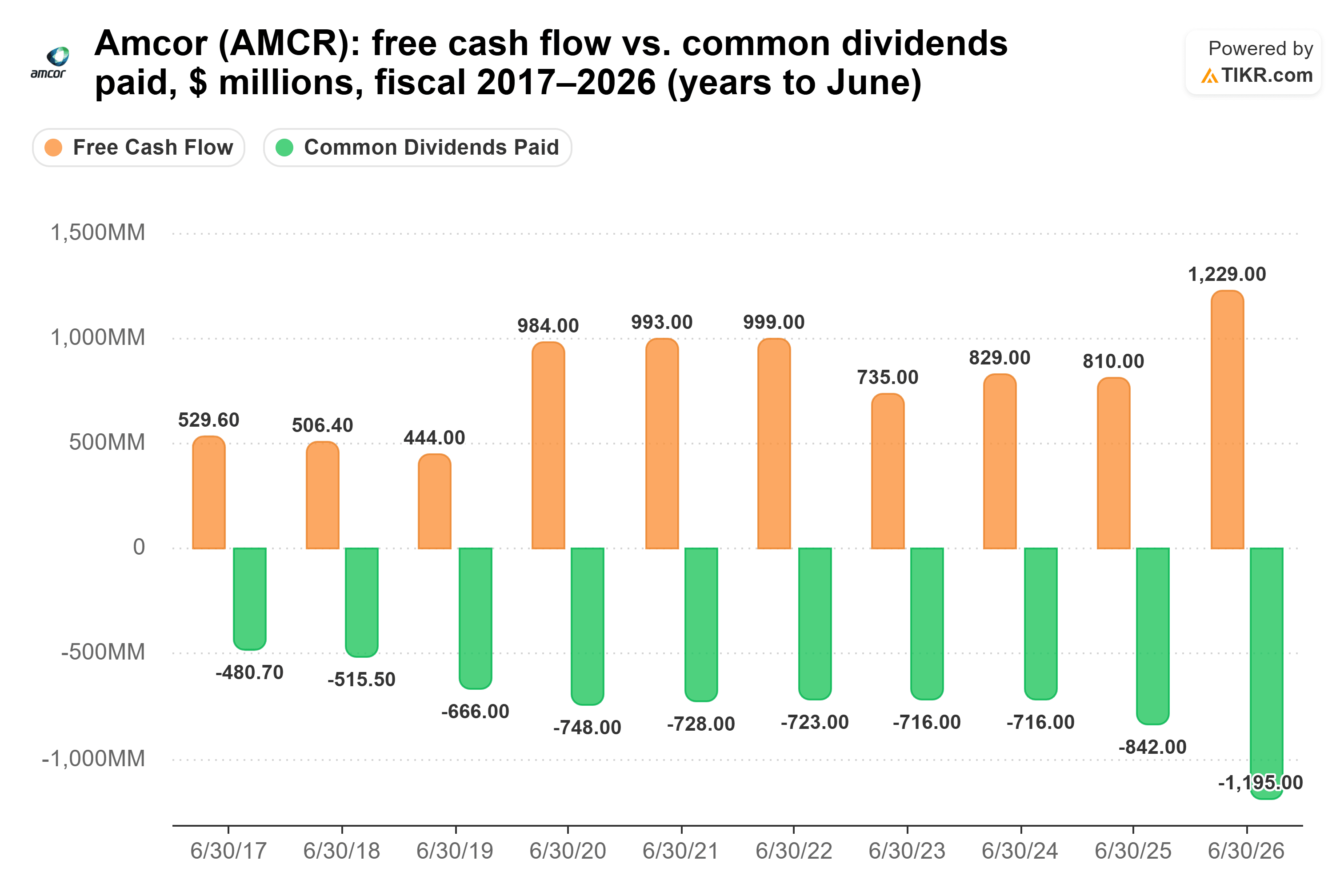
Its cash dividend payout ratio rose from 72.4% in fiscal 2022 to 104.0% in fiscal 2025, when $842 million of dividends topped $810 million of free cash flow. In fiscal 2026, free cash flow jumped to $1.23 billion. But dividends paid rose to $1.20 billion, a risky 97%.
Part of the squeeze is temporary. Management says the Middle East conflict tied up $500 million of working capital. CFO Stephen Scherger said Amcor targets recovering more than $500 million in cash over the next 12 months.
The main risk is debt and costs. Amcor had $12.9 billion of net debt at June 30, 2026, and expects leverage of 3.5x to 3.6x at the end of the year. It’s also managing what CEO Peter Konieczny called “unprecedented input cost inflation.”
So which dividend wins?
I’d go with Realty Income. Its dividend used 75% of AFFO in fiscal 2025, against 97% of free cash flow for Amcor over the twelve months to June 30, 2026. It has also grown faster: 2.9% a year from fiscal 2020 to fiscal 2025, against 2.1% for Amcor.
Amcor does pay more today: $630 a year on $10,000, against $610 from Realty Income. But at each company’s 5-year rate, Realty Income’s income would pass Amcor’s in about four years. By year 10, that $10,000 would pay about $790 a year, a 7.9% yield on your original cash, against about $759 from Amcor.
And you don’t pay up for the better-covered dividend.

At 12.1x forward AFFO, Realty Income sits well below its five-year average of 14.7x.
None of this means Amcor’s dividend is in trouble. The Berry synergies are running ahead of plan, and management expects leverage of about 3x by the end of 2027. Amcor also scores better than Realty Income on both net debt to EBITDA and interest coverage. It’s just that Realty Income has more room under its dividend today, plus more than 31 years of raises behind it.
Of course, Amcor’s cash recovery could change the picture. If it brings back that $500 million-plus over the next year, its cushion would look a lot healthier. The first look comes with its report for the six months to Dec. 31, 2026.
So what is Realty Income stock actually worth?
TIKR lets you forecast the future price of any stock in less than a minute. Just enter a few assumptions into TIKR’s valuation model and see what Realty Income could be worth. Start from Wall Street consensus estimates, or adjust the inputs to reflect your own view of the business. It’s free to use.
Disclaimer:
Please note that the articles on TIKR are not intended to serve as investment or financial advice from TIKR or our content team, nor are they recommendations to buy or sell any stocks. We create our content based on TIKR Terminal’s investment data and analysts’ estimates. Our analysis might not include recent company news or important updates. TIKR has no position in any of the stocks mentioned. Thank you for reading, and happy investing!