


CVS Health (CVS) agreed on Tuesday, October 13, to pay $315 million to settle a Justice Department lawsuit over opioid prescriptions, Reuters reported. The government alleged that CVS pharmacies filled invalid prescriptions for opioids and other controlled substances from October 2013 through December 2025, then billed Medicare and other federal programs for many of them. CVS didn’t admit wrongdoing and says it disagrees with the claims.
The stock barely noticed. CVS closed at $87.55 on Tuesday, down 0.2%, and was flat before Wednesday’s open.
What CVS Agreed To
- $315 million to resolve claims under the Controlled Substances Act and the False Claims Act
- A hotline for employees and the public to report suspicious prescriptions, plus monitoring of dispensing patterns (AP)
- A process with the DEA to evaluate suspect prescribers
- No admission of liability (the case began as a former employee’s whistleblower suit, and the government filed its own complaint in December 2024)
Sizing the Bill Against CVS’s Cash
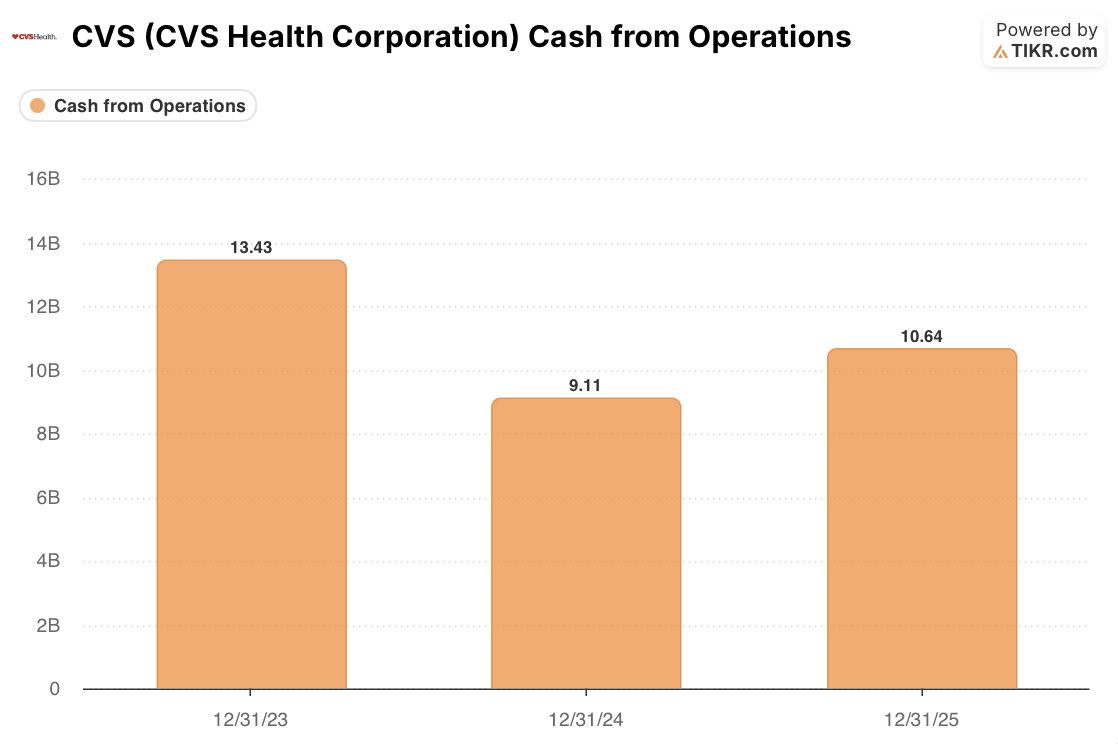
CVS generated $10.64 billion of cash from operations in 2025 and has guided to at least $11.5 billion this year. The settlement is under 3% of either figure, or about 25 cents a share against an $88 stock.
It’s also the second federal case CVS has closed since July. CVS and Omnicare, its long-term care pharmacy unit, agreed to settle for at least $440 million against a judgment of nearly $950 million. CVS pays $130 million within two weeks of the agreement taking effect and covers any shortfall in a further $310 million if Omnicare’s estate hasn’t paid it by March 2028. Together, the two settlements come to about $755 million, roughly 7% of last year’s operating cash flow. Walmart (WMT) settled its own DOJ opioid-dispensing case for $50 million in August.
The opioid settlement on its own is a rounding error.
Why Legal News Hasn’t Moved the CVS Multiple

The muted reaction to this settlement stands out against the selloff after CVS’s August results. CVS traded at 14.5x forward normalized earnings at its peak this summer. Then on August 5, CFO Brian Newman said a preliminary 2027 adjusted EPS floor of at least $8.44, in line with consensus, “appears reasonable at this juncture,” and the stock closed down 5.8% that day. The multiple now sits at 10.8x, much closer to its 10.1x average since late 2023 than to that peak.
The November 4 Call Matters More for CVS Stock
CVS hosts its third-quarter call on Wednesday, November 4, and the settlement won’t be the headline. The 2027 outlook will. If management raises that preliminary $8.44 floor, or shows Caremark’s client retention recovering from the slightly-below-normal trend it flagged in August, the multiple has room to climb back toward the 11x to 12x range it held through late 2025. If the floor stays put, 10.8x looks about right, and the stock waits on 2027 to prove itself.
Want to see how CVS’s cash flow and valuation have moved through all of this? Pull up the same charts on TIKR for free. Learn more here.
So what is CVS Health stock actually worth?
TIKR lets you forecast the future price of any stock in less than a minute. Just enter a few assumptions into TIKR’s valuation model and see what CVS stock could be worth. Start from Wall Street consensus estimates, or adjust the inputs to reflect your own view of the business. It’s free to use.
Value CVS Health Corporation for free→
Disclaimer:
Please note that the articles on TIKR are not intended to serve as investment or financial advice from TIKR or our content team, nor are they recommendations to buy or sell any stocks. We create our content based on TIKR Terminal’s investment data and analysts’ estimates. Our analysis might not include recent company news or important updates. TIKR has no position in any of the stocks mentioned. Thank you for reading, and happy investing!


